
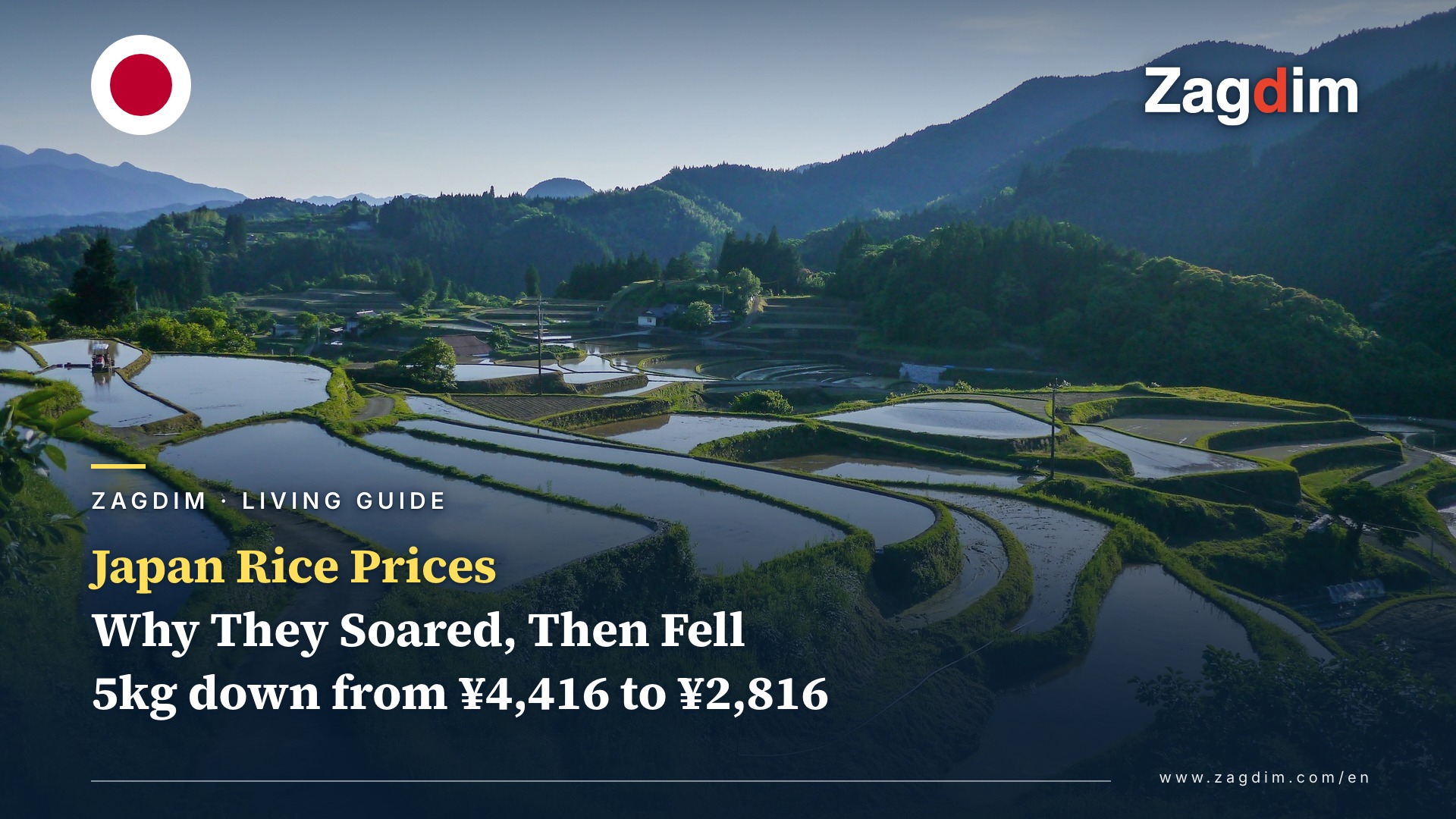
Japan rice prices fell to ¥2,816 for 5kg in late October 2026, while warehouses hold the most previous-year rice in seven years
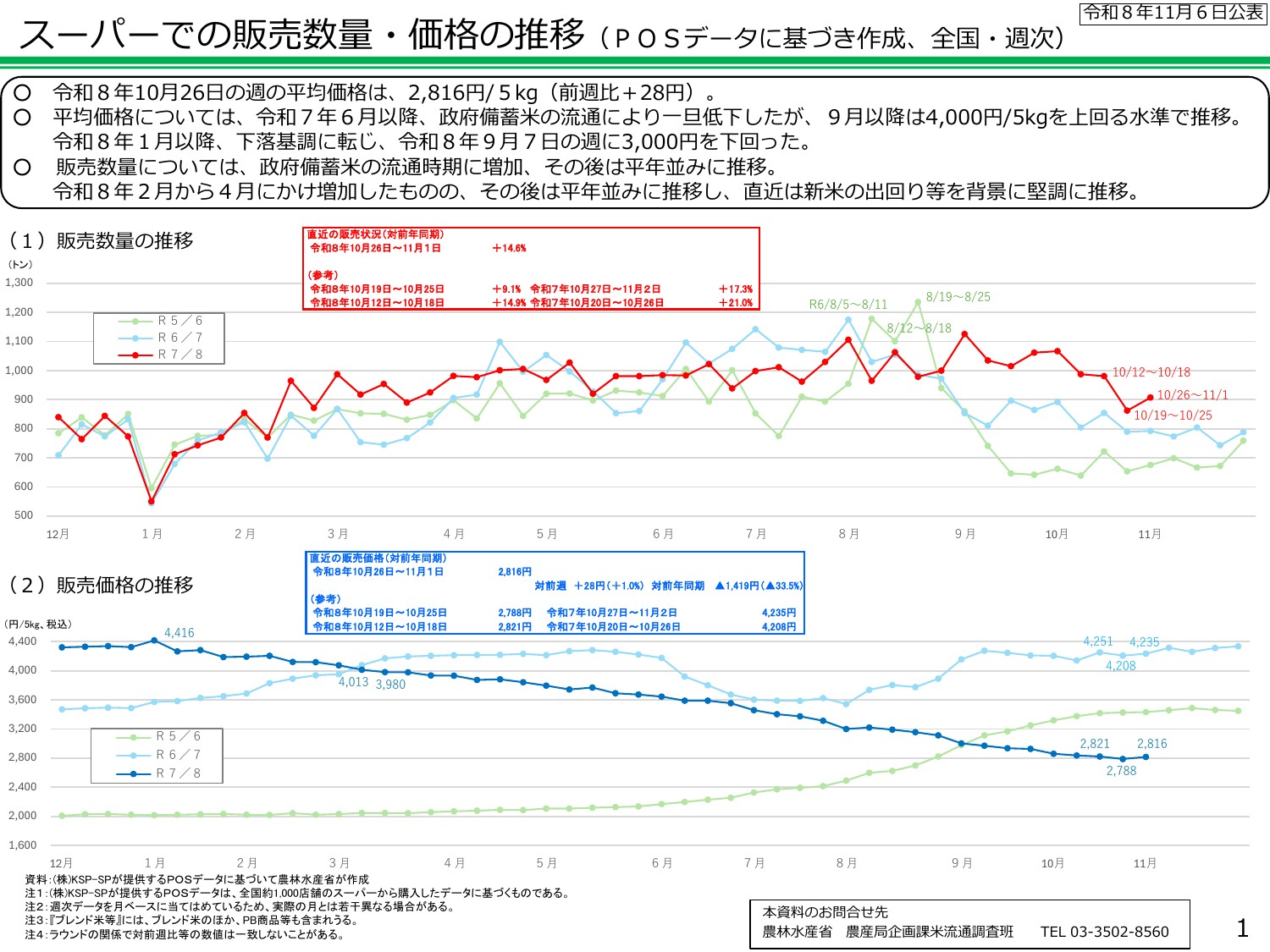
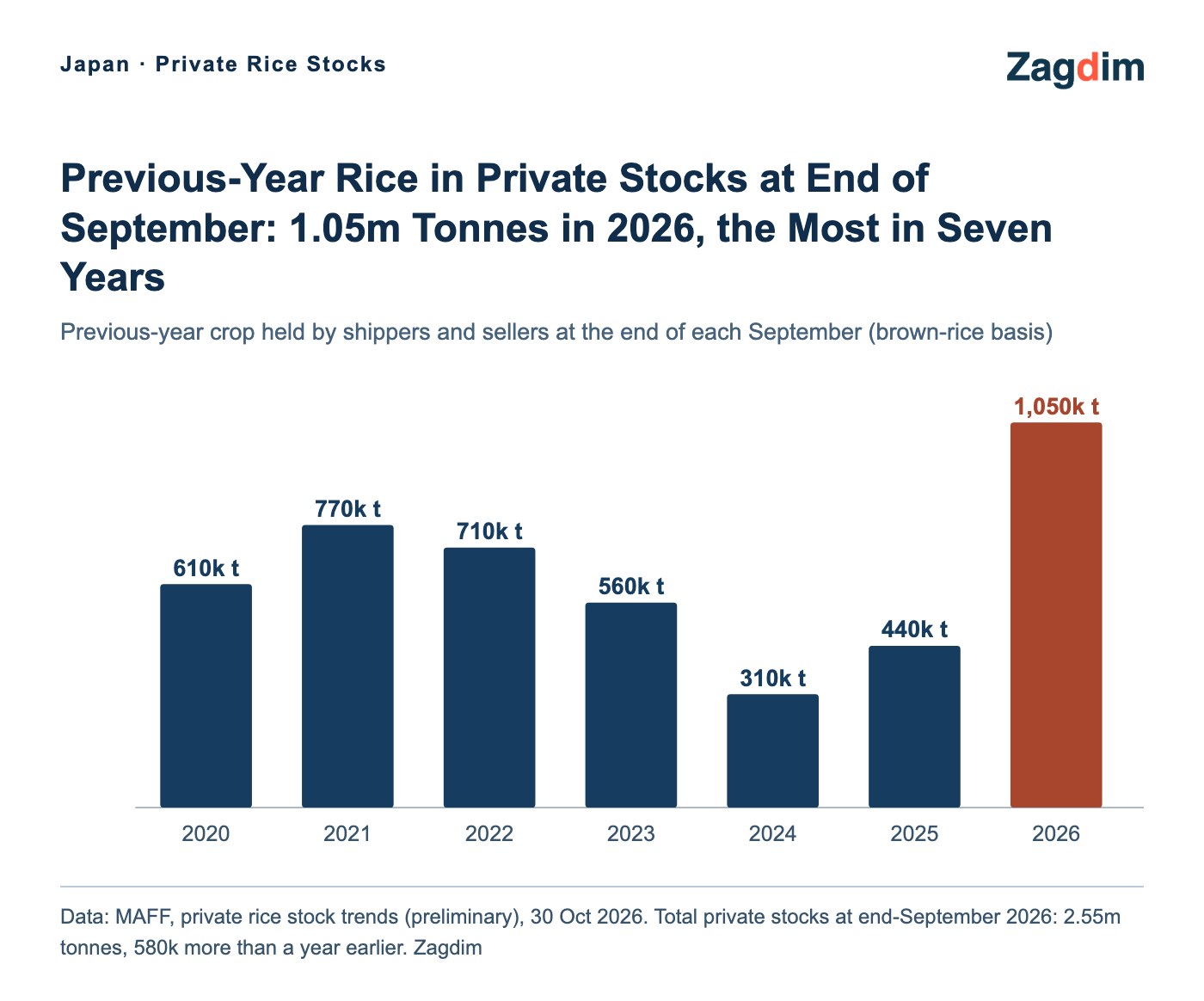
Japan rice prices have fallen from a peak of ¥4,416 for 5kg in late 2025 to ¥2,816. According to figures published by Japan’s Ministry of Agriculture, Forestry and Fisheries (MAFF) on 6 November 2026, a 5kg bag of rice averaged ¥2,816 (tax included) across about 1,000 supermarkets in the week of 26 October to 1 November 2026. That was 33.5% below the ¥4,235 of a year earlier. The highest weekly average in the period was ¥4,416, in the week of 29 December 2025. At the same time, private stocks stood at 2.55 million tonnes at the end of September 2026, and 1.05 million tonnes of that was the previous year’s crop (the 2025 harvest), against 440,000 tonnes a year earlier.
CBC TV reported on 8 November 2026, in a story carried by Yahoo! News Japan, that a rice shop in Okazaki, Aichi Prefecture, is selling rice it bought at last year’s high prices at a loss, and that its new-crop rice now costs less than its old stock.
This guide uses that report as a starting point and turns to MAFF’s price and stock figures to answer two broader questions: why Japan rice prices rose and then fell, and what people living in Japan should check when they buy rice now.
Key Points
- Who should pay attention: households and single residents in Japan who buy their own rice; people running restaurants, bento shops or guesthouses in Japan who need a steady rice supply; anyone planning a move to Japan and estimating food costs.
- The national supermarket average for 5kg fell from a peak of ¥4,416 in late 2025 to ¥2,816 in the week of 26 October 2026. It has been below ¥3,000 since the week of 7 September 2026.
- The turn came from supply. After the 2025 shortage, the government released about 590,000 tonnes of stockpiled rice; once the 2026 crop arrived, private stocks rose to 2.55 million tonnes, 580,000 tonnes more than a year earlier.
- The previous year’s rice was bought when prices were high, at an average wholesale price of ¥35,174 per 60kg. The new crop is ¥21,287. This autumn, older rice is not always cheaper than new rice.
- On 1 September 2026 the government announced it would buy back 210,000 tonnes of stockpile rice. The supermarket average rose ¥28 in the last week of October, and MAFF has not published a forecast.
How to Read Japan Rice Prices: Supermarket Price, Wholesale Price and Private Stocks
MAFF publishes three main sets of rice figures. Each answers a different question:
| Figure | What it tells you | How often | Latest |
|---|---|---|---|
| Supermarket sales price (POS) | What shoppers actually pay | Weekly, usually updated on Fridays | ¥2,816 per 5kg (week of 26 Oct 2026) |
| Negotiated transaction price | What producers such as farm co-ops charge wholesalers | Monthly | ¥21,293 per 60kg of brown rice (Sep 2026) |
| Private stocks | How much rice producers, wholesalers and retailers hold | Monthly | 2.55 million tonnes (end of Sep 2026) |
All three come from MAFF. The supermarket price uses POS data from about 1,000 stores and includes tax. The negotiated transaction price is a weighted average for grade-one rice, including freight, packaging and consumption tax. Stocks are measured as brown rice.
Supermarket 5kg Price: From ¥4,416 to ¥2,816
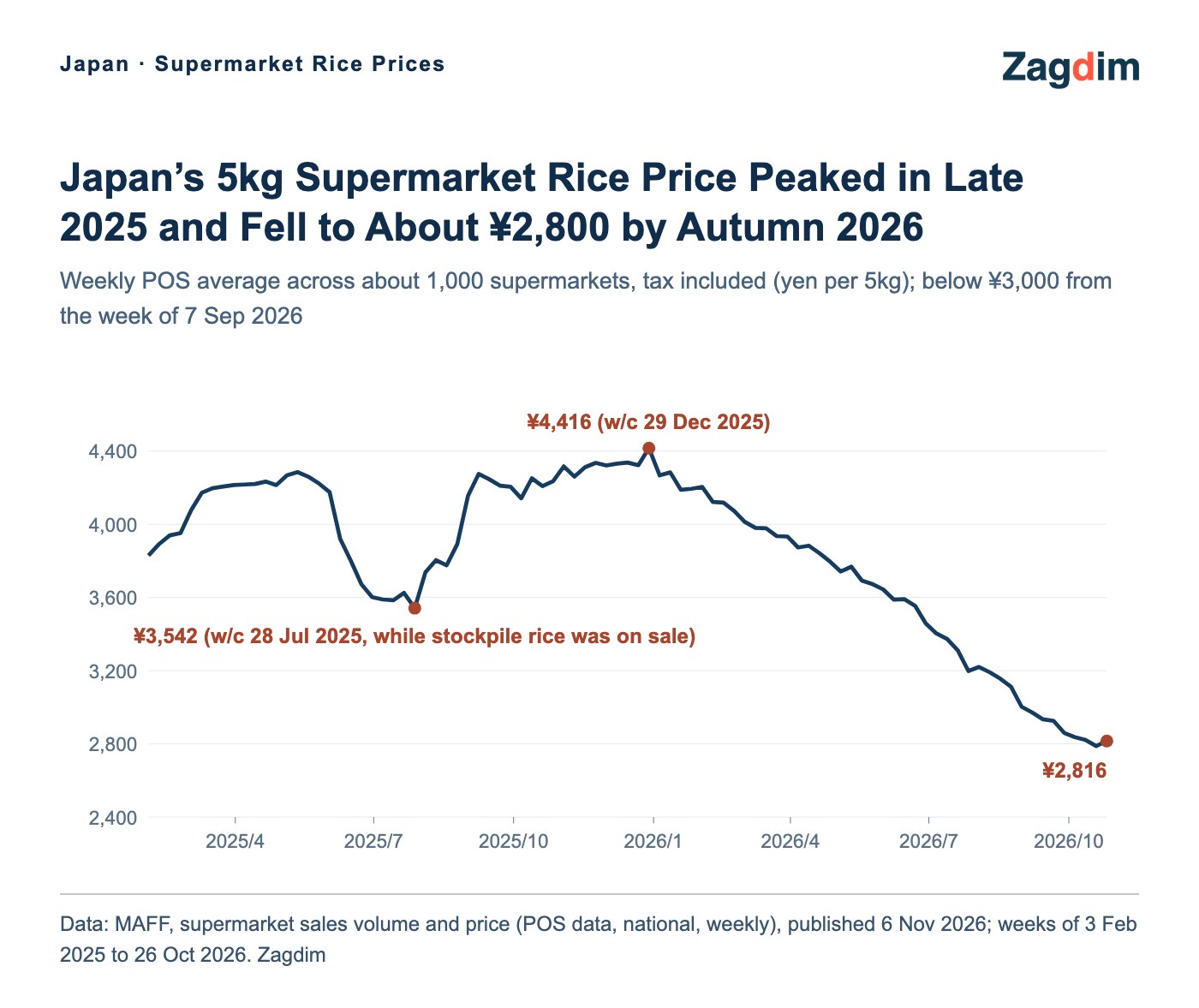
According to MAFF’s weekly report, supermarket prices dipped from June 2025 as government stockpile rice reached shelves, reaching ¥3,542 in the week of 28 July 2025. From September they were back above ¥4,000, and they peaked at ¥4,416 in the week of 29 December 2025. Prices began falling in January 2026, dropped below ¥3,000 in the week of 7 September and stood at ¥2,816 in the week of 26 October. By Zagdim’s calculation, that is about 36% below the peak.
The average covers both branded and blended rice. In the week of 26 October, branded rice (銘柄米) made up 85% of sales by volume at an average of ¥2,841; blended and other rice made up 15% at ¥2,674.
Wholesale Price: New Rice About 40% Cheaper Than Last Year’s Crop
The negotiated transaction price is what producers charge wholesalers, and it moves ahead of shop prices. MAFF published these figures on 16 October 2026:
| Crop | Period | Per 60kg of brown rice |
|---|---|---|
| 2023 crop (令和5年産) | September 2023 | ¥15,291 |
| 2024 crop (令和6年産) | September 2024 | ¥22,700 |
| 2025 crop (令和7年産) | October 2025, the peak | ¥37,058 |
| 2025 crop | Crop-year average | ¥35,174 |
| 2026 crop (令和8年産) | September 2026 | ¥21,293 |
This September’s new-crop price is 42% below the same month last year and 6% below two years earlier, roughly back to autumn 2024 levels. Against the ¥15,291 of September 2023, it is still about 39% higher (Zagdim’s calculation). So “rice is cheaper” means cheaper than the 2025 peak, not back to where prices were before the shortage.
Private Stocks: 1.05 Million Tonnes of Previous-Year Rice
MAFF reported on 30 October 2026 that private stocks held by shippers and sellers stood at 2.55 million tonnes at the end of September 2026, 580,000 tonnes more than a year earlier. Of that, 1.05 million tonnes was the previous year’s crop, the highest end-of-September figure since at least 2020 and about 2.4 times the 440,000 tonnes of a year earlier (Zagdim’s calculation).
Why Japan Rice Prices Rose and Then Fell
2025: Shortage, Higher Prices and Stockpile Releases
According to MAFF, the government released stockpile rice in two ways in 2025. Three auctions from March to April sold about 310,000 tonnes by contract volume to rice collectors, on condition that the government could later buy back the same amount of domestic rice. From May, direct contracts sold rice straight to retailers, with confirmed applications of about 280,000 tonnes. Together that is about 590,000 tonnes (Zagdim’s total). The government stockpile fell from 960,000 tonnes at the end of March 2025, before the releases, to an expected 320,000 tonnes in November 2025.
Supermarket prices fell to around ¥3,500 while stockpile rice was on sale, but after the 2025 harvest came in, the wholesale price peaked at ¥37,058 in October 2025 and the supermarket average reached ¥4,416 by the end of the year.
2026: New Rice and Heavy Stocks Turn Last Year’s Crop Into Expensive Old Rice
In 2026 the picture reversed. Traders still held a lot of 2025 rice bought at high prices, and the 2026 crop was already on the market, pushing private stocks back to 2.55 million tonnes. MAFF noted that because the previous year’s rice was still being traded, new-crop trading in September 2026 came to only 54,000 tonnes, 66% less than a year earlier.
That is the situation CBC TV described: shops that bought rice at last year’s prices now have to sell it alongside cheaper new rice, cutting prices or taking a loss. MAFF’s figures show the gap. The 2025 crop averaged ¥35,174 per 60kg wholesale, against ¥21,287 for the new crop, a cost difference of about 40%.
What the 210,000-Tonne Buy-Back Means for Prices
At a press conference on 1 September 2026, the agriculture minister said the government would begin buying back stockpile rice, starting with 210,000 tonnes of the 2025 crop, because rice supply had been confirmed as sufficient. The aim is to rebuild the stockpile in a planned way towards an appropriate level of about 1 million tonnes.
A buy-back moves some rice off the market and into government storage. The supermarket average was ¥2,788 in the week of 19 October and rose slightly to ¥2,816 in the week of 26 October. MAFF’s data does not include a forecast. For the latest trend, check the weekly supermarket report, updated on Fridays.
What to Check When Buying Rice in Japan Now
Look for the Crop Year and Milling Date on the Bag
Under Japan’s Food Labelling Standards, bagged rice must state under 原料玄米 whether it is single-origin rice (単一原料米) or a blend (複数原料米), along with the place of origin. Where the seller holds supporting records, the variety and crop year may also be shown, and blends list the share from each origin. Every bag must also carry a milling date (精米時期), given as a day or as the early, middle or late part of a month.
- 令和8年産: the 2026 harvest, sold as new rice this autumn.
- 令和7年産: the 2025 harvest, what shops now call old rice (古米).
- 複数原料米: a blend of different origins, varieties or crop years, with origin shares on the bag.
- No crop year shown: you cannot tell old from new from the label, so ask the shop.
Choosing Between New and Old Rice
This autumn new and old rice sit on the same shelf, and old rice, bought at higher prices, is not always the cheaper option. Compare crop year, milling date and price per kilo together rather than relying on a new-rice or old-rice tag.
When prices are close, the choice comes down to taste and how fast your household gets through rice. A more recent milling date means the rice was polished more recently. Before buying a large bag, work out how long it will take you to finish it.
How to Track Japan Rice Prices
- Weekly: MAFF’s supermarket sales price report on its rice price page (米の価格を知りたい), usually updated on Fridays.
- Monthly: the negotiated transaction price (wholesale) and private stocks, published mid-month and at month end.
- In store: local supermarket prices differ from the national average; the shelf price is what counts.
Common Misunderstandings About Japan Rice Prices
Misunderstanding 1: “Rice prices in Japan are back to normal”
Why it is incomplete: supermarket prices are 33.5% below a year earlier, but the new-crop wholesale price of ¥21,293 per 60kg is still about 39% above the ¥15,291 of September 2023.
Practical tip: when estimating food costs in Japan, use the latest weekly figures rather than pre-2024 impressions.
Misunderstanding 2: “Old rice is always cheaper than new rice”
Why it is incomplete: the 2025 crop was bought at high prices, with a crop-year average wholesale price of ¥35,174 against ¥21,287 for the new crop, so some shops now sell new rice for less.
Practical tip: compare the crop year and price per kilo on the bag.
Misunderstanding 3: “Rice prices will keep falling”
Why it is incomplete: the supermarket average rose ¥28 in the last week of October, and the government is buying back 210,000 tonnes of stockpile rice. MAFF has not published a forecast.
Practical tip: businesses buying in bulk can judge in stages using the weekly and monthly official figures.
Misunderstanding 4: “Stockpile rice is all very old”
Why it is incomplete: the stockpile rice released in 2025 came from the 2020 to 2024 crops, so ages varied, and bags follow the labelling rules for crop year or 複数原料米.
Practical tip: check the crop year and blend information before buying.
Japan Rice Price Examples
A family in Tokyo buying 10kg a month
Background: a family of four buys two 5kg bags a month at the supermarket.
How to think about it: at national averages, two bags cost about ¥8,470 at the end of October last year and about ¥5,632 at the end of October this year (Zagdim’s calculation from the weekly averages), more than ¥2,800 less a month. Actual shelf prices will differ.
Do not overlook: within one supermarket, the gap between new, old and blended rice can be bigger than the change in the national average, so check the crop year and blend on the bag.
A bento shop owner in Osaka
Background: uses a lot of rice each month and signed supply terms when prices were high last year.
How to think about it: the new crop’s wholesale price is about 40% below last year’s crop. When negotiating new terms, MAFF’s negotiated transaction price is a useful reference.
Do not overlook: the buy-back, future harvests and stock levels all affect prices, and there is no official forecast, so confirming in stages is more cautious than locking in a long contract.
A newcomer buying rice in Japan for the first time
Background: cannot read the Japanese label.
How to think about it: find the crop year under 原料玄米 (令和8年産 is the 2026 new crop) and the 精米時期 milling date, then compare weight and price.
Do not overlook: when prices are close, a more recent milling date means the rice was polished more recently. Smaller households can start with a smaller bag.
Japan Rice Prices FAQ
What are Japan rice prices now?
According to MAFF figures published on 6 November 2026, a 5kg bag of rice averaged ¥2,816 (tax included) across about 1,000 supermarkets in the week of 26 October 2026, 33.5% less than a year earlier. MAFF figures published on 13 November 2026 put the week of 2 November at ¥2,747, 36.4% lower than a year earlier.
Why did Japan rice prices rise in 2025?
Rice was in short supply in 2025. The wholesale price peaked at ¥37,058 per 60kg in October 2025, and the supermarket average for 5kg reached ¥4,416 at the end of the year. The government released about 590,000 tonnes of stockpile rice that year; shop prices fell to around ¥3,500 while it was on sale, then rose again once the new crop arrived.
Why did Japan rice prices fall in 2026?
After the 2026 crop arrived, private stocks rose to 2.55 million tonnes, 580,000 tonnes more than a year earlier, including 1.05 million tonnes of the previous year’s rice. The new crop’s wholesale price of ¥21,293 per 60kg was 42% below the same month a year earlier, and supermarket prices followed.
How do I tell new rice from old rice in Japan?
Look for the crop year under 原料玄米 on the bag, where it is shown. 令和8年産 is the 2026 harvest and 令和7年産 is the previous year’s. Blends of different origins or years are labelled 複数原料米, and every bag carries a milling date (精米時期).
What does Japan’s stockpile rice buy-back mean?
On 1 September 2026 the agriculture minister announced a buy-back starting with 210,000 tonnes of the 2025 crop, aiming to rebuild the stockpile towards about 1 million tonnes. A buy-back moves some rice off the market and into government storage.
Where can I find the latest Japan rice prices?
The official figures for Japan rice prices are on MAFF’s rice price page (米の価格を知りたい). The supermarket report is usually updated every Friday and shows the national average plus branded and blended rice. The wholesale negotiated transaction price comes out mid-month and private stocks at month end. Local shelf prices may differ.
Living in Japan and Working Out Your Budget? Ask Zagdim
If you want help estimating food and living costs in Japan, or have other questions about life there, leave a question at Ask Zagdim. Zagdim’s full guide to living costs in Japan is listed in the references below.
Life abroad? Ask Zagdim.
Your first stop for international property and global living.
Research and insights. Know what’s changing. Understand what matters.
Newsletter for overseas updatesSubscribe →
Disclaimer
This article is general information and is not investment, business or consumer advice. Price and stock figures come from data published by Japan’s Ministry of Agriculture, Forestry and Fisheries in October and November 2026; the rice shop selling at a loss is based on a CBC TV report. Local shelf prices vary, and later changes should be checked against MAFF’s latest releases.
Figures are current as of 11 November 2026; check MAFF’s latest releases for updates.
References
Ministry of Agriculture, Forestry and Fisheries – スーパーでの販売数量・価格の推移(POSデータに基づき作成、全国・週次)(6 November 2026) / Ministry of Agriculture, Forestry and Fisheries – 米の価格を知りたい / Ministry of Agriculture, Forestry and Fisheries – 令和8年産米の相対取引価格・数量について(令和8年9月)(16 October 2026) / Ministry of Agriculture, Forestry and Fisheries – 令和8年9月の米穀流通の動向(集荷、販売、民間在庫)(30 October 2026) / Ministry of Agriculture, Forestry and Fisheries – 政府備蓄米の買戻し条件付売渡しの状況 / Ministry of Agriculture, Forestry and Fisheries – 随意契約による政府備蓄米の売渡しの状況 / Ministry of Agriculture, Forestry and Fisheries – 政府備蓄米の在庫状況について (12 November 2025) / Ministry of Agriculture, Forestry and Fisheries – Minister’s press conference (1 September 2026) / Chiba Prefecture – 食品表示法に基づく袋詰め玄米・精米の表示 / CBC TV – 倉庫には”古米の山” 販売店「かつてない量」 新米より古米が高い逆転現象… 赤字覚悟で販売 (8 November 2026) / Zagdim – Cost of Living in Japan for Foreigners: A Full Budget Breakdown / Zagdim – UNIQLO Sock Price Increase Withdrawn After 11 Days: Why Are the Other 10 Items Still Going Up?