Japan Doorstep Delivery Counts as Delivered Once the Parcel Is Set Down, and the Transport Ministry Plans Liability Guidelines This Year
Japan doorstep delivery (okihai, 置き配) counts as complete once the parcel is left at the spot the recipient chose: according to Sagawa Express and Yamato Transport pages checked in November 2026, neither carrier covers later loss, theft or damage, and Japan Post’s okihai insurance pays up to 10,000 yen per claim only for parcels from partner online shops.
The Yomiuri Shimbun reported on 6 November 2026 (republished by Yahoo! News Japan on 7 November) that Japan’s Ministry of Land, Infrastructure, Transport and Tourism (MLIT) plans to publish okihai guidelines by the end of the year. They would set out, case by case, when delivery counts as complete and how responsibility is shared, and would be aimed at carriers, online shopping platforms and recipients. According to the report, when a recipient asks for a parcel to be left at the front door, delivery is complete once the carrier sets it down, and later trouble may be the recipient’s responsibility; the guidelines would also encourage carriers to photograph each drop-off and notify the recipient. Kyodo News reported on 18 November 2026 that the guidelines will go through a public comment period before they are finalised and are still due by the end of the year; as of that report they had not been published, and their final content will be whatever MLIT releases.
This guide does not wait for the guidelines. It sets out the rules already written into each company’s terms: whether a doorstep parcel counts as delivered, how to set up okihai with each carrier, who to contact when a parcel goes missing, and what foreign residents, short-stay residents and landlords should each watch.
Key Points
- Who should pay attention: foreign residents in Japan who shop online often; people in Japan for a short stay, study or business who have online orders delivered; and landlords or flat owners who let property in Japan.
- Set down means delivered: Sagawa states it accepts no liability for loss, theft or damage once a parcel is left at the chosen spot, and Yamato states such losses are not covered. Japan Post’s okihai insurance covers only parcels from partner shops, up to 10,000 yen per claim and twice a year.
- Online platforms work differently: Amazon.co.jp states that if a doorstep order shows as delivered but never arrives, it will look into the case and resend or refund.
- The rules are changing: an MLIT study group report of 7 November 2025 proposed adding doorstep and other options to Japan’s standard parcel delivery terms, with guidelines on sharing responsibility; the Yomiuri reports those guidelines are due this year.
What Is Okihai, and Why Is Japan Doorstep Delivery Growing?
Okihai is a delivery method in which the carrier does not hand the parcel over in person or ask for a signature, and delivery is complete once the parcel is left at a place the recipient chose, such as the front door, a delivery box, the gas meter box or a garage.
Japan is pushing okihai mainly to cut redeliveries. The MLIT study group on making last-mile delivery more efficient said in its 7 November 2025 report that in April 2025 the redelivery rate was 9.5% across the three largest parcel carriers and 8.4% across six major firms, against a government target of halving it from 12% to 6%.
More use has brought more disputes. The Yomiuri cited figures from the Tokyo Metropolitan Consumer Affairs Center showing okihai-related complaints of 75 in fiscal 2016, 375 in fiscal 2020 and 550 in fiscal 2025.
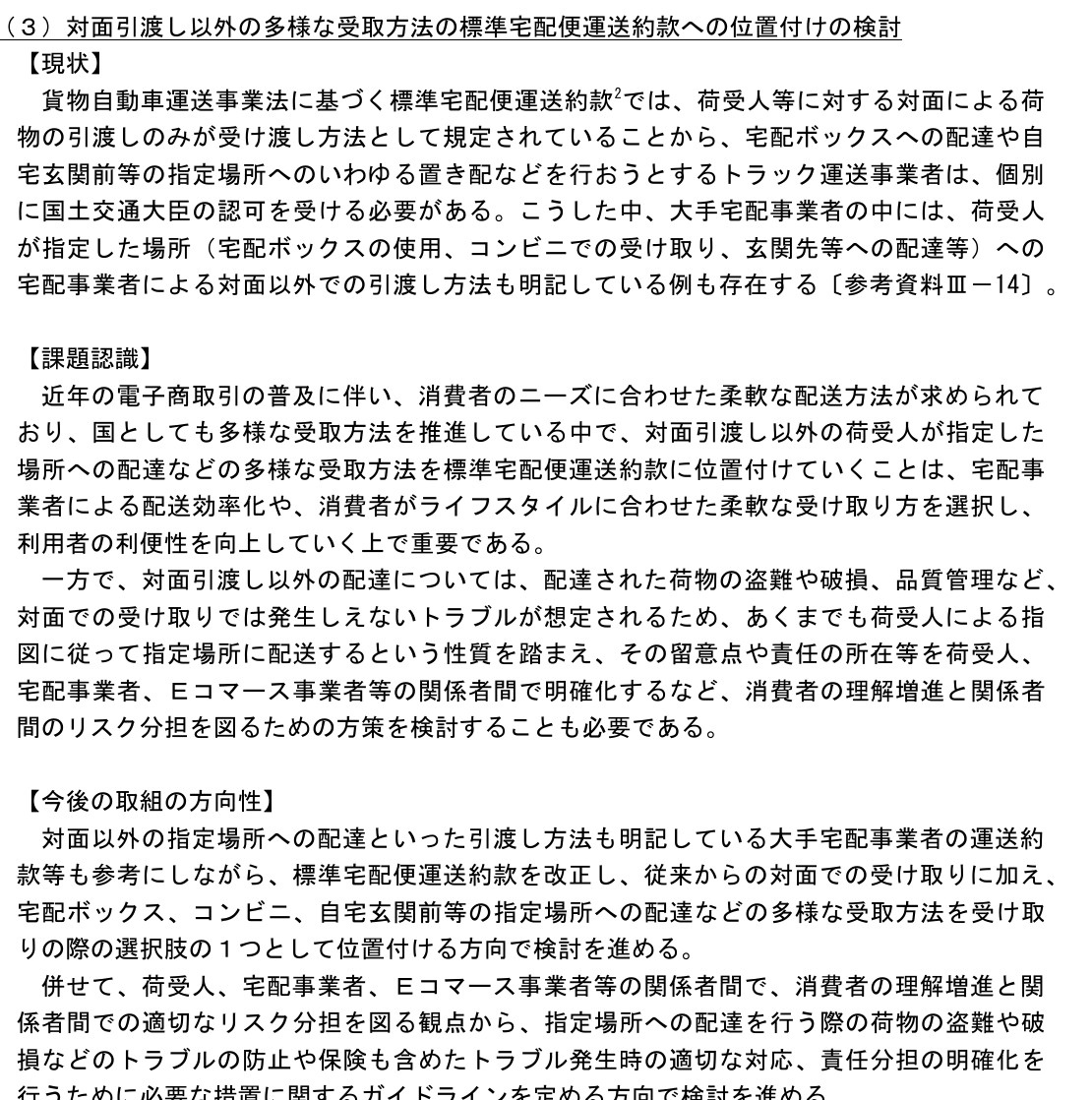
The same report explains the current legal position. The standard parcel delivery terms (標準宅配便運送約款) set under the Motor Truck Transportation Business Act cover only in-person handover, so a carrier that wants to offer okihai needs separate approval from the transport minister. That is why each carrier’s okihai rules sit in its own terms and service pages. The report’s direction is to revise the standard terms so that delivery boxes, convenience stores, the front door and similar spots become one of the options, and to set guidelines on preventing theft and damage, handling problems and sharing responsibility.
Japan Doorstep Delivery Liability: What Three Carriers and Amazon Say
The rules differ by company, so each row shows its source (all company websites checked on 9 November 2026):
| Company | Theft or loss after the parcel is left | How to set up okihai | When okihai is not available (summary) | Source |
|---|---|---|---|---|
| Sagawa Express | States it accepts no liability for loss, theft or damage once the parcel is left; its FAQ adds that it may handle cases individually | Register for Smart Club or use Sagawa’s official LINE account, then choose okihai from the delivery notice; the spot can be set only once and cannot be changed | Chilled or frozen parcels (Hikyaku Cool), cash on delivery (e-Collect), valuables, cash-on-arrival shipping; also when the sender restricts it | Sagawa Express okihai page |
| Yamato Transport | States that theft, loss, damage or soiling after okihai is not covered | Register for Kuroneko Members and choose a spot and time on the parcel details page; My Calendar lets you set it in advance; requests cannot be made by phone | Chilled or frozen parcels (Cool Takkyubin), cash on delivery (Takkyubin Collect), cash-on-arrival shipping | Yamato Transport okihai service page |
| Japan Post | No compensation stated for ordinary okihai; separate okihai insurance covers only parcels from partner shops | Submit the designated-place delivery request on Japan Post’s website; homes with a delivery box or a lockable container at the door are treated as having submitted it, and parcels are left there when no one is home | Registered mail containing cash, proof of delivery, restricted delivery, chilled and perishable items, mail with charges to pay and others; when the front door is chosen, express, time-slot delivery, special record and EMS are not available | Japan Post okihai and okihai insurance pages |
| Amazon.co.jp | If an okihai order shows as delivered but never arrives, Amazon looks into the case and resends or refunds | The default setting is the front door; you can change the spot or switch to in-person delivery at checkout, from the dispatch notice or on the delivery status page | Some Amazon Fresh orders and orders above a certain value | Amazon.co.jp okihai page |
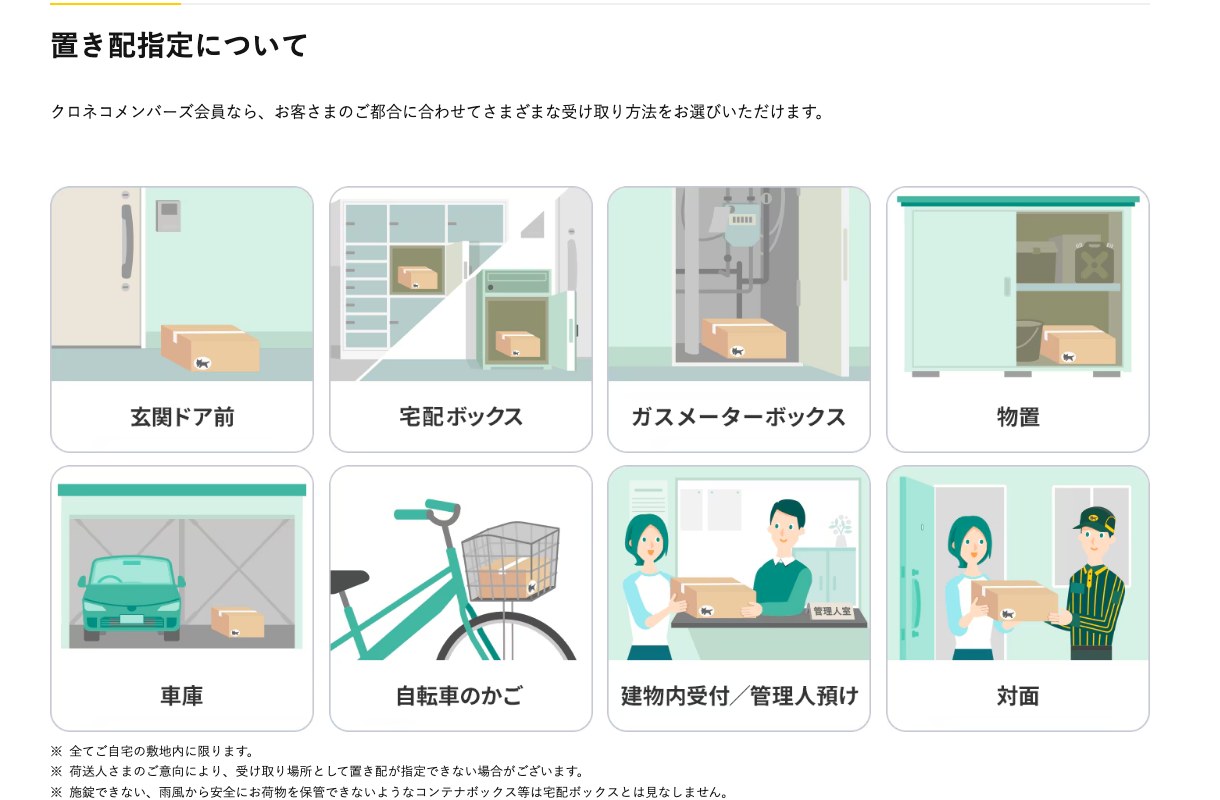
A few details are easy to miss:
- The spot must be on your own property: Yamato says all spots are limited to your own premises; Japan Post requires the spot to be in the same building or grounds as the recipient’s address and not exposed to rain.
- Buildings with an auto-lock entrance: Yamato says that when the front door is chosen, the driver rings your flat number and delivers to the door only if you unlock the entrance; Japan Post says buildings it cannot enter are generally not eligible for front-door or meter-box drop-offs; Amazon allows the front door only in buildings fitted with Amazon Key for Business.
- Photo records: all three carriers say they photograph the parcel once it is left. Sagawa attaches the photo to its delivery notice, while Yamato does not take a photo when you choose in-person delivery, a delivery box or building reception. The photo is the most direct evidence if something goes wrong, so save it when the notice arrives.
Japan Post Okihai Insurance: Who Can Claim, How Much and How
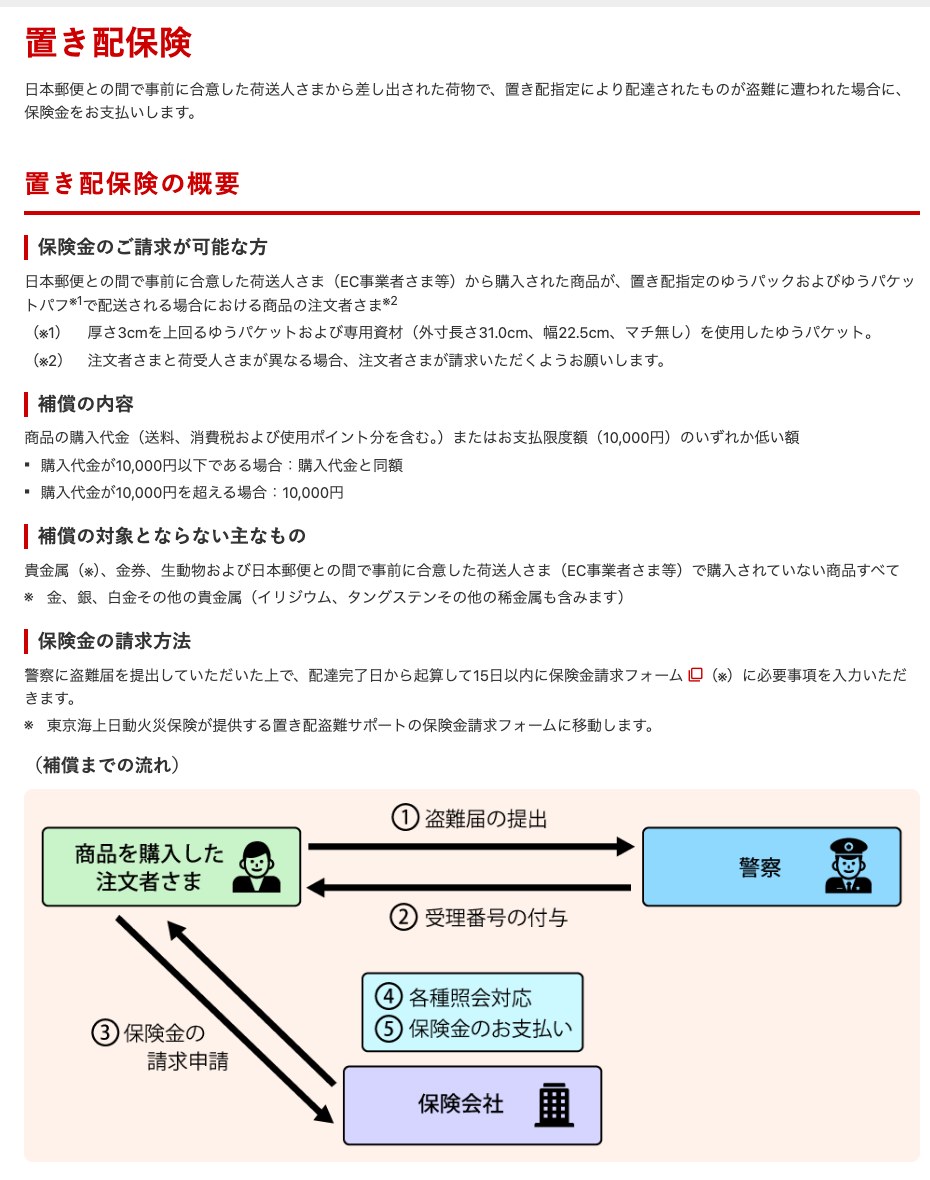
Everything below comes from Japan Post’s okihai insurance page (checked on 9 November 2026):
| Item | Details |
|---|---|
| Covered parcels | Yu-Pack and Yu-Packet Puff parcels delivered by okihai for goods bought from senders, such as online shops, that have a prior agreement with Japan Post |
| Who claims | The person who placed the order; if the orderer and recipient differ, the orderer claims |
| How much | The lower of the purchase price (including shipping, consumption tax and points used) and the 10,000-yen limit |
| How often | Up to twice a year, counted from 00:00 on the day of the claim |
| Conditions | Report the theft to the police and keep the receipt number, then claim within 15 days of the delivery date using the claim form provided by Tokio Marine & Nichido Fire Insurance |
| Not covered | Damage, breakage or water damage; goods not from partner senders; precious metals, gift vouchers and live animals; claims after 15 days; no police report; intent or negligence by the customer |
In short, this insurance covers theft only, only for partner shops, and only for modest amounts. For expensive items left at the door, the risk still sits mainly with the recipient.
Japan Doorstep Delivery Gone Missing: Who to Contact, in Order
- Check around your home: the delivery box, gas meter box, bicycle basket, garage and the manager’s office, and ask anyone you live with. Amazon suggests the same and notes that an order can show as delivered before it actually arrives.
- Check the delivery photo and address: open the photo in the delivery notice or tracking page to confirm where the parcel was left, and check that the order address is correct.
- For online orders, contact the shop or platform: for an Amazon.co.jp okihai order that shows as delivered but never arrived, contact customer service for a resend or refund. Other shops follow their own rules, so check the order page first.
- Contact the carrier: use the tracking number; Sagawa says it may handle cases individually.
- Report suspected theft to the police: Japan Post’s okihai insurance requires a police report, so note the receipt number and claim within 15 days of delivery.
- If you cannot settle it, contact a consumer centre: call the Consumer Hotline on 188 and enter your postcode to be connected to the consumer affairs centre near you; when local centres are closed at weekends, the National Consumer Affairs Center of Japan fills in.
Foreign Residents, Short-Stay Residents and Landlords: What Each Should Watch
| Your situation | Safer approach for now | Watch out for |
|---|---|---|
| Foreign residents who shop online often | Everyday items can be left at the door; for expensive items, ID documents or papers that need a signature, choose in-person delivery or a delivery box | Sagawa and Yamato okihai require registering for their member services (Sagawa also works through its official LINE account); Sagawa’s spot can be set only once, so decide before you choose |
| Short stays, study or business trips | If there is no delivery box or the building has an auto-lock entrance, choose in-person delivery or collect from a carrier office, convenience store or similar point (check each carrier’s website for options) | Drop-off spots must be at the recipient’s address; if you do not manage the building yourself, check its rules first |
| Landlords who let a home or own a flat | State in the tenancy agreement or house rules whether parcels may be left in corridors or at the door | In March 2025 MLIT sent condominium associations guidance on drafting okihai rules; the building’s management rules take precedence, and Sagawa also states that residents of shared buildings must follow them |
Common Misunderstandings About Japan Doorstep Delivery
- “If a doorstep parcel is stolen, the carrier pays”: Sagawa states it accepts no liability and Yamato states such losses are not covered. Tip: do not choose okihai for important items.
- “All Japan Post okihai parcels are insured”: only parcels from shops with a prior agreement with Japan Post, up to 10,000 yen per claim, and only for theft, not damage. Tip: check whether the shop says the insurance applies.
- “MLIT’s new rules are already in force”: according to the Yomiuri, the guidelines are due by the end of the year and had not been published as of Kyodo News’s 18 November 2026 report, which says a public comment period comes first; revising the standard terms is still under review. Tip: until then, each company’s current terms apply.
- “If an Amazon parcel goes missing, I have to chase Sagawa or Yamato myself”: Amazon.co.jp says to contact its customer service for an okihai order that shows as delivered but never arrived, and it will resend or refund. Tip: start with the platform you ordered from.
- “Doorstep delivery works in any auto-lock building”: it depends on the carrier and the building. Yamato needs you to unlock the entrance, Japan Post generally will not leave parcels inside, and Amazon needs Amazon Key for Business. Tip: check how your building receives parcels.
Example Situations: Receiving Japan Doorstep Delivery
Situation 1: an office worker who has just moved to Tokyo and buys household items on Amazon. Amazon’s default is the front door, which is fine for everyday orders. For headphones, cameras and other expensive items, change the delivery instructions to in-person delivery or a delivery box before ordering. If an order shows as delivered but is not there, check the delivery photo, then contact Amazon customer service for a resend or refund.
Situation 2: a student in Osaka for six months, living in a student building with an auto-lock entrance. If you choose the front door with Yamato, the driver rings your flat number and can reach your door only if someone unlocks the entrance; if you are out, the parcel cannot be left. In-person delivery or the building’s delivery box is safer. With Japan Post, buildings it cannot enter are generally not eligible for front-door drop-offs.
Situation 3: an overseas landlord who lets a flat in Fukuoka. The tenant often has parcels left in the corridor, and neighbours say it blocks the way. Start by checking what the building’s management rules say, then state in the tenancy agreement or house rules whether parcels may be left at the door and how the delivery box should be used. MLIT’s guidance to condominium associations on drafting okihai rules is a useful reference when talking to the management company.
Japan Doorstep Delivery FAQ
Who is liable if a Japan doorstep delivery parcel is stolen?
Under current terms, Sagawa Express states it accepts no liability once the parcel is left at the chosen spot, and Yamato Transport states such losses are not covered, so the risk generally sits with the recipient. The exceptions are Japan Post’s okihai insurance and the platforms’ own policies; Amazon.co.jp, for example, resends or refunds after looking into the case. According to the Yomiuri, MLIT’s liability guidelines are due by the end of the year.
How do I set up Japan doorstep delivery?
With Sagawa, use Smart Club or its official LINE account and choose okihai from the delivery notice. With Yamato, use Kuroneko Members to choose a spot on the parcel details page, or set it in advance with My Calendar. With Japan Post, submit the designated-place delivery request on its website. Amazon.co.jp defaults to the front door, which you can change at checkout or on the delivery status page.
Can I opt out of having parcels left at my door?
Yes. On Amazon.co.jp, choose not to use okihai in the delivery instructions to switch to in-person delivery. Yamato’s spot options include in-person handover, and Japan Post lets you stop the service on its website. Sagawa okihai only applies if the recipient chooses it. All three carriers already exclude chilled or frozen, cash-on-delivery and cash-on-arrival parcels from okihai.
How do I claim Japan Post okihai insurance?
Report the theft to the police and get a receipt number, then claim within 15 days of the delivery date using the okihai insurance claim form provided by Tokio Marine & Nichido Fire Insurance. The person who placed the order claims. It pays the lower of the purchase price and 10,000 yen, up to twice a year, and covers theft only, not damage or water damage.
Who is responsible if a parcel is left at the wrong address or gets wet?
A parcel left at the wrong address is a delivery error, which is different from theft after correct delivery, so contact the carrier directly. On rain, Japan Post requires the chosen spot to be protected from rain and its okihai insurance does not cover water damage, while Sagawa advises choosing a spot sheltered from wind and rain. Specific compensation follows each company’s terms and customer service.
When will MLIT publish the okihai guidelines, and what will change?
The Yomiuri Shimbun reported on 6 November 2026 that MLIT plans to publish them by the end of the year, setting out when delivery counts as complete and how responsibility is shared, and encouraging carriers to photograph drop-offs. MLIT’s November 2025 study group report also proposed revising the standard parcel delivery terms. The final content will be whatever MLIT publishes.
Living in Japan and Unsure About Deliveries? Ask Zagdim
If you have just arrived in Japan and are not sure how your home receives parcels, or you let property there and want to understand the rules, Ask Zagdim.
Life abroad? Ask Zagdim.
Your first stop for international property and global living.
Research and insights. Know what’s changing. Understand what matters.
Newsletter for overseas updatesSubscribe →
Disclaimer
This article is general information and is not legal, insurance or other professional advice, and does not represent the position of any carrier or online platform. It draws mainly on MLIT reports published between 2020 and 2025, official pages of Sagawa Express, Yamato Transport, Japan Post and Amazon.co.jp, and Consumer Affairs Agency information; the MLIT liability guidelines and the Tokyo Metropolitan Consumer Affairs Center complaint figures are based on Yomiuri Shimbun reporting. Service conditions and compensation rules may change, so check each company’s latest terms.
Information in this article is current as of 20 November 2026 (company terms checked on 9 November 2026); refer to the latest announcements from MLIT and each carrier. Next update: when MLIT publishes the okihai guidelines or the standard parcel delivery terms are revised.
References
Yomiuri Shimbun (Yahoo! News Japan) – Okihai thefts rise as use grows; MLIT to publish guidelines on liability by year-end (6 November 2026, in Japanese) / Ministry of Land, Infrastructure, Transport and Tourism – Last-mile delivery efficiency study group report (7 November 2025, PDF in Japanese) / Ministry of Land, Infrastructure, Transport and Tourism – Okihai: current state and key points for implementation (31 March 2020, in Japanese) / Sagawa Express – Okihai application page (in Japanese) / Yamato Transport – Okihai service (in Japanese) / Japan Post – Receiving by okihai (in Japanese) / Japan Post – Okihai insurance (in Japanese) / Amazon.co.jp – About Amazon okihai (in Japanese) / Amazon.co.jp – When status shows delivered but package not received / Consumer Affairs Agency – Consumer Hotline 188 (in Japanese)