
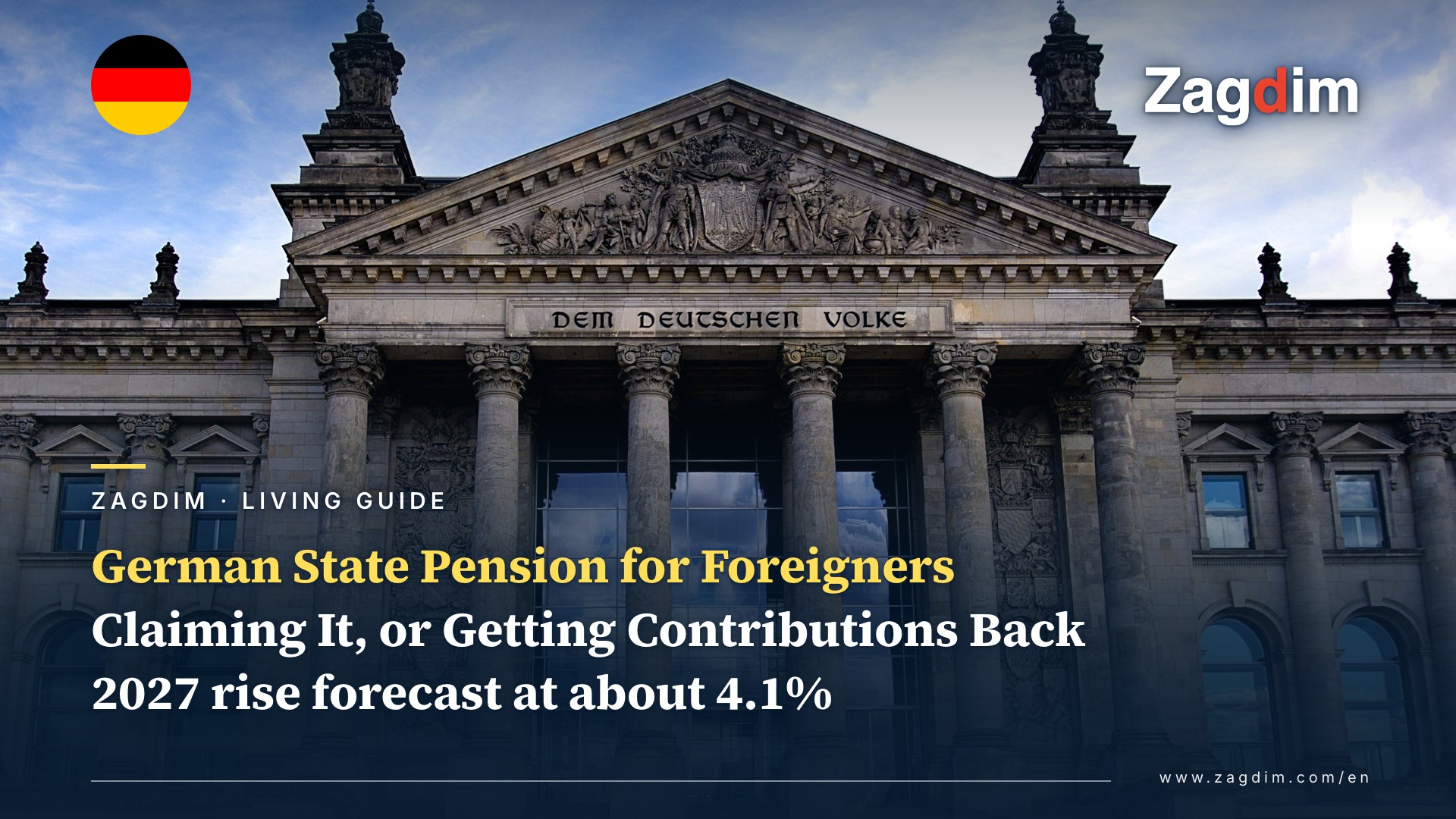
The German state pension is forecast to rise about 4.1% in July 2027, but the figure comes from a report and the official rise will be announced in spring 2027
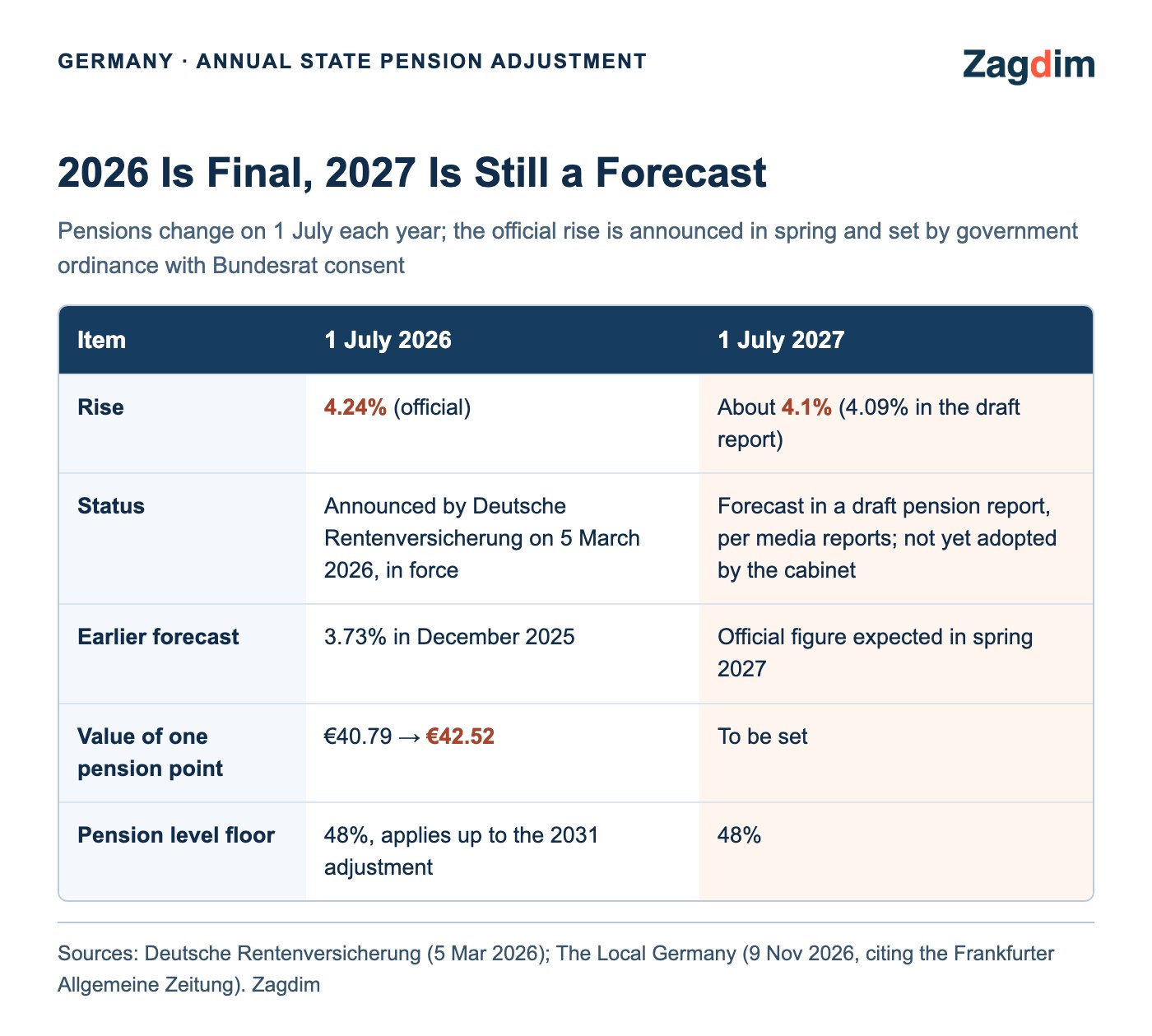
According to Deutsche Rentenversicherung, the German state pension is adjusted once a year on 1 July. The Local Germany reported on 9 November 2026, citing the Frankfurter Allgemeine Zeitung, that the Federal Labour Ministry’s 2026 pension insurance report forecasts a rise of about 4.1% on 1 July 2027 (4.09% in the report). On a €1,000 monthly pension, that is about €41 more. The cabinet adopted the report on 18 November 2026 (according to the Federal Labour Ministry’s press release), but the figure is still a forecast and can change: the official rise is announced each spring and set by government ordinance with the consent of the Bundesrat.
Compare a year that is already settled. On 5 March 2026, Deutsche Rentenversicherung announced that pensions would rise by 4.24% from 1 July 2026, above the 3.73% forecast in December 2025, mainly because wages grew faster than expected in 2025.
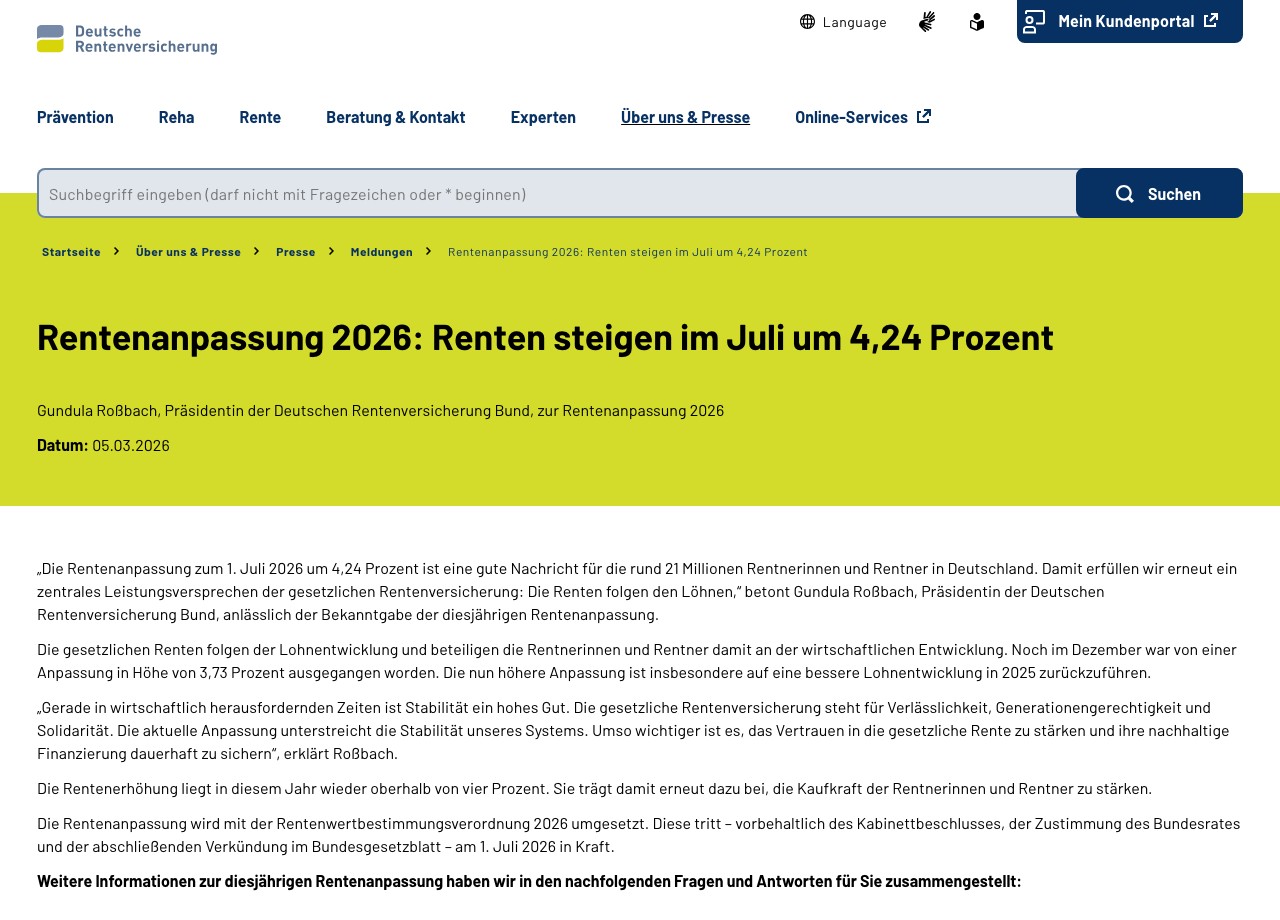
This guide uses the forecast as a starting point for a more basic question: how the German pension system works, how foreign nationals who have paid in can claim a pension, and whether people leaving Germany can get their contributions back.
Key Points
- Who should pay attention: foreign employees in Germany who pay statutory pension insurance from their salary; people who plan to retire in Germany or move abroad after retiring; people who work in Germany for a few years and then return to their home country.
- You need at least 5 years of contributions and must reach the statutory retirement age; for people born in 1964 or later, that age is 67. The pension can generally be paid if you live abroad.
- Non-EU nationals who move to a place without an agreement with Germany can ask for a refund of the contributions they paid once 24 months have passed since insurance ended and no right to voluntary insurance exists. The employer’s share is not refunded, and a refund wipes out all pension rights.
- Many home countries have no social security agreement with Germany; Germany’s agreement with China covers posted workers only and contains no rules on claiming pensions.
- The 2027 figure of about 4.1% is a forecast, with the official rise expected in spring 2027; the 4.24% rise for 2026 is already in force.
How the German State Pension Works: Contributions, Insurance Periods and the Annual Adjustment
Statutory pension insurance (gesetzliche Rentenversicherung) is run by Deutsche Rentenversicherung. Employees in Germany are in principle insured whatever their nationality. The figures below come from Deutsche Rentenversicherung and Social Code Book VI:
| Item | Current rule |
|---|---|
| Contribution rate | 18.6% of salary (2026), usually split equally between employee and employer |
| Minimum insurance period | 5 years for a monthly state pension |
| Statutory retirement age | Rising to 67; 67 for people born in 1964 or later |
| Annual adjustment | Every 1 July, the value of one pension point is adjusted in line with wages |
| Pension level floor | 48%, applies up to the 2031 adjustment |
How the pension amount is calculated
The pension is calculated in pension points. Put simply, a year in which your salary equals the national average earns 1 point; higher or lower pay earns points in proportion. At retirement, your total points are multiplied by the value of one pension point at that time to give the monthly pension.
From 1 July 2026, the value of one pension point rose from €40.79 to €42.52. The annual rise is the change in this value, so it affects both people already drawing a pension, whose monthly payment goes up, and people still paying in, whose future pension is worth more.
Who decides the annual rise
According to Deutsche Rentenversicherung, the rise is set by the federal government in a pension value ordinance (Rentenwertbestimmungsverordnung), which needs the consent of the Bundesrat and must be promulgated; it takes effect on 1 July. In 2026 the steps were: the 4.24% rise was announced on 5 March, the Bundesrat consented on 12 June, and it took effect on 1 July.
The pension insurance report published in the autumn is the government’s forecast for the coming years, not the final figure. The 4.09% for 2027 is a forecast in that report and will be revised with the latest wage data before it is set.
Foreign Nationals Working in Germany: How You Claim the German State Pension After Paying In
Foreign employees in Germany
Foreign employees pay statutory pension insurance on their salary just like German employees, and the employee’s half appears on the payslip. The insurance periods are recorded in your own account and still count whether you stay in Germany or leave, unless you claim a refund.
To see how many points you have built up, check the pension information (Renteninformation) that Deutsche Rentenversicherung sends regularly, or view your insurance record online.
Retiring in Germany or moving abroad
With 5 years of contributions and the statutory retirement age reached, you can apply for a monthly pension. Deutsche Rentenversicherung said on 10 June 2026 that the pension can generally continue to be paid abroad. The exceptions are parts of the pension based on foreign insurance periods, and disability pensions not granted for purely medical reasons; in those cases the insurer checks whether the amount must change.
Before moving abroad for good, Deutsche Rentenversicherung recommends getting advice and telling the responsible pension insurer at least 3 months in advance. The free service line is 0800 1000 4800.
People leaving Germany after a few years
When you leave Germany, you have two options:
- Keep your insurance periods: do not claim a refund, and apply for the pension at statutory retirement age. With 5 years you get a monthly pension; if you also have insurance periods in a country that has an agreement with Germany, some agreements allow the periods to be combined.
- Claim a refund: if you qualify, ask for the contributions you paid to be refunded, but all your insurance periods are lost.
Can You Get Your German State Pension Contributions Back When You Leave Germany?
Yes, if you meet the conditions. Social Code Book VI Section 210 and Deutsche Rentenversicherung set out three points:
- You are no longer compulsorily insured in Germany, at least 24 months have passed since insurance ended, and you have not been insured again in between.
- You have no right to voluntary insurance. German nationals can insure voluntarily from abroad, so they generally cannot claim a refund.
- Or you have reached the statutory retirement age with less than 5 years of contributions.
If you qualify, you get back the contributions you paid yourself; the employer’s half is not refunded. You cannot limit the claim to some periods, and once the refund is paid the insurance relationship ends and all rights from the earlier periods are lost.
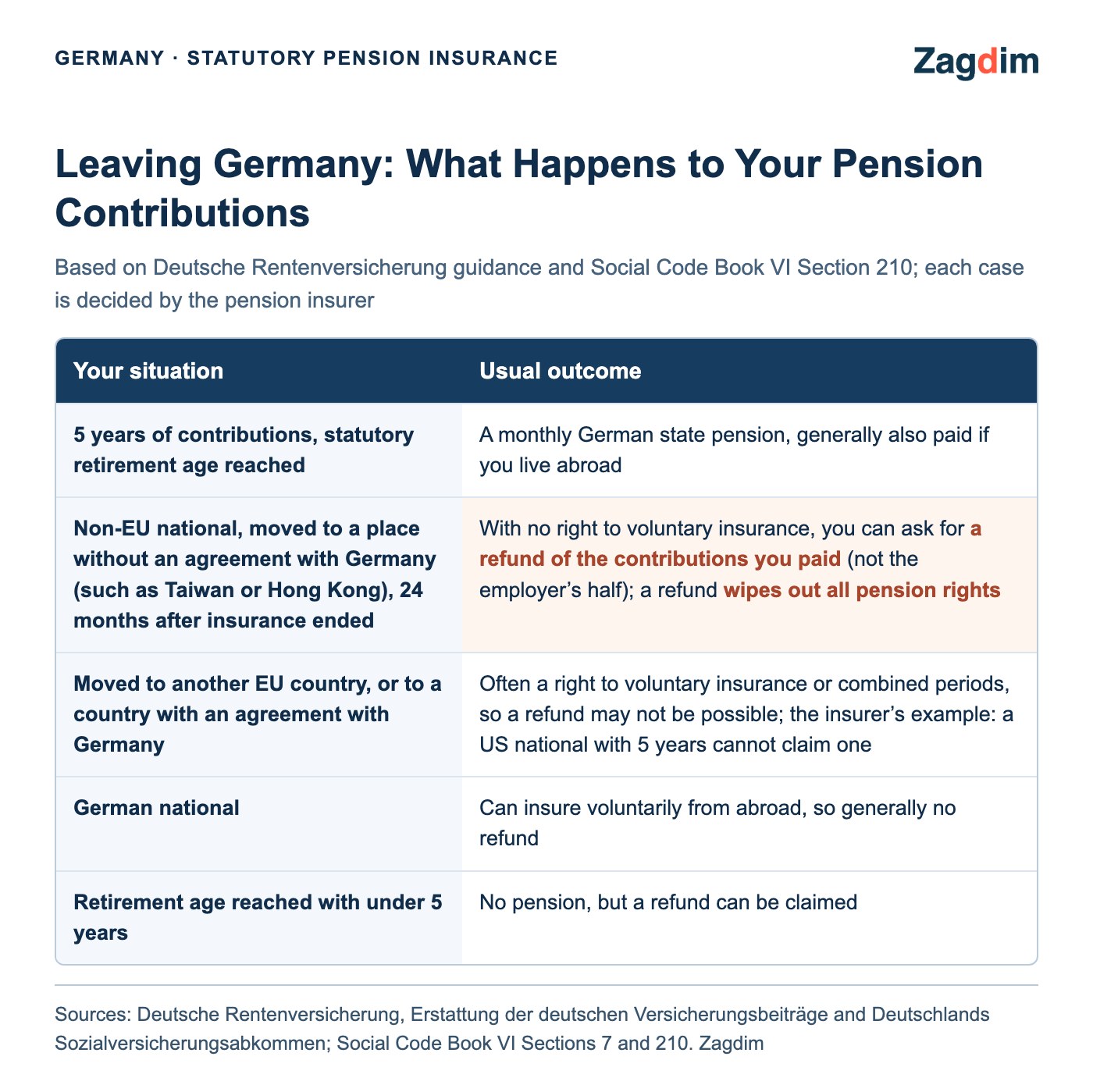
Which countries have a social security agreement with Germany, and what if mine does not?
Deutsche Rentenversicherung lists bilateral social security agreements with 21 countries outside the EU, including Australia, Canada, Japan, South Korea, the United States, India and the Philippines; Taiwan and Hong Kong are not on the list. Germany and China have only an agreement on posted workers, which avoids double contributions during temporary postings and contains no rules on claiming pensions.
| Where you move | Agreement with Germany | Refund, as a general rule |
|---|---|---|
| Taiwan | None | Possible for non-EU nationals 24 months after insurance ends, with no right to voluntary insurance |
| Hong Kong | None | As above |
| Mainland China | Posted-worker agreement only | Depends on nationality and residence; check with the pension insurer before applying |
| Another EU country | EU rules | People who have paid German contributions usually have a right to voluntary insurance, so generally no refund |
| United States and other agreement countries | Bilateral agreement | Depends on the agreement; the insurer’s example is that a US national with 5 years cannot claim one |
This table is based on Deutsche Rentenversicherung’s list of agreements and its refund guidance; each case is decided by the pension insurer.
What the 2027 rise means for refunds and pensions
A refund pays back the contributions you made and does not grow with the 2027 rise; the rise affects the monthly pension of people who keep their insurance periods. On a €1,000 monthly pension, the 4.24% rise in 2026 adds about €42 (Zagdim’s calculation from the rate), and the forecast rise of about 4.1% in 2027 would add about €41 more. If you are weighing up a refund, factor this in.
Common Misconceptions About the German State Pension
Misconception 1: “The 2027 rise is definitely 4.1%”
Why it is incomplete: 4.09% is a forecast in the pension insurance report, which the cabinet adopted on 18 November 2026 but which remains a forecast; the official rise is set by government ordinance and in 2026 was announced on 5 March. The first forecast for 2026 was 3.73%, and the final figure was 4.24%.
Practical tip: once Deutsche Rentenversicherung announces the official figure in spring 2027, use that number.
Misconception 2: “Foreign nationals leaving Germany get all their contributions back”
Why it is incomplete: only your own half is refunded, not the employer’s; at least 24 months must have passed and you must have no right to voluntary insurance. People moving to another EU country or some agreement countries usually cannot claim one.
Practical tip: check where you are moving and your nationality before deciding whether to apply.
Misconception 3: “Under 5 years, the contributions are wasted”
Why it is incomplete: if you reach the statutory retirement age with less than 5 years, you can claim a refund; and some agreements let insurance periods in the partner country count towards the 5-year threshold.
Practical tip: before claiming a refund, check whether you have periods in other countries that can be combined.
Misconception 4: “Moving out of Germany after retiring means losing the German pension”
Why it is incomplete: the German state pension can generally be paid abroad. The exceptions are parts based on foreign insurance periods, and disability pensions not granted for purely medical reasons.
Practical tip: tell the pension insurer at least 3 months before you move.
German State Pension Scenarios
Scenario 1: An engineer who worked in Munich for 3 years and is returning to a country without an agreement
Background: a Taiwanese national employed in Germany for 3 years who returns to Taiwan when the contract ends, with no plan to work in Germany again.
What applies: Taiwan has no social security agreement with Germany. Once 24 months have passed since insurance ended and with no right to voluntary insurance, the engineer can ask for a refund of the contributions they paid.
Do not overlook: the employer’s half is not refunded and the 3 years of insurance are lost; if a return to Germany or a move to another EU country for work is possible, think it through before applying.
Scenario 2: A manager from outside the EU who worked in Berlin for 12 years and plans to retire in Portugal
Background: more than 5 years of contributions, with a plan to live in Portugal after reaching the statutory retirement age.
What applies: with 5 years of contributions, the manager can draw a monthly German pension at statutory retirement age, and it can generally be paid while living in Portugal. If the 2027 rise of about 4.1% goes ahead as forecast, the value of one pension point rises again.
Do not overlook: people living in another EU country generally cannot claim a refund; tell the pension insurer at least 3 months before moving.
Scenario 3: An employee posted from Shanghai to Germany for 2 years
Background: a Chinese national sent by a Chinese employer to a German subsidiary for 2 years.
What applies: the Germany–China posting agreement avoids double contributions during temporary postings, and eligible posted workers can stay insured only in China; whether it applies depends on the posting arrangement and certificates.
Do not overlook: the agreement has no rules on claiming pensions. If you did pay German pension insurance, check your own case with the pension insurer before deciding between a refund and keeping your periods.
German State Pension FAQ
How much will the German state pension rise in 2027?
The Local Germany reported on 9 November 2026, citing the Frankfurter Allgemeine Zeitung, that the Labour Ministry report forecasts a rise of about 4.1% (4.09%) on 1 July 2027, or about €41 more on a €1,000 monthly pension. It is a forecast; the cabinet adopted the report on 18 November 2026, and the official rise is expected in spring 2027.
How much did the German state pension rise in 2026?
Deutsche Rentenversicherung announced on 5 March 2026 that pensions would rise by 4.24% from 1 July 2026, with the value of one pension point going from €40.79 to €42.52. The rise affects around 21 million pensioners.
How many years must a foreign national pay in to get a German state pension?
At least 5 years, and you must reach the statutory retirement age, which is 67 for people born in 1964 or later. Some agreements let insurance periods in the partner country count.
Can I get my German pension contributions back after returning to a country without an agreement?
Taiwan and Hong Kong have no social security agreement with Germany. Non-EU nationals can ask for a refund of the contributions they paid once 24 months have passed since German insurance ended and no right to voluntary insurance exists. The employer’s half is not refunded, and all pension rights are lost after a refund.
Can I still receive the German state pension if I live abroad?
Generally yes. Deutsche Rentenversicherung says the pension can generally be paid abroad; parts based on foreign insurance periods, and disability pensions not granted for purely medical reasons, are checked. Tell the pension insurer at least 3 months before you move.
What is the contribution rate for German statutory pension insurance?
18.6% of salary in 2026, usually split equally between employee and employer. According to media reports, the report expects the rate to stay at 18.6% in 2027.
Working in Germany and Planning to Retire or Leave? Ask Zagdim
If you want to check whether to keep your insurance periods or claim a refund when you leave Germany, or follow what changes once the 2027 rise is announced, leave your question at Ask Zagdim.
Life abroad? Ask Zagdim.
Your first stop for international property and global living.
Research and insights. Know what’s changing. Understand what matters.
Newsletter for overseas updatesSubscribe →
Disclaimer
This article is general information and does not constitute legal, tax or financial advice. It is based mainly on official 2026 material from Deutsche Rentenversicherung, the German federal government and Social Code Book VI; the 2027 rise is a forecast in the report, as reported by the media, and may change. Your insurance periods, points and refund eligibility are decided by Deutsche Rentenversicherung; seek advice from a qualified professional where needed.
The rules described here are current as of 18 November 2026; check the latest announcements from Deutsche Rentenversicherung.
References
Deutsche Rentenversicherung – Rentenanpassung 2026: Renten steigen im Juli um 4,24 Prozent (5 March 2026) / German Federal Government – Renten steigen zum 1. Juli / Deutsche Rentenversicherung – Deutschlands Sozialversicherungsabkommen / Deutsche Rentenversicherung – Erstattung der deutschen Versicherungsbeiträge / Deutsche Rentenversicherung – Rente im Ausland genießen (10 June 2026) / Deutsche Rentenversicherung – Die Änderungen in der gesetzlichen Rentenversicherung zum 1. Januar 2026 / Federal Ministry of Justice – Social Code Book VI, Section 210 / Federal Ministry of Justice – Social Code Book VI, Section 7 / The Local Germany – German pensions forecast to rise by 4.1 percent in 2027 (9 November 2026) / Zagdim – Child Benefit in Germany and the Early Start Pension: What Foreign Families Can Claim