

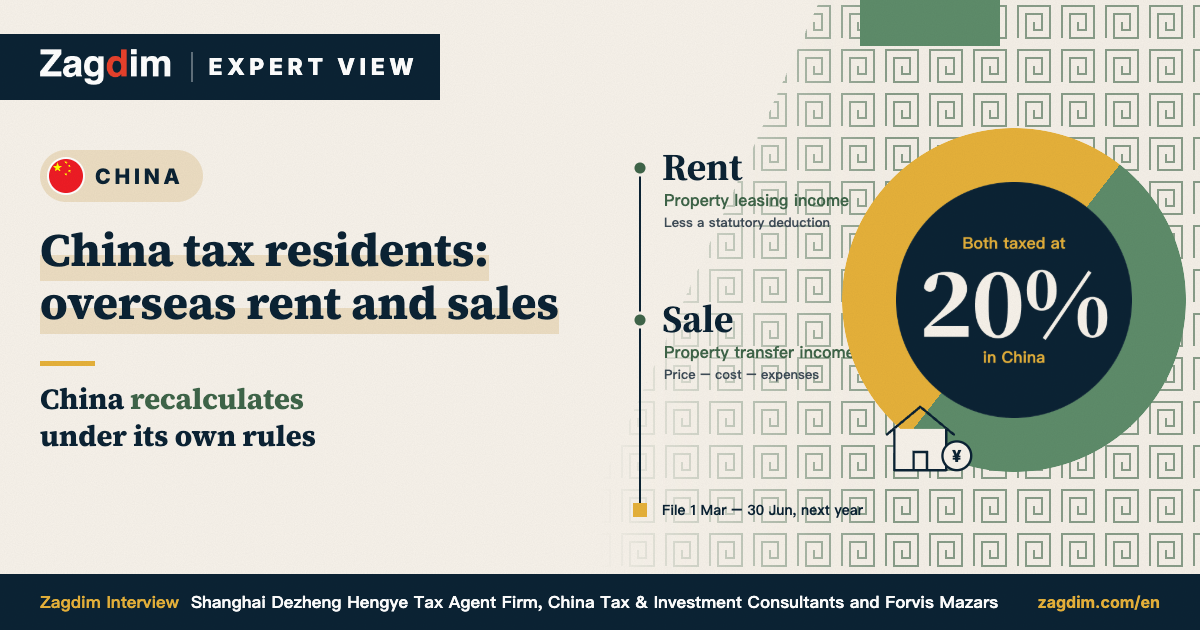
Under China’s Individual Income Tax Law, individuals who are tax-resident in mainland China are taxed on income from both inside and outside China. Announcement No. 3 of 2020 from the Ministry of Finance and the State Taxation Administration treats rent from property used abroad and gains from selling overseas real estate as foreign-source income, to be reported between 1 March and 30 June of the following year. For readers who own property abroad and are mainland China tax residents, Zagdim interviewed Andy Yu, founder of Shanghai Dezheng Hengye Tax Agent Firm; Alfred Chan, director of China Tax & Investment Consultants Limited; and Peter LAW, Partner, Tax Advisory Services at Forvis Mazars. Their shared message: China recalculates the income under its own rules rather than adopting the figures filed in the country where the property sits, and income tax paid abroad can be credited only with proper records and an on-time filing.
Key Points
- Overseas rent is “income from leasing of property” and a sale is “income from transfer of property”. Each is computed separately under Chinese rules.
- For rent, RMB 800 is deducted from each monthly receipt of up to RMB 4,000, and 20% above that. Actual overseas expenses cannot be deducted item by item; documented repair costs of up to RMB 800 per occasion can be deducted first.
- A sale is taxed at 20% on the sale price less the original cost and reasonable expenses. Mortgage principal cannot be deducted again.
- Income tax paid abroad can be credited within a limit calculated country by country. Foreign property tax and stamp duty are not creditable income taxes.
- If the foreign tax certificate arrives late, file on time and claim the credit later. Even if no Chinese tax is due after the credit, the income still has to be reported.
- Not every China tax resident is taxed in China on worldwide income; people without a domicile in China should first check the exemption conditions.
How Does China View Your Overseas Property Income? It Recalculates Under Its Own Rules
The official rule: resident individuals are taxed in China on foreign-source income. Announcement No. 3 of 2020 provides that foreign rental income and gains from transferring property are not combined with domestic income; each is taxed separately.
Alfred Chan puts it plainly:
“Tax authorities in China recalculate the income tax under China’s own individual income tax rules and do not simply adopt the “net rent” or “capital gain” shown on the tax return in the country where the property is located.”
Peter LAW notes that under the PRC IIT law and regulations, rental income and gain on disposal of property fall under two different heads of charge. Andy Yu adds that rental income and gains from selling a property are each taxed once, under their own rules, and are not merged with a reader’s everyday domestic income.
Does being a China tax resident always mean being taxed in China on worldwide income? Not necessarily, according to Peter LAW:
“Not all China tax residents would automatically be taxed on worldwide income. Readers should take care to plan their tax affairs in accordance with relevant law and regulations. For example, foreign nationals and Hong Kong, Macau and Taiwan residents may avoid being taxed on worldwide income if careful planning is made.”
Alfred Chan also notes that non-PRC domiciled resident individuals should first check exemption conditions for foreign income such as the “six-year rule”; staying 183 days in a year does not by itself mean the income must be taxed.
What this means for readers: first establish whether your foreign income actually has to be reported in China. If it does, the net rent or capital gain you reported abroad cannot simply be copied across; it has to be recomputed from scratch under Chinese rules.
How Is Rent Taxed? A Statutory Standard Deduction, Not Itemised Overseas Expenses
The official rule: under Article 6 of the Individual Income Tax Law, RMB 800 is deducted from each receipt of rental income of up to RMB 4,000, and 20% from receipts above RMB 4,000; the balance is taxable income. Article 14 of the Implementing Regulations treats income received within one month as one receipt. Item 6 of Guoshuifa [1994] No. 89 further allows, in addition to the statutory deduction and related taxes and fees, a deduction for repair costs borne by the taxpayer and supported by valid records, capped at RMB 800 per occasion, with any balance carried forward until used up.
Andy Yu cautions readers:
“This is a statutory standard deduction; it is not an item-by-item deduction of the actual overseas property taxes, management fees, repairs or loan interest. Readers should not mistake the two”
On repairs, all three agree. Alfred Chan explains that a maximum of RMB 800 may be deducted for repair expenses on each occasion, any portion not fully deducted may be carried forward to later periods, and this RMB 800 is distinct from the statutory RMB 800 expense deduction; the carry-forward does not apply to the statutory deduction. Andy Yu adds that the repair allowance is a monthly cap of RMB 800 with carry-forward, with no 20% element in it; the 20% belongs to a different layer, the statutory deduction under Article 6. Peter LAW’s formula also caps repairs at RMB 800: where monthly rent exceeds RMB 4,000, taxable income = (rental income less repair and maintenance fee (capped at RMB 800)) x (1 – 20%), and the IIT is taxable income x 20%.
Alfred Chan warns that depreciation, mortgage interest, property management fees, letting agents’ commission, insurance, utilities and travel should not be assumed deductible in China just because they are deductible abroad.
On income tax paid abroad, Alfred Chan says foreign income tax paid on rent should be handled under the foreign tax credit rules, and cannot be treated both as a deductible expense and as a tax credit. Having reviewed the point, Peter LAW agrees that the foreign tax credit is more in line with actual practice.
Zagdim’s note: under Articles 3 and 4 of Announcement No. 3 of 2020, foreign taxes of an income tax nature that have been lawfully paid are credited against the Chinese tax payable, within the credit limit; they are not first deducted from the rental income. Both experts’ views match this rule: compute the Chinese tax under Chinese rules first, then credit the income tax already paid abroad.
On the preferential rate for residential lettings, Andy Yu explains that it is based on Caishui [2008] No. 24 and primarily targets the domestic rental market; whether it applies to overseas property varies by local practice, so readers should confirm first.
How Is a Sale Taxed? Sale Price Less Original Cost and Reasonable Expenses, at 20%
The official rule: under Article 6 of the Individual Income Tax Law and Articles 16 and 17 of the Implementing Regulations, income from transferring property is the transfer proceeds less the original cost and reasonable expenses. The original cost is the purchase price or construction cost plus other related costs; reasonable expenses are the taxes and fees paid on sale as required.
Peter LAW describes the same calculation: the gain is subject to 20% and is computed as the consideration less the initial acquisition cost less reasonable expenses and taxes. Andy Yu adds that this part is computed on an actual-expense basis, including purchase taxes and fees, brokerage, and qualifying capital expenditure during ownership.
Alfred Chan raises three points:
- Mortgage principal cannot be deducted again: the purchase price already reflects the original cost, so repaying principal is not a separate cost.
- Sale commission, legal fees, improvements and loan interest: do not assume they are deductible in China because they are deductible abroad; confirm how the rules apply. Guoshuifa [2006] No. 108 sets out detailed rules on original cost, renovation and interest for homes in China, but these should not be applied wholesale to overseas property without confirmation.
- Lost records of the original cost: if records of the original cost are lost, Article 16 of the Implementing Regulations allows the competent tax authority to determine the original cost; it does not automatically allow tax to be paid as a percentage of the sale price.
How Is Foreign Tax Credited? Within a Limit, Country by Country
The official rule (Article 7 of the Individual Income Tax Law and Announcement No. 3 of 2020): foreign taxes of an income tax nature can be credited within the limit set by Chinese law, calculated separately for each country or region; any amount above the limit can be carried forward for five tax years (Article 6 of the Announcement). A credit claim requires a tax payment certificate, payment slip or tax record issued by the foreign tax authority. A taxpayer who has reported the income without claiming a credit and later obtains the certificate can claim the credit back to the year of the income, going back no more than five years; a taxpayer who genuinely cannot provide a certificate may use the foreign tax return (or tax payment notice) together with the matching bank payment record (Article 10).
The order is to compute the Chinese tax payable first, then credit qualifying foreign income tax. Alfred Chan adds that any credit above the limit can be carried forward to the following five tax years as provided under the PRC tax law, and that foreign property tax, stamp duty and similar taxes are usually not creditable against “income tax”.
Where tax years and currencies differ, Andy Yu explains that overseas income is converted into RMB at the prescribed exchange rate, and the PRC calendar year is used to map the year of the overseas tax statement. Alfred Chan adds that income and a purchase cost from many years earlier should not simply be converted at the exchange rate on the day of sale.
When the foreign tax certificate arrives late, Andy Yu’s advice is: “If the tax statement is not yet available by then, do not worry: file on time first (on a non-credited or estimated basis), then apply within the statutory period for a refund or additional credit once the certificate is in hand. The key is to request the overseas tax statement as early as possible.”
Peter LAW describes two routes: if the tax payment certificates have not been obtained, upload copies of the relevant foreign tax returns to show the foreign tax has been paid; or claim the credit once the certificates are obtained, with five years to do so.
Zagdim’s note: the article mentions two five-year periods. They cover two different situations and do not conflict. Peter LAW explains, in confirming his comments, that his refers to a late certificate: taxpayers who cannot provide foreign tax payment evidence can claim the credit within five years once they obtain the documents, and the five years run not from when they obtain the evidence but from when the relevant foreign income was taxed in China (Article 10 of Announcement No. 3 of 2020 allows a credit back to the year of the income, going back no more than five years). Alfred Chan’s refers to another situation: where the foreign tax paid exceeds the annual credit limit, the excess can be carried forward to the following five tax years (Article 6 of the same Announcement).
Alfred Chan also stresses that even if no additional tax is due after the credit, that does not mean there is no obligation to file the tax return.
Which Records to Keep? Contract, Bill, Payment and Title in One Chain
Overseas transactions usually have no Chinese tax invoices. Alfred Chan’s advice is to build a verifiable chain of evidence: contract, bill or receipt, payment, and proof of title or of the service. A bill shows what was owed and a bank record shows what was actually paid, so keep both; if a managing agent remits rent net of charges, keep the gross rent and the itemised deductions as well.
Andy Yu sorts the documents this way: the purchase contract and payment and loan records reconstruct the original cost; property tax statements, repair and management invoices and loan interest records support holding costs; rent receipts and brokerage and transaction tax documents support income and the sale. For foreign-language documents, keeping Chinese translations is advisable. Peter LAW adds that foreign tax payment records should certainly be retained.
Whether documents need authentication, notarisation or supplements depends on the competent tax authority’s requirements, Alfred Chan notes; not every overseas document needs to be notarised.
What Readers Can Do Now
- Confirm whether you are a mainland China tax resident; if you have no domicile in China, check the exemption conditions such as the “six-year rule” first.
- From this year, organise purchase, tax, rent, repair and loan records year by year. Andy Yu’s advice is to treat your overseas property like “a ledger that earns interest”.
- Report the previous year’s foreign income between 1 March and 30 June each year, and ask the foreign tax authority for the tax certificate early.
- Before deducting overseas expenses other than repairs, deciding how to treat foreign income tax, or deducting sale costs, check with your competent tax authority rather than copying the overseas treatment.
Andy Yu also has a reminder for readers who missed earlier years: “Foreign-source income must be reported between 1 March and 30 June of the following year; supplementary and amended filings, however, are not confined to that window and may be made in any month of the year. Readers who missed earlier years, or who filed incorrectly, will accumulate less late-payment surcharge (0.05% per day) the sooner they regularise their position.”
If you own a rental property abroad or are planning to sell one and are unsure how to report it in China, tell the Zagdim Reader Desk about your situation. The Reader Desk will understand your needs and identify suitable professionals.
Glossary
- Tax resident: under China’s Individual Income Tax Law, an individual who has a domicile in China, or who has no domicile but stays in China for a total of 183 days or more in a tax year, is a resident individual and is taxed on income from inside and outside China.
- Income from leasing / transfer of property: rent from letting property and gains from selling property are two separate categories of income for Chinese individual income tax, with different deduction rules.
- Foreign tax credit: income tax already paid abroad, credited against the Chinese tax payable within the limit set by Chinese law.
About This Article
The official rules are drawn from the Individual Income Tax Law, its Implementing Regulations, Announcement No. 3 of 2020 of the Ministry of Finance and the State Taxation Administration, and Guoshuifa [1994] No. 89. Announcement No. 3 of 2020 and Guoshuifa [1994] No. 89 were read in the State Taxation Administration’s regulations database on 17 November 2026; the other official documents were checked on 20 November 2026.
The experts’ views come from Zagdim’s interviews with Andy Yu (written replies, 3 and 11 November 2026), Alfred Chan (written reply, 4 November 2026) and Peter LAW (written replies in English, 10 and 16 November 2026, with clarifications when confirming on 19 November). Andy Yu and Alfred Chan’s English wording is their own. All quotations and paraphrases were confirmed by the interviewees before publication. This article covers filing practice and published rules only, does not address any individual case, and is not tax advice.
Experts interviewed
Andy Yu (喻靜菊) | Founder, Shanghai Dezheng Hengye Tax Agent Firm Co., Ltd.; International Certified Public Accountant (ICPA) | Certified Tax Agent
Alfred Chan (陳國基) | Director, China Tax & Investment Consultants Limited
Peter LAW | Partner, Tax Advisory Services, Forvis Mazars
References
Ministry of Finance and State Taxation Administration, ‘Announcement on Individual Income Tax Policies Relating to Foreign Income’ (Announcement No. 3 of 2020) / State Taxation Administration, ‘Provisions on Several Issues Concerning the Levy of Individual Income Tax’ (Guoshuifa [1994] No. 89) / National People’s Congress, Individual Income Tax Law of the People’s Republic of China (amended 31 August 2018) / State Council, Implementing Regulations of the Individual Income Tax Law (State Council Decree No. 707) / Ministry of Finance and State Administration of Taxation, Notice on Tax Policies for Low-Rent Housing, Affordable Housing and Housing Leasing (Caishui [2008] No. 24) / State Administration of Taxation, Notice on Individual Income Tax on Income from the Transfer of Individual Housing (Guoshuifa [2006] No. 108)