






























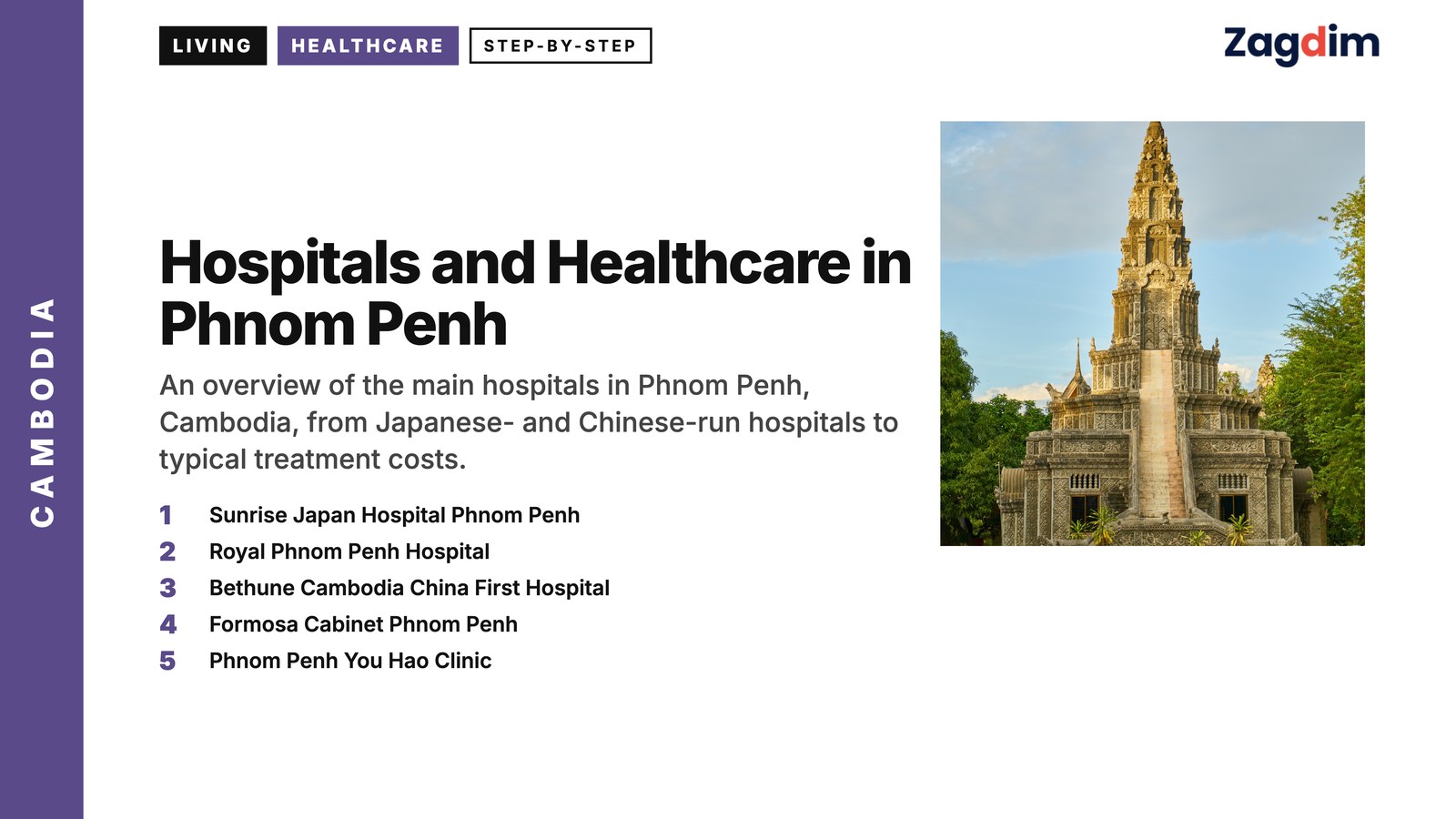
Many people ask about healthcare in Cambodia. Looking back at Cambodia’s history, the Khmer Rouge era’s internal massacres killed many intellectuals, including medical staff, leaving Cambodia’s medical standards relatively behind those of neighbouring countries such as Thailand and Vietnam. As Cambodia’s middle class has grown, demand for effective, high-quality care and treatment has gradually increased. To provide Cambodians with a higher standard of service and treatment, Cambodia has also had hospitals built with support from countries including China, Japan, Taiwan and Thailand, introducing advanced medical equipment and more scientific systems of care. Most of Cambodia’s medical resources are concentrated in the capital, Phnom Penh; the following is a reference list of hospitals there for anyone who may need help.
Several private hospitals in Phnom Penh are particularly well known, including Sunrise Japan Hospital Phnom Penh, Royal Phnom Penh Hospital (RPH), Bethune Cambodia China First Hospital, Formosa Cabinet Phnom Penh, and Phnom Penh You Hao Clinic. Overseas visitors seeking treatment can generally communicate in English or Mandarin.
Sunrise Japan Hospital Phnom Penh
Sunrise Japan Hospital Phnom Penh opened in early 2016. It provides a high standard of medical care led by a team of Japanese doctors, nurses and other medical professionals, who also train alongside experienced Cambodian medical staff.
Address: No. 177E, Kola Loum Road, Village 2, Sangkat Chak Angre Krom, Phnom Penh. Telephone: 023-260-152 / 078-260-152
Royal Phnom Penh Hospital (RPH)
Royal Phnom Penh Hospital (RPH) is a tertiary-care hospital managed and operated by Bangkok Dusit Medical Services Public Company Limited (BDMS). It opened in Cambodia on 1 October 2014. The hospital has 8 floors and international-standard medical equipment, including CT scan, 1.5 Tesla MRI, and breast-screening equipment. It has more than 40 internationally trained medical specialists from Thailand, Cambodia, the United States and France, among other countries. With advanced equipment, professional doctors and effective treatment expertise, it has an international reputation, and it became Cambodia’s first hospital to receive Joint Commission International (JCI) accreditation, ensuring safe, high-quality standards of care for patients, and earning the trust of international insurers and institutions worldwide.
Address: No. 888, Russian Boulevard, Phnom Penh. Telephone: 023991222
Bethune Cambodia China First Hospital
Bethune Cambodia China First Hospital is a comprehensive hospital founded in Cambodia by Morgan International Hospital Co., Ltd. The hospital has 10 floors plus a basement car park, 150 inpatient beds, and is currently Cambodia’s largest hospital run by ethnic Chinese staff and its largest medical check-up centre, with a luxury VIP ward on each ward floor.
Address: No. 506 Monivong Boulevard, Phnom Penh, opposite Hun Sen Boulevard. Telephone: 023 231 119 / 066 555 119
Formosa Cabinet Phnom Penh
Staffed by a Taiwanese medical team, this clinic offers treatment for colds, gastroenteritis, skin conditions, lower back pain, arthritis, sciatica, hypertension, diabetes, ear-nose-throat conditions, cardiovascular disease, gynaecological conditions, trauma care, medical aesthetics, physiotherapy and rehabilitation, and medical consultations. It has Taiwanese doctors on staff, and Taiwanese patients tend to prefer this hospital.
Address: 27A, Street 110, Russian Boulevard, Phnom Penh (opposite the airport, next to a hotel toward Chroy Changvar). Telephone: 0975075500
Phnom Penh You Hao Clinic
This clinic is one of the health businesses under the Cambodian Khmer Group. It has a convenient location and a pleasant environment, with complete medical equipment, and offers internal medicine, surgery (urology), traditional Chinese medicine, ENT, gynaecology, and ultrasound testing.
Address: at the intersection of Monivong Boulevard (61) and Street 252, Phnom Penh. Telephone: 060 999 120 / 011 871 119 / 066 222 119
First Center Polyclinic
Also well known among local residents, First Center Polyclinic was founded in 1997. It has departments covering internal medicine, surgery, obstetrics and gynaecology, paediatrics, ENT, ophthalmology, orthopaedics, spinal surgery, gastroenterology, dermatology and venereology, urology, and colorectal medicine, offering a professional range of health check-up services, infant vaccinations, and prevention of tropical infectious diseases. After its expansion, the total floor area exceeds 3,000 square metres, and it is equipped with enhanced laparoscopic and hysteroscopic facilities, a tertiary-hospital-grade operating theatre, and the latest examination equipment. It also offers 24-hour emergency services, with multiple languages available: Khmer, English, Mandarin, Korean, Russian, Japanese, French, Vietnamese, Cantonese and Teochew, among others.
Address: No. 408 Monivong Boulevard, Phnom Penh. Telephone: 023 211 010 / 099 911 911
Hong En Hospital
A well-regarded hospital in Cambodia, Hong En Hospital has departments including gynaecology, burns, dermatology, psychiatry, orthopaedics, internal medicine, surgery, paediatrics, traditional Chinese medicine, imaging and laboratory testing, with dozens of medical professionals trained in mainland China.
To keep up with the information age, the hospital has also built a cooperation mechanism with tertiary-grade hospitals in mainland China and improved its network infrastructure, achieving informatised medical management.
Address: No. 186 Monireth Boulevard, Phnom Penh. Telephone: 012 892 958
Royal Fertility Hospital
This is currently the only medical institution in the Kingdom of Cambodia licensed as a reproductive “hospital,” and currently the only one able to independently complete genetic disease, chromosome and gene testing, as well as the only one with both a laminar-flow laboratory and a PGD laboratory.
Address: No. 410 Monivong Boulevard, Phnom Penh. Telephone: 088 557 8769
Victoria Hospital
A hospital serving the ethnic Chinese community in Cambodia, offering treatment mainly for infertility, gynaecology, dermatology, andrology, colorectal conditions, pain management, gastroenterology, internal medicine, ENT and urinary stone conditions.
Address: No. 61A, Street 315, Toul Kork, Phnom Penh. Telephone: 023 951 111
Zhongxin Hospital
A comprehensive hospital combining medical treatment, health maintenance and prevention, with departments in internal medicine, surgery, gynaecology, traditional Chinese medicine physiotherapy, and moxibustion-based wellness care, among others. Its moxibustion department, opened in 2014, filled a gap in Cambodia’s treatment options for a range of chronic conditions, with notable results for conditions including herniated discs, bone spurs, cervical spondylosis, frozen shoulder, breast hyperplasia and uterine fibroids.
Address: No. 28-30A, Monireth Boulevard (Mean Chey district), Phnom Penh. Telephone: 023 636 9988 / 093 325 824 / 085 402 572
Preah Kossamak Hospital
With more than 60 years of history, the Cambodia-China Friendship Preah Kossamak Hospital, built with Chinese assistance, is located in the Toul Kork area of Phnom Penh on the site of the former Preah Kossamak Hospital, and formally opened on 21 March 2022. It introduced advanced medical equipment and a more scientific system of care, and is set to become one of Cambodia’s most modern public hospitals. It aims to provide the public with safe, convenient medical services, significantly lowering the cost of treatment for patients and bringing benefits to many more of them. It has also established a dedicated traditional Chinese medicine department, with technical guidance and setup support from senior Chinese national experts in traditional Chinese medicine. It is a comprehensive teaching hospital focused mainly on surgery, including outpatient, emergency, treatment and inpatient care, and logistics functions, with capacity for more than 400 beds, and even a rooftop helicopter landing pad.
A Note on Private Clinics
In Phnom Penh, small private clinics can be found on almost every other street; some may be comparatively dirty and disorganised, and overseas visitors may sometimes be charged excessive fees. It is advisable to have a local acquaintance accompany you when visiting one. Because Cambodia was formerly a French colony, local pharmacies tend to sell a relatively large amount of higher-priced branded medication. For safety, most people choose to visit a properly established hospital for peace of mind.
As a reference on cost, one visitor described going to Sunrise Japan Hospital Phnom Penh, where a personal medical card (valid for one year) initially cost US$60, a single consultation fee was about US$30, and medication cost about US$40 — though costs vary from hospital to hospital. It is recommended to buy travel insurance before travelling and to understand your coverage clearly, and to keep the doctor’s note and receipts from any treatment received in order to make an insurance claim before the deadline. Wishing everyone safe and enjoyable travels.
Have a question about this guide? Leave a comment below, or ask Zagdim directly.
Your first stop for international property and global living.
Research and insights. Know what’s changing. Understand what matters.