





























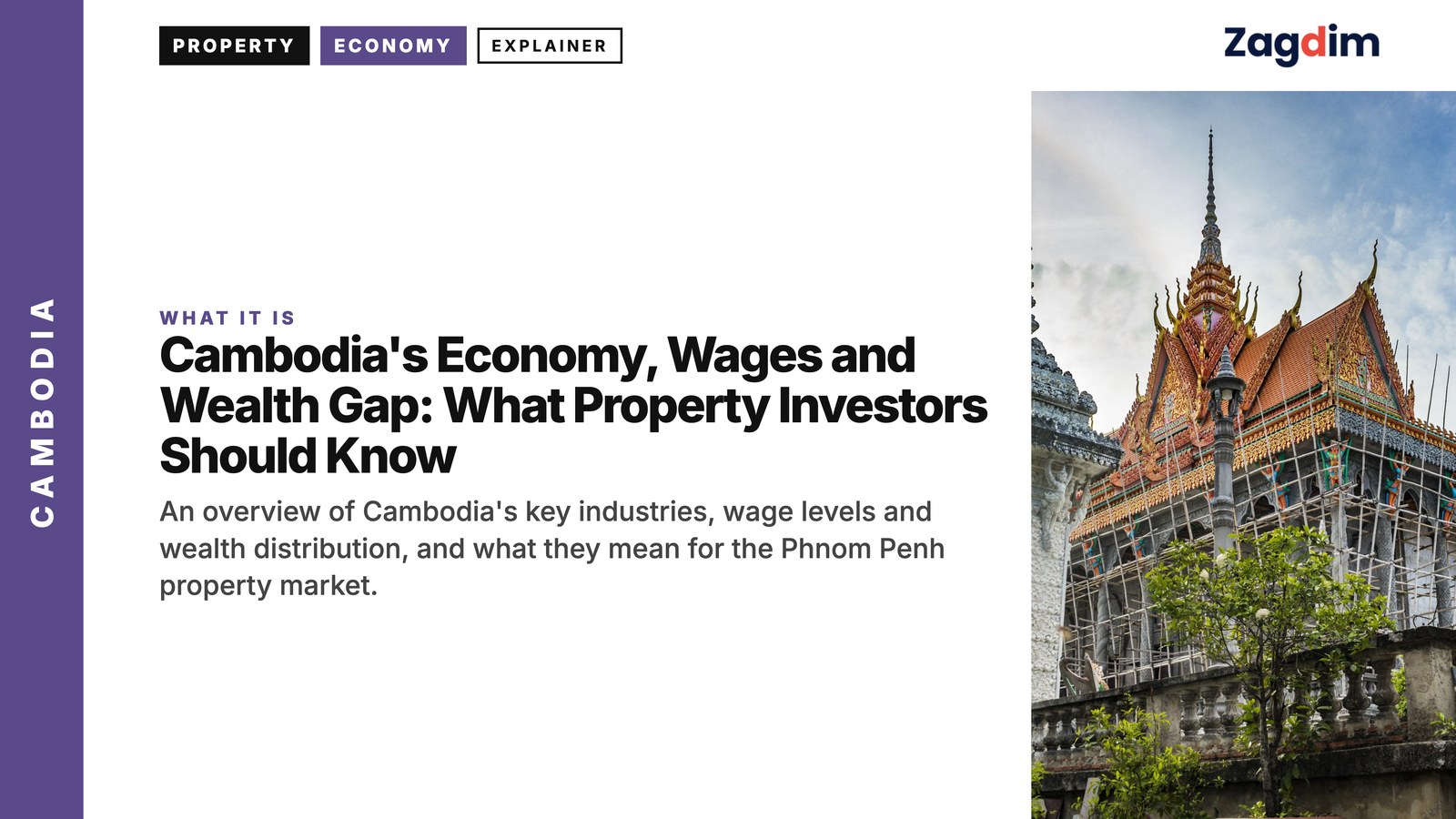
Cambodia is often still pictured as poor and underdeveloped, but the country has changed a great deal. This article looks at Cambodia’s main industries, how quickly wages have grown, and the scale of the country’s wealth gap — all factors that shape demand and pricing in the Phnom Penh property market.
Cambodia’s Main Industries
Cambodia’s economy currently rests on four main industries: agriculture, tourism, garment-export manufacturing, and construction.
Agriculture is Cambodia’s largest single source of income, accounting for about 20.8% of GDP and involving around 36% of the national workforce. Main crops include rice, cassava, sugar cane, corn, mango, natural rubber, palm oil, black pepper and bananas. Cambodian jasmine rice was named the “World’s Best Rice” for two consecutive years, in 2012 and 2013, and Cambodian mangoes — in season each May — have earned the title “ASEAN’s Top Mango.”
Tourism is also a major driver of the economy, thanks to Cambodia’s deep cultural and historical heritage — most famously Angkor Wat, a UNESCO World Heritage Site that draws tens of thousands of visitors to Siem Reap each year to see this monument built through ancient ingenuity. Sihanoukville, viewed by many overseas visitors as a holiday paradise, is another well-known tourist destination, with white sand beaches, a wide range of water sports, and island-hopping boat trips to snorkel in clear water near coral reefs.
Cambodia is the second-smallest economy among the ten ASEAN members and is a key hub country for China’s Belt and Road Initiative. Services account for roughly 44% of GDP, and industry — including garment manufacturing, tourism and construction — accounts for about 30%.
In 1993, the Cambodian government adopted an open free-market economic policy, allowing foreign investors to hold 100% ownership of registered companies and giving foreign firms the same treatment as Cambodian companies on business operations, customs and tax incentives. This inflow of foreign investment has helped drive up interest in Phnom Penh real estate: housing there is comparatively upscale without being expensive. Phnom Penh property prices have grown by as much as 15% a year, with rental yields of 5–8%. Diamond Island, just across the river from Phnom Penh, has been developed into a European-style upscale enclave, and the Mekong River runs through the region seen as Southeast Asia’s heartland — all of which has attracted overseas investors betting on Cambodia’s fast-growing economy to buy into Phnom Penh, the country’s hub for culture, commerce and finance.
How Fast Have Wages Grown?
Large inflows of foreign investment have also pushed up local prices. Cambodia attracted foreign direct investment (FDI) of US$3.5 billion in 2019, with investors from North America, Europe, Japan, Singapore, Malaysia, mainland China, Hong Kong, Taiwan and elsewhere all active in the market.
Cambodia’s minimum wage — set for the garment and footwear manufacturing sector — has risen sharply each year since the 2013 election: from US$61 to US$80 in 2013, US$100 in 2014, US$128 in 2015, US$140 in 2016, US$153 in 2017, US$170 in 2018, US$182 in 2019, US$190 in 2020, and US$192 in 2021.
The government set the 2022 minimum wage for garment and footwear factory workers at US$194, up from US$192. On top of the statutory minimum, workers also receive allowances and benefits including a US$10 full-attendance bonus, a US$7 transport and housing allowance, and a seniority allowance of US$2–11, meaning a worker who has completed at least one year’s service earns at least US$211 to US$222 a month before overtime pay.
Workers often eat at roadside food stalls, where a large plate of rice with a meat dish and a glass of iced Cambodian tea costs about US$2–3 — less than half the price of an “affordable restaurant” in Phnom Penh.
Beyond the minimum wage, ordinary Cambodian workers earn around US$200 a month; office staff in non-managerial roles earn about US$250; senior staff about US$350; junior managers about US$500; and senior managers around US$1,000. Many young office workers work during the day and attend evening classes at night. Meanwhile, workers who speak English can earn US$400–500 a month, and those who speak both English and Chinese can earn US$1,000 or more a month — a gap that, if anything, makes local people appreciate the value of education and language skills even more.
Higher-earning Cambodians are relatively few as a proportion of the population, though not small in absolute number. A good lawyer, for example, charges about US$100 an hour for consultations; other well-paid professions include Chinese-Khmer-English interpreting/translation, also around US$100 an hour, and jobs in banking and telecommunications. White-collar staff at upmarket office buildings such as ANZ Royal or Canadia Tower can also earn US$1,000 or more a month. As Cambodia’s economy and education system keep developing, demand for higher-paying roles is expected to keep rising, along with the supply of mid-to-senior-level talent suited to them.
Cambodia’s range of industries is still much narrower than in more developed economies, so senior white-collar and highly paid roles remain relatively few for now — but the trend is clearly upward, which is where the future potential lies.
Cambodia’s Wealth Gap and What It Means for Housing
Outside Phnom Penh, Sihanoukville and Siem Reap, most provinces in Cambodia currently have little in the way of formal housing developments, since local residents generally already own land they can build on themselves. In cities such as Phnom Penh and Sihanoukville, housing that ordinary local residents can afford — based roughly on the ratio of income to price — would need to sit in the range of US$600–1,000 per square metre. Such housing does exist, but it tends to be in less central locations, in limited supply, and often without even English-speaking staff on site, so in practice it is mainly bought by local residents rather than foreign investors.
At the top of the market are Cambodia’s urban elite — a mix of long-established local wealth and a newly emerging local middle class. In the BKK1 and Toul Kork areas, it is easy to see one detached villa after another behind attractive walls — genuinely striking mansions, typically sitting on plots of 500 to 2,000-plus ping (roughly 1,650–6,600+ square metres), often with a large gate and, in some cases, multiple dedicated security guards. Land prices in BKK1 already exceed US$7,000 per square metre, and in Toul Kork about US$4,000 per square metre, meaning the land alone under such a villa can already be worth tens of millions, or even more than a hundred million, Hong Kong dollars.
Looking further at ordinary wealthy households: judged by spending habits, those who drive a Rolls-Royce or Bentley in Cambodia are at the very top of the wealth ladder, while Lexus or Mercedes-Benz owners would generally be considered simply well-off. In real estate terms, the very wealthy tend to hold large plots of land or build their own high-rise buildings, while the ordinary wealthy tend to hold scattered parcels of land or buy finished units.
Cambodia may look poor and underdeveloped on the surface, but in practice it likely has more wealthy residents than visitors might expect. A telling example is Cambodia’s taxi drivers: using the PASS ride-hailing app is convenient and easy in Cambodia. If you speak some English, Cambodian drivers tend to treat you with more respect, since in their experience “most Chinese visitors don’t speak English, so anyone who does stands out.” Some drivers rent their housing, but quite a few drivers in Phnom Penh actually own townhouse-style properties — one driver was reported to own 15 hectares of land near the airport, worth tens of millions.
These wealthy groups, however, are not the main source of ordinary housing demand. The real driving force for future demand is the emerging urban elite and younger generation. Phnom Penh already has a population of 3.6 million; by a conservative estimate, if the elite class currently makes up about 5% of that population, that is already around 180,000 people, and as the country develops further, that share could rise to as much as 15%. By 2025, Phnom Penh’s population was projected to grow to 5 million, which would put the size of this elite group at more than 750,000. So beyond overseas investors, local buying power is also a market worth watching closely in the years ahead.
Have a question about this guide? Leave a comment below, or ask Zagdim directly.
Your first stop for international property and global living.
Research and insights. Know what’s changing. Understand what matters.