
































Zagdim Overseas
Subscribe
  • Home
  • Real Estate & Economic News
    • All
    • Japan Market News
    • Other Market News
    • Thailand Market News
    • UK Market News
    • Vietnam Market News
    Prime London Rental Values Jump 67% as Supply Contracts

    Prime London Rental Values Rise 67% as Supply Contracts

    Portugal's One-Bed Rent Now Tops the Minimum Wage

    One-Bedroom Flat Rent in Portugal Now Costs More Than Minimum Wage

    Dubai Rents Fall Up to 15% as Tenants Switch to New Leases

    Dubai Tenants Switch Homes as New-Lease Rents Fall Up to 15%

    Ras Al Khaimah waterfront apartments and palm promenade aerial view

    Ras Al Khaimah Apartment Prices Rise 18% in H1 2026 as Record Hotel Guest Numbers Land

    Halifax Harbour sunset skyline

    Canada Sets 90-Day Deadline for Atlantic Immigration Applicants Facing Employment Changes

    Sydney CBD night skyline

    Australia’s Capital Gains Tax Reform Takes Effect July 2027 — Why a Valuation Now Could Matter

    Trending Tags

  • Zagdim Insights
    • All
    • Market Trends Overview
    • Policy Interpretation
    • Zagdim Insights
    Automated immigration gates at Suvarnabhumi Airport

    Thailand’s Suvarnabhumi Auto Gates Expand to 33 Nationalities: Full List, Eligibility and TDAC Guide

    1960 archive photo of Queen Sirikit at a gala concert in The Hague, with Bank of Thailand specimens of the THB100 and THB500 commemorative notes

    Thailand’s commemorative banknotes return in October: where to exchange the THB100 and THB500 notes

    A document-style cover showing the Thai Revenue Department’s 15 September 2026 GloBE MCAA announcement with the subject line highlighted.

    Thailand joins the global minimum tax information exchange: which businesses need to pay attention, and are individuals affected?

    A 2025 file photo of Australian Home Affairs Minister Tony Burke at a meeting, alongside Zagdim’s analysis title on Australia’s migration reforms.

    Australia announces migration reforms targeting student families, visa switching and longer stays

    China’s Entry-Exit Agency Rules: What Your Business Needs to Prepare. Paper folders labelled Deadlines, Documents and Partners, with a calendar, Chinese gateway and flight route. AI-generated illustration.

    China’s New Entry-Exit Agency Rules: What Your Business Needs to Prepare

    Three UK New-Build Thresholds for 2026: The Building Safety Levy, Second Staircases and the New EPC

    Zagdim Research cover: investigator setting up cameras in an empty Japanese apartment - Japan Prices Death Into Its Housing Market, and Buyers Have Begun to Bite

    Japan Prices Death Into Its Housing Market — and Buyers Have Begun to Bite

    Thailand to Cancel 60-Day Visa Exemption: What Long-Stay Options Are Available for Foreigners?

    Thailand to Cancel 60-Day Visa Exemption: What Long-Stay Options Are Available for Foreigners?

    Thailand Cabinet Approves Cancellation of 60-Day Visa Exemption for 93 Countries; Official Effective Date Still Pending Royal Gazette Publication

    Thailand Cabinet Approves Cancellation of 60-Day Visa Exemption for 93 Countries; Official Effective Date Still Pending Royal Gazette Publication

    • Zagdim Insights
    • Market Trends Overview
    • Policy Interpretation
  • Global Reports
    Zagdim Featured CBRE Thailand Mid-Year Outlook 2026

    CBRE Thailand Mid-Year Outlook: What Is Changing Across Six Real Estate Sectors?

    More Firms, a Busier First Half, a Softer Q2: What Vietnam’s Property Data Show, and Where ‘Repositioning’ Is a Reading

    More Firms, a Busier First Half, a Softer Q2: What Vietnam’s Property Data Show, and Where ‘Repositioning’ Is a Reading

    The Headline Number and the Real One: Reading UK Home Values After Inflation

    The Headline Number and the Real One: Reading UK Home Values After Inflation

    Tokyo’s Property Boom: How to Read AMRO’s ‘Warning, Not a Crisis’

    Tokyo’s Property Boom: How to Read AMRO’s ‘Warning, Not a Crisis’

    A Soft Summer for US Housing: What the Data Show, and Where ‘Hurting’ Is CNBC’s Word

    A Soft Summer for US Housing: What the Data Show, and Where ‘Hurting’ Is CNBC’s Word

    Malaysia’s Property Market Is Getting Choosier — What \”Selective\” Does and Doesn’t Say

    Malaysia’s Property Market Is Getting Choosier — What \”Selective\” Does and Doesn’t Say

    72% at the Top: What Mainland Buyer-Share Data Say About Hong Kong Property — and What They Don’t

    72% at the Top: What Mainland Buyer-Share Data Say About Hong Kong Property — and What They Don’t

    Hong Kong Home Prices Are Up ~10% This Year — but Can the Rebound Last Without Local Owners?

    Hong Kong Home Prices Are Up ~10% This Year — but Can the Rebound Last Without Local Owners?

    193 Deals in Dubai, 94 in Hong Kong: Reading a Super-Prime Quarter Without Calling It a Cycle

    193 Deals in Dubai, 94 in Hong Kong: Reading a Super-Prime Quarter Without Calling It a Cycle

  • Buying & Immigration Guide
    • All
    • Expat Lifestyle Guide
    • International Property Buying Guide
    • Overseas Leasing & Long-Term Stay
    • Real Estate Law & Taxation
    • Relocation, Immigration & Visa
    Five things a first-time overseas buyer must settle before buying in London: entry (SDLT and the two surcharges), financing (interest relief capped at 20%), holding (NRLS and letting compliance), title (leasehold and building safety), exit (NRCGT and your treaty position)

    Is London property worth buying? Five things a first-time overseas buyer must settle first

    Japan’s Revised Condominium Ownership Act (2026): What Overseas Owners Need to Know About Voting Rights, Resolutions, and the New Domestic Manager Requirement

    Japan’s Revised Condominium Ownership Act (2026): What Overseas Owners Need to Know About Voting Rights, Resolutions, and the New Domestic Manager Requirement

    Before You Buy Property in Vietnam: Eligible Assets, Prohibited Categories, and How Land Rights Actually Work for Overseas Buyers

    Before You Buy Property in Vietnam: Eligible Assets, Prohibited Categories, and How Land Rights Actually Work for Overseas Buyers

    Buying Property in London: Key Risks to Check Before You Exchange — Leasehold, Service Charges, Off-Plan Deposits, and Contracts

    Buying Property in London: Key Risks to Check Before You Exchange — Leasehold, Service Charges, Off-Plan Deposits, and Contracts

    Opening a UK Bank Account as an Overseas Resident: Identity, Address, and What to Check Before You Apply

    Opening a UK Bank Account as an Overseas Resident: Identity, Address, and What to Check Before You Apply

    UK Residential Mortgage Readiness for Overseas Buyers: What Lenders Check on Income, Status, and Deposit

    UK Residential Mortgage Readiness for Overseas Buyers: What Lenders Check on Income, Status, and Deposit

    How should overseas owners manage and rent out property in Japan after purchase?

    How should overseas owners manage and rent out property in Japan after purchase?

    The retirees who no longer want to renew their Thai visa every year

    The retirees who no longer want to renew their Thai visa every year

    Same retirement age, different Thailand residence choices: Retirement O, LTR, and Thailand Privilege

    Same retirement age, different Thailand residence choices: Retirement O, LTR, and Thailand Privilege

    Trending Tags

  • About
    • Ask Questions
    • Zagdim Research
    • Contact Us — LINE / WhatsApp
  • 中文 EN
No Result
View All Result
Zagdim
  • Home
  • Real Estate & Economic News
    • All
    • Japan Market News
    • Other Market News
    • Thailand Market News
    • UK Market News
    • Vietnam Market News
    Prime London Rental Values Jump 67% as Supply Contracts

    Prime London Rental Values Rise 67% as Supply Contracts

    Portugal's One-Bed Rent Now Tops the Minimum Wage

    One-Bedroom Flat Rent in Portugal Now Costs More Than Minimum Wage

    Dubai Rents Fall Up to 15% as Tenants Switch to New Leases

    Dubai Tenants Switch Homes as New-Lease Rents Fall Up to 15%

    Ras Al Khaimah waterfront apartments and palm promenade aerial view

    Ras Al Khaimah Apartment Prices Rise 18% in H1 2026 as Record Hotel Guest Numbers Land

    Halifax Harbour sunset skyline

    Canada Sets 90-Day Deadline for Atlantic Immigration Applicants Facing Employment Changes

    Sydney CBD night skyline

    Australia’s Capital Gains Tax Reform Takes Effect July 2027 — Why a Valuation Now Could Matter

    Trending Tags

  • Zagdim Insights
    • All
    • Market Trends Overview
    • Policy Interpretation
    • Zagdim Insights
    Automated immigration gates at Suvarnabhumi Airport

    Thailand’s Suvarnabhumi Auto Gates Expand to 33 Nationalities: Full List, Eligibility and TDAC Guide

    1960 archive photo of Queen Sirikit at a gala concert in The Hague, with Bank of Thailand specimens of the THB100 and THB500 commemorative notes

    Thailand’s commemorative banknotes return in October: where to exchange the THB100 and THB500 notes

    A document-style cover showing the Thai Revenue Department’s 15 September 2026 GloBE MCAA announcement with the subject line highlighted.

    Thailand joins the global minimum tax information exchange: which businesses need to pay attention, and are individuals affected?

    A 2025 file photo of Australian Home Affairs Minister Tony Burke at a meeting, alongside Zagdim’s analysis title on Australia’s migration reforms.

    Australia announces migration reforms targeting student families, visa switching and longer stays

    China’s Entry-Exit Agency Rules: What Your Business Needs to Prepare. Paper folders labelled Deadlines, Documents and Partners, with a calendar, Chinese gateway and flight route. AI-generated illustration.

    China’s New Entry-Exit Agency Rules: What Your Business Needs to Prepare

    Three UK New-Build Thresholds for 2026: The Building Safety Levy, Second Staircases and the New EPC

    Zagdim Research cover: investigator setting up cameras in an empty Japanese apartment - Japan Prices Death Into Its Housing Market, and Buyers Have Begun to Bite

    Japan Prices Death Into Its Housing Market — and Buyers Have Begun to Bite

    Thailand to Cancel 60-Day Visa Exemption: What Long-Stay Options Are Available for Foreigners?

    Thailand to Cancel 60-Day Visa Exemption: What Long-Stay Options Are Available for Foreigners?

    Thailand Cabinet Approves Cancellation of 60-Day Visa Exemption for 93 Countries; Official Effective Date Still Pending Royal Gazette Publication

    Thailand Cabinet Approves Cancellation of 60-Day Visa Exemption for 93 Countries; Official Effective Date Still Pending Royal Gazette Publication

    • Zagdim Insights
    • Market Trends Overview
    • Policy Interpretation
  • Global Reports
    Zagdim Featured CBRE Thailand Mid-Year Outlook 2026

    CBRE Thailand Mid-Year Outlook: What Is Changing Across Six Real Estate Sectors?

    More Firms, a Busier First Half, a Softer Q2: What Vietnam’s Property Data Show, and Where ‘Repositioning’ Is a Reading

    More Firms, a Busier First Half, a Softer Q2: What Vietnam’s Property Data Show, and Where ‘Repositioning’ Is a Reading

    The Headline Number and the Real One: Reading UK Home Values After Inflation

    The Headline Number and the Real One: Reading UK Home Values After Inflation

    Tokyo’s Property Boom: How to Read AMRO’s ‘Warning, Not a Crisis’

    Tokyo’s Property Boom: How to Read AMRO’s ‘Warning, Not a Crisis’

    A Soft Summer for US Housing: What the Data Show, and Where ‘Hurting’ Is CNBC’s Word

    A Soft Summer for US Housing: What the Data Show, and Where ‘Hurting’ Is CNBC’s Word

    Malaysia’s Property Market Is Getting Choosier — What \”Selective\” Does and Doesn’t Say

    Malaysia’s Property Market Is Getting Choosier — What \”Selective\” Does and Doesn’t Say

    72% at the Top: What Mainland Buyer-Share Data Say About Hong Kong Property — and What They Don’t

    72% at the Top: What Mainland Buyer-Share Data Say About Hong Kong Property — and What They Don’t

    Hong Kong Home Prices Are Up ~10% This Year — but Can the Rebound Last Without Local Owners?

    Hong Kong Home Prices Are Up ~10% This Year — but Can the Rebound Last Without Local Owners?

    193 Deals in Dubai, 94 in Hong Kong: Reading a Super-Prime Quarter Without Calling It a Cycle

    193 Deals in Dubai, 94 in Hong Kong: Reading a Super-Prime Quarter Without Calling It a Cycle

  • Buying & Immigration Guide
    • All
    • Expat Lifestyle Guide
    • International Property Buying Guide
    • Overseas Leasing & Long-Term Stay
    • Real Estate Law & Taxation
    • Relocation, Immigration & Visa
    Five things a first-time overseas buyer must settle before buying in London: entry (SDLT and the two surcharges), financing (interest relief capped at 20%), holding (NRLS and letting compliance), title (leasehold and building safety), exit (NRCGT and your treaty position)

    Is London property worth buying? Five things a first-time overseas buyer must settle first

    Japan’s Revised Condominium Ownership Act (2026): What Overseas Owners Need to Know About Voting Rights, Resolutions, and the New Domestic Manager Requirement

    Japan’s Revised Condominium Ownership Act (2026): What Overseas Owners Need to Know About Voting Rights, Resolutions, and the New Domestic Manager Requirement

    Before You Buy Property in Vietnam: Eligible Assets, Prohibited Categories, and How Land Rights Actually Work for Overseas Buyers

    Before You Buy Property in Vietnam: Eligible Assets, Prohibited Categories, and How Land Rights Actually Work for Overseas Buyers

    Buying Property in London: Key Risks to Check Before You Exchange — Leasehold, Service Charges, Off-Plan Deposits, and Contracts

    Buying Property in London: Key Risks to Check Before You Exchange — Leasehold, Service Charges, Off-Plan Deposits, and Contracts

    Opening a UK Bank Account as an Overseas Resident: Identity, Address, and What to Check Before You Apply

    Opening a UK Bank Account as an Overseas Resident: Identity, Address, and What to Check Before You Apply

    UK Residential Mortgage Readiness for Overseas Buyers: What Lenders Check on Income, Status, and Deposit

    UK Residential Mortgage Readiness for Overseas Buyers: What Lenders Check on Income, Status, and Deposit

    How should overseas owners manage and rent out property in Japan after purchase?

    How should overseas owners manage and rent out property in Japan after purchase?

    The retirees who no longer want to renew their Thai visa every year

    The retirees who no longer want to renew their Thai visa every year

    Same retirement age, different Thailand residence choices: Retirement O, LTR, and Thailand Privilege

    Same retirement age, different Thailand residence choices: Retirement O, LTR, and Thailand Privilege

    Trending Tags

  • About
    • Ask Questions
    • Zagdim Research
    • Contact Us — LINE / WhatsApp
  • 中文 EN
No Result
View All Result
Zagdim
No Result
View All Result

UAE VAT Explained: How It Affects Expats’ Daily Life

Home Dubai
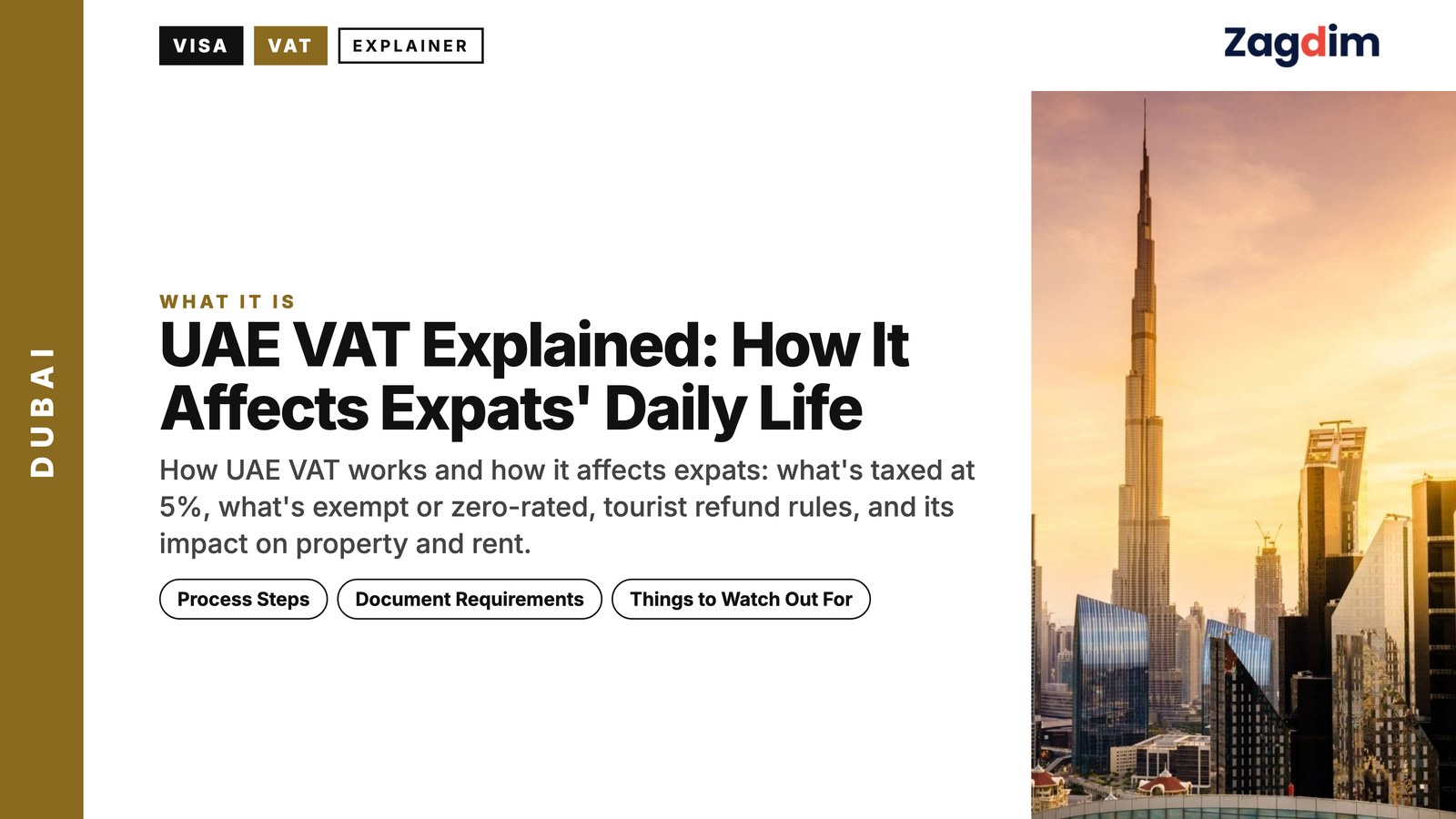
Skyline — Downtown Dubai skyline with Burj Khalifa at sunset, illustrating UAE VAT Explained: How It Affects Expats' Daily Life

Image: Zagdim

September 24, 2026
in Dubai, Living Abroad, Visa & Immigration
Reading Time: 13 mins read

1. Introduction: UAE VAT Explained

Since January 1, 2018, the UAE has formally implemented Value Added Tax (VAT), a reform that marked an important step in the country’s move to diversify its revenue. As one of the countries with the lowest VAT rate in the world, the UAE set its standard VAT rate at 5% — relatively low compared with other countries, yet it has still had a significant impact on residents and businesses. The introduction of VAT has not only changed the UAE’s fiscal structure but has also had a noticeable effect on daily consumption, business operations and the lifestyle of expats.

For expats, even though the UAE does not levy personal income tax, VAT has become the most direct form of taxation they encounter while living there. This has raised questions for many residents from different countries, particularly about how it affects their day-to-day spending. From shopping and dining to transport and housing, VAT touches many aspects of expat life. At the same time, local residents have also gone through an adjustment period in accepting VAT, especially coming from an environment used to zero or low taxes.

This article looks in depth at how UAE VAT works, particularly its effect on expats, and explains its specific impact on everyday spending. This is intended to help readers understand how UAE VAT affects their financial planning, and how to make the most of exemption and refund mechanisms within the policy for the best possible arrangement of their finances.

2. Who Should Understand UAE VAT

Understanding UAE VAT matters for many different groups, especially those living or working in the UAE, or planning to settle there long term. This includes expats, long-term residents, homemakers and international students. Whether you are an expat or a local resident, you will encounter VAT in daily life, so understanding this policy is essential for financial planning and budgeting.

1. Expats and Long-Term Residents

Expats make up one of the UAE’s main population groups, with many coming from around the world to work or do business. For these expats, even though the UAE does not levy personal income tax, VAT directly affects their day-to-day spending. Whether buying food, clothing, or using public transport, the 5% VAT shows up in their spending. Expats should therefore understand which goods and services are taxed and which are exempt or reduced, so they can better plan their living expenses.

Long-term residents (such as those with a permanent residence permit or planning to settle in the UAE) need to understand how VAT affects their daily life and what refund mechanisms are available, helping them manage their budget effectively and reduce unnecessary tax burden after relocating to the UAE.

2. Homemakers

For homemakers settled in the UAE, VAT’s impact is mainly felt in everyday household spending, such as food, daily necessities and services. Although the UAE provides exemptions or zero-rating for certain basic services and goods (such as basic food, healthcare and education), homemakers still need to be aware of the tax treatment of other everyday spending. Understanding how VAT applies can help homemakers make smarter choices in their spending and budgeting.

3. International Students

International students in the UAE also encounter the effects of VAT, particularly when buying food, transport and study materials. While education services in the UAE are tax-exempt, other everyday spending (such as shopping and dining) is still subject to the 5% VAT. Understanding these tax rules helps students plan a reasonable living budget.

4. Different Treatment by Status

The UAE treats different groups slightly differently when it comes to VAT. While most consumers are affected by VAT, residents and non-residents may be treated differently in certain circumstances. The 183-day rule determines UAE personal tax residency status (relevant for a Tax Residency Certificate or double-tax treaty claims) — it has no bearing on VAT. VAT is charged at the standard 5% on everyday spending for residents and non-residents alike.

5. Differences by Region and Purpose of Stay

The UAE’s major cities (such as Dubai, Abu Dhabi and Sharjah) apply VAT largely consistently, under the unified administration of the Federal Tax Authority (FTA). However, some specific areas may see minor differences in the taxation of infrastructure, services and goods. For example, Dubai, as a major commercial and tourism hub, may have more retail and service activity subject to VAT, while smaller cities with a lower cost of living may see relatively less direct VAT impact.

Understanding the details of how VAT is applied is therefore important based on your own region and purpose of stay, especially when planning living expenses and business activity.

3. Process Steps: How to Understand and Apply UAE VAT

In the UAE, understanding the scope and calculation of VAT is essential to an expat’s daily life. The following steps explain each part in detail to help you manage VAT’s impact effectively.

Step 1: Understand What VAT Applies To

First, understand which goods and services are subject to VAT and which are exempt or reduced — this is the basis for planning your spending.

  • Goods and services subject to VAT:
    • Most goods and services — such as clothing, electronics, dining, entertainment, private transport and accommodation — are subject to 5% VAT.
    • For example, when you shop at a supermarket or dine at a restaurant, 5% VAT is added to the bill at checkout.
  • Goods and services that are exempt or reduced:
    • Basic food items (such as rice, bread and vegetables) and certain medical and education services are generally tax-exempt.
    • For example, when you buy a bottle of water or vegetables, no VAT is charged on these items.
  • Zero-rated (0% VAT) goods:
    • This includes first-time supply of residential property (delivered within 3 years of completion) and international flight services.
    • For example, when you buy a qualifying residential property, the transaction will not be charged VAT.

Step 2: How VAT Is Calculated in Everyday Spending

Understanding how VAT is calculated in daily spending helps you budget and manage expenses more precisely.

  • Example 1: Supermarket shopping
    • Say you buy goods totaling AED 100 at a supermarket. 5% VAT is calculated as AED 5, so the final amount you pay is AED 105.
  • Example 2: Dining at a restaurant
    • If your bill is AED 150, the restaurant adds 5% VAT, which is AED 7.5. The total you pay is AED 157.5.
  • Example 3: Car rental
    • If a car’s daily rental rate is AED 200, 5% VAT is AED 10. So you need to pay AED 210 for the service.

Step 3: Handling VAT Refunds on Shopping or Services

Expats may be able to claim a VAT refund in the UAE, especially after certain purchases. If you are a visitor or business traveler from a non-resident country, understanding the refund process is particularly important.

  • Basic conditions for applying for a refund:
    • You can only apply for a refund when leaving the UAE.
    • Purchases must reach a minimum amount (such as AED 250) and must be made at a retailer participating in the refund scheme.
    • You need a valid purchase receipt and refund document, and must apply at the airport refund counter when departing.
  • The refund process:
    • You can submit your goods and receipts at a designated refund location (airport, seaport or land border).
    • Once your refund application is approved, the current fee structure deducts 13% of the VAT amount plus a fixed AED 3.60 per tax-free transaction, netting out to roughly 87% of the VAT back.

Step 4: Understanding VAT’s Effect on Property Investment

In the UAE, VAT’s impact on property transactions varies mainly depending on the nature of the transaction and how the property is used.

  • Property purchase:
    • First-time home purchase (within 3 years): buying a qualifying first-time residential property is treated as zero-rated (0% VAT), so no VAT is charged.
    • Example: if you buy a newly built home and move in within 3 years of completion, the transaction will not be charged VAT.
  • Rental transactions:
    • Residential rentals are mostly tax-exempt (for example, long-term leases). However, commercial property, such as offices or retail units, is subject to the standard 5% VAT.
  • Other property-related services:
    • Services such as real estate agency fees and maintenance fees are generally also subject to 5% VAT.

Step 5: Keep Monitoring Policy Updates

UAE VAT policy may be adjusted based on economic conditions and government needs. It is therefore especially important for expats to keep track of changes to VAT policy.

  • Effect of policy changes:
    • Some amendments were made to VAT regulations in 2023 and 2024, such as expanding exemptions and reductions, and adjusting requirements for international business and exports.
    • As the UAE further implements new policies such as Corporate Tax, VAT policy may be further adjusted, so keeping up to date with these changes helps you adjust your living and investment plans in time.

By understanding and following the steps above, you will be better equipped to manage VAT’s impact and ensure your financial planning and spending habits are handled smoothly.

4. Document Requirements: VAT Registration and Receipts

In the UAE, depending on their status, residents and expats need to prepare and provide certain documents for consumption, business operations or refund purposes under VAT requirements. The following sets out the necessary documents for VAT registration and refunds:

1. Local Registration Information: Do You Need to Register for a VAT Account

UAE VAT registration is generally determined by a business’s or individual’s annual sales volume. For expats, this mainly depends on whether business activity is involved, or whether personal spending volume meets the registration threshold.

  • Business registration requirements:
    • If a business’s annual sales exceed AED 375,000, it must register for a VAT account and file with the Federal Tax Authority (FTA) as required.
    • If annual sales are between AED 187,500 and AED 375,000, the business may choose to register for VAT voluntarily.
  • Situation for expats:
    • If an expat conducts business or trade in the UAE and meets the above thresholds, they must register for a VAT account. Once registered, the expat is obligated to charge VAT and report regularly to the local tax authority.
    • If you are an expat who is simply an ordinary consumer and not engaged in business activity, you do not need to register for a VAT account.

2. Necessary Purchase Receipts or Refund Documents

If you are an expat shopping or using certain services in the UAE, it is important to understand what documents are needed to support your purchases or refund applications.

  • Purchase receipts:
    • When shopping at retail stores in the UAE, you need to keep a valid purchase receipt or invoice. These receipts usually list the price of goods or services and the VAT charged. This is an important document to keep after a purchase, especially if you plan to apply for a refund or carry out further tax-related actions.
  • Documents required for a refund application:
    • Purchase receipt: you need to provide a purchase receipt that shows VAT charged, and ensure the purchase reaches the minimum amount for a refund (usually AED 250).
    • Refund tag or registration: when shopping at a store participating in the refund scheme, you will receive a refund tag or refund card, which is required proof when applying for a refund.
    • Passport: you need a valid passport, and must apply for the refund when leaving the UAE.
    • Registration information: when processing a refund at the airport, you need to provide registration information and travel details to prove you are a non-resident and eligible for a refund.
  • Property lease agreement:
    • If you rent property in the UAE and wish to apply for a VAT refund related to the lease or carry out other tax actions, you will need to provide a signed lease agreement. This agreement should clearly set out the lease terms, rent, and whether VAT is charged.
  • Other necessary documents:
    • For certain specific VAT exemptions or special circumstances (such as commercial property leasing or certain financial services), additional documents may be required to prove that your spending or investment qualifies for tax-exempt or zero-rated treatment.

Understanding UAE VAT registration requirements and the necessary documentation will help expats better manage tax-related matters while living and working in the UAE. Whether it’s VAT registration for business activity, or receipts for everyday spending and refunds, having these documents ready can effectively avoid tax-related trouble and let you legally benefit from any available tax advantages or refund policies.

5. FAQ

Q1: What is the UAE’s VAT rate?

Answer: The UAE’s current standard VAT rate is 5%. This is one of the lower VAT rates globally and applies to most goods and services. However, certain basic goods and services (such as basic food, healthcare and education services) can qualify for exemption or zero-rated treatment, reducing the burden on consumers.

Q2: Which goods and services are subject to VAT?

Answer: In the UAE, most goods and services are subject to 5% VAT, including but not limited to:

  • Luxury goods: such as jewelry, designer clothing, electronics.
  • Electronics: such as phones, TVs, home appliances.
  • Dining services: dining in at a restaurant or takeout services are charged VAT.
  • Transport services: including taxis and airport transfers.
  • Real estate: purchasing commercial property, and some residential leases (depending on lease term and type).

That said, some goods and services in the UAE enjoy exemption or zero-rated treatment, such as basic food, certain medical and education services, and public transport.

Q3: Can expats apply for a VAT refund?

Answer: If their purchases meet the conditions, expats in the UAE can apply for a VAT refund. The main conditions include:

  • The expat must apply for the refund when leaving the UAE.
  • The purchase amount must meet the minimum spending threshold (usually AED 250).
  • The purchase must be made at a retailer participating in the refund scheme.
  • Documents must be verified and the refund applied for at a refund point such as the airport.

The current fee structure deducts 13% of the VAT amount plus a fixed AED 3.60 per tax-free transaction, netting out to roughly 87% of the VAT back. Refunds can be paid in cash, to a credit card, or via a digital wallet.

Q4: Does VAT affect property transactions?

Answer: Yes, VAT affects property transactions in the UAE, but the specifics depend on the type of property and the nature of the transaction:

  • Residential property: if it is a first-time supply (within three years of completion), zero-rated (0% VAT) treatment applies. This means the purchase or lease of the property will not be charged VAT.
  • Commercial property: transactions involving commercial-use property (such as offices or retail units) are charged the standard 5% VAT.
  • Property leasing: residential leases are generally VAT-exempt, but commercial leases are charged VAT.

Understanding exactly how VAT applies before buying or renting is therefore important, especially for expat investors.

Q5: How does VAT affect household daily expenses?

Answer: VAT has a direct impact on household daily expenses, especially at the spending level. Most everyday consumer goods and services (such as food, clothing, dining, entertainment) are subject to 5% VAT, which increases household spending:

  • Lower-income households: for those with a monthly income below AED 5,000, VAT’s impact on the cost of living is relatively small.
  • Middle- and higher-income households: as income rises and spending increases, the 5% VAT significantly increases the household’s spending burden.

However, the UAE government has also implemented exemption or zero-rated policies for certain basic needs (such as basic food, healthcare and education services), reducing the cost of living for these households.

Overall, understanding exactly what VAT applies to and its effect on daily spending can help households plan their budget better and reduce unnecessary spending.

6. Things to Watch Out For

When learning about UAE VAT policy, many people may hold some common misconceptions. Below are two common misconceptions and clarifications, to help readers better understand the scope of VAT.

Misconception 1: All Goods Are Subject to VAT

Many people mistakenly believe that all goods and services in the UAE are subject to VAT, but that is not actually the case. Under UAE VAT policy, certain goods and services are tax-exempt, and others are zero-rated. Common exempt or zero-rated goods and services include:

  • Basic food: such as rice, bread and vegetables — these goods are not charged VAT.
  • Medical services: medical services provided by hospitals and clinics, and certain medications, are also not charged VAT.
  • Education services: services provided by government-funded education institutions, such as school and university tuition, are generally tax-exempt.
  • Public transport: services such as the metro and buses are generally tax-exempt.

Understanding which goods or services are not subject to VAT can help consumers save money and avoid misconceptions about certain products.

Misconception 2: Non-Residents Don’t Need to Worry About VAT

Another common misconception is that non-residents (such as short-term workers or tourists) don’t need to worry about VAT. In fact, even non-residents need to pay VAT in certain circumstances. Specifically:

  • Everyday spending: whether or not you are a resident, any spending you do in the UAE (such as shopping, dining or renting services) is charged the standard 5% VAT. Non-residents’ spending in the UAE is therefore also subject to VAT.
  • Property transactions: even non-residents buying or leasing property may be affected by VAT, especially in commercial property transactions, which are generally charged VAT.
  • Refund applications: if you are a tourist or business visitor, you may apply for a refund once you meet certain conditions, but this does not mean you are fully exempt from VAT — it only means you can get back part of the VAT you paid when leaving the UAE.

So even as a non-resident, you should understand how VAT applies, especially for large purchases or property transactions, to avoid misunderstanding VAT.

7. Conclusion

In summary, UAE VAT has a direct impact on expats’ daily lives and financial planning. Whether it’s shopping, dining or property transactions, VAT affects spending in some way. Understanding which goods and services are subject to VAT, how VAT is calculated on everyday spending, and clearly understanding the refund process and how VAT applies to property investment, will help expats better manage their daily expenses and avoid extra costs from not being familiar with the policy. Planning your spending and investments sensibly, and budgeting according to UAE VAT policy, will help reduce unnecessary financial pressure. If you have further questions or want to learn more about managing your finances in the UAE, feel free to ask Zagdim.

Related in this series:

  • UAE Tax Guide: Personal Tax, Corporate Tax and the Global Minimum Tax
  • Abu Dhabi Property Tax Compliance: Risks Investors Can't Ignore
  • UAE Corporate Tax Compliance 2025: Registration, Transfer Pricing and EmaraTax
  • Do You Need to Declare Foreign Income While Living in the UAE?

Have a question about this guide? Leave a comment below, or ask Zagdim directly.

Life abroad? Ask Zagdim.

Your first stop for international property and global living.

Research and insights. Know what’s changing. Understand what matters.

Sources

  • 1stopvat – *UAE VAT Changes from 2023: Key Facts*
  • BMS Auditing – *New VAT Rules in UAE*
  • Tungsten Automation – *Compliance Overview*
  • PwC – *Corporate Tax in the UAE*
  • Flying Colour Tax – *VAT Refund in UAE*
  • Jaxaa Auditors – *Updates to UAE VAT Rules in 2024*
  • Aviaan Accounting – *Sending Money from the UAE: Here’s How VAT Could Affect You*

Disclaimer

This article draws on reports from major institutions, mainly covering the latest changes and implementation of UAE VAT policy in 2023 and 2024. Sources include authoritative bodies such as 1stopvat, BMS Auditing and PwC, and have been cross-checked to ensure accuracy and reliability.


Zagdim AI
All content is researched, written, or authorized for publication by the @Zagdim Overseas team. Sharing and reposting are welcome, but please make sure to credit the source and include the original article link from this website. Any plagiarism or unauthorized use may result in legal action. For article submissions, please contact us via Facebook. Thank you for your support!

For article submissions, press release publication, or interview notices, please contact [email protected]. 

Zagdim Ask

Have a specific question about overseas living, property, visa, or practical arrangements?

Fill in your situation and key concerns through Zagdim Ask. Our team will review your message and get back to you by email where appropriate.

Submit your enquiry →

Similar Topics

Skyline — Osaka skyline with tower at sunset, illustrating Japan Residence Essentials: How to Apply for the Residence Card, Juminhyo, and My Number Card
Japan

Japan Residence Essentials: How to Apply for the Residence Card, Juminhyo, and My Number Card

September 24, 2026
Architecture — curved modern building with garden terraces, illustrating How to Set Up a Company in Japan as a Foreigner: Requirements and Process
Japan

How to Set Up a Company in Japan as a Foreigner: Requirements and Process

September 24, 2026
Street — shopping street exterior with billboards in Osaka, illustrating How to Find a Job in Japan: 7 Methods for Foreigners
Japan

How to Find a Job in Japan: 7 Methods for Foreigners

September 24, 2026
Next Post
Landmark — Large illuminated DUBAI sign lettering close-up, illustrating Do You Need to Declare Foreign Income While Living in the UAE?

Do You Need to Declare Foreign Income While Living in the UAE?

Aerial — Dubai skyline seen through an airplane window, illustrating Dubai Free Zone Tax Incentives: How Entrepreneurs Can Maximise Benefits

Dubai Free Zone Tax Incentives: How Entrepreneurs Can Maximise Benefits

Landmark — Illuminated sculpture with Arabic calligraphy at night, illustrating UAE Inheritance Tax and Wealth Transfer: What Expats Need to Know

UAE Inheritance Tax and Wealth Transfer: What Expats Need to Know

Facebook Twitter Youtube

About Us

Zagdim is a global knowledge platform focused on cross-border property, relocation, lifestyle, and location-based decision-making.

We provide insights on overseas real estate, market trends, regional analysis, economic developments, and practical relocation information. Through continuous market observation and on-the-ground research, Zagdim helps readers better understand a place before deciding where to live, invest, buy property, or establish a base abroad.

We currently follow markets including the UK, Japan, Thailand, Malaysia, Germany, Australia, the UAE, Greece, Portugal, and Spain, while continuing to track emerging lifestyle, relocation, and property trends worldwide.

Category

  • Australia
  • Buying & Immigration Guide
  • Canada
  • Costa Rica
  • Dubai
  • Encyclopedia
  • Europe
  • Expat Lifestyle Guide
  • Global Reports Analysis
  • Hong Kong
  • Human-Picked
  • International Property Buying Guide
  • Japan
  • Japan Market News
  • Kenya
  • Living Abroad
  • Malaysia
  • Mallorca
  • Market Trends Overview
  • News
  • Other Market News
  • Overseas Leasing & Long-Term Stay
  • Philippines
  • Policy Interpretation
  • Portugal
  • Property
  • Property Law & Tax
  • Real Estate & Economic News
  • Real Estate Law & Taxation
  • Relocation, Immigration & Visa
  • Singapore
  • South Korea
  • Spain
  • Switzerland
  • Thailand
  • Thailand Market News
  • UK Market News
  • United Kingdom
  • United States
  • Vietnam Market News
  • Visa & Immigration
  • Zagdim Insights
  • Zagdim Property Insights

Email:[email protected]


Add Friends


WhatsApp
Contact Us


Wechat:Zagdim

Work with Zagdim

Put your brand inside the overseas property research process — in English and in Chinese. Reaching buyers, expats and investors across 19 markets.

View partnership packages →

©2026 Zagdim Overseas All Right Reserved

No Result
View All Result
  • Home
  • Zagdim Property Insights
    • Market Trends Overview
    • Policy Interpretation
    • Forest
    • PLACEHOLDER sub-cate for Zagdim Property Insights
  • Global Reports Analysis
    • In-Depth Project Analysis
  • Real Estate & Economic News
    • Thailand Market News
    • UK Market News
    • Germany Market News
    • Japan Market News
  • Buying & Immigration Guide
    • Expat Lifestyle Guide
    • Real Estate Law & Taxation
    • Overseas Leasing & Long-Term Stay
    • Starting a Business & Company Setup
  • Zagdim Ask
  • 中文 EN

©2026 Zagdim Overseas All Right Reserved