
































Introduction: Why Is the UAE Still a Tax Advantage in 2025?
While many countries around the world raise taxes, the UAE — with zero personal income tax at the federal level — remains a tax haven in the eyes of investors and high-earning professionals. However, with the 9% corporate income tax (CIT) formally taking effect in June 2023, and the OECD’s 15% global minimum tax (the Domestic Minimum Top-up Tax, or D-MTT) in effect since January 1, 2025 for multinational groups with global consolidated revenue of EUR 750 million or more, the old narrative of “completely tax-free” is no longer the full picture. For anyone planning a free zone SPV structure, or freelancing on the side, the new thresholds, penalties and transfer pricing (TP) documentation requirements all call for a fresh look at tax exposure and compliance cost.
The UAE has long been seen as one of the world’s most attractive tax havens, especially for expats, whose exemption from personal income tax provides a substantial financial advantage and has drawn tens of thousands of international professionals, entrepreneurs and investors to settle there. Compared with higher-tax countries, this exemption offers a meaningful tax saving for professionals working there, particularly high-net-worth individuals and corporate investors. Still, as the UAE introduces new tax rules, expats also need to adapt — particularly around business operations and international tax compliance.
This guide walks through personal taxation, corporate taxation, the global minimum tax, the compliance calendar, and how residency routes such as the Golden Visa fit into the picture — citing official provisions and the white papers of the Big Four accounting firms so that every rate, threshold and filing deadline can be traced back to its source.
Who This Guide Is For
- Relocators and professionals: expats intending to settle or work long-term in the UAE and benefit from its exemption from personal income tax. This particularly appeals to professionals and entrepreneurs coming from higher-tax countries — working in the UAE lets you keep most of your income and avoid the tax burden of a higher-tax home country. Work visas and long-term residency options such as the Golden Visa also provide legal stability.
- Investors: those planning long-term investment in the UAE, particularly real estate. The UAE does not levy an annual property tax and exempts capital gains, giving property investors a higher potential return; investors in Dubai’s and Abu Dhabi’s free zones can also access additional tax incentives.
- High-net-worth individuals: those looking to use the UAE’s tax advantages for wealth management. Zero tax on capital gains, inheritance and wealth makes the UAE an appealing base for global wealth management, and many high-net-worth individuals move capital there to maximize growth and protection under its low- or no-tax policies. The Golden Visa program is particularly suited to investors and wealth managers who want to reside there long term while using these tax advantages.
To judge whether you qualify, key factors include: whether you hold or can obtain long-term residency or a work visa (the Golden Visa offers residency of up to 10 years for qualifying investment or business plans); whether you hold a valid residence permit (a precondition for the personal income tax exemption, generally tied to work or property investment); which free zone or company structure you plan to use (tax incentives vary depending on business type, company size and how connected the business is to the local market); and which emirate you choose (Dubai’s appeal centers on open free zones and a tax-free business environment, while Abu Dhabi emphasizes policy stability and support for large-scale investors).
Part One: Personal Taxation — Five Things to Know
Working in the UAE, the most common thing people say is: “There’s no personal income tax here.” That’s true, but it doesn’t mean you can ignore the filing system altogether — once you move from being purely salaried to running a side business, freelancing, or renting out property, the UAE’s tax picture becomes more complex. Here are five personal tax items still relevant today:
0% Wage Tax: No Filing Obligation, But Social Insurance and Gratuity Rules Still Apply
| Item | Details |
|---|---|
| Who it applies to | Everyone working in the UAE, regardless of nationality |
| Rate | 0% (fully exempt) |
| Filing obligation | No annual personal return required |
| Exceptions | GCC nationals must pay social insurance; for non-GCC expats, the employer covers an End of Service Gratuity (EOSG) |
Note: the End of Service Gratuity is effectively a retirement contribution the employer sets aside for you, generally calculated as wages × years of service. It can be placed into a company-run savings platform and does not fall within personal tax filing.
9% Corporate Tax Applies to “Side-Business Income and Self-Employment”
If, beyond your main job, you also run a business as a freelancer, sole proprietor, or contractor, and your annual turnover exceeds AED 1,000,000 (about USD 272,000), you must register and file corporate income tax (CIT) in the following financial year.
| Item | Details |
|---|---|
| Applies when | An individual conducts business activity with annual turnover > AED 1 million |
| Rate | The first AED 375,000 of taxable profit is exempt; 9% applies above that |
| Filing | Must be completed within 9 months of the end of the accounting year |
| Common trades affected | Consultants, photographers, designers, personal trainers, short-let hosts, etc. |
Note: this threshold counts only “business income” — it does not include non-business income such as wages, interest, dividends or capital gains.
Living Tax: The Municipality Housing Fee
Whether you rent or own the home you live in, living in Dubai comes with a tax called the “housing fee,” calculated as:
Housing fee = annual rental value × 5%
| Item | Details |
|---|---|
| How it’s collected | Added directly to the DEWA utility bill |
| Who pays | The tenant (if renting); an owner-occupier must also pay |
| Special case | A landlord with a vacant property must still pay this tax, based on the estimated rental value |
The housing fee is not applied uniformly across the whole UAE — it mainly applies in the Emirate of Dubai. Abu Dhabi currently maintains a “no housing fee” policy.
Property Transaction Cost: DLD Transfer Fee
When buying or selling property in Dubai, a one-time transfer tax and administrative fee is payable:
Total cost = sale price × 4% (negotiable between buyer and seller) + AED 580 administrative fee
| Item | Additional note |
|---|---|
| Mortgage buyers | Also pay a mortgage registration fee (0.25% × mortgage amount) plus an AED 290 administrative fee |
| Timing of payment | Paid in full on the day of transfer — cannot be deferred |
| Free zone / foreign buyers | The fee applies equally, with no exemption |
Tip: some developers may cover the fee, but it is usually already built into the sale price — check the contract details carefully before buying.
Consumption and Tourism Tax: Every Hotel Night Is Taxed
Dubai doesn’t tax wages, but it does tax “you, the hotel guest.” Short-let and hotel operators are required to collect the following taxes on the government’s behalf:
| Tax | Rate | Note |
|---|---|---|
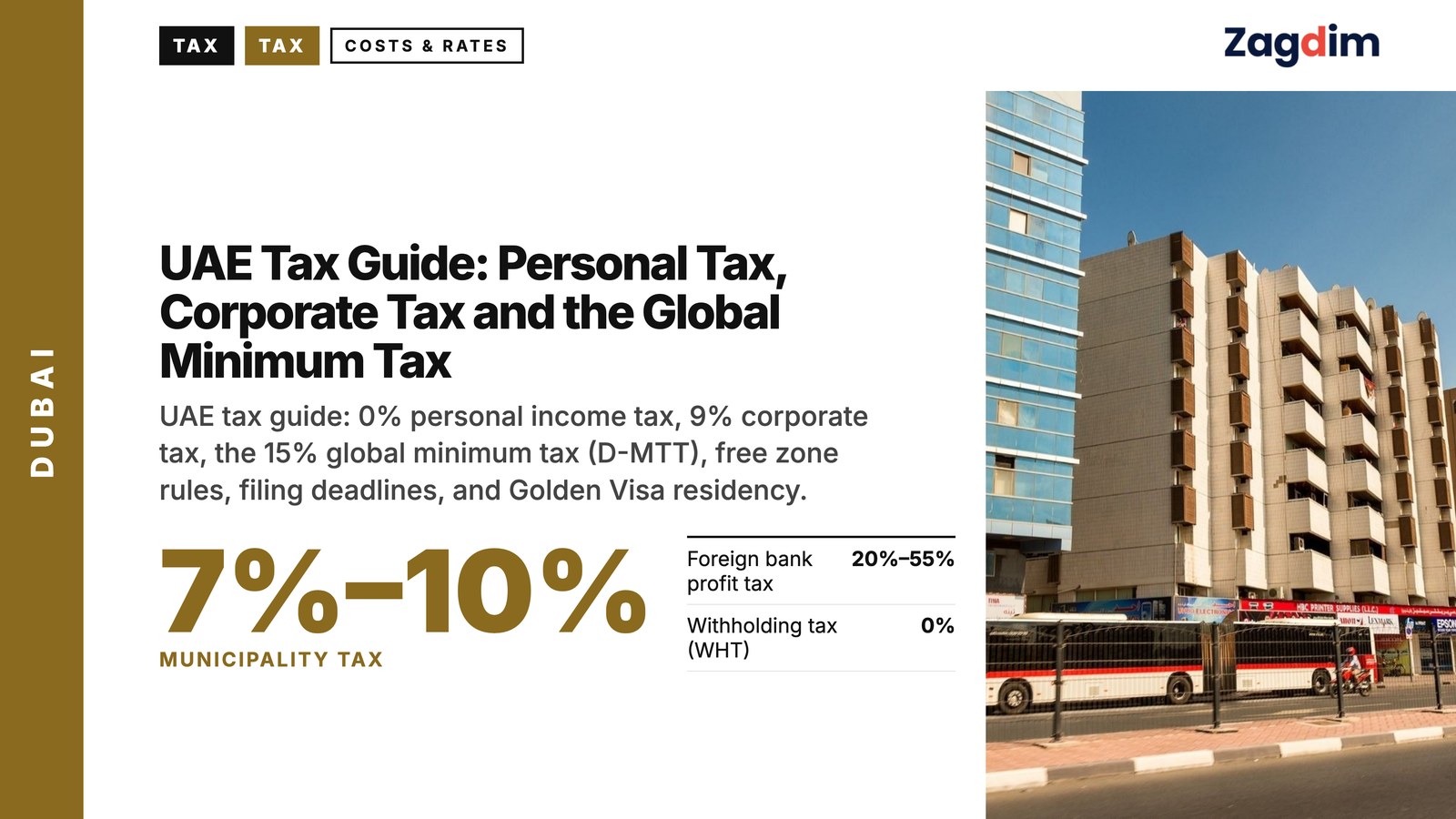
| Municipality tax | 7%–10% | Depends on the area and hotel category |
| Tourism Dirham | AED 7–20 per night | A flat fee depending on room type |
| Airbnb-style accommodation | Requires a Holiday Home license, and is taxed the same way |
Tip: if you buy property to run as a short-let, you also need to obtain the proper license, or you may face a penalty.
Part Two: Corporate Taxation — How 9% CIT and the 15% Global Minimum Tax Affect Your Company Structure
Since June 2023, the UAE has formally implemented the federal Corporate Income Tax (CIT), closing the chapter on the myth of “Dubai equals a tax-free haven.” While the first AED 375,000 of taxable profit still enjoys a 0% rate, the new tax law brings challenges that SMEs, freelancers and even multinational groups should not overlook. This section breaks down three key systems: CIT, D-MTT, and the free zone exception.
CIT (Corporate Income Tax) Overview: Does Your Company Need to File?
| Item | Details |
|---|---|
| Effective date | From June 2023 (timing depends on each company’s financial year) |
| Rate | 0% on taxable profit ≤ AED 375k; 9% on the amount above that |
| Filing deadline | File and pay within 9 months of the end of the financial year |
| Who it applies to | All companies in the UAE (local companies and sole proprietorships) |
| Related-party transactions | TP documentation must be prepared under OECD transfer pricing principles |
Note on the individual threshold: even without forming a company, if your business activity (such as freelancing or contracting) reaches annual turnover > AED 1,000,000, you must still register and file.
D-MTT: Multinational Groups Face a “15% Global Minimum Tax” Top-Up From 2025
This is a system aimed at multinational groups with global revenue exceeding €750,000,000, formally called the Domestic Minimum Top-up Tax (D-MTT).
| Item | Details |
|---|---|
| Effective from | January 1, 2025 |
| Who it applies to | Groups meeting the global revenue threshold that have an operating entity in the UAE |
| Mechanism | If the effective tax rate is below 15%, the government can levy an additional top-up tax |
| Purpose | Aligns with the OECD’s Pillar Two reforms to prevent base erosion and profit shifting (BEPS) |
Note: this system directly challenges companies that enjoy 0% in a free zone — if the entity is part of a multinational group, even if the main entity is in a free zone, it must still calculate its effective tax rate and pay any top-up owed.
Free Zone and DIFC Companies: 0% Still Applies, But With Stricter Conditions
While many companies register in a free zone (such as DMCC, JAFZA or DIFC) to benefit from a “0% income tax” rate, the new rules require meeting the following conditions:
| Income type | 0% CIT | 9% CIT | Note |
|---|---|---|---|
| Free zone → overseas customer (export) | Yes | No | Qualifying income, eligible for 0% |
| Free zone → rest of the UAE | No | Yes | Non-qualifying income, subject to 9% |
| DIFC financial services income | Yes (if conditions are met) | No | Requires approval and submission of a qualifying substance report |
Compliance note: free zone companies were required to re-register their “0% qualifying status” and submit an Economic Substance Report (ESR), or be treated as an ordinary company subject to 9% CIT.
Related Tax Items: VAT, Bank Tax and Withholding Tax
| Tax | Rate | When it applies |
|---|---|---|
| VAT | 5% | Annual turnover ≥ AED 375k; requires a TRN and regular filing |
| Foreign bank profit tax | 20%–55% | Applies as an additional regional tax on foreign banks operating in the emirates |
| Withholding tax (WHT) | 0% | No withholding on dividend, interest or royalty payments to non-residents |
VAT is an indirect tax, but late registration or incorrect filing can lead to substantial penalties — it’s advisable to apply for a Tax Registration Number (TRN) as soon as turnover approaches the threshold.
Compliance Calendar: Filing Deadlines and Penalty Risk by Tax Type
Whether you’re a newly arrived individual, a freelancer just starting out, or a business owner who has run a company for years, once you become subject to a UAE tax, you need to follow a specific set of filing deadlines and documentation processes.
The table below sets out the filing items and deadlines that were most relevant heading into the 2025 filing cycle (illustrated using the 2024 financial year), so you can see them at a glance and avoid missteps. As some of these dates are now in the past, use them as a guide to the recurring pattern (registration deadline, 9-month filing window, ESR timing) rather than the current year’s exact dates, and confirm this year’s deadlines with the FTA or an advisor.
| Action / item | Deadline (as originally published) | Note |
|---|---|---|
| Initial CIT registration | Before December 31, 2024 | Failing to register for a Tax Registration Number (TRN) by the deadline results in a AED 10,000 penalty |
| CIT filing (FY 2024) | September 30, 2025 | Filing and payment must be completed together — no extension |
| D-MTT formally effective | From January 1, 2025 | First filings were estimated for Q2 2026; it was recommended that internal effective-tax-rate modeling and TP documentation begin in 2025 |
| VAT filing | Quarterly or semi-annually depending on registration category | Filing errors or omissions can be self-corrected within 20 days; penalties stack after that |
| ESR (Economic Substance Report) submission | Within 6–12 months of financial year-end (depending on business type) | Applies to “controlled activities” of free zone and mainland companies (such as consulting or financial services) |
| TP documentation | No statutory filing deadline, but must be produced immediately on request during a review | Includes a Master File and a Local File; it was recommended that a full model be built with an accountant during the 2025 financial year |
Additional note: the UAE has significantly increased the digitization and automation of tax compliance enforcement in recent years. Missing a single filing can result in a company’s TRN being suspended, which can in turn affect banking services and the renewal of a business license.
Common Individual Misconceptions
| Common misconception | The correct understanding |
|---|---|
| “I haven’t set up a company, so I don’t need to file.” | Wrong. As long as your business activity (such as freelancing or side contracting) has turnover > AED 1 million, you must register for corporate tax |
| “A free zone company is always 0% CIT.” | Wrong. Non-qualifying income (such as sales to the UAE mainland) is still taxed at 9% |
| “A free zone company doesn’t need to worry about transfer pricing.” | Wrong. Any company transacting with a related party must maintain TP documentation and price transactions on an arm’s-length basis |
| “VAT and CIT share the same registration number.” | Wrong. VAT and CIT are registered separately, each with its own threshold and filing method |
Note: from the first year a company is set up, it’s worth establishing a filing and bookkeeping schedule — particularly if you receive payments through an offshore account, earn cryptocurrency income, or move funds from an overseas parent company, it’s advisable to work with a professional accountant to build an audit and filing strategy.
Golden Visa and Residency Routes
The UAE’s Golden Visa is one of the main long-term residency routes tied to the investment and business activity discussed above, and it comes with several paths, each requiring its own proof of investment and financial background:
- Public investment: a minimum capital of AED 2,000,000.
- Real estate investment: property valued at at least USD 545,000.
- Entrepreneurship: a business project valued at at least AED 500,000.
The Golden Visa can offer a residency permit of 5 to 10 years, and is well suited to investors and wealth managers who intend to reside in the UAE long term and make use of its tax advantages. A standard work visa, by contrast, generally requires employer sponsorship and restricts the visa holder’s scope of activity in the country — this remains the most common route for expat professionals.
Documents typically required for these applications include:
- Identification: a passport valid for at least 6 more months; a birth certificate in some cases (such as a Golden Visa application including family members); proof of current address if relocating from another country.
- Financial background: bank statements showing a balance meeting the minimum required for the relevant visa or investment route; proof of income (recent payslips, an employer income letter, or tax documents); financial statements or proof of assets for real estate or other high-value investments.
- Investment proof: a signed property purchase contract for a Golden Visa or similar program; an investment contract or other proof for other investment routes; in some cases, proof of investment return or growth potential, particularly for those setting up a company or business activity.
- Health and background checks: a health check report (a general physical exam and screening for infectious diseases such as tuberculosis or HIV, per UAE immigration requirements — some visa types, including the Golden Visa, may require a more detailed check); a police clearance certificate for longer-term residency and the Golden Visa, generally obtained from the applicant’s home country or local police authority.
Processing time for a Golden Visa is generally 1 to 2 months; other work visas or residency permits can sometimes be processed faster. Certain investment types, such as real estate, may require an additional financial background review, so it’s advisable to prepare documentation well ahead of time.
Strategy Summary: How to Structure Your UAE Tax Position
From 0% wage tax to a 15% global minimum tax, how should you structure your own Middle East presence? By this point it should be clear that the UAE’s status as a tax haven is still appealing, but three key shifts have emerged:
- First, “side-business income” at the individual level is increasingly being brought within the scope of CIT monitoring.
- Second, “0% in a free zone” at the company level now faces D-MTT exposure and tax risk on non-qualifying income.
- Third, every company needs to address transfer pricing and ESR requirements — no one is exempt.
This means the real advantage is no longer “avoiding tax,” but “legally and intelligently minimizing tax through smart structuring.” Below is a strategy summary for different situations:
Individuals, Relocators and Side-Business Operators: Three Key Actions
| Strategy direction | Recommendation |
|---|---|
| Tax-efficient structure | Legally earn 0%-taxed wage income as an individual; if running a side business, try to keep turnover under AED 1 million, or route contracting income through a free zone SPV |
| Asset allocation | Hold multiple currency accounts (such as AED, USD and other major currencies) to reduce currency risk, and avoid concentrating funds in an account governed by a single jurisdiction’s rules alone |
| Property investment | Buying property remains tax-attractive (0% rental and capital gains tax), but factor in the one-time 4% DLD transfer fee and 5% housing fee; a short-let business requires a license and filing |
Freelancers and Micro-Business Founders: Upgrading Step by Step From Bookkeeping to Tax
| Area | Recommendation |
|---|---|
| Early stage | Set up in a suitable free zone (such as IFZA, Meydan or RAKEZ) based on business needs, and open a company account and lease an office address as required |
| Invoicing | Use accounting software (such as Zoho Books or Xero) to issue formal invoices that meet CIT and VAT requirements |
| Setting aside tax | Set aside an amount equal to estimated profit above AED 375k × 9%; from 2025 it was recommended to set up a dedicated tax reserve account |
Mid-Size and Larger Companies, International Groups: Start D-MTT 15% Stress-Testing Early
| Required action | Reason and impact |
|---|---|
| Build TP documentation (Master File + Local File) | Needed for CIT and D-MTT review, to avoid back taxes and penalties |
| Model the effective tax rate | If the group’s global revenue is ≥ €750M, model immediately whether the UAE would levy a top-up tax |
| Reassess free zone subsidiary location and income sources | If a large share of income is non-qualifying, some departments may need to relocate or restructure payment flows |
| Integrate ESR reporting into internal controls | Avoid scrambling to prepare it only at audit time — ESR is a key area of tax review risk |
Looking Ahead: Where Might the UAE’s Tax System Tighten Next?
| Potential reform direction | Indicator to watch |
|---|---|
| A minimum wage system and a personal tax threshold | If social welfare policy is strengthened, an OECD-style “income threshold plus simplified filing” system could be introduced |
| Real estate capital gains tax (CGT) | If the property market overheats, short-term transactions or non-owner-occupied holdings could be taxed |
| Global CRS asset reporting links | Related to greater transparency of personal bank accounts and fund flows, particularly among countries that have implemented the OECD’s Automatic Exchange of Information (AEOI) |
FAQ
Does the UAE really have no personal income tax?
Yes, the UAE does not tax personal income, meaning expats working there can keep their full wage income. However, the UAE does levy corporate income tax and VAT, which remain the main tax burden for businesses and consumers.
Do I need to pay social insurance if I work in the UAE?
Expats generally do not need to pay social insurance, as the UAE does not mandate it for foreign workers. However, certain circumstances (such as working for some government departments or in specific industries) may carry a social insurance requirement — it’s advisable to confirm the specific arrangement with your employer.
Can I buy property in the UAE and still benefit from tax exemptions?
Yes, the UAE offers tax advantages to property buyers, particularly in Dubai and Abu Dhabi, including exemption from personal income tax, capital gains tax and inheritance tax on the property. However, buyers still pay transfer fees, registration fees and, in some areas, an annual housing-related fee, as detailed above. These exemptions are part of why the UAE remains a popular investment destination, especially for investment property.
How does UAE tax policy affect families?
The tax exemptions mean families living in the UAE can benefit from lower living costs, particularly through the absence of income tax, easing the household financial burden. That said, families still need to budget for other living costs, such as education and healthcare, which can be relatively high in the UAE, so expat families should plan their finances accordingly.
Have a question about this guide? Leave a comment below, or ask Zagdim directly.
Your first stop for international property and global living.
Research and insights. Know what’s changing. Understand what matters.
Sources
- Ministry of Finance – *The Ministry of Finance Announces the Introduction of a Corporate Tax in the UAE*
- DLA Piper – *UAE Introduces Federal Corporate Income Tax from June 2023*
- Immigrant Invest – *UAE Golden Visa for US Citizens*
- KPMG – *Doing Business in the UAE 2024*
- PwC – *Taxes on Corporate Income in the UAE*
Disclaimer
This article is a general information summary and does not constitute legal, financial or other professional advice. It draws on official provisions and reports from major accounting and advisory firms, compiled in 2025; some figures and deadlines are illustrative examples originally tied to the 2024–2025 filing cycle. Tax rates, thresholds and filing deadlines change and should be confirmed against the latest official announcements from the UAE Ministry of Finance and the Federal Tax Authority (FTA), or with a professional advisor.