
































Hello everyone. It is always interesting to see how differently people in Germany and in Asia think about what a house or apartment should be. This affects the interior and exterior of the home in many ways. There are many reasons for this, and this article discusses the topic.
Germany Keeps a Low Profile
Most Germans prefer to keep a low profile, and generally do not display success or wealth. It is more common for others to feel resentment or envy toward wealthy households than to feel happy for them — a very different mindset from Asia, where success and wealth are often meant to be shown. As a result, homes belonging to wealthy German families tend to be understated, or simply not visible from the street. Houses and apartments carry no nameplates either. Entrances are kept low-key, and the house is often painted the same color as its surroundings.
Practicality Comes First
At the same time, Germans like their homes to be practical. A private car needs a garage or carport, and bicycles need storage too. Houses and apartments also have a separate storage room for household items or other belongings. Building regulations set out clearly how large windows must be, and how large a child’s room or bedroom must be. You will also need sun protection, and to decide what kind of heating system the house or apartment should have. Air conditioning and cooling systems are not common for now, though this is likely to change after recent very hot summers — but any such system would be integrated with the heating.
Energy Efficiency
For autumn, winter and spring in Germany, you need heating for at least half the year — sometimes longer — and one of the most fundamental things in Germany is saving on energy costs. As a result, homes are extremely well insulated, and windows now commonly have five layers of glass. This seals the house or apartment tightly, so that no energy is lost. This is known by the term “energy efficiency,” which is very popular in Germany. But high energy efficiency also means the home needs good ventilation, otherwise it can quickly develop mold. Finding the right balance between high energy efficiency and good ventilation is quite complex.
Interior Details
The floor plan of a German house or apartment differs from an Asian one. The entrance usually has its own hall or hallway where you can leave your coat and shoes. Taking your shoes off is not compulsory in Germany — it depends on how the homeowner feels about it. From the hall or hallway you then move on to the other rooms; an entrance opening directly into the kitchen or living room is unusual. The kitchen is an important space in a German house or apartment, and is often connected to the living room. German houses and apartments do not come with a fitted kitchen included — owners or tenants fit out their own kitchen, since personal taste varies widely.
Furniture works the same way. Germans have their own furniture, and can take all of it with them however they move. Very few Germans leave furniture behind in their old house or apartment.
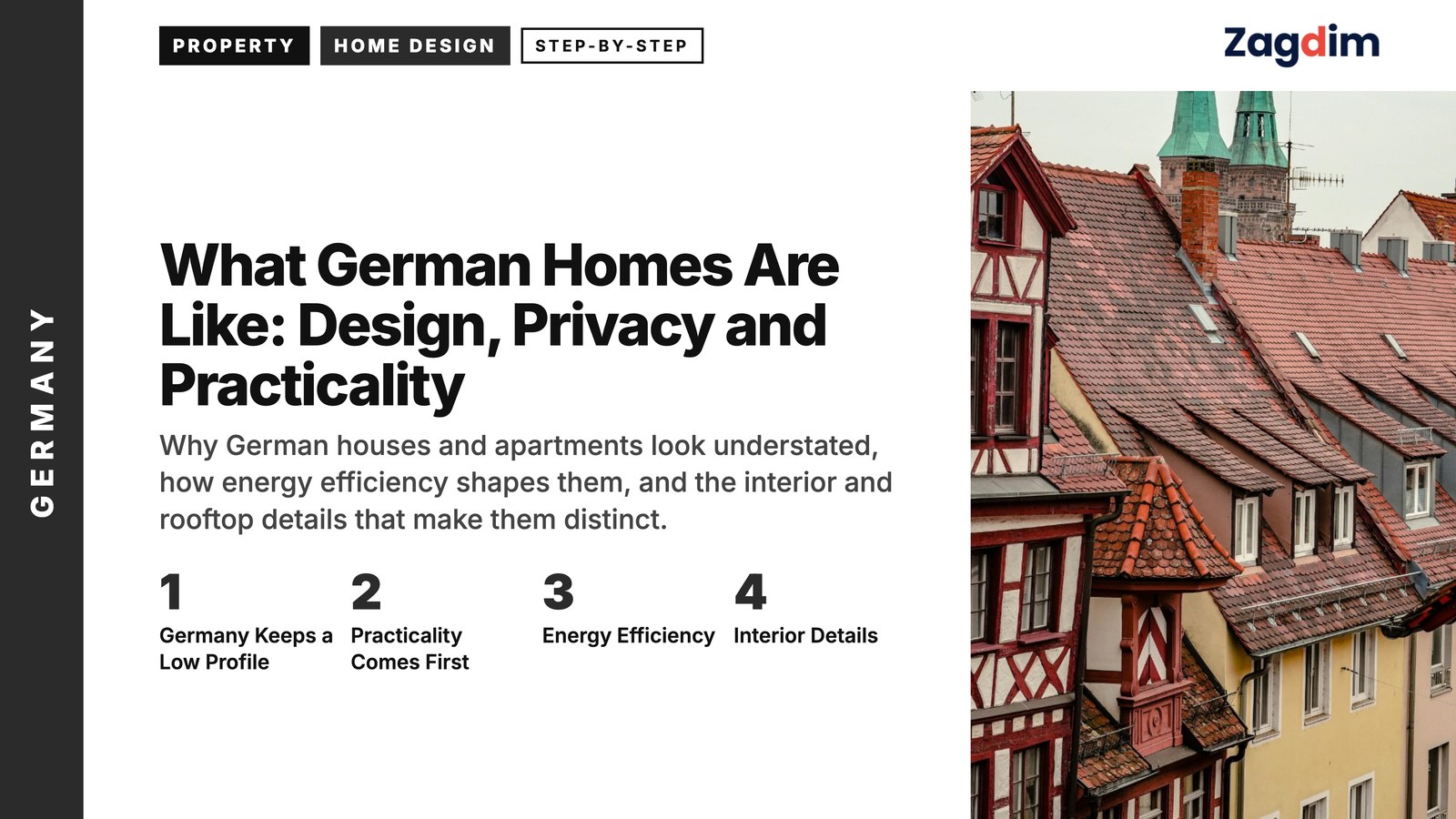
Germans like spacious rooms. You will also find large balconies or small gardens, whether the house or apartment is in the city or outside it. In Germany you will find the typical pitched roof — rain and snow are a given. Sometimes you will find a single-pitched roof, where rain and snow simply slide off. As a rule, owners can usually choose the color of their roof freely, though some counties impose strict rules on this. The height of a house or apartment is also regulated. There is an old rule that a house must not be taller than the local church spire or the tallest building in town — which is exactly why you will not find any skyscrapers outside the big cities.
If you visit German houses or apartments, you will find many more details and differences. But the most important point is this: German and Asian taste differ, for reasons that are understandable once you see the logic behind them.
Have a question about this guide? Leave a comment below, or ask Zagdim directly.
Your first stop for international property and global living.
Research and insights. Know what’s changing. Understand what matters.