































Zagdim Overseas
Subscribe
  • Home
  • Real Estate & Economic News
    • All
    • Japan Market News
    • Other Market News
    • Thailand Market News
    • UK Market News
    • Vietnam Market News
    Prime London Rental Values Jump 67% as Supply Contracts

    Prime London Rental Values Rise 67% as Supply Contracts

    Portugal's One-Bed Rent Now Tops the Minimum Wage

    One-Bedroom Flat Rent in Portugal Now Costs More Than Minimum Wage

    Dubai Rents Fall Up to 15% as Tenants Switch to New Leases

    Dubai Tenants Switch Homes as New-Lease Rents Fall Up to 15%

    Ras Al Khaimah waterfront apartments and palm promenade aerial view

    Ras Al Khaimah Apartment Prices Rise 18% in H1 2026 as Record Hotel Guest Numbers Land

    Halifax Harbour sunset skyline

    Canada Sets 90-Day Deadline for Atlantic Immigration Applicants Facing Employment Changes

    Sydney CBD night skyline

    Australia’s Capital Gains Tax Reform Takes Effect July 2027 — Why a Valuation Now Could Matter

    Trending Tags

  • Zagdim Insights
    • All
    • Market Trends Overview
    • Policy Interpretation
    • Zagdim Insights
    Automated immigration gates at Suvarnabhumi Airport

    Thailand’s Suvarnabhumi Auto Gates Expand to 33 Nationalities: Full List, Eligibility and TDAC Guide

    1960 archive photo of Queen Sirikit at a gala concert in The Hague, with Bank of Thailand specimens of the THB100 and THB500 commemorative notes

    Thailand’s commemorative banknotes return in October: where to exchange the THB100 and THB500 notes

    A document-style cover showing the Thai Revenue Department’s 15 September 2026 GloBE MCAA announcement with the subject line highlighted.

    Thailand joins the global minimum tax information exchange: which businesses need to pay attention, and are individuals affected?

    A 2025 file photo of Australian Home Affairs Minister Tony Burke at a meeting, alongside Zagdim’s analysis title on Australia’s migration reforms.

    Australia announces migration reforms targeting student families, visa switching and longer stays

    China’s Entry-Exit Agency Rules: What Your Business Needs to Prepare. Paper folders labelled Deadlines, Documents and Partners, with a calendar, Chinese gateway and flight route. AI-generated illustration.

    China’s New Entry-Exit Agency Rules: What Your Business Needs to Prepare

    Three UK New-Build Thresholds for 2026: The Building Safety Levy, Second Staircases and the New EPC

    Zagdim Research cover: investigator setting up cameras in an empty Japanese apartment - Japan Prices Death Into Its Housing Market, and Buyers Have Begun to Bite

    Japan Prices Death Into Its Housing Market — and Buyers Have Begun to Bite

    Thailand to Cancel 60-Day Visa Exemption: What Long-Stay Options Are Available for Foreigners?

    Thailand to Cancel 60-Day Visa Exemption: What Long-Stay Options Are Available for Foreigners?

    Thailand Cabinet Approves Cancellation of 60-Day Visa Exemption for 93 Countries; Official Effective Date Still Pending Royal Gazette Publication

    Thailand Cabinet Approves Cancellation of 60-Day Visa Exemption for 93 Countries; Official Effective Date Still Pending Royal Gazette Publication

    • Zagdim Insights
    • Market Trends Overview
    • Policy Interpretation
  • Global Reports
    Zagdim Featured CBRE Thailand Mid-Year Outlook 2026

    CBRE Thailand Mid-Year Outlook: What Is Changing Across Six Real Estate Sectors?

    More Firms, a Busier First Half, a Softer Q2: What Vietnam’s Property Data Show, and Where ‘Repositioning’ Is a Reading

    More Firms, a Busier First Half, a Softer Q2: What Vietnam’s Property Data Show, and Where ‘Repositioning’ Is a Reading

    The Headline Number and the Real One: Reading UK Home Values After Inflation

    The Headline Number and the Real One: Reading UK Home Values After Inflation

    Tokyo’s Property Boom: How to Read AMRO’s ‘Warning, Not a Crisis’

    Tokyo’s Property Boom: How to Read AMRO’s ‘Warning, Not a Crisis’

    A Soft Summer for US Housing: What the Data Show, and Where ‘Hurting’ Is CNBC’s Word

    A Soft Summer for US Housing: What the Data Show, and Where ‘Hurting’ Is CNBC’s Word

    Malaysia’s Property Market Is Getting Choosier — What \”Selective\” Does and Doesn’t Say

    Malaysia’s Property Market Is Getting Choosier — What \”Selective\” Does and Doesn’t Say

    72% at the Top: What Mainland Buyer-Share Data Say About Hong Kong Property — and What They Don’t

    72% at the Top: What Mainland Buyer-Share Data Say About Hong Kong Property — and What They Don’t

    Hong Kong Home Prices Are Up ~10% This Year — but Can the Rebound Last Without Local Owners?

    Hong Kong Home Prices Are Up ~10% This Year — but Can the Rebound Last Without Local Owners?

    193 Deals in Dubai, 94 in Hong Kong: Reading a Super-Prime Quarter Without Calling It a Cycle

    193 Deals in Dubai, 94 in Hong Kong: Reading a Super-Prime Quarter Without Calling It a Cycle

  • Buying & Immigration Guide
    • All
    • Expat Lifestyle Guide
    • International Property Buying Guide
    • Overseas Leasing & Long-Term Stay
    • Real Estate Law & Taxation
    • Relocation, Immigration & Visa
    Five things a first-time overseas buyer must settle before buying in London: entry (SDLT and the two surcharges), financing (interest relief capped at 20%), holding (NRLS and letting compliance), title (leasehold and building safety), exit (NRCGT and your treaty position)

    Is London property worth buying? Five things a first-time overseas buyer must settle first

    Japan’s Revised Condominium Ownership Act (2026): What Overseas Owners Need to Know About Voting Rights, Resolutions, and the New Domestic Manager Requirement

    Japan’s Revised Condominium Ownership Act (2026): What Overseas Owners Need to Know About Voting Rights, Resolutions, and the New Domestic Manager Requirement

    Before You Buy Property in Vietnam: Eligible Assets, Prohibited Categories, and How Land Rights Actually Work for Overseas Buyers

    Before You Buy Property in Vietnam: Eligible Assets, Prohibited Categories, and How Land Rights Actually Work for Overseas Buyers

    Buying Property in London: Key Risks to Check Before You Exchange — Leasehold, Service Charges, Off-Plan Deposits, and Contracts

    Buying Property in London: Key Risks to Check Before You Exchange — Leasehold, Service Charges, Off-Plan Deposits, and Contracts

    Opening a UK Bank Account as an Overseas Resident: Identity, Address, and What to Check Before You Apply

    Opening a UK Bank Account as an Overseas Resident: Identity, Address, and What to Check Before You Apply

    UK Residential Mortgage Readiness for Overseas Buyers: What Lenders Check on Income, Status, and Deposit

    UK Residential Mortgage Readiness for Overseas Buyers: What Lenders Check on Income, Status, and Deposit

    How should overseas owners manage and rent out property in Japan after purchase?

    How should overseas owners manage and rent out property in Japan after purchase?

    The retirees who no longer want to renew their Thai visa every year

    The retirees who no longer want to renew their Thai visa every year

    Same retirement age, different Thailand residence choices: Retirement O, LTR, and Thailand Privilege

    Same retirement age, different Thailand residence choices: Retirement O, LTR, and Thailand Privilege

    Trending Tags

  • About
    • Ask Questions
    • Zagdim Research
    • Contact Us — LINE / WhatsApp
  • 中文 EN
No Result
View All Result
Zagdim
  • Home
  • Real Estate & Economic News
    • All
    • Japan Market News
    • Other Market News
    • Thailand Market News
    • UK Market News
    • Vietnam Market News
    Prime London Rental Values Jump 67% as Supply Contracts

    Prime London Rental Values Rise 67% as Supply Contracts

    Portugal's One-Bed Rent Now Tops the Minimum Wage

    One-Bedroom Flat Rent in Portugal Now Costs More Than Minimum Wage

    Dubai Rents Fall Up to 15% as Tenants Switch to New Leases

    Dubai Tenants Switch Homes as New-Lease Rents Fall Up to 15%

    Ras Al Khaimah waterfront apartments and palm promenade aerial view

    Ras Al Khaimah Apartment Prices Rise 18% in H1 2026 as Record Hotel Guest Numbers Land

    Halifax Harbour sunset skyline

    Canada Sets 90-Day Deadline for Atlantic Immigration Applicants Facing Employment Changes

    Sydney CBD night skyline

    Australia’s Capital Gains Tax Reform Takes Effect July 2027 — Why a Valuation Now Could Matter

    Trending Tags

  • Zagdim Insights
    • All
    • Market Trends Overview
    • Policy Interpretation
    • Zagdim Insights
    Automated immigration gates at Suvarnabhumi Airport

    Thailand’s Suvarnabhumi Auto Gates Expand to 33 Nationalities: Full List, Eligibility and TDAC Guide

    1960 archive photo of Queen Sirikit at a gala concert in The Hague, with Bank of Thailand specimens of the THB100 and THB500 commemorative notes

    Thailand’s commemorative banknotes return in October: where to exchange the THB100 and THB500 notes

    A document-style cover showing the Thai Revenue Department’s 15 September 2026 GloBE MCAA announcement with the subject line highlighted.

    Thailand joins the global minimum tax information exchange: which businesses need to pay attention, and are individuals affected?

    A 2025 file photo of Australian Home Affairs Minister Tony Burke at a meeting, alongside Zagdim’s analysis title on Australia’s migration reforms.

    Australia announces migration reforms targeting student families, visa switching and longer stays

    China’s Entry-Exit Agency Rules: What Your Business Needs to Prepare. Paper folders labelled Deadlines, Documents and Partners, with a calendar, Chinese gateway and flight route. AI-generated illustration.

    China’s New Entry-Exit Agency Rules: What Your Business Needs to Prepare

    Three UK New-Build Thresholds for 2026: The Building Safety Levy, Second Staircases and the New EPC

    Zagdim Research cover: investigator setting up cameras in an empty Japanese apartment - Japan Prices Death Into Its Housing Market, and Buyers Have Begun to Bite

    Japan Prices Death Into Its Housing Market — and Buyers Have Begun to Bite

    Thailand to Cancel 60-Day Visa Exemption: What Long-Stay Options Are Available for Foreigners?

    Thailand to Cancel 60-Day Visa Exemption: What Long-Stay Options Are Available for Foreigners?

    Thailand Cabinet Approves Cancellation of 60-Day Visa Exemption for 93 Countries; Official Effective Date Still Pending Royal Gazette Publication

    Thailand Cabinet Approves Cancellation of 60-Day Visa Exemption for 93 Countries; Official Effective Date Still Pending Royal Gazette Publication

    • Zagdim Insights
    • Market Trends Overview
    • Policy Interpretation
  • Global Reports
    Zagdim Featured CBRE Thailand Mid-Year Outlook 2026

    CBRE Thailand Mid-Year Outlook: What Is Changing Across Six Real Estate Sectors?

    More Firms, a Busier First Half, a Softer Q2: What Vietnam’s Property Data Show, and Where ‘Repositioning’ Is a Reading

    More Firms, a Busier First Half, a Softer Q2: What Vietnam’s Property Data Show, and Where ‘Repositioning’ Is a Reading

    The Headline Number and the Real One: Reading UK Home Values After Inflation

    The Headline Number and the Real One: Reading UK Home Values After Inflation

    Tokyo’s Property Boom: How to Read AMRO’s ‘Warning, Not a Crisis’

    Tokyo’s Property Boom: How to Read AMRO’s ‘Warning, Not a Crisis’

    A Soft Summer for US Housing: What the Data Show, and Where ‘Hurting’ Is CNBC’s Word

    A Soft Summer for US Housing: What the Data Show, and Where ‘Hurting’ Is CNBC’s Word

    Malaysia’s Property Market Is Getting Choosier — What \”Selective\” Does and Doesn’t Say

    Malaysia’s Property Market Is Getting Choosier — What \”Selective\” Does and Doesn’t Say

    72% at the Top: What Mainland Buyer-Share Data Say About Hong Kong Property — and What They Don’t

    72% at the Top: What Mainland Buyer-Share Data Say About Hong Kong Property — and What They Don’t

    Hong Kong Home Prices Are Up ~10% This Year — but Can the Rebound Last Without Local Owners?

    Hong Kong Home Prices Are Up ~10% This Year — but Can the Rebound Last Without Local Owners?

    193 Deals in Dubai, 94 in Hong Kong: Reading a Super-Prime Quarter Without Calling It a Cycle

    193 Deals in Dubai, 94 in Hong Kong: Reading a Super-Prime Quarter Without Calling It a Cycle

  • Buying & Immigration Guide
    • All
    • Expat Lifestyle Guide
    • International Property Buying Guide
    • Overseas Leasing & Long-Term Stay
    • Real Estate Law & Taxation
    • Relocation, Immigration & Visa
    Five things a first-time overseas buyer must settle before buying in London: entry (SDLT and the two surcharges), financing (interest relief capped at 20%), holding (NRLS and letting compliance), title (leasehold and building safety), exit (NRCGT and your treaty position)

    Is London property worth buying? Five things a first-time overseas buyer must settle first

    Japan’s Revised Condominium Ownership Act (2026): What Overseas Owners Need to Know About Voting Rights, Resolutions, and the New Domestic Manager Requirement

    Japan’s Revised Condominium Ownership Act (2026): What Overseas Owners Need to Know About Voting Rights, Resolutions, and the New Domestic Manager Requirement

    Before You Buy Property in Vietnam: Eligible Assets, Prohibited Categories, and How Land Rights Actually Work for Overseas Buyers

    Before You Buy Property in Vietnam: Eligible Assets, Prohibited Categories, and How Land Rights Actually Work for Overseas Buyers

    Buying Property in London: Key Risks to Check Before You Exchange — Leasehold, Service Charges, Off-Plan Deposits, and Contracts

    Buying Property in London: Key Risks to Check Before You Exchange — Leasehold, Service Charges, Off-Plan Deposits, and Contracts

    Opening a UK Bank Account as an Overseas Resident: Identity, Address, and What to Check Before You Apply

    Opening a UK Bank Account as an Overseas Resident: Identity, Address, and What to Check Before You Apply

    UK Residential Mortgage Readiness for Overseas Buyers: What Lenders Check on Income, Status, and Deposit

    UK Residential Mortgage Readiness for Overseas Buyers: What Lenders Check on Income, Status, and Deposit

    How should overseas owners manage and rent out property in Japan after purchase?

    How should overseas owners manage and rent out property in Japan after purchase?

    The retirees who no longer want to renew their Thai visa every year

    The retirees who no longer want to renew their Thai visa every year

    Same retirement age, different Thailand residence choices: Retirement O, LTR, and Thailand Privilege

    Same retirement age, different Thailand residence choices: Retirement O, LTR, and Thailand Privilege

    Trending Tags

  • About
    • Ask Questions
    • Zagdim Research
    • Contact Us — LINE / WhatsApp
  • 中文 EN
No Result
View All Result
Zagdim
No Result
View All Result

How to Buy Property in Germany: Process, Costs, and Taxes

Home Germany
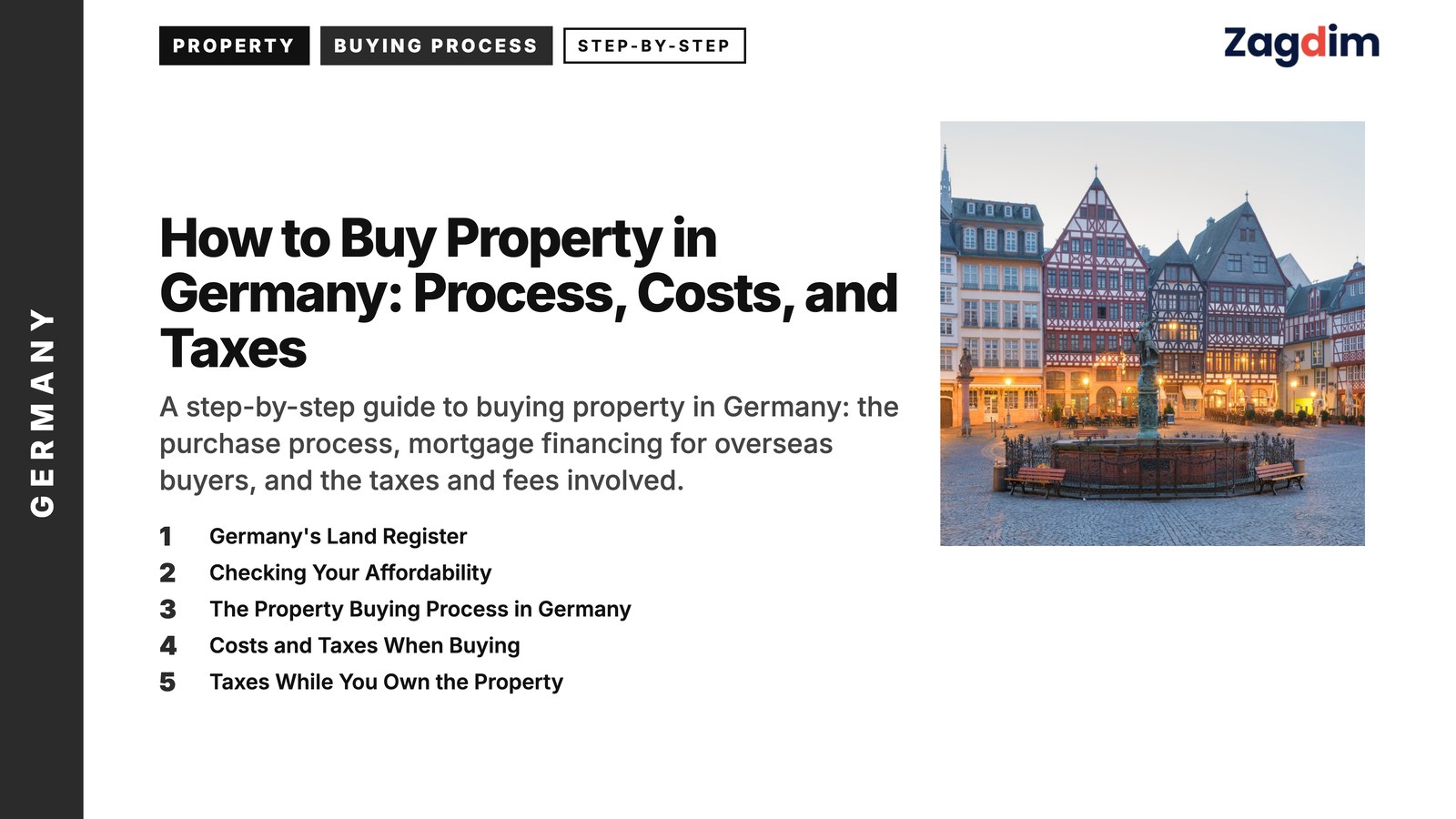
Architecture — Roemerberg square with half-timbered houses and fountain at dusk Frankfurt, illustrating How to Buy Property in Germany: Process, Costs, and Taxes

Image: Zagdim

September 25, 2026
in Germany
Reading Time: 10 mins read

In recent years, more and more international investors have started buying residential property in Germany, either as a long-term investment or in preparation for relocation. All of Germany’s major cities are going through a new wave of redevelopment, making the country a strong option for investors looking for stable long-term returns or a foothold in Europe. Berlin has become a rising star of the tech scene, home to offices for companies such as Uber, SoundCloud, and Twitter, which has drawn in talent from around the world. Frankfurt, meanwhile, is not only home to the European Central Bank but has also become a major European financial center. Foreign investors face virtually no restrictions on buying property in Germany, and there are few additional taxes or restrictions aimed specifically at overseas buyers. When you buy property in Germany, you receive full ownership of both the building and the land it stands on. Another key difference from many other markets is that the down payment requirement can be low: as long as you can show a bank proof of stable employment and income and a good credit history, it is even possible to apply for a mortgage with no down payment at all — the exact loan amount approved is at the bank’s discretion.

Germany’s Land Register

Germany’s land register (Grundbuch) records the legal status of every plot of land. It lists the current and past owners of the land, along with any rights held by third parties over it, such as encumbrances, easements, mortgages, and land charges. Entries in the land register are given a presumption of accuracy and are treated as legally reliable.

Checking Your Affordability

Most buyers in Germany start by using an online affordability calculator. By entering monthly income and the planned down payment budget, the tool automatically works out an approximate price range the buyer can afford, which then guides the property search.

The Property Buying Process in Germany

1. Property Selection and Reservation

Overseas investors typically select a property together with a real estate agent. To reserve a property, you will usually need a copy of the first page of your passport, plus your home address, phone number, and email address. Once the developer or seller confirms the reservation, a deposit is normally due within around three working days, though the exact timing depends on the developer and project.

Reservations in Germany generally work on a first-come, first-served basis. Signing a formal reservation agreement typically requires a reservation fee of 0.5%–1% of the total property price. Once the seller receives this fee, the property is taken off the open market. The reservation is usually valid for about 2–4 weeks, which gives the buyer time to arrange mortgage financing and other paperwork. If the buyer proceeds with the purchase, the reservation fee is deducted from the final payment; if the buyer withdraws, the fee is refunded in full.

2. Appointing a Lawyer

If the buyer does not speak German, or does not speak it well enough to follow the process, it is necessary to appoint a lawyer. The lawyer acts on the buyer’s behalf, reviewing and explaining the contract and supervising the purchase process from start to finish.

3. Mortgage Application (If Needed)

Depending on the project, buyers can typically borrow 50%–70% of the property’s value, with the exact amount depending on personal income. Income earned outside Germany can also be used as the basis for a mortgage application with a German bank; income and tax paid within Germany can support borrowing of up to 100%, with no additional fees for the loan itself.

Three key decisions need to be made when applying: how long to fix the interest rate for, the loan term, and how to secure the most favorable rate — since requirements differ by investor, it is worth seeking advice from a specialist. After an application is submitted, the bank typically takes 3–10 working days to review it, and may request additional supporting documents during that time. Once approved, the bank issues a formal loan contract, which the applicant generally needs to sign within about two weeks.

4. Drafting and Notarizing the Purchase Contract

The buying process in Germany is rigorous and transparent, overseen throughout by an independent third party: the notary’s office. The real estate agent notifies the notary’s office, which prepares a draft purchase contract and related documents and sends them by email to the buyer or the buyer’s lawyer.

The buyer has 14 days from receiving the first draft to review it and negotiate any changes with the other party. Once both sides agree on the contract, buyer and seller attend the notary’s office in person; the notary explains the entire document in German, and both parties then sign it there and then. Around 4–6 weeks after notarization, the notary sends the formally signed purchase contract to the buyer by both email and post; an electronic copy can also be provided for the buyer’s records.

5. Land Registry Change of Ownership

After buyer and seller sign at the notary’s office, the notary forwards the property documents to the local land registry (Grundbuch office), which first records a provisional transfer of the property. Once the buyer has paid 100% of the purchase price, the land registry completes the formal registration of the new ownership, and the buyer receives the property’s land register extract. This provisional registration is typically recorded around 4–6 weeks after notarization, and the whole process — from notarization to completed formal registration — usually takes 8–16 weeks in total.

6. Paying the Purchase Price and Other Costs

For off-plan (pre-construction) property, payment follows the construction schedule and is generally split into seven installments:

  • 30% of the price, due 6–8 weeks after notarization
  • 28% of the price, once the building’s basic structural shell is complete
  • 12.6% of the price, once the roof, drainage system, and windows are installed
  • 10.5% of the price, once the heating and plumbing systems, electrical wiring, and interior wall plastering are complete
  • 7% of the price, once flooring, bathroom tiling, and exterior finishing are complete
  • 8.4% of the price, once the property is ready for move-in
  • 3.5% of the price, once final finishing work is complete

(The exact terms vary by project and are set out in the contract.)

Separately from the purchase price itself, the buyer also needs to budget for other costs. A few days after signing, the buyer typically receives an invoice from the agent for their fee or commission — for example, in Berlin this is commonly around 3.57% of the purchase price. A notary fee of roughly 1.5% of the purchase price is generally due a few weeks after signing. The bill for the property transaction tax typically follows 6–10 weeks after signing.

As for the remaining balance of the purchase price itself: this is generally due 6–8 weeks after notarization. If the buyer has already arranged a mortgage, only the down payment specified in the mortgage contract needs to be paid at this point; if no mortgage was arranged, the full remaining balance must be transferred to the seller. Buyer and seller also agree on a handover date, and the buyer must have paid the full price before that date.

7. Real Estate Transfer Tax (RETT)

As noted above, around 6–10 weeks after signing the buyer receives a tax bill from the tax office, which must be paid within 4 weeks of receipt. The tax is set by the government and varies by region, generally running at around 3.5%–6.5% of the purchase price. Once the tax office confirms payment has been received, it notifies the land registry so that final registration can proceed.

8. Paying the Land Registration Fee

Finally, the buyer pays a land registration fee of 0.5%–1.5% of the transaction price. Once this is confirmed, the land registry formally records the change of ownership, the buyer’s name appears on the relevant land registration documents, and the transaction is complete.

9. Final Inspection and Handover

For off-plan purchases, the developer generally invites the buyer for a final inspection shortly before the last installment is due. If the buyer identifies any defects, these are reported to the developer immediately and repaired before a further inspection. Once the buyer is satisfied and has paid the final installment, the developer hands over the keys. New homes in Germany are typically delivered fully finished and come with a 5-year warranty.

Costs and Taxes When Buying

Fee / Tax Rate
Notary fees About 2% of the purchase price
Real estate agent commission 3%–6% of the purchase price
Real estate transfer tax (Grunderwerbsteuer) Varies by state, historically about 3.5% (e.g. Bavaria) to 6.5%; several states have raised their rate in recent years (e.g. Saxony and Hamburg to around 5% since 2023, Thuringia to around 5% since 2024) — confirm the current rate for the specific state directly with that state’s finance ministry before publication

Taxes While You Own the Property

Fee / Tax Rate
Property tax assessment rate Applies to multi-family housing and owner-occupied apartments; approximately 0.35
Rental income tax All income in Germany must be declared. The tax due on rental income depends on the taxpayer’s overall income and is calculated after deductions such as property depreciation, mortgage interest, land tax, and property management fees. It is usually not very high — typically ranging from tens to a few hundred euros
Land tax (Grundsteuer) Not linked to income; the rate is set locally and controlled by each municipality. It depends on the size of the property, its value, and the value of the land. Rate range: 3‰ to 10‰

Taxes When Selling

If the resale price is lower than the original purchase price, the owner does not need to pay income tax on the sale. For property bought in a personal capacity and held for more than 10 years, no profit tax is due on resale. If the property is resold within 10 years, the profit is added to the seller’s taxable income and taxed at their progressive personal income tax rate (roughly 14%-45% depending on income), not a flat ~15%. Selling more than 3 properties within a 5-year period generally triggers reclassification as commercial property trading (gewerblicher Grundstückshandel, the “three-object rule” / Drei-Objekt-Grenze); the profit is then taxed as business income at the seller’s progressive personal income tax rate plus trade tax (Gewerbesteuer), not a flat 25% capital gains rate. Recommend consulting a German tax advisor to confirm the classification for a specific case. If the property being sold was rented out, a 25% capital gains tax applies based on the rental income.

Other Taxes and Fees

Fee / Tax Rate
VAT Standard German property purchases are exempt from VAT — real estate transfer tax (Grunderwerbsteuer) applies instead, under §4 No. 9 of the VAT Act (UStG). A 19% VAT charge on the purchase price would only arise in rare commercial cases where the seller opts to waive the exemption
Real estate transfer tax (Grunderwerbsteuer) Varies by state, historically about 3.5% (e.g. Bavaria) to 6.5%; several states have raised their rate in recent years (e.g. Saxony and Hamburg to around 5% since 2023, Thuringia to around 5% since 2024) — confirm the current rate for the specific state directly with that state’s finance ministry before publication
Personal income tax (non-EU residents) At least 15%; the rate for non-German citizens is 25%. Paid quarterly, based on the individual’s tax return from the previous year
Capital gains tax If the property is held for less than 10 years, the gain is treated as reinvested into the property. If held for more than 10 years, no capital gains tax is due. The rate range is the same as personal income tax
Inheritance tax Each heir is entitled to a tax-free allowance — for example, EUR 500,000 for a spouse and EUR 400,000 for children. Once the allowance is used up, the remaining value of the estate is taxed at different rates: 7%–30% for spouses and children depending on the amount, while for other relatives such as siblings the allowance is only EUR 20,000 and the rate can be as high as 15%–43%

How Overseas Investors Can Apply for a German Mortgage

Step 1: Find a Suitable Loan Plan

Once investors have signed the purchase contract for a German property, they can apply for a local mortgage, but should compare interest rates across different banks and lenders when looking for a suitable plan.

  • Understand Germany’s lending limits. German lenders factor in a property’s future appreciation potential and set a loan-to-value (LTV) limit accordingly. German banks tend to be conservative when underwriting mortgages, and the valuation they use is generally lower than the market price. Based on the property’s assessed value and the borrower’s fixed income, the maximum loan is typically around 70%.
  • Fixed or floating rate? Borrowers in Germany can choose between fixed- and floating-rate mortgages, and rates vary between lenders.
  • Prepare proof of income. Investors who prepare relevant documents in advance can avoid delays — this matters especially for self-employed applicants, who often find it harder to provide standard proof of income.

Step 2: Choose a Lender

Overseas investors can identify potential lending banks in advance, though overseas buyers may not always qualify for the most favorable rates available to local borrowers, since some loan programs are lender-specific. A professional real estate agent can simplify the loan application process and help identify the most suitable option.

Step 3: Submit Documents to the Real Estate Agent

The agent will advise the investor what documents to submit and when, based on the lender’s requirements. This typically includes identity documents such as a passport and two years of proof of address.

On the financial side, investors need to provide proof of income and complete a personal declaration form. Self-employed applicants generally need to provide balance sheets for the past two years and their most recent tax return. Investors also need to provide documents demonstrating their ability to service the loan, typically in the form of bank statements.

Additional information is also required about the property itself, such as its location, size, and expected completion date.

Step 4: Obtain a SCHUFA Report

Lenders generally require borrowers to provide a SCHUFA report — a credit risk score from Germany’s loan and credit data registry — as part of the loan review. Since overseas buyers rarely have a German credit history, the real estate agent will typically know exactly which alternative documents are needed to verify creditworthiness. If an investor’s home country has no credit rating agency (the UAE is one example), bank loan statements and account records can be submitted instead.

Step 5: Appoint a Lawyer

Once an investor has chosen a property, they can begin the purchase process — but under German law, all property transactions must go through a professional lawyer. The appointed lawyer issues a power of attorney to the investor, who can then take the power of attorney, the loan application form, and other supporting documents to the German consulate in their home country to sign, before sending the original power of attorney to the lawyer by registered mail.

Step 6: Submit the German Loan Application Form

Besides the power of attorney, investors also need to submit the German loan application form. Once received, the loan broker reviews the application before forwarding it to the lender, and follows up with the lender to confirm the application has been received and that the review process is proceeding smoothly.

Step 7: Lender Review

The review process usually takes one to two weeks. During this time, the appointed lawyer carries out due diligence on the purchase contract, while the broker confirms that the investment, funding required, and the investor’s financial position meet the lender’s requirements. If the investor has prepared everything in advance, approval tends to be quick and straightforward.

Step 8: Loan Approval

Once the lender approves the loan amount, the appointed lawyer completes their review of the contract and then contacts the investor to proceed.

If you are considering buying property in Germany and want guidance on the process, ask Zagdim.

Related in this series:

  • The Real Cost of Buying Property in Germany: Transfer Tax, Fees, and Commissions
  • Owning Rental Property in Germany: Taxes and Running Costs

Have a question about this guide? Leave a comment below, or ask Zagdim directly.

Life abroad? Ask Zagdim.

Your first stop for international property and global living.

Research and insights. Know what’s changing. Understand what matters.

Zagdim AI
All content is researched, written, or authorized for publication by the @Zagdim Overseas team. Sharing and reposting are welcome, but please make sure to credit the source and include the original article link from this website. Any plagiarism or unauthorized use may result in legal action. For article submissions, please contact us via Facebook. Thank you for your support!

For article submissions, press release publication, or interview notices, please contact [email protected]. 

Zagdim Ask

Have a specific question about overseas living, property, visa, or practical arrangements?

Fill in your situation and key concerns through Zagdim Ask. Our team will review your message and get back to you by email where appropriate.

Submit your enquiry →

Similar Topics

Architecture — Roemerberg square with half-timbered houses and fountain at dusk Frankfurt, illustrating How to Buy Property in Germany: Process, Costs, and Taxes
Germany

How to Buy Property in Germany: Process, Costs, and Taxes

September 25, 2026
Landmark — Neuschwanstein Castle at sunset overlooking green valley, illustrating A Landlord's Checklist for Letting Property in Germany
Germany

A Landlord’s Checklist for Letting Property in Germany

September 25, 2026
Landmark — Neuschwanstein Castle among forested hills and mountains, illustrating Maintenance and Repairs in German Rentals: Landlord vs. Tenant Duties
Germany

Maintenance and Repairs in German Rentals: Landlord vs. Tenant Duties

September 25, 2026
Facebook Twitter Youtube

About Us

Zagdim is a global knowledge platform focused on cross-border property, relocation, lifestyle, and location-based decision-making.

We provide insights on overseas real estate, market trends, regional analysis, economic developments, and practical relocation information. Through continuous market observation and on-the-ground research, Zagdim helps readers better understand a place before deciding where to live, invest, buy property, or establish a base abroad.

We currently follow markets including the UK, Japan, Thailand, Malaysia, Germany, Australia, the UAE, Greece, Portugal, and Spain, while continuing to track emerging lifestyle, relocation, and property trends worldwide.

Category

  • Australia
  • Buying & Immigration Guide
  • Canada
  • Costa Rica
  • Dubai
  • Encyclopedia
  • Europe
  • Expat Lifestyle Guide
  • Germany
  • Global Reports Analysis
  • Hong Kong
  • Human-Picked
  • International Property Buying Guide
  • Japan
  • Japan Market News
  • Kenya
  • Living Abroad
  • Malaysia
  • Mallorca
  • Market Trends Overview
  • News
  • Other Market News
  • Overseas Leasing & Long-Term Stay
  • Philippines
  • Policy Interpretation
  • Portugal
  • Property
  • Property Law & Tax
  • Real Estate & Economic News
  • Real Estate Law & Taxation
  • Relocation, Immigration & Visa
  • Singapore
  • South Korea
  • Spain
  • Switzerland
  • Thailand
  • Thailand Market News
  • UK Market News
  • United Kingdom
  • United States
  • Vietnam Market News
  • Visa & Immigration
  • Zagdim Insights
  • Zagdim Property Insights

Email:[email protected]


Add Friends


WhatsApp
Contact Us


Wechat:Zagdim

Work with Zagdim

Put your brand inside the overseas property research process — in English and in Chinese. Reaching buyers, expats and investors across 19 markets.

View partnership packages →

©2026 Zagdim Overseas All Right Reserved

No Result
View All Result
  • Home
  • Zagdim Property Insights
    • Market Trends Overview
    • Policy Interpretation
    • Forest
    • PLACEHOLDER sub-cate for Zagdim Property Insights
  • Global Reports Analysis
    • In-Depth Project Analysis
  • Real Estate & Economic News
    • Thailand Market News
    • UK Market News
    • Germany Market News
    • Japan Market News
  • Buying & Immigration Guide
    • Expat Lifestyle Guide
    • Real Estate Law & Taxation
    • Overseas Leasing & Long-Term Stay
    • Starting a Business & Company Setup
  • Zagdim Ask
  • 中文 EN

©2026 Zagdim Overseas All Right Reserved