































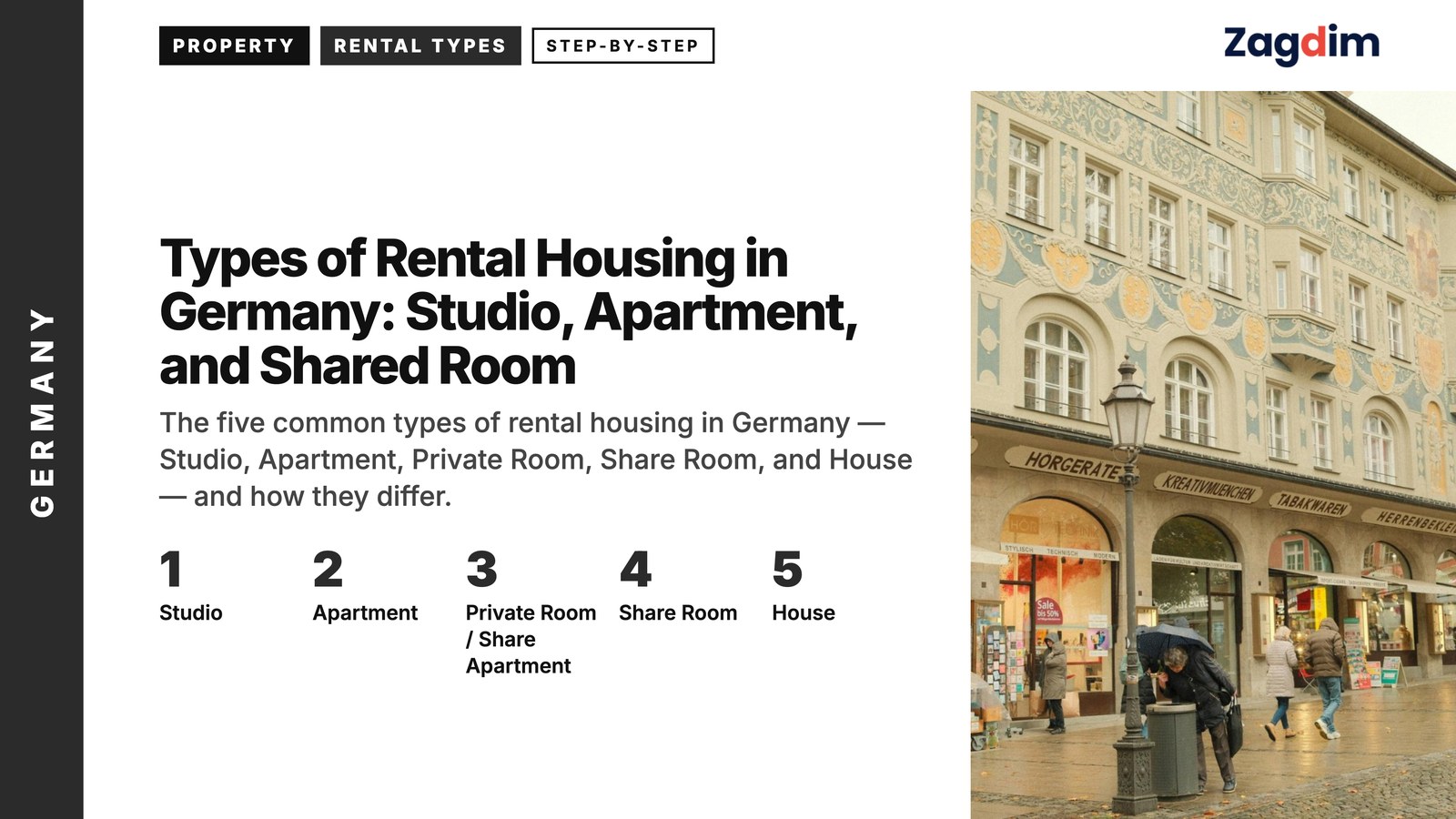
More than half of Germany’s population lives in rented housing, the highest rate of tenancy in Europe. Understanding the common types of rental property on the German market matters because it maps directly onto what a given renter needs. This article covers five common housing types found on Germany’s rental market, to help readers understand the options in the German property market.
Studio
In Germany, a “Studio” refers to a small unit without a separate living room. It is very common in large cities such as Berlin and Hamburg. A studio has its own bathroom and interior space, but does not necessarily include kitchen equipment or a stove; even where kitchen facilities exist, they are not separated from the sleeping area. In Berlin, a studio typically rents for around €500 a month or more.
Apartment
An “Apartment,” in the sense used here, is a unit in a residential building with distinct rooms. A one-bedroom-plus-living-room layout already counts as an apartment, with a clearly divided kitchen, bathroom, bedroom, and living room. In Berlin, a typical one-bedroom apartment rents for roughly €700-800 a month; each additional bedroom generally adds around €500, so a three-bedroom apartment runs to roughly €1,500 a month.
Private Room / Share Apartment
A “Private Room,” also called a “Share Apartment,” refers to a single independent room within a unit, where the tenant shares the bathroom and kitchen with tenants of the other rooms in the same unit; only the individual room itself is the tenant’s private space, typically furnished with just a bed, a wardrobe, or a desk. Because bathroom facilities are shared, rent is cheaper than a studio — in Berlin, typically from around €300 a month per room.
Share Room
A “Share Room” means sharing a single room with other tenants — the room itself holds 2-3 beds — and tenants also share the kitchen and bathroom with tenants in other rooms; there is no individual private room at all. In Berlin, a share room with 2-3 beds typically rents for around €400-600 a month, depending on the size of the room.
House
Finally, there are Germany’s detached houses, semi-detached houses, and terraced houses — housing that is not part of an apartment building. These are rented out less often, and pricing varies widely depending on location, size, number of rooms, and fittings. A semi-detached house shares one wall with the neighboring house; a terraced house shares walls with houses on both sides; a detached house shares no walls with any neighboring property.
Summary
These five are the most common types of rental property on the German market. The same unit can often be let in three or four different ways: for example, a three-bedroom apartment can be rented out as a single three-bedroom unit, split into three separate private rooms, or let as share rooms. A landlord in Germany can adjust how a unit is let based on its location and current market information. Before deciding on a rental format, it is worth understanding a German landlord’s legal responsibilities and the relevant regulations first, to avoid problems down the line.
Have a question about this guide? Leave a comment below, or ask Zagdim directly.
Your first stop for international property and global living.
Research and insights. Know what’s changing. Understand what matters.