































A Cap Set by Local Averages
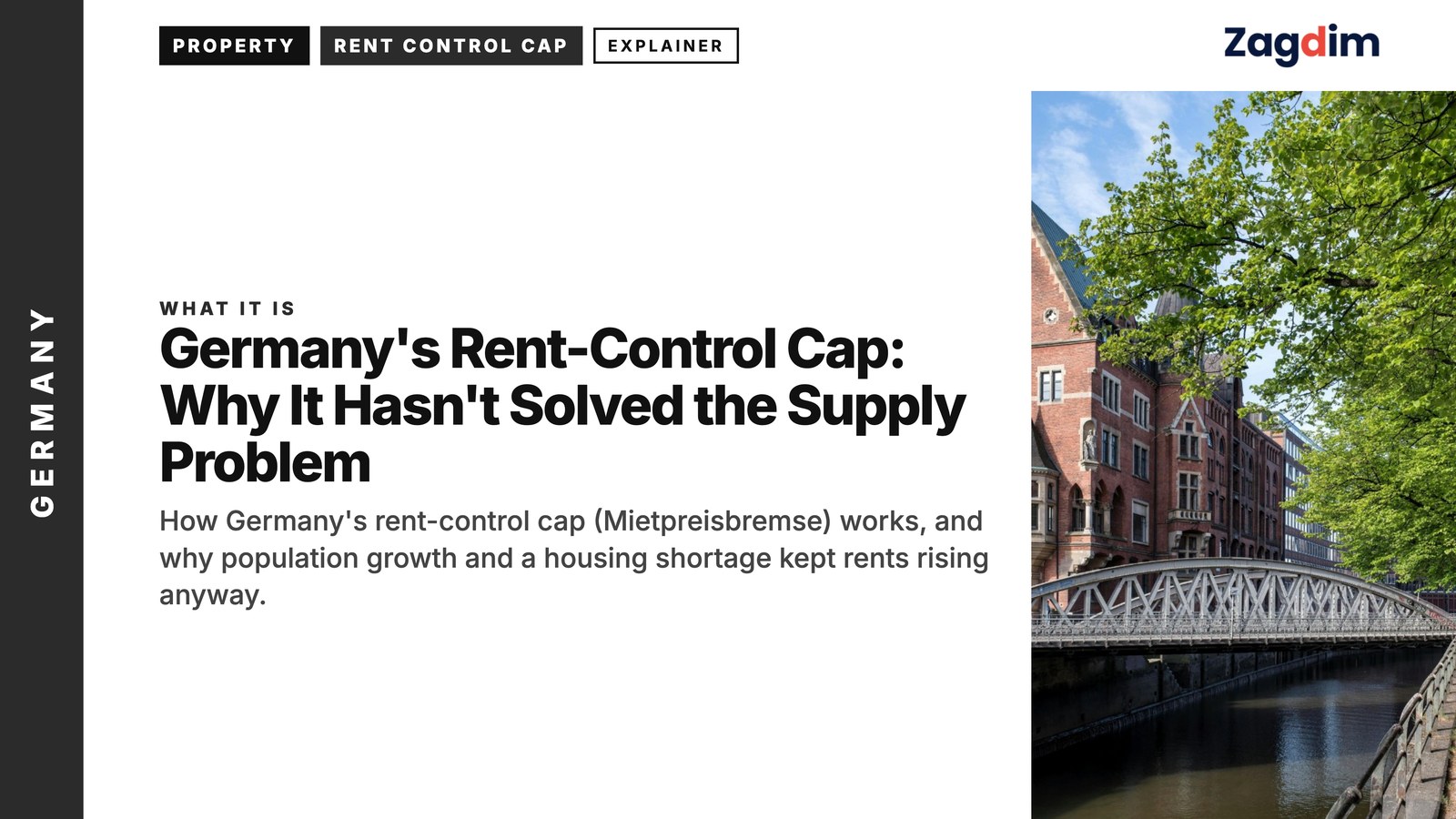
In 2015 Germany introduced a rent-control policy known as the Mietpreisbremse. Under this rule, the rent charged for a unit cannot be priced more than 10% above the local comparable rent for similar housing in the same area. The government set up a rent-monitoring body that divides the apartments in a city into price zones by location and type, so that an average rent for each zone can be estimated and used as the benchmark for capping increases.
But the market moves while policy stays still: German rents have continued to grow at around 1.4% a year, and because demand still outstrips supply, tenants’ bargaining power remains very limited.
Population Growth and a “Siphon Effect” Toward Major Cities
German statistics show that immigration has driven population growth over the past decade: Germany’s population has continued growing since, reaching about 83.5 million at the end of 2025 — though 2025 itself saw the first annual population decline (-0.1%) since 2020. Property supply has also grown — the most recent Destatis figures show 44.0 million dwellings at the end of 2025, up 0.4% (196,000 units) on 2024, and up 6.0% (2.5 million units) over the ten years since end-2015 — in theory, supply should have kept pace with demand.
The problem is that population movement skews heavily toward first-tier cities, creating a “siphon effect.” Munich, for example, is the economic center of southern Germany, and its growth rate has consistently outpaced the national average: between 2010 and 2019 alone, Munich’s population grew from about 1.35 million to 1.52 million, a rise of 13% (compared with 7% in Hong Kong over the same period). Housing supply growth has lagged well behind.
Land Scarcity and Financing Constraints
According to Munich’s city planning and building-regulation authority, as land becomes scarcer its price keeps climbing, and land now accounts for 60% of the total price of a home in Munich. Private construction volume — 36,000 units completed between 2011 and 2015, but only 7,400 in 2016 — has failed to keep up with demand growth; the city currently estimates it needs around 8,500 new homes a year to meet demand.
A second cause of constrained supply is developer financing. Since the 2008 financial crisis in particular, banks have tightened corporate financing, making it harder for developers to raise money; in recent years many developers have turned to crowdfunding, at interest rates above 8%. At the same time, the ECB’s negative-interest-rate era ended in mid-2022; as of 16 September 2026 its deposit facility rate stands at 2.50% and its main refinancing rate at 2.65% — both firmly positive, and mortgage costs have risen accordingly rather than easing. Together, these two forces have widened the gap between supply and demand.
Bargaining Power Has Shifted to Landlords
Faced with this situation, bargaining power has steadily shifted toward landlords. Any tenant who complains knows that a dozen or more people are waiting in line for the unit if they leave. In practice, tenants have very little room to negotiate.
Anyone weighing a move to Germany or a long-term rental there can ask Zagdim about current conditions in the city they are considering.
Have a question about this guide? Leave a comment below, or ask Zagdim directly.
Your first stop for international property and global living.
Research and insights. Know what’s changing. Understand what matters.