

On 8 September 2026 the Bali provincial government announced that, the day before, it had met the visa services company VFS Global to discuss sending travelers, before they depart, through a dedicated link to the official Love Bali payment portal. VFS Global said this would help travelers recognize the official payment channel and reduce the chance of being scammed. The cooperation is still at the discussion stage, no launch date has been announced, and the announcement did not mention any change to the tourist levy amount or rules. In practice, anyone going to Bali today still has to sort out three separate things: which status to enter on, where to complete the arrival declaration, and where to pay the tourist levy. This guide covers the entry steps for Bali and how to avoid fake websites that charge fees.
The short answer: Hong Kong SAR, Singapore and Malaysia passports are on Indonesia’s visa-free list, with a maximum stay of 30 days that cannot be extended. Taiwan and mainland China passports are on the visa on arrival (VOA) list, so plan on getting a B1 visa on arrival or an electronic visa on arrival (e-VOA) with an official visa fee of Rp500,000. Whatever passport you hold, arriving in Bali on an international flight requires the All Indonesia arrival declaration (free, available from 3 days before arrival). Foreign visitors also pay the Bali tourist levy of Rp150,000 per person, paid electronically through the official Love Bali system.
This guide answers:
- Do I need a visa for Bali on my passport? What if I want to stay longer than 30 days?
- What do I need for an e-VOA? What is the difference between the 90 days and the 30 days?
- When do I fill in All Indonesia, and do I still need a separate customs declaration?
- Where do I pay the tourist levy? How do I tell fake websites and fee-charging agents from the real thing?
Key Points
- Who this is for: travelers heading to Bali for tourism, family visits, property viewing or short business meetings who hold a Hong Kong SAR, Taiwan, mainland China, Singapore or Malaysia passport, and holders of a British National (Overseas), or BN(O), passport.
- Check the passport first: Hong Kong SAR, Singapore and Malaysia passports are on the visa-free list, for a maximum stay of 30 days with no extension. Taiwan and mainland China passports are on the visa on arrival list. A BN(O) passport cannot simply be treated like a Hong Kong SAR passport or a British citizen passport, so confirm separately before you travel.
- B1 visa on arrival: the official visa fee is Rp500,000. It is single-entry, allows a stay of up to 30 days from the day of arrival, and can be extended once, for a maximum total of 60 days. The electronic e-VOA must be used within 90 days of the issue date. That is the validity period of the visa, not the number of days you may stay.
- All Indonesia: since 1 September 2025, international travelers arriving at Bali’s I Gusti Ngurah Rai International Airport must complete it. Immigration, customs, health and quarantine declarations are combined in one form, and it is free.
- Bali tourist levy: Rp150,000 per foreign visitor, paid electronically, once per Bali trip, and it must be completed before you leave Indonesia. Holders of KITAS, KITAP, student visas and some other statuses are exempt.
- Do not confuse them: All Indonesia is an arrival declaration. It is not a visa and not the tourist levy. The three are handled separately.
Do You Need a Visa? Check Your Passport, Not Where You Live
Whether you need a visa depends on the passport you actually use to enter. Your place of residence, departure point or language does not change that. The table below follows two lists on the national website of Indonesia’s Directorate General of Immigration (checked 14 November 2026). The visa-free list (Bebas Visa Kunjungan) includes Hong Kong, Singapore and Malaysia, and does not include Taiwan or mainland China. The visa on arrival list (Visa on Arrival) includes Taiwan, mainland China, Singapore and Malaysia, and does not include Hong Kong. The explanation of visa-free stay days draws on the visa-free page of the Manado immigration office. Lists on different immigration office pages are not fully in sync and lists get updated, so confirm on the official page again before you leave.
| If you hold a… | Current position | What to watch |
|---|---|---|
| Hong Kong SAR passport | On the visa-free list; visa-free stay of up to 30 days, no extension | The national website’s visa on arrival list does not include Hong Kong. If you plan to stay beyond 30 days, check which visas a Hong Kong SAR passport can select on the official Indonesia e-Visa portal before you leave |
| BN(O) passport | The lists do not state which category BN(O) falls into | The UK government’s Indonesia entry guidance applies only to British citizen passports and cannot be used to judge BN(O). Do not apply the Hong Kong SAR visa-free treatment directly either. Confirm with an Indonesian embassy or consulate, or your airline, before you travel |
| Taiwan passport | On the visa on arrival (VOA) list | Plan on a B1 visa on arrival or e-VOA |
| Mainland China passport | On the visa on arrival (VOA) list | Plan on a B1 visa on arrival or e-VOA |
| Singapore passport | On the visa-free list; visa-free stay of up to 30 days, no extension | Also on the visa on arrival list. Confirm the route first if you will stay beyond 30 days |
| Malaysia passport | On the visa-free list; visa-free stay of up to 30 days, no extension | Also on the visa on arrival list. Confirm the route first if you will stay beyond 30 days |
What is the difference between visa-free and visa on arrival? The difference is cost and whether you can extend. Visa-free entry costs no visa fee and allows a stay of up to 30 days, with no extension when it ends. A B1 visa on arrival costs Rp500,000 and allows a stay of up to 30 days, but it can be extended once, for a maximum total of 60 days.
What if I hold a Hong Kong, Singapore or Malaysia passport and want to stay longer than 30 days? If your trip exceeds 30 days, check on the official Indonesia e-Visa portal (evisa.imigrasi.go.id) which visas your nationality can select, or confirm with the Indonesian immigration authorities. Do not enter visa-free and plan to extend afterwards. Singapore and Malaysia passports appear on both the visa-free and visa on arrival lists, but the lists do not say whether the holder of one passport can choose to pay for a visa on arrival in order to gain the extension option. A Hong Kong SAR passport appears only on the visa-free list.
For example, a traveler with a Singapore passport plans to spend a little over a month in Bali looking at property. Before departure, the thing to do is confirm whether the passport can apply for a B1 visa on arrival, and only then decide which status to enter on. Once you enter visa-free, the 30 days cannot be extended when they run out.
Staying long term, working or retiring? Those depend on other visa categories. Visa-free entry and the B1 visa on arrival are both short-term visitor statuses. Related categories include Zagdim’s guides to the Bali digital nomad visa and the new Indonesian retirement visa (E33E category, minimum age 55).
When to Apply and What to Prepare
Three things need doing before a Bali trip: enter within 90 days of the e-VOA being issued, fill in All Indonesia from 3 days before arrival, and pay the tourist levy before leaving Indonesia. Zagdim recommends putting all three in your itinerary so none gets missed.
| Task | Who needs it | When | Cost |
|---|---|---|---|
| B1 visa on arrival or e-VOA | Passports on the visa on arrival list, for example Taiwan and mainland China | Apply for the e-VOA online before departure; enter within 90 days of issue | Rp500,000 |
| All Indonesia arrival declaration | Travelers arriving in Bali on an international flight | From 3 days before arrival; it can also be filled in on arrival | Free |
| Bali tourist levy | Foreign visitors (except exempt statuses) | Before arrival or during your stay, and before leaving Indonesia | Rp150,000 per person |
**Glossary | e-VOA:** the electronic version of the B1 visa on arrival, applied for online before departure.
To apply for a B1 visa on arrival or e-VOA, prepare:
- A passport with at least 6 months of validity remaining, with the data page uploaded.
- A return ticket, or an onward ticket to another country.
- A color photo taken within the last year.
- Any other files the application page asks for, as shown on the page at the time.
The passport validity and return ticket requirements are conditions stated in the Indonesian immigration authority’s B1 visa on arrival information. The official information does not spell out whether visa-free entrants face the same requirements. Check your airline’s boarding requirements before departure, and renew a passport that is close to expiry.
How are the e-VOA’s 90 days counted? The 90 days are the e-VOA’s validity period. They count from the issue date, and you must enter within that time. How long you may stay after entering depends on the B1 stay limit: up to 30 days from the day of arrival, and up to 60 days in total after one extension. Do not read the 90 days as permission to live in Indonesia for 90 days.
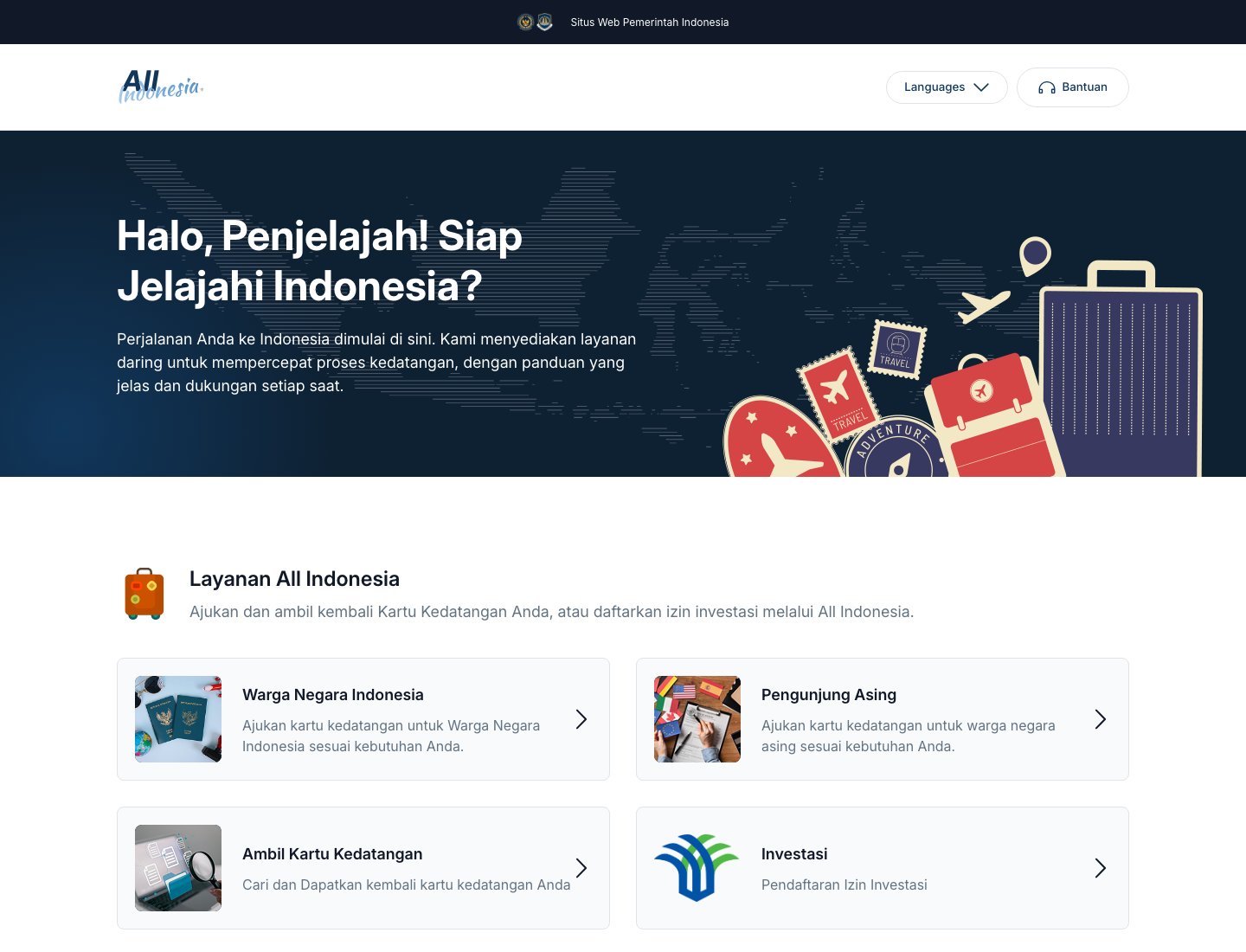
**Glossary | All Indonesia:** Indonesia’s electronic arrival declaration, which combines four declarations (immigration, customs, health and quarantine) into one. The official website is allindonesia.imigrasi.go.id.
When do I fill in All Indonesia? You can fill it in from 3 days before arriving in Indonesia, and also on arrival. Zagdim recommends completing it before you leave, so there is one less thing to do after landing.
Application Steps
The entry process for Bali takes 8 steps, from confirming your passport category to checking the tourist levy before you leave Indonesia.
- Confirm your passport category. Use the table above to see whether your passport is visa-free, visa on arrival, or needs separate confirmation (BN(O)).
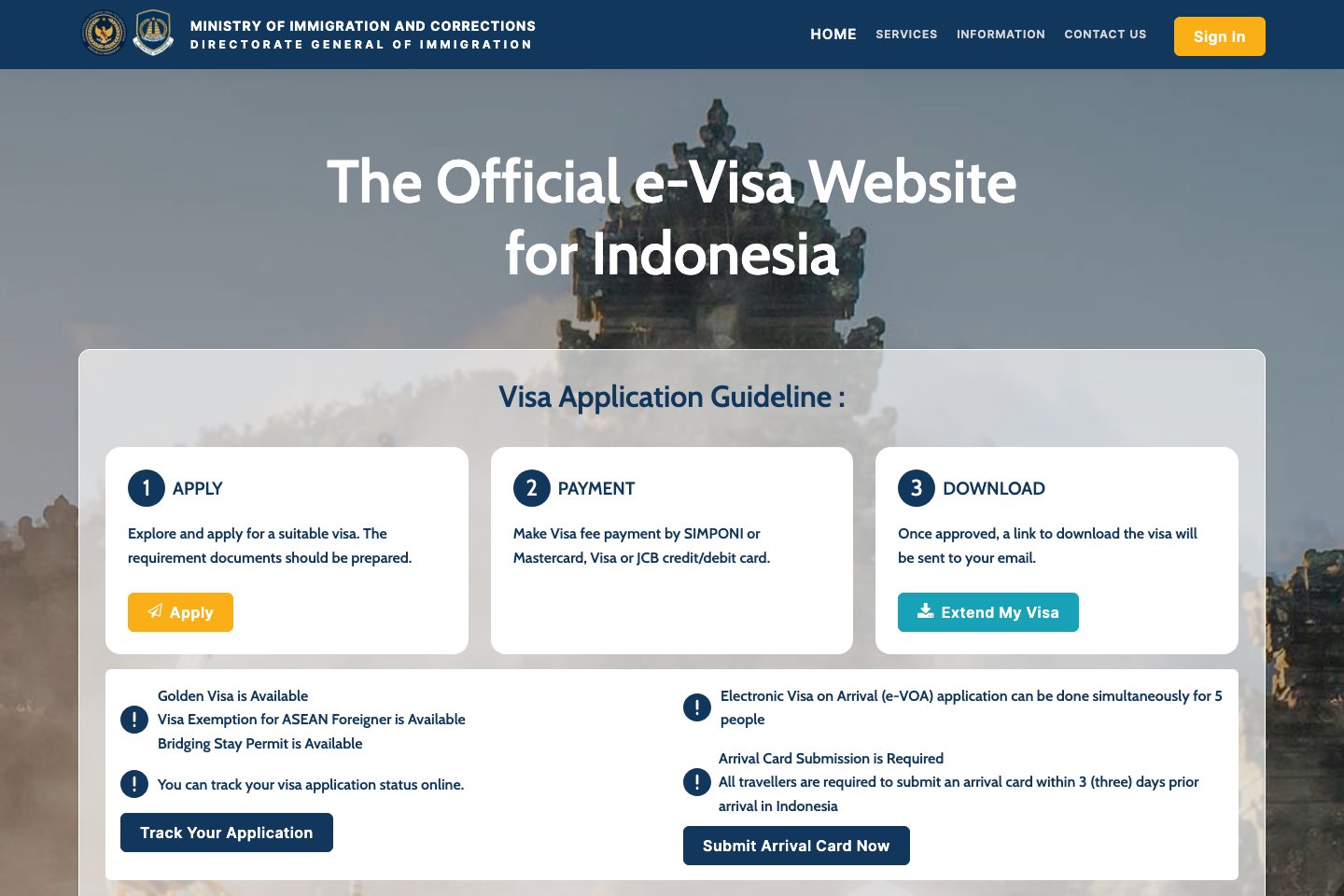
- If you need a visa on arrival, apply for an e-VOA. Type the address yourself to reach the official e-Visa portal, evisa.imigrasi.go.id. The Indonesian immigration authority’s B1 information page also lists indonesiavoa.vfsevisa.id as an application portal.
- Upload documents and pay. Upload the passport data page, a recent photo and a return or onward ticket, and pay the Rp500,000 visa fee.
- Keep your e-VOA. Check the name and passport number, note the issue date, and enter within 90 days.
- Fill in All Indonesia within 3 days before departure. Go to allindonesia.imigrasi.go.id and complete the arrival declaration; immigration, customs, health and quarantine are all in the one form.
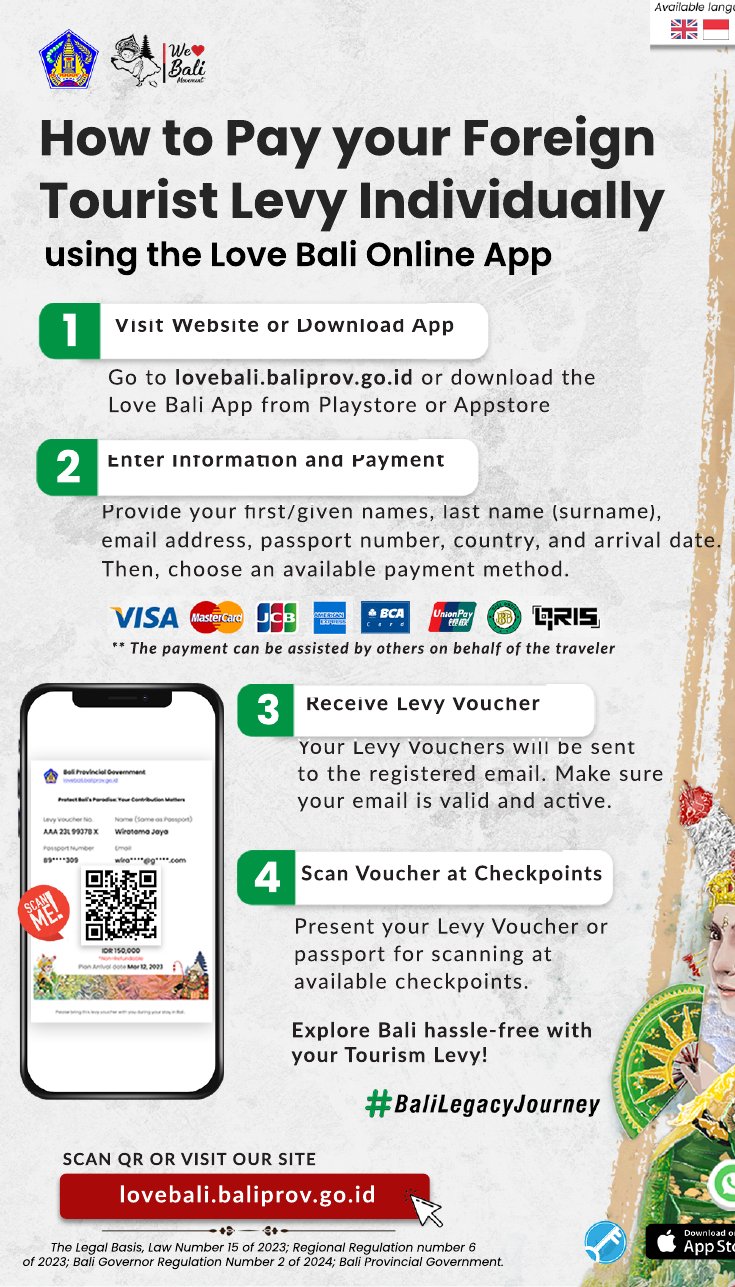
- Pay the Bali tourist levy. Pay on the official Love Bali system (lovebali.baliprov.go.id). When payment is complete, an electronic voucher with a QR code is sent to the email address you entered.
- Arrive in Bali. Have your passport, e-VOA (if you have one), the All Indonesia declaration and the tourist levy voucher ready.
- Before leaving Indonesia. If you have not yet paid the tourist levy, pay it before you depart. Keep the voucher until the end of the trip.
Fees and Validity
The official B1 visa on arrival fee is Rp500,000, the All Indonesia declaration is free, and the Bali tourist levy is Rp150,000 per person.
| Item | Amount or period |
|---|---|
| Visa-free stay | Up to 30 days, no extension |
| B1 visa on arrival, official visa fee | Rp500,000 |
| B1 stay period | Up to 30 days from the day of arrival; can be extended once, up to 60 days in total |
| e-VOA validity | Enter within 90 days of the issue date |
| All Indonesia arrival declaration | Free |
| Bali tourist levy | Rp150,000 per person, paid electronically, once per Bali trip |
| Large cash declaration threshold | Rp100,000,000 or more in rupiah or foreign currency equivalent |
- Rp500,000 is the government visa fee. If you apply through another website or an agent, any extra service fee they charge is not included in this amount. Ask what the extra amount is before you pay.
- B1 is single-entry. If you leave Indonesia and come back, you must arrange your entry status again.
- Extensions: a B1 can be extended once. The procedure follows the official e-Visa portal and the Indonesian immigration authority’s guidance.
Bali Tourist Levy: Where to Pay and Who Is Exempt
The Bali tourist levy is paid through the Love Bali system. You can pay online, at counters in the airport or seaport, or at hotels, travel agencies and attractions registered with the system. Holders of exempt statuses such as KITAS and KITAP do not pay. The levy is a local charge collected by the Bali provincial government from foreign visitors. It is separate from Indonesia’s national visa fee and customs declaration, and it applies even if you entered visa-free.
**Glossary | Bali tourist levy:** a local charge that Bali province collects from foreign visitors (Pungutan Wisatawan Asing), paid through the Love Bali system.
Amount and frequency: Rp150,000 per person, paid once per Bali trip, to be completed before you leave Indonesia.
Where you can pay:
- Before or on arrival, online through the official Love Bali system.
- At payment counters at Bali’s airport or seaports.
- During your trip, through points registered in the Love Bali system, such as hotels, travel agencies and tourist attractions.
Payment must be electronic. Cash is not accepted. After you pay, an electronic voucher with a QR code is sent to the email address you entered in Love Bali, so Zagdim recommends checking that the email address is correct before you pay.
Who is exempt? The statuses exempted under Bali regulations include:
- Crew of transport vehicles
- Holders of a KITAS (temporary stay permit) or KITAP (permanent stay permit)
- Holders of a diplomatic or official visa
- Holders of a family reunification visa
- Holders of a student visa
- Holders of a Golden Visa
- Holders of other visa categories
Holders of a Golden Visa and other visa categories must apply for the exemption through the Love Bali system first. For the other exempt statuses, showing the relevant document to the inspecting officer is enough. Love Bali’s guidance does not say how far in advance an exemption application must be made, so Zagdim recommends that anyone who needs one check with Love Bali well before departure.
**Glossary | KITAS:** Kartu Izin Tinggal Sementara, Indonesia’s temporary stay permit card, held by foreigners living in Indonesia long term.
Family, Children, Long Stays and Island Hopping
Each family member pays the tourist levy, long-term residents depend on their residence status, trips to other islands and back should be checked with Love Bali first, and large amounts of cash must be declared to customs.
How does the tourist levy work for a family? The levy is Rp150,000 per person, and each family member pays separately. Whether children have different rules should be confirmed on the Love Bali system or in the official guidance before you pay.
Already living in Bali long term? Holders of a KITAS or KITAP are on the exemption list and show their residence card to the inspecting officer on arrival.
Going from Bali to another Indonesian island and coming back? Zagdim recommends checking with Love Bali first for this kind of trip, and not assuming no further payment is due. Love Bali’s guidance says the levy is paid once per Bali trip and completed before leaving Indonesia, but it does not explain how a case is counted where you leave Bali without leaving Indonesia and then come back.
Carrying a large amount of cash? If you carry rupiah or foreign currency cash, or payment instruments such as checks and traveler’s checks, with a combined equivalent of Rp100,000,000 or more, you must declare it to Indonesian customs. For flights arriving in Bali, the customs declaration is already integrated into All Indonesia. If you will pay rent, a deposit or a property purchase in Bali, Zagdim recommends deciding in advance whether to use a bank transfer or carry cash. If you carry cash, you must declare it truthfully.
Which Agencies You Will Deal With
Entry formalities for Bali involve three bodies: Indonesia’s Directorate General of Immigration, Indonesia’s Directorate General of Customs and Excise, and the Bali provincial government through Love Bali.
| Agency | Responsible for | When you deal with it | Rough equivalent (powers are not identical) |
|---|---|---|---|
| **Directorate General of Immigration, Indonesia** (Direktorat Jenderal Imigrasi) | Visa-free entry, visa on arrival, e-VOA, All Indonesia | Applying for a visa, filling in the arrival declaration, immigration inspection | A national immigration authority |
| **Directorate General of Customs and Excise, Indonesia** (Direktorat Jenderal Bea dan Cukai) | Baggage and cash declarations | When carrying large amounts of cash or declarable goods | A national customs authority |
| **Bali Provincial Government, Love Bali** (Pemerintah Provinsi Bali) | Bali tourist levy and exemption applications | Paying the tourist levy, applying for an exemption | A local government charge on tourism |
What If You Made a Mistake or Did Not Apply?
You can complete All Indonesia and the tourist levy after arrival. An expired e-VOA must be reapplied for, and a visa-free stay cannot be extended.
Forgot to fill in All Indonesia? You can also fill it in on arrival. Go to the official website, allindonesia.imigrasi.go.id, and complete it there. Zagdim recommends filling it in before departure so there is one less thing at immigration.
Arrived in Bali without paying the tourist levy? You can pay at a payment counter at the airport or seaport, or during your trip through a registered point. It must be completed before you leave Indonesia.
Got your e-VOA, but the trip was postponed? An e-VOA must be used within 90 days of the issue date. If you do not enter within that period, you must apply for a new visa.
Entered visa-free and then found you need to stay longer? A visa-free stay cannot be extended. If your trip may exceed 30 days, confirm the visa category before departure rather than after you arrive.
Made a mistake in your details? Zagdim recommends not resubmitting or paying again first. Go back to the official e-Visa or All Indonesia portal to see whether the details can be corrected, or confirm with the Indonesian immigration authorities.
How to Spot Fake Websites and Fee-Charging Agents
The way to tell is to use only official addresses and compare against the official amounts: All Indonesia is free, the B1 visa fee is Rp500,000, and the tourist levy is Rp150,000 per person. One aim of the Bali provincial government’s talks with VFS Global is to help travelers recognize the official payment channel, but that cooperation is not yet live. The UK government’s travel guidance also warns that All Indonesia is free and advises avoiding alternative websites or email links that ask for payment.
Use only these addresses:
| Purpose | Official address |
|---|---|
| e-VOA application (official e-Visa portal) | evisa.imigrasi.go.id |
| e-VOA application (portal listed on the Indonesian immigration authority’s B1 information page) | indonesiavoa.vfsevisa.id |
| All Indonesia arrival declaration | allindonesia.imigrasi.go.id |
| Bali tourist levy | lovebali.baliprov.go.id |
How to judge the website in front of you:
- Compare the address character by character, type it in yourself, and do not click in from a search ad or an unfamiliar email.
- All Indonesia is free. If a site asks you to pay before you can fill in the arrival declaration, stop.
- The tourist levy is Rp150,000 per person. If the amount is clearly higher, ask what the extra fee is and who collects it.
- If you pay the tourist levy in Bali through a hotel, travel agency or attraction, first ask whether it is a point registered in the Love Bali system, and confirm that you receive an official electronic voucher with a QR code.
- Not every non-government address is a scam. The test is whether the visa fee, declaration fee and tourist levy all match the official amounts.
- Enter passport photos and credit card details only after you have checked the address.
FAQ
Does a Hong Kong SAR passport need a visa for Bali?
Not for stays up to 30 days. A Hong Kong SAR passport is on Indonesia’s visa-free list, with a maximum stay of 30 days and no extension. The national website’s visa on arrival list does not include Hong Kong. If you plan to stay longer than 30 days, check on the official e-Visa portal before you leave which visa you can apply for.
Do Taiwan passport holders need a visa for Bali?
Plan on getting a B1 visa on arrival or e-VOA. A Taiwan passport is on Indonesia’s visa on arrival list. The official visa fee is Rp500,000, with a stay of up to 30 days that can be extended once, to 60 days in total.
What visa does a BN(O) passport need for Bali?
Confirm with an Indonesian embassy or consulate, or your airline, before you travel. Indonesia’s lists do not state which category BN(O) falls into, and the UK government’s guidance applies only to British citizen passports.
Are the e-VOA’s 90 days the number of days I can stay?
No. The 90 days are the e-VOA’s validity period from the issue date. After entering, you may stay up to 30 days from the day of arrival, and up to 60 days in total after one extension.
When do I fill in All Indonesia, and does it cost anything?
You can fill it in from 3 days before arriving in Indonesia, and also on arrival. It is completely free. After you complete All Indonesia, you do not need to fill in the customs e-CD separately.
How much is the Bali tourist levy, and where do I pay?
It is Rp150,000 per person, paid electronically. You can pay on the official Love Bali system before departure, or at counters at Bali’s airport and seaports, or at registered hotels, travel agencies and attractions. It must be completed before you leave Indonesia.
Do KITAS holders still pay the Bali tourist levy?
No. KITAS and KITAP holders are on the exemption list and show their residence card to the inspecting officer. Holders of a Golden Visa or other visa categories must apply for the exemption through the Love Bali system first.
Important Notice
This guide is general information and does not constitute financial, tax or legal advice, and it does not mean entry will definitely be granted. It is based on public information from Indonesia’s Directorate General of Immigration and its immigration offices, Indonesia’s Directorate General of Customs and Excise, the Bali provincial government and the Love Bali official system, with the UK government’s travel guidance also consulted. Information was checked on 14 November 2026. The English names given for regulations are descriptive and the official text is the Indonesian original. Visa-free and visa on arrival lists, visa fees, stay periods, arrival declaration and tourist levy rules are subject to change. Please rely on the latest announcements from Indonesian authorities, the Bali provincial government and embassies or consulates.
Have a question about this guide? Leave a comment below, or ask Zagdim directly.
Your first stop for international property and global living.
Research and insights. Know what’s changing. Understand what matters.
Sources
- Directorate General of Immigration, Indonesia: Daftar Subjek Visa on Arrival (visa on arrival list)
- Directorate General of Immigration, Indonesia: Daftar Subjek Bebas Visa Kunjungan (visa-free list)
- Manado Class I Immigration Office, Indonesia: Bebas Visa Kunjungan
- Central Jakarta Class I Immigration Office, Indonesia: B1 Visa Saat Kedatangan (Wisata)
- Directorate General of Immigration, Indonesia: press release SP/IMI/09/2025/01 (All Indonesia arrival declaration)
- Directorate General of Customs and Excise, Indonesia: Electronic Customs Declaration (Indonesia E-CD)
- Directorate General of Customs and Excise, Indonesia: Indonesian Customs Declaration (e-CD)
- Bali Provincial Government: Regional Regulation No. 2 of 2025 (foreign tourist levy, official English translation)
- Bali Provincial Government, Love Bali: FAQ
- Bali Provincial Government Communication and Information Office: Pemprov Bali Jajaki Kolaborasi dengan VFS Global
- UK Foreign, Commonwealth and Development Office: Indonesia travel advice: Entry requirements