
































Consecutive Working Days in Japan: The Law Requires One Day Off a Week or Four in Four Weeks, With No Direct Cap Yet
Consecutive working days in Japan have no direct legal cap yet: under Article 35 of the Labour Standards Act (Rōdō Kijun-hō, 労働基準法), employers must give at least one statutory day off a week or four in four weeks, and the Ministry of Health, Labour and Welfare (MHLW) says the four-in-four-weeks rule allows up to 48 days in a row.
On 30 October 2026, the MHLW set out discussion points at the 214th meeting of the Working Conditions Subcommittee (Rōdō Jōken Bunkakai, 労働条件分科会) of the Labour Policy Council, including how to limit long runs of consecutive work (renzoku kinmu, 連続勤務). The Asahi Shimbun reported the same day that the direction is a statutory limit of up to 13 days, with exceptions under discussion for situations such as disasters. Nothing has become law and no start date is set.
This guide starts with the question people working in Japan ask most: how the current law counts days, what already limits a roster, what is being changed, and which documents to check depending on your status of residence (zairyū shikaku, 在留資格).
Key Points
- Who should pay attention: foreign employees in Japan, people working on Specified Skilled Worker (tokutei ginō, 特定技能) or Engineer/Specialist in Humanities/International Services (Gijutsu・Jinbun Chishiki・Kokusai Gyōmu, 技術・人文知識・国際業務) status, international students with part-time jobs, and shift workers in restaurants and hotels.
- The current law has two layers. Without an Article 36 agreement (saburoku kyōtei, 36協定), a written labour-management agreement, the days-off rule applies. With one, work on statutory days off is possible, but it needs premium pay and stays within the working-hour caps.
- Thirteen days is a limit under discussion. On 31 October 2026 it was not current law, so working more than 13 days in a row is neither automatically illegal nor automatically legal; it depends on days off, the agreement and hours.
- International students face an extra limit: on top of labour law, their residence permission caps work at 28 hours a week.
How the Current Law Counts: Days Off and Daily Hours in Japan
Foreign nationals working at a workplace in Japan are fully covered by the Labour Standards Act, whether full-time or part-time. These are the rules most often needed to read a roster:
| Item | Current rule | Basis |
|---|---|---|
| Statutory days off | At least 1 day a week, or at least 4 days in 4 weeks | Labour Standards Act, Article 35 |
| Condition for 4-in-4 weeks | Work rules (shūgyō kisoku, 就業規則) or similar must state when each 4-week period starts | Enforcement Regulations, Article 12-2 |
| Working hours | 40 hours a week, 8 hours a day | Labour Standards Act, Article 32 |
| Small-business exception | 44 hours a week for specified sectors such as retail, inns and restaurants with fewer than 10 regular workers | Enforcement Regulations, Article 25-2 |
| Breaks | At least 45 minutes over 6 hours, at least 1 hour over 8 hours | Labour Standards Act, Article 34 |
| Work on a statutory day off | Requires an Article 36 agreement and at least 35% premium pay | Labour Standards Act, Articles 36 and 37 |
| Overtime caps | In principle 45 hours a month and 360 a year; under a special clause (tokubetsu jōkō, 特別条項), up to 720 a year, with overtime plus day-off work under 100 hours a month and within an 80-hour average over 2 to 6 months | Labour Standards Act, Article 36 |
| Disaster exception | With government permission, or notice afterwards if urgent, hours may be extended and statutory days off worked during temporary needs such as disasters | Labour Standards Act, Article 33 |
A statutory day off is in principle a full calendar day. The MHLW’s working-conditions site says that even one hour of work means the day off has not been given. Many companies use a two-day weekend because of the 40-hour limit; the law’s statutory day off is still one a week, and the other is usually a company-set rest day (shotei kyūjitsu, 所定休日).
Overtime caps for construction, drivers and doctors are set separately, so check the latest notice for those sectors.
How 48 Days Adds Up, and Why an Article 36 Agreement Removes the Day Limit
The 48 comes from the four-in-four-weeks rule. An employer puts the days off at the very start of one 4-week period and at the very end of the next, leaving 48 days in between with no statutory day off. On a one-day-a-week pattern the theoretical maximum is 12 days in a row; on two days in two weeks it is 24. The Study Group on Labour Standards Legislation (Rōdō Kijun Kankei Hōsei Kenkyūkai, 労働基準関係法制研究会) noted in its January 2025 report that clustering days off in this way does not in itself breach the Labour Standards Act.
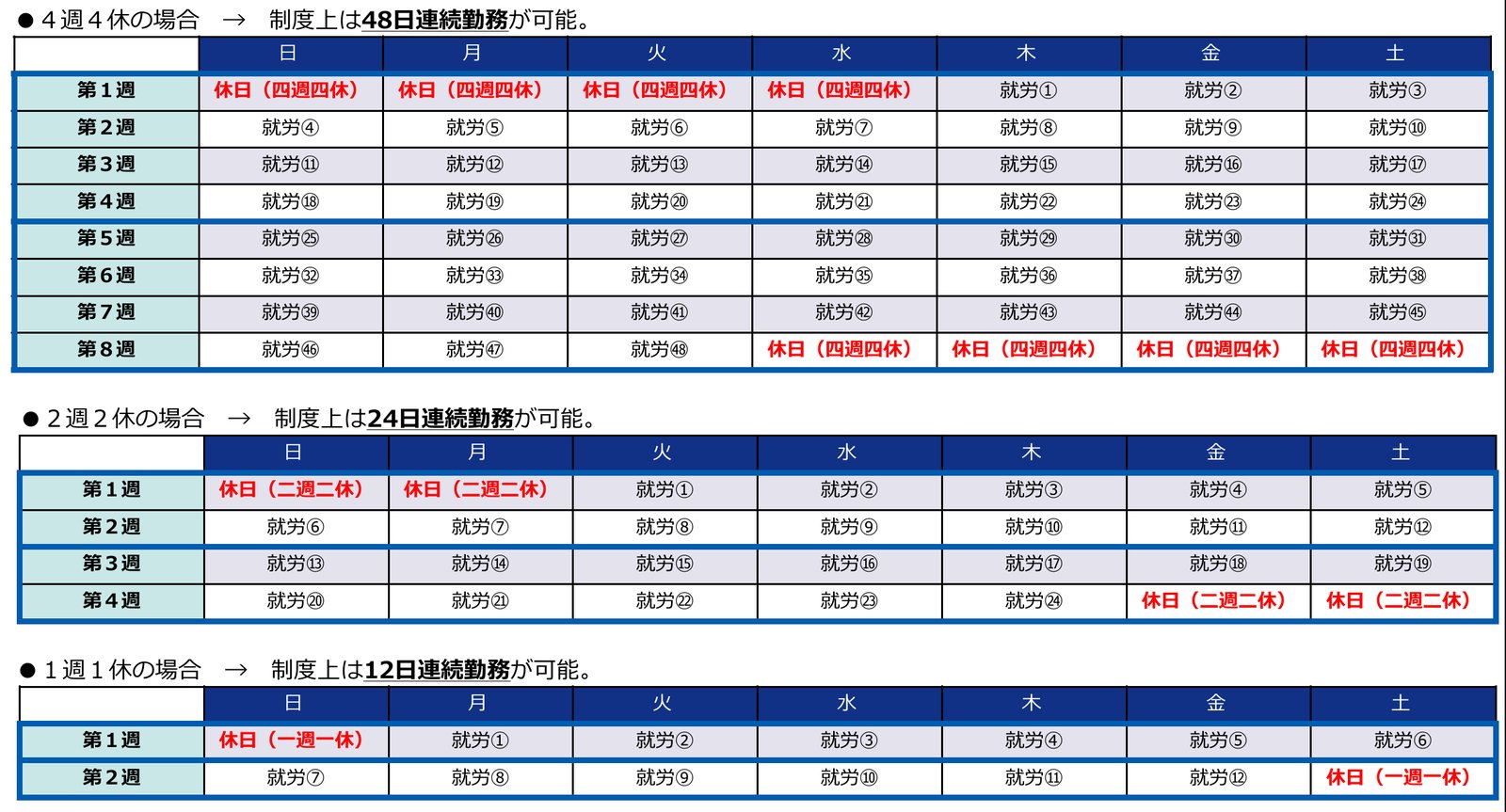
Forty-eight is not the final ceiling. It is the figure when work on days off is not counted. With an Article 36 agreement that covers day-off work, and with premium pay, the report says consecutive work is theoretically unlimited within the agreement. In practice the limit then comes from caps such as under 100 hours a month.
Few people actually work this long. A survey cited by the MHLW, covering April to June 2024, found about 2% of workers had a longest run of 14 days or more, with big differences by sector: the share at 14 to 20 days was 1.2% overall, 8.0% in accommodation and food services and 4.5% in construction.
What the 13-Day Cap Would Change: Decided and Undecided
The 13 days comes from the workers’ compensation criteria for mental disorders (seishin shōgai no rōsai nintei kijun, 精神障害の労災認定基準). They list “working consecutively for two weeks or more” as a specific stressful event. In fiscal 2025, 30 compensation decisions had this as the main event rated “strong” stress. The study group’s report, published on 8 January 2025, proposed a rule against more than 13 days in a row, including where an Article 36 agreement exists.
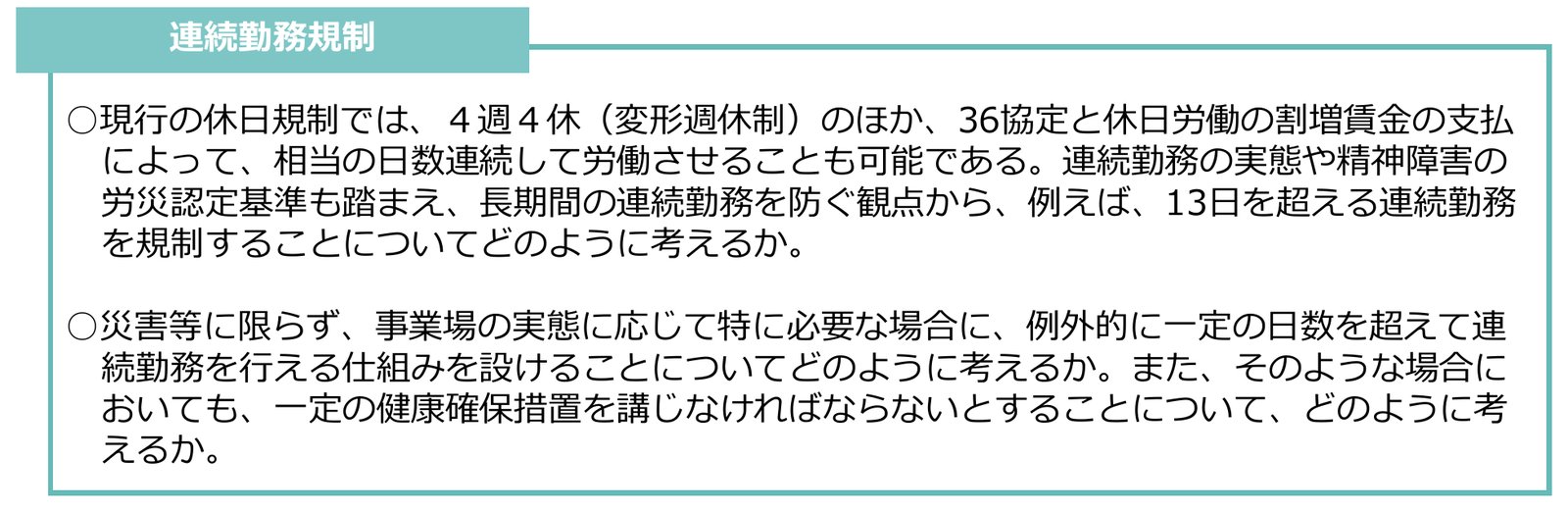
As of 31 October 2026, the minutes of the 214th meeting had not been posted. This is where each item stands:
| Item | Current status | Basis |
|---|---|---|
| 13-day limit | The MHLW paper says “for example, restricting consecutive work of more than 13 days”; the Asahi Shimbun reports a direction of up to 13 days. Not law | Paper No. 1-1 of 30 October 2026, Asahi Shimbun |
| Which article | Papers illustrate two drafting options, Article 35 or Article 36; under Article 36, one day off in two weeks is kept even with an agreement | Paper No. 1-2 |
| Scope of exceptions | The MHLW asks whether exceptions should go beyond disasters, where a workplace has a particular need | Paper No. 1-1 |
| Employer side | Agrees a limit is needed; wants exceptions possible if health protection measures (kenkō kakuho sochi, 健康確保措置) are taken | Asahi Shimbun |
| Labour side | Understands the need in disasters, but worries about arbitrary use; wants an upper limit set in law even for exceptions | Asahi Shimbun |
| Fixing statutory days off in advance | Discussed at the same meeting, not decided | Paper No. 1-1 |
| Bill and start date | The official papers list no bill text and no start date | Papers No. 1-1 and 1-2 |
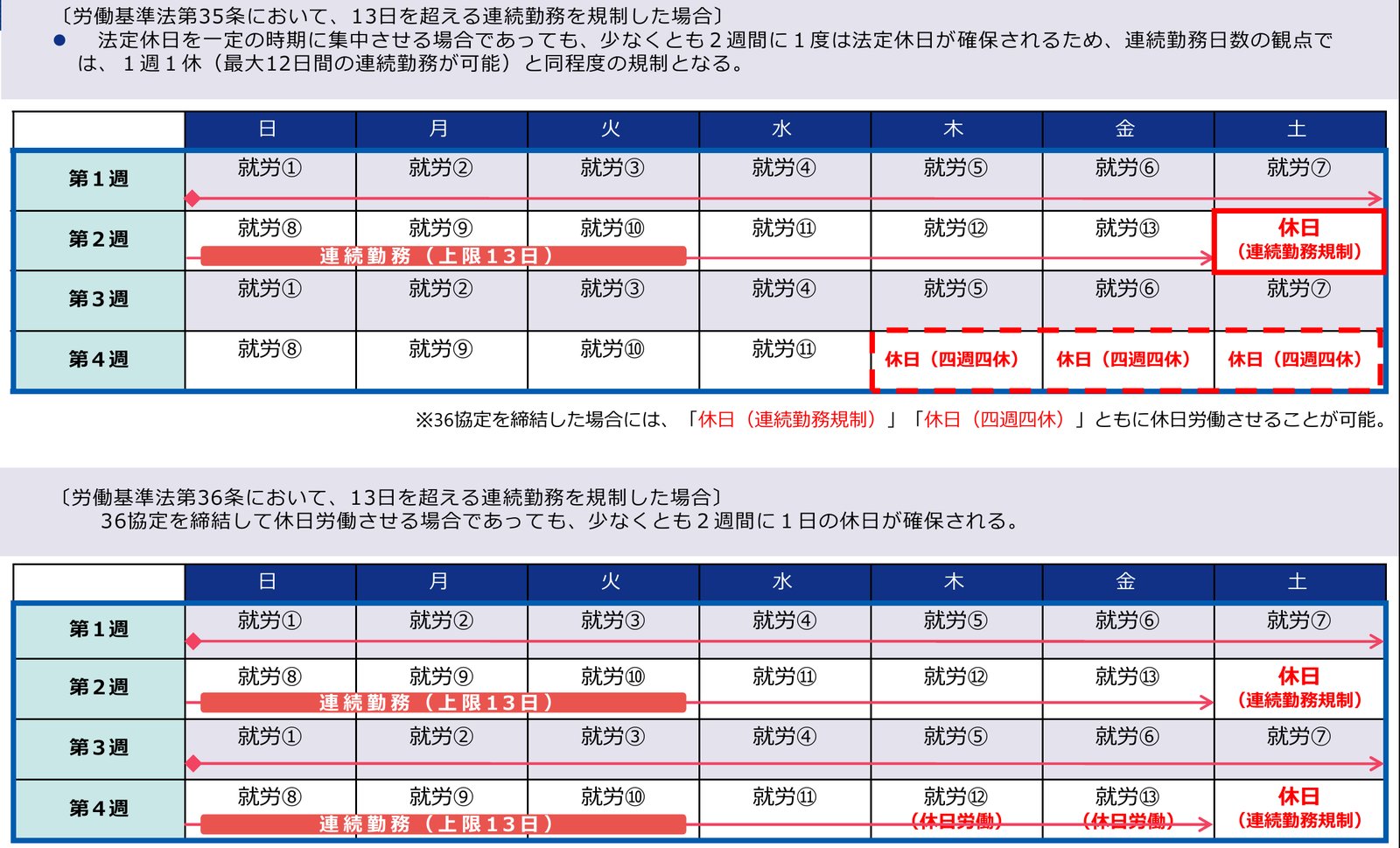
If a 13-day limit follows the model in the papers, the 14th day would have to be a day off. Which sectors or situations could be exempt, and what health measures would apply, depends on further discussion.
Consecutive Working Days in Japan by Situation: Foreign Employees, Specified Skilled Workers, Students and Shift Staff
The days-off rules do not depend on nationality. The differences come from contracts, status of residence and sector:
| Your situation | How days off work | What else to check | Basis |
|---|---|---|---|
| Foreign full-time employees, including Engineer/Specialist status | Same as Japanese employees | Whether the company uses 4-in-4 weeks and whether the Article 36 agreement covers day-off work | Labour Standards Act, MHLW Q&A |
| Specified Skilled Worker | The employment contract must comply with the Labour Standards Act | Scheduled hours must match regular workers; full-time generally means 5 or more days a week, 217 or more days a year and 30 or more hours a week; the employment terms must be in a language you understand | Immigration Services Agency operating guidelines, August 2026 |
| International students working part-time | The Labour Standards Act applies | Permission to engage in activity outside status (shikakugai katsudō kyoka, 資格外活動許可) caps work at 28 hours a week, counted from any day of the week; up to 8 hours a day during school-defined long holidays | Immigration regulations, Article 19; Immigration Services Agency Q&A |
| Dependents (kazoku taizai, 家族滞在) working part-time | The Labour Standards Act applies | All part-time work combined must stay within 28 hours a week | Immigration Services Agency document |
| Restaurant and hotel rosters | Workplaces with fewer than 10 regular workers may use 44 hours a week; the days-off rule is unchanged | Whether rosters cross months and how the start date is set | Enforcement Regulations, Article 25-2 |
| Store managers and other managers | Genuine supervisors (kanri kantokusha, 管理監督者) are outside the hours and days-off rules | Job title does not decide it; duties, authority and working patterns do | Labour Standards Act, Article 41; MHLW booklet |
| Agriculture, livestock and fisheries | Under Article 41, hours, breaks and days-off rules do not apply (forestry excepted) | Days off depend on the employment contract | Labour Standards Act, Article 41 |
For students, the 28 hours and labour law are separate tracks. The Immigration Services Agency warns that breaching the permission may mean a renewal of the period of stay is refused, and a company’s roster does not change that limit. On combining several jobs, the document for dependents says hours are added together; students who are unsure should ask their school or the Immigration Services Agency directly.
If the Roster Looks Wrong: Check Three Documents, Then the Labour Standards Inspection Office
Before deciding whether a roster has a problem, gather these:
- Employment contract or written working conditions (rōdō jōken tsūchisho, 労働条件通知書): Employers must state days off, hours and overtime when you sign.
- Work rules and the Article 36 agreement: Employers must make these available to staff. Check how statutory days off are set, the 4-week start date and the limit on day-off work.
- Actual records: Rosters, time records and payslips. Check whether statutory days off were given and whether day-off work was paid at 35% extra.
If it still looks wrong, go to the Labour Standards Inspection Office (Rōdō Kijun Kantokusho, 労働基準監督署). Under Article 104, workers can report violations there, and employers must not dismiss them or treat them unfavourably for it. Breaches of Articles 32, 35 and other provisions carry up to six months’ imprisonment or a fine of up to ¥300,000.
If Japanese is difficult, the MHLW runs foreign-language services. All details below come from its page for foreign workers, marked as of October 2026. They close from 29 December to 3 January, and hours can change temporarily:
| Service | Hours | Chinese | English | Cost |
|---|---|---|---|---|
| Telephone Consultation Service for Foreign Workers (外国人労働者向け相談ダイヤル) | Monday to Friday, 10:00 to 15:00, closed 12:00 to 13:00 | 0570-001-702 | 0570-001-701 | Paid: ¥9.35 per 180 seconds from landlines, ¥22 per 30 seconds from mobiles |
| Working Conditions Consultation Hotline (労働条件相談ほっとライン) | Weekdays 17:00 to 22:00, weekends and holidays 9:00 to 21:00 | 0120-531-402 | 0120-531-401 | Free |
| Foreign Workers Consultation Service (外国人労働者相談コーナー) | Varies by labour bureau and office | Search by prefecture on the page | Search by prefecture on the page | Varies |
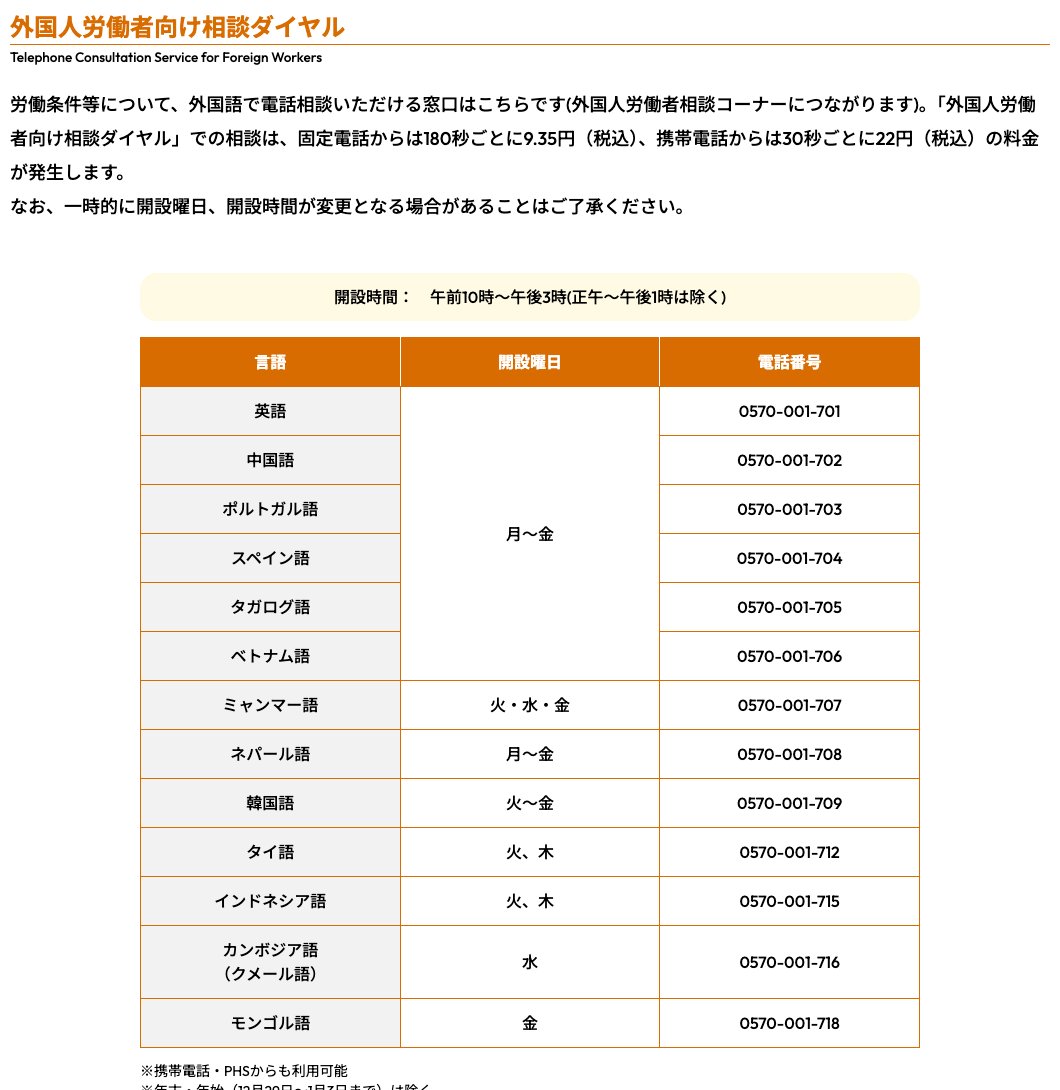
The page also covers Portuguese, Spanish, Vietnamese, Nepali and others, 13 foreign languages in all, with different days for each. Check it before calling.
Common Misunderstandings About Days Off and Consecutive Work in Japan
- “More than 13 days in a row is always illegal.” There is no such rule yet. It depends on whether enough days off were given in four weeks, and whether an Article 36 agreement and premium pay are in place. Do not cite 13 days as current law.
- “The two-day weekend is a legal requirement.” The statutory day off is one a week. Work on a company rest day may not earn the 35% premium, but hours over 40 a week still count as overtime.
- “A day off in lieu cancels the premium.” Only a swap made in advance (furikae kyūjitsu, 振替休日) avoids day-off work. A day off given afterwards (daikyū, 代休) still needs the premium. Check whether the roster changed before or after the work.
- “A half day counts as rest.” A statutory day off is in principle a full calendar day, and even one hour of work means it was not given.
- “Under 28 hours, students can work every day.” The 28 hours is a residence limit; the statutory days-off rule still applies.
Example Situations: Reading a Long Run of Work in Japan
A Specified Skilled Worker in a Tokyo restaurant, 16 days in a row because of a staff shortage. Check whether the company uses 4-in-4 weeks and how the start date is written, then whether there is an Article 36 agreement and premium pay. If days off in the 4-week period were given in full, the length of the run alone is not necessarily illegal. If they were not and there is no agreement, ask the Labour Standards Inspection Office. The employment terms should be in a language you understand, so compare against them first.
A language school student with jobs at a convenience store and a restaurant. A roster covering both weekend days needs the hours worked out first: counted from any day of the week, the total must not pass 28. The 8-hour daily limit applies only to long holidays set in the school’s rules. The risk of going over sits with your residence status, and an employer’s approval does not solve it.
An engineer at a Tokyo IT company on Engineer/Specialist status, 20 days in a row for a system launch. This usually turns on the Article 36 agreement’s day-off work count and the hour caps. If overtime plus day-off work nears 100 hours in a month, watch the limit. If a 13-day cap arrives, whether a system failure counts as an exception is undecided, though the employer side has raised such cases.
Consecutive Working Days in Japan: FAQ
How many consecutive working days in Japan are legal?
There is no direct day limit in current law. Without an Article 36 agreement, one day off a week allows up to 12 days in a row, and four in four weeks allows up to 48 in theory. With an agreement covering day-off work and premium pay, there is in theory no day limit within the agreement, though hour caps such as under 100 hours a month still apply.
How many days off a week does Japan require?
The law requires at least one statutory day off a week, or at least four in four weeks. Many companies use two-day weekends because of the 40-hour weekly limit, but the law does not directly require two days. How many you actually get depends on your employment contract and work rules.
When would a cap on consecutive working days in Japan start?
As of 31 October 2026 there is no start date. The MHLW’s papers of 30 October 2026 are still discussion points and list no bill text or start date. A firm date would come only after the Labour Policy Council reaches a conclusion and the Diet passes an amendment.
Do the rules on consecutive working days in Japan apply to foreign part-timers?
Yes. The MHLW says the Labour Standards Act applies in full to foreign nationals working at a workplace in Japan, whether part-time or full-time. International students must also keep to the 28-hour weekly limit in their permission, which is a residence rule counted separately from labour law.
My boss says everyone works this way. Can I refuse work on a day off?
It depends on whether an Article 36 agreement exists and what the work rules and contract say. Without an agreement, an employer cannot require work on a statutory day off. Whether you can refuse in your case turns on your contract, so a call to a Chinese or English consultation line is a sensible first step.
Can my company dismiss me for going to the Labour Standards Inspection Office?
No. Article 104 of the Labour Standards Act lets workers report violations and bars employers from dismissing them or treating them unfavourably for doing so. In practice, rosters, time records and payslips are useful, so keep a copy.
Working in Japan and Unsure of the Rules? Ask Zagdim
If you are working in Japan and unsure how your roster and status of residence fit together, Ask Zagdim first, then confirm with the Labour Standards Inspection Office or your school.
Life abroad? Ask Zagdim.
Your first stop for international property and global living.
Research and insights. Know what’s changing. Understand what matters.
Newsletter for overseas updatesSubscribe →
Disclaimer
This article is general information and is not legal, tax, financial or other professional advice. It draws mainly on public material from 2025 to 2026 published by Japan’s Ministry of Health, Labour and Welfare, the Immigration Services Agency and official legal databases. The limit on consecutive work is still under discussion, and whether a specific case is illegal depends on the contract, work rules, Article 36 agreement and actual hours. Rules may change, so check the latest official announcements in Japan and consult a qualified professional where needed.
Rules and figures in this article are current as of 31 October 2026; refer to the latest MHLW announcements. Next update: when the Labour Policy Council issues its conclusion, or when an amendment to the Labour Standards Act goes to the Diet.
References
MHLW – Materials for the 214th Working Conditions Subcommittee meeting (30 October 2026) / MHLW – Discussion points on working-hour legislation, Paper No. 1-1 / MHLW – Specific issues in working-hour legislation, Paper No. 1-2 / MHLW – Report of the Study Group on Labour Standards Legislation (8 January 2025) / e-Gov – Labour Standards Act (in Japanese) / e-Gov – Enforcement Regulations of the Labour Standards Act (in Japanese) / MHLW – Overtime, day-off work and premium pay / MHLW – Does the Labour Standards Act apply to everyone who works? / MHLW – Guide to the overtime limit rules / MHLW – Booklet on the scope of supervisors under the Labour Standards Act / MHLW – Consultation services for foreign workers / Immigration Services Agency – Permission to engage in activity outside status / Immigration Services Agency – Q&A on status of residence applications / Immigration Services Agency – Notice for newly enrolled international students / Immigration Services Agency – Part-time work at gaming parlours / Immigration Services Agency – Operating guidelines for accepting Specified Skilled Workers (August 2026) / e-Gov – Enforcement Regulations of the Immigration Control Act (in Japanese) / Asahi Shimbun via Yahoo! News Japan – Upper limit on consecutive working days, up to 13 days considered (30 October 2026)