

























Updated guide (October 2026): Japan Property Costs Beyond the Price: Fees, Taxes, Insurance; Japan Property Purchase Costs by Due Date: A Buyer's Checklist
Buying property in Japan involves more than the purchase price itself — a number of related costs apply on top of it. These fall into two broad groups: taxes and charges collected by the Japanese government, such as the real estate acquisition tax, and fees involving third parties, such as agency commissions and administrative-scrivener (gyoseishoshi) fees. Overseas buyers may also face bank charges for the international remittance. This article walks through the taxes and fees involved in buying property in Japan.
Taxes on Buying Property
Real Estate Acquisition Tax (Fudousan Shutokuzei)
The real estate acquisition tax is a local tax, paid to the prefectural government when a property is acquired. It also applies to gifts and to extensions or renovations of a building. The tax rate is set by each local government and is not necessarily the same everywhere, and various local reductions exist — but if you are not a resident of the area, you generally cannot claim the owner-occupier reduction, even if you plan to use the property as a holiday home. The most common rates, in effect through March 31, 2027, are 3% of the assessed value for “land,” 3% of the assessed value for a residential “building,” and 4% of the assessed value for a non-residential “building” — the building rate reverts to the standard 4% for all building types after that date unless further extended.
The taxable base for the real estate acquisition tax is not the transaction price but the property’s “fixed asset tax assessed value” (固定資產稅評価額), which is set by the relevant local government and varies by unit; a “certificate of fixed asset valuation” detailing this figure can be requested from the local tax office (or obtained through your agent). The tax is calculated separately for land and for the building, as follows (rates in effect through March 31, 2027):
- Building (residential): fixed asset tax assessed value x 3%
- Building (non-residential): fixed asset tax assessed value x 4%
- Land: fixed asset tax assessed value x 50% x 3%
Adding the land and building amounts together gives the total real estate acquisition tax payable.
Reference: Reiwa 3 Property Valuation Standards · Osaka Prefecture: real estate acquisition tax rates (link) · Fukuoka Prefecture: real estate acquisition tax rates (link)
Stamp Duty (Inshizei)
Stamp duty is levied on certain documents, such as contracts and receipts tied to everyday economic transactions — including the real estate sale and purchase agreement used in a property transaction, which is therefore also subject to stamp duty. The amount depends on the value stated in the contract:
| Amount Stated in the Contract | Stamp Duty |
|---|---|
| JPY 10,000 – 100,000 | JPY 200 |
| JPY 100,000 – 500,000 | JPY 400 |
| JPY 500,000 – 1,000,000 | JPY 1,000 |
| JPY 1,000,000 – 5,000,000 | JPY 2,000 |
| JPY 5,000,000 – 10,000,000 | JPY 10,000 |
| JPY 10,000,000 – 50,000,000 | JPY 20,000 |
| JPY 50,000,000 – 100,000,000 | JPY 60,000 |
| JPY 100,000,000 – 500,000,000 | JPY 100,000 |
| JPY 500,000,000 – 1,000,000,000 | JPY 200,000 |
| JPY 1,000,000,000 – 5,000,000,000 | JPY 400,000 |
| Over JPY 5,000,000,000 | JPY 600,000 |
Reference: National Tax Agency — contracts related to the transfer of real estate and loans for consumption (link)
Registration and License Tax (Tourokumenkyozei)
The registration and license tax is payable when registering ownership of a property, and when setting up a mortgage. It applies to registrations for sale, gift, exchange and other purposes. Like the acquisition tax, it is calculated on the fixed asset tax assessed value, split between land and building. The formula for a typical property purchase is:
- Building: fixed asset tax assessed value x 2%
- Land: fixed asset tax assessed value x 2% (a reduced rate of 1.5% applies to registrations completed on or before March 31, Reiwa 11 / 2029, under a time-limited special measure that has been repeatedly extended, with the current deadline set at March 31, 2029)
Adding the land and building amounts together gives the registration and license tax payable on the purchase.
Reference: National Tax Agency — registration and license tax rate table (link)
Kotozei Settlement (Fixed Asset Tax and City Planning Tax Proration)
“Kotozei” is the combined name for the fixed asset tax and the city planning tax — broadly comparable to a rates-and-rent-tax charge. Because it is billed by tax year, and Japan’s tax year ends March 31, a buyer must reimburse the seller, prorated by date, for the remaining kotozei of that tax year when a property changes hands. For example:
- Kotozei already paid by the seller for the 2020 tax year: JPY 60,000 (covering April 1, 2020 – March 31, 2021)
- Seller: Mr. Chen (previous owner)
- Buyer: Ms. Zhang (new owner)
- Settlement date: July 1, 2020
- The buyer owes the seller the kotozei for July 1, 2020 – March 31, 2021, calculated as:
“`
JPY 60,000 x (365-91)/365 = JPY 45,041
“`
So the buyer must also pay the seller an additional JPY 45,041 in kotozei settlement at the time of the transaction. This amount for the prior tax year can be confirmed on the property’s tax payment certificate (“koka shomeisho”).
Consumption Tax
Consumption tax is a broad-based tax on transactions such as the sale of goods and the provision of services, borne by the consumer and remitted by the business. In a Japanese property transaction, third-party services are subject to consumption tax — most commonly, a 10% consumption tax (the current standard rate as of September 2026, unchanged since October 2019) is added on top of the agency fee and the administrative scrivener’s fee. Likewise, if the property being purchased is newly built and the seller is a property developer or corporate entity, the “building” portion of the price also carries a 10% consumption tax; most new-build listings state clearly on their price sheet whether the price is tax-inclusive (“zeikomi”).
Agency Fee (Chukai Tesuryo)
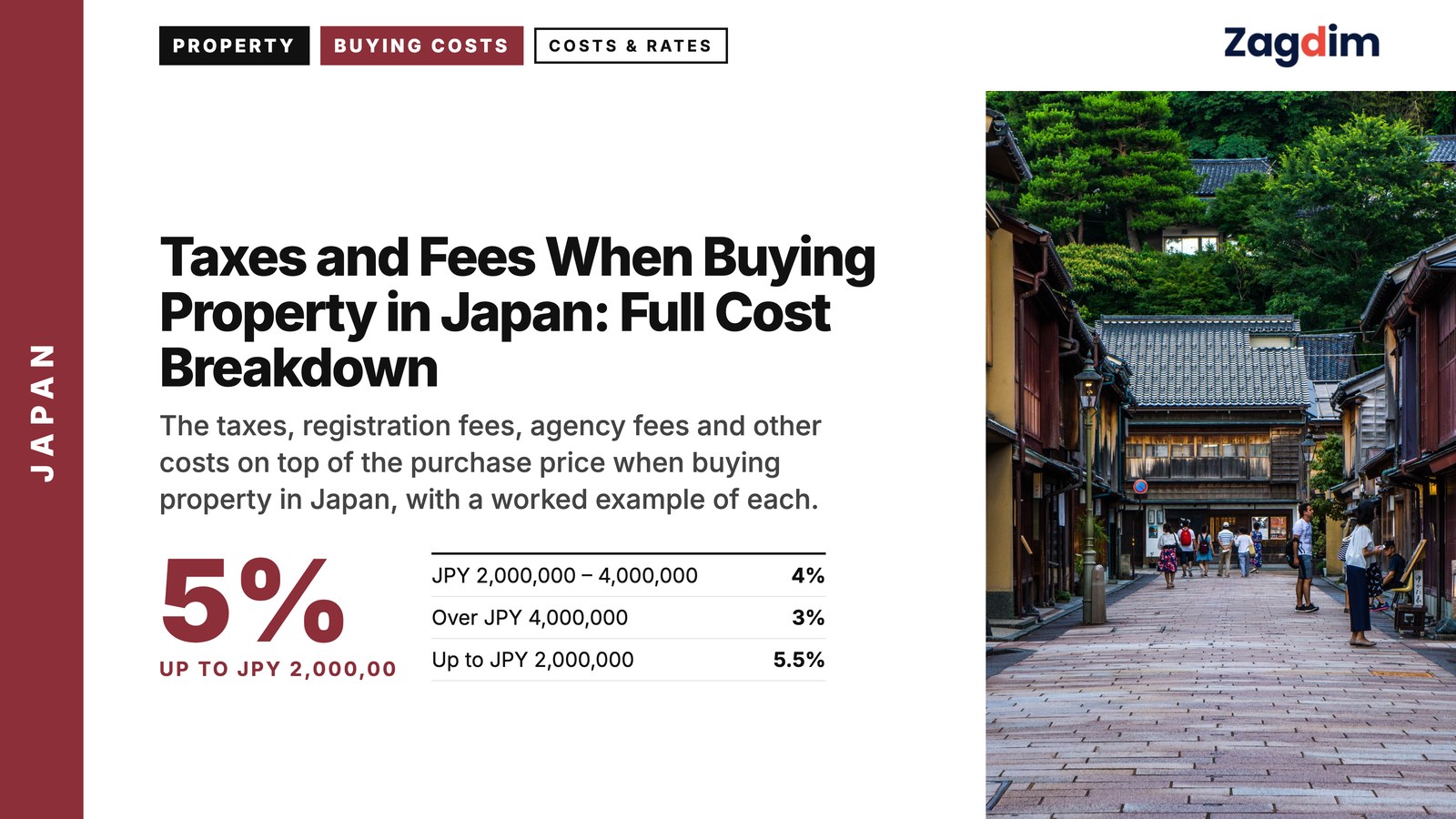
Japanese law requires a licensed real estate transaction agent (takken shunin) to be involved in a property purchase, and that agent’s service fee is the property’s agency fee. The commonly quoted shorthand for Japan’s agency fee is “3% of the transaction price plus JPY 60,000,” but the fee is actually calculated on a progressive, bracket-by-bracket basis; it simply happens to reduce to that same 3%-plus-¥60,000 formula once the calculation is carried through. The nationwide bracket structure is:
| Transaction Amount | Agency Fee | Including Consumption Tax |
|---|---|---|
| Up to JPY 2,000,000 | 5% | 5.5% |
| JPY 2,000,000 – 4,000,000 | 4% | 4.4% |
| Over JPY 4,000,000 | 3% | 3.3% |
Worked example: for a JPY 10,000,000 property, the agency fee is calculated as follows:
| Bracket | Agency Fee (incl. tax) | Calculation | Amount |
|---|---|---|---|
| Up to JPY 2,000,000 | 5.5% | 2,000,000 x 5.5% | JPY 110,000 |
| JPY 2,000,000 – 4,000,000 | 4.4% | 2,000,000 x 4.4% | JPY 88,000 |
| Over JPY 4,000,000 | 3.3% | 6,000,000 x 3.3% | JPY 198,000 |
| Total | JPY 396,000 |
Using the shorthand “3% + JPY 60,000” formula instead: [10,000,000 x 3% (JPY 300,000) + JPY 60,000] x 1.1 (consumption tax) = JPY 396,000 — the same result. In practice, once a property’s transaction price is above JPY 4,000,000, the “3% + JPY 60,000” shorthand can always be used directly.
Judicial Scrivener (Shiho Shoshi)
A shiho shoshi is a licensed legal professional under Japan’s Judicial Scrivener Act, working in a similar capacity to lawyers and administrative scriveners, but focused on legal matters relating to real estate and land. In a property purchase, a licensed shiho shoshi is generally engaged to carry out the real estate registration, and the shiho shoshi’s fee varies by individual.
Fire and Earthquake Insurance
Because Japan sits on a seismically active zone with occasional earthquakes, the Japanese property market offers related insurance policies for owners to purchase, commonly sold in five-year terms. Premiums vary depending on the building’s age, floor area, construction materials and other factors. If the seller already holds a fire/earthquake policy on the property at the time of sale, the buyer must reimburse the seller for the insurance premium covering the policy’s remaining term.
International Remittance Fees
If the currency you use day to day is not the Japanese yen, you will typically need to buy yen through your bank and then wire it to the agency in Japan. This involves an international wire transfer, for which banks charge a fee, and exchange rates differ from bank to bank — it is worth comparing rates across major banks on the day before sending the transfer.
Have a question about this guide? Leave a comment below, or ask Zagdim directly.
Your first stop for international property and global living.
Research and insights. Know what’s changing. Understand what matters.
Sources
- National Tax Agency — Reiwa 3 Property Valuation Standards: https://www.rosenka.nta.go.jp/index.htm
- National Tax Agency — contracts related to the transfer of real estate: https://www.nta.go.jp/taxes/shiraberu/taxanswer/inshi/7101.htm
- National Tax Agency — registration and license tax rate table: https://www.nta.go.jp/taxes/shiraberu/taxanswer/inshi/7191.htm
- Osaka Prefecture — real estate acquisition tax: https://www.pref.osaka.lg.jp/zei/alacarte/fudousan.html
- Fukuoka Prefecture — real estate acquisition tax: https://www.pref.fukuoka.lg.jp/contents/fudousan.html
If you need help estimating the full cost of buying property in Japan, feel free to ask Zagdim.