































01 | What Kind of Case Is This in Japan?
In Japan, if a neighbor’s renovation work damages your walls, flooring, ceiling, window frames or other parts of your home, this can still amount to legal “tortious liability” as long as the damage was caused by improper construction work or negligence — even if you had previously signed a construction consent form.
What Law Applies?
Under Article 709 of Japan’s Civil Code:
“A person who intentionally or negligently infringes the rights or legally protected interests of another is liable to compensate any damage arising as a result.”
In other words, if it can be shown that the construction party failed to exercise reasonable care during the work (negligence), and this caused damage to your walls, decor or belongings, that constitutes a tort, and you are entitled to claim compensation.
Signing a Consent Form Does Not Mean You Waive Your Right to Claim
In practice, many homeowners sign a “construction consent form” or “neighbor notification acknowledgment” when a neighbor renovates, but these documents usually only:
- Confirm that you are aware the work will take place
- Commit that you will not object during a reasonable construction period
However, this does not mean you have voluntarily accepted the risk of damage from the work, and it is not a liability waiver. The construction party still has a legal duty to prevent harm to others’ property; otherwise, they can still be held liable for negligence.
What Obligations Does the Construction Party Have?
The law requires them to meet a so-called “duty of care of a good manager” (zenkan chui gimu), meaning they must:
- Use appropriate construction methods
- Take proper protective measures (such as laying anti-vibration mats, avoiding excessive wall-breaking vibration, etc.)
- Give advance notice and avoid action where damage to a neighboring unit is foreseeable
If they fail to do this and damage results, they are legally liable to pay compensation.
Illustrative Examples
| Situation | Does It Constitute a Tort? | Reason |
|---|---|---|
| Next-door renovation wall-breaking causes cracks in your wall | May constitute one | Construction vibration caused the damage — a construction fault |
| Contractor’s worker accidentally drops a tool and breaks your window | Clearly constitutes one | Clear physical damage and worker negligence |
| You signed a consent form, but the contractor overran the agreed schedule and caused noise disturbance and loosened furniture | Partly actionable | Work exceeding the reasonable scope, disturbance and property damage both fall within tort |
| Contractor built strictly to plan with no attributable fault, but your old wall cracked on its own | Does not constitute one | No negligence and no direct causal link — no liability |
Conclusion
As long as you can “prove the damage was caused by their construction” and “the other party was at fault (such as inadequate protection or improper construction)”:
- It does not matter whether you signed anything beforehand
- It does not matter whether it is a detached house or an apartment
You can seek damages under Civil Code Article 709, and can even proceed to mediation or litigation.
02 | What’s the First Step After Damage Occurs?
Once you discover your home has been damaged by a neighbor’s renovation, the most important thing is not to confront them immediately, but to calmly gather evidence and record every detail. In Japan, evidence is the key to whether you can successfully claim compensation.
1. Preserve Evidence at the Scene (as Soon as Possible)
Your first step is to collect everything that proves both “the damage exists” and “the damage came from their construction work”:
- Photograph and film every damaged area
- Take multiple angles, wide shots plus close-ups, clearly in focus
- If possible, capture the crack alongside the corresponding wall on the neighbor’s construction side
- Turning on your phone’s built-in timestamp strengthens the timeline evidence
- Record audio or capture unusual conditions during construction
- Such as wall-vibration noise, construction sound recordings, conversation records
- If you exchanged messages with the neighbor over LINE or Messenger, keep these carefully too
- Seek a professional assessment
- If you can get a renovation contractor, architect or structural engineer to issue a simple report (the damage and its likely cause), this will carry significant weight in mediation or litigation
A tip: if the damage needs urgent repair, take photos first before repairing, and keep the repair receipt and contractor’s contact details so you can seek reimbursement later.
2. Contact the Other Party and the Construction Company Promptly
Once you have evidence in hand, you can calmly and courteously contact the neighbor or the contractor, explain the damage and your concerns, and ask whether they are willing to:
- Send someone to inspect the damage
- Have the original contractor carry out repairs, or provide repair funds
- Handle it through insurance (many renovation companies carry third-party liability insurance for exactly this kind of incident)
If the other party is cooperative, it is best to record the repair method and timeline in writing to protect both sides’ interests.
If the other party verbally agrees to repair but takes no action, you should start preparing a formal written request to avoid further delay.
3. Assess the Other Party’s Sincerity and Risk
At this point you can observe:
- Are they willing to proactively deal with it?
- Do they respond quickly with a concrete plan?
- Are they shifting blame or denying the damage?
If the other party behaves badly or deliberately delays, you will need to prepare a further written request or legal action, moving into “housing dispute resolution” or “small claims litigation.”
In short: the amount of evidence you can provide determines how much justice you can obtain.
03 | How to Formally Claim When Talks Break Down?
If you have already tried contacting the neighbor or the contractor, but they are unresponsive or deny liability, the next step should be to formally demand compensation in writing, to establish a basis for further mediation or legal proceedings.
Preparing a “Damage Claim Letter” (Japanese: 損害賠償請求書)
The letter should be clear and specific, and should generally include:
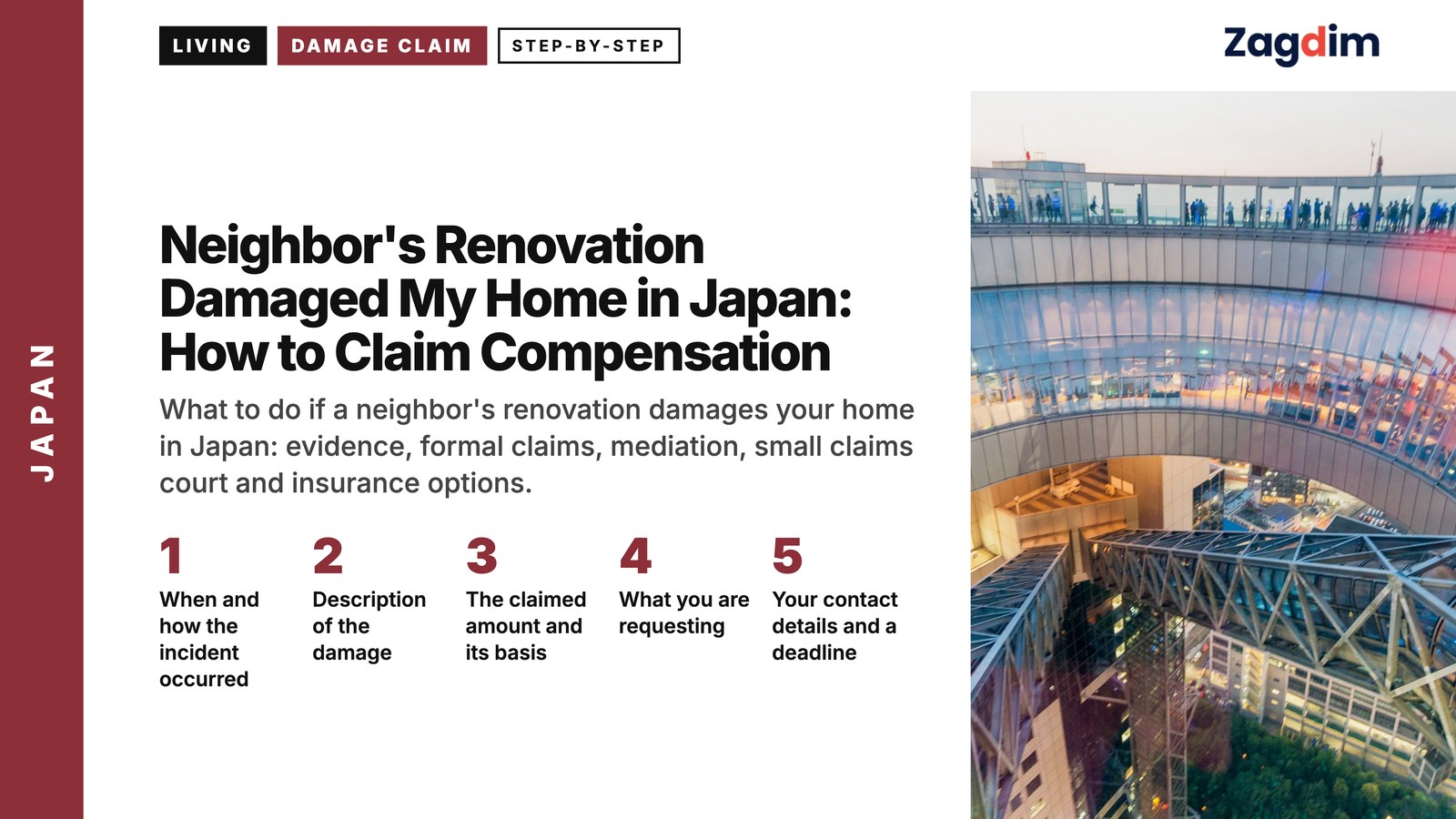
- When and how the incident occurred — e.g., “On [date] 2025, damage of such-and-such type occurred to our wall during the neighbor’s wall-breaking work.”
- Description of the damage (supported by photos or video) — e.g., “a wall crack of × cm; water leaking through the ceiling; cabinet tilting,” etc.
- The claimed amount and its basis — you can cite a repair quotation, a contractor’s estimate, or your own self-paid repair invoice or quote.
- What you are requesting (repair or monetary compensation) — e.g., “Please contact us within 14 days to confirm compensation, and complete repair or transfer payment within 30 days.”
- Your contact details and a deadline — clearly state the reply deadline and method (letter, phone or email).
Sending It by “Naiyo Shomei Yubin” (Content-Certified Mail — Legally Effective)
This is a special legal mail service provided by Japan Post, with the following features:
- The post office keeps a copy and a delivery record, proving when, to whom, and what content you sent
- If the matter later goes to mediation or court, this letter serves as strong evidence that you “reasonably notified the other party”
- You can handle this yourself at the post office, or have a lawyer send it on your behalf
A reminder: keep a copy for yourself before sending, or prepare a Japanese/Chinese bilingual copy as backup.
What If There Is Still No Response?
If, after your formal request, the other party continues to:
- Refuse to accept liability
- Delay and not respond
- Propose unreasonable conditions
then the following table sets out the information a damage claim letter should contain:
| Item | Japanese Field | Description | Filling Tip |
|---|---|---|---|
| 1. Sender’s name | 差出人氏名 | Name of the claimant | e.g., Wang Daming |
| 2. Sender’s address | 差出人住所 | Claimant’s address | e.g., a specific block/lot in Setagaya-ku, Tokyo |
| 3. Recipient’s name | 宛先氏名 | Name of the other party (neighbor or the responsible person at the construction company) | e.g., Tanaka Ichiro |
| 4. Recipient’s address | 宛先住所 | The other party’s address | e.g., address of the construction company or the neighbor |
| 5. Date damage occurred | 損害発生日 | When the incident occurred | e.g., May 8, 2025 |
| 6. Description of damage | 損害内容 | Specific damage description | e.g., crack on the north wall approximately 1.5 meters long; loosened decor, etc. |
| 7. Summary of evidence | 証拠概要 | List of evidence (can include images) | e.g., 5 damage photos, on-site video, 1 quotation |
| 8. Amount claimed | 請求金額 | Compensation or repair cost | e.g., JPY 132,000 (tax included) |
| 9. What is requested | 要求内容 | Whether payment or repair is requested | e.g., “Please pay compensation within 14 days, or have the construction company complete repairs” |
| 10. Reply deadline | 返答期限 | How many days the other party has to reply | recommended within 14 days, e.g., by May 22, 2025 |
| 11. Contact details | 連絡先 | Phone, email, etc. | e.g., 090-1234-5678 / [email protected] |
| 12. Date | 作成日 | Date the request letter is sent | e.g., May 8, 2025 |
| 13. Signature | 署名 | Claimant’s own signature | handwritten signature recommended, or company seal where applicable |
04 | Third-Party Mediation or Legal Process: What Are the Options?
Once you have sent a written request and the other party still does not respond, refuses to take responsibility, or offers unreasonable terms, the next step is to consider third-party mediation or a legal process. Below are three main options, graded by amount and complexity.
Option 1: Housing Dispute Resolution Support Center
(Japanese: 住宅紛争処理支援センター)
This is a professional mediation body backed by Japan’s Ministry of Land, Infrastructure, Transport and Tourism, specializing in housing sale, renovation and neighbor-damage disputes.
- Professional assistance: architects and lawyers act as mediators, protecting both parties’ interests
- Low cost: generally only JPY 1,000–10,000, depending on the case
- Fast processing: most cases resolve within 1–3 months
- Legally binding outcome: once both parties sign the mediated agreement, it has the effect of a contract
Suitable if you want a quick resolution while avoiding court, especially if you want to preserve the neighborly relationship.
A reminder: both parties must agree to participate for formal mediation to proceed; if the other party refuses to attend, you will need to consider legal channels instead.
Option 2: Small Claims Litigation
(Japanese: 少額訴訟)
Small claims litigation is a special one-hearing procedure that applies only where the damage amount you have assessed is JPY 600,000 or less; this is the most efficient court process.
| Item | Description |
|---|---|
| Jurisdiction | Summary Court (簡易裁判所) |
| Is a lawyer required? | Not mandatory — you can represent yourself |
| Number of hearings | Generally concluded in one hearing |
| Litigation cost | Roughly 1% of the claimed amount (e.g., claiming JPY 100,000 costs about JPY 1,000) |
| Processing time | Judgment typically within about 1 month |
| Enforceability after winning | Court-ordered enforcement can be applied for (such as wage or bank account garnishment) |
Suitable where the damage is clear, evidence is complete, the amount is low, and you want a fast resolution. Claims between JPY 600,001 and JPY 1.4 million are still heard at Summary Court, but follow the ordinary civil procedure rather than this special small-claims track.
Option 3: Ordinary Civil Litigation
(Damage amount exceeding JPY 1.4 million, heard at District Court)
If your loss is serious or the amount is higher, or the case involves structural safety, professional appraisal, third-party liability or similar issues, formal civil litigation is required.
- Longer timeline: roughly 3–12 months from preparation to judgment
- A lawyer is recommended: because the procedure is complex and the evidentiary standard is higher
- Higher cost: lawyer’s fees are separate, and court fees are charged proportionally to the claimed amount
- If you have “homeowner’s fire insurance” or “legal expense insurance,” part of the cost may be covered
Suitable where the loss is substantial, or you already have complete evidence and are willing to commit the time to pursue your rights.
Summary of Recommendations
| Case Type | Amount Range | Recommended Option | Characteristics |
|---|---|---|---|
| Minor repair (cracks, loosened corners) | JPY 10,000–100,000 | Mediation center | Low cost, fast processing |
| Medium damage (wall cracks, deformed decor) | JPY 100,001–600,000 | Small claims litigation (Summary Court, one-hearing track) | Single hearing, strong legal effect |
| Moderate damage | JPY 600,001–1,400,000 | Ordinary litigation at Summary Court | Not eligible for the small-claims track |
| Serious structural / full renovation loss | JPY 1,400,001+ | Ordinary litigation at District Court | Professional appraisal, lawyer involvement |
05 | Can Insurance Help? Both Your Policy and Theirs May Assist
Many people assume that if a neighbor’s construction damages their home, they can only “absorb the loss themselves” or “go to court.” In fact, in Japan, if either you or the other party holds certain types of insurance, the insurance system can be used to cover the loss, saving time and reducing conflict.
Below are the three most common types of insurance that may apply:
1. The Other Party’s “Construction Liability Insurance”
(Japanese: 施工会社の賠償責任保険)
If the damage to your home was caused by the construction company’s staff or equipment, that company likely already carries “third-party liability insurance” (第三者賠償責任保険), which covers neighboring-unit damage caused by construction negligence.
- It is worth directly asking the other party: “Does this construction project carry third-party liability insurance?”
- If they do have insurance, you can ask the contractor to have their insurer contact you and assist with repairs or compensation.
Where insurance is in place, processing is usually much faster than litigation, and you don’t need to advance the repair costs yourself first.
2. Your Own “Homeowner’s Fire Insurance (Including Supplementary Damage Coverage)”
(Japanese: 火災保険 + 住宅総合保険)
If the damage to your home can be classified as “building damage” or “interior damage,” some homeowner’s fire insurance policies also provide compensation, particularly if you have the following riders attached:
- “Compensation for damage caused by a neighboring fire or another person’s act”
- “Damage from an external object’s collision or fall”
Different policies vary greatly in their applicable terms, so contact your own insurer’s customer service directly to confirm, for example by asking: “Nearby construction work damaged my wall — is this damage covered by my policy?”
3. Your Own or the Other Party’s “Legal Expense Insurance”
(Japanese: 弁護士費用保険)
If you plan to pursue small claims or ordinary civil litigation, lawyer’s fees can become a significant burden.
However, if you (or a family member) have additional legal-support insurance, such as:
- JI Kyosai (Japan Judicial Cooperative)
- Bengoshi Hoken Mikata, Bengoshi Hoken Common, and similar products
these policies may fully or partially cover lawyer’s fees, litigation costs, and content-certified mail costs, giving you more confidence to pursue a reasonable claim.
A special note: some credit cards’ “housing damage support” clauses may also apply — it is worth checking these as well.
Don’t Forget to “Ask About Insurance First”
| Insurance Type | Who Holds It? | Coverage | Recommended Action |
|---|---|---|---|
| Construction liability insurance | The other party’s construction company | Damage to your home | Ask the other party to process it through insurance |
| Fire / homeowner’s comprehensive insurance | You | Damage to your own building | Call your own insurer to confirm |
| Legal expense insurance | You or family | Legal support costs | Check your policy or ask your credit card company |
Summary: Five Steps to Protect Your Rights in Japan
Facing damage caused by a neighbor’s renovation in Japan, as long as you keep clear evidence and follow clear steps, you have a real chance of legally securing compensation and repair. Here are five practical steps to guide you toward a reasonable resolution:
- Preserve evidence — Photograph and film the damaged areas, keep records of construction noise and conversations, and if necessary have a professional issue a simple assessment.
- Contact the other party to request compensation — Explain the situation calmly, ask whether they are willing to repair it or go through insurance, and keep a record of the conversation for later reference.
- Send a formal written request — Draft a “Damage Claim Letter” clearly listing the facts, evidence and amount, and it is recommended to send it via content-certified mail.
- Apply for mediation or file litigation — Options include the Housing Dispute Resolution Support Center (mediation), Summary Court (small claims litigation) or formal civil litigation, depending on the amount and complexity.
- Make use of insurance — This can include the contractor’s construction liability insurance, your own homeowner’s fire insurance, or legal expense insurance — any of these may become a powerful backer in your pursuit of a fair outcome.
Have a question about this guide? Leave a comment below, or ask Zagdim directly.
Your first stop for international property and global living.
Research and insights. Know what’s changing. Understand what matters.
Sources
- Japan Ministry of Land, Infrastructure, Transport and Tourism – introductory material on the Housing Dispute Resolution Support Center
- Japan’s Civil Code – Article 709, tort provisions and case interpretation
- Courts in Japan – guide to the small claims litigation system
- The General Insurance Association of Japan – explanation of the scope of homeowner’s fire insurance and liability insurance
- JI Kyosai – examples of using legal expense insurance
*This article compiles publicly available information and explanatory documents released between 2023 and 2025 by Japan’s official legal, insurance and dispute-mediation bodies, combined with practical guidance. Procedures and amounts described are based on the latest official information available at the time of writing; readers should consult a qualified professional or their insurer to confirm their own situation.*