
































Zagdim Overseas
Subscribe
  • Home
  • Real Estate & Economic News
    • All
    • Japan Market News
    • Other Market News
    • Thailand Market News
    • UK Market News
    • Vietnam Market News
    Singapore's Immigration & Checkpoints Authority (ICA) Commissioner at an official signing ceremony, with the Singapore state crest and national flag in the background

    Singapore Confirms Citizenship Age Threshold and Re-Entry Permit Conditions for PRs

    Matthew Pennycook, Minister of State at the UK's Ministry of Housing, Communities and Local Government, meets with housing-reform stakeholders as the department confirms mandatory property agent licensing and leasehold fee caps

    UK Government Confirms Property Agent Licensing and Leasehold Fee Caps

    A vacant undeveloped residential block in Victoria, Australia, with a developed suburb visible in the distance, illustrating the ATO land-banking enforcement case

    Foreign Investor Fined $508,000 as ATO Tightens Grip on Australian Land Banking

    Facade of Spain's Congreso de los Diputados in Madrid, where lawmakers vote Friday on whether the new housing decree survives

    Spain Approves New Housing Rules, but a Friday Vote Could Undo Them

    A DHS official speaks at the USCIS Headquarters groundbreaking ceremony

    USCIS More Than Doubles EB-5 Investor Visa Fees from 30 November

    The Eccles Building, headquarters of the U.S. Federal Reserve Board in Washington, DC, which released the draft stablecoin reserve and redemption rules

    Fed Proposes Detailed Stablecoin Reserve and Redemption Rules Under GENIUS Act

    Trending Tags

  • Zagdim Insights
    • All
    • Market Trends Overview
    • Policy Interpretation
    • Zagdim Insights
    Automated immigration gates at Suvarnabhumi Airport

    Thailand’s Suvarnabhumi Auto Gates Expand to 33 Nationalities: Full List, Eligibility and TDAC Guide

    1960 archive photo of Queen Sirikit at a gala concert in The Hague, with Bank of Thailand specimens of the THB100 and THB500 commemorative notes

    Thailand’s commemorative banknotes return in October: where to exchange the THB100 and THB500 notes

    Bangkok Aerial — Chao Phraya dusk, illustrating Thailand Joins Global Minimum Tax Information Exchange: What Businesses and Individuals Need to Know

    Thailand joins the global minimum tax information exchange: which businesses need to pay attention, and are individuals affected?

    A 2025 file photo of Australian Home Affairs Minister Tony Burke at a meeting, alongside Zagdim’s analysis title on Australia’s migration reforms.

    Australia announces migration reforms targeting student families, visa switching and longer stays

    China’s Entry-Exit Agency Rules: What Your Business Needs to Prepare. Paper folders labelled Deadlines, Documents and Partners, with a calendar, Chinese gateway and flight route. AI-generated illustration.

    China’s New Entry-Exit Agency Rules: What Your Business Needs to Prepare

    City of London skyline at sunset, illustrating UK New-Build Rules in 2026: Safety Levy, Staircases and the New EPC

    Three UK New-Build Thresholds for 2026: The Building Safety Levy, Second Staircases and the New EPC

    Zagdim Research cover: investigator setting up cameras in an empty Japanese apartment - Japan Prices Death Into Its Housing Market, and Buyers Have Begun to Bite

    Japan Prices Death Into Its Housing Market — and Buyers Have Begun to Bite

    Thailand to Cancel 60-Day Visa Exemption: What Long-Stay Options Are Available for Foreigners?

    Thailand to Cancel 60-Day Visa Exemption: What Long-Stay Options Are Available for Foreigners?

    Thailand Cabinet Approves Cancellation of 60-Day Visa Exemption for 93 Countries; Official Effective Date Still Pending Royal Gazette Publication

    Thailand Cabinet Approves Cancellation of 60-Day Visa Exemption for 93 Countries; Official Effective Date Still Pending Royal Gazette Publication

    • Zagdim Insights
    • Market Trends Overview
    • Policy Interpretation
  • Global Reports
    Zagdim Featured CBRE Thailand Mid-Year Outlook 2026

    CBRE Thailand Mid-Year Outlook: What Is Changing Across Six Real Estate Sectors?

    More Firms, a Busier First Half, a Softer Q2: What Vietnam’s Property Data Show, and Where ‘Repositioning’ Is a Reading

    More Firms, a Busier First Half, a Softer Q2: What Vietnam’s Property Data Show, and Where ‘Repositioning’ Is a Reading

    The Headline Number and the Real One: Reading UK Home Values After Inflation

    The Headline Number and the Real One: Reading UK Home Values After Inflation

    Tokyo’s Property Boom: How to Read AMRO’s ‘Warning, Not a Crisis’

    Tokyo’s Property Boom: How to Read AMRO’s ‘Warning, Not a Crisis’

    A Soft Summer for US Housing: What the Data Show, and Where ‘Hurting’ Is CNBC’s Word

    A Soft Summer for US Housing: What the Data Show, and Where ‘Hurting’ Is CNBC’s Word

    Malaysia’s Property Market Is Getting Choosier — What \”Selective\” Does and Doesn’t Say

    Malaysia’s Property Market Is Getting Choosier — What \”Selective\” Does and Doesn’t Say

    72% at the Top: What Mainland Buyer-Share Data Say About Hong Kong Property — and What They Don’t

    72% at the Top: What Mainland Buyer-Share Data Say About Hong Kong Property — and What They Don’t

    Hong Kong Home Prices Are Up ~10% This Year — but Can the Rebound Last Without Local Owners?

    Hong Kong Home Prices Are Up ~10% This Year — but Can the Rebound Last Without Local Owners?

    193 Deals in Dubai, 94 in Hong Kong: Reading a Super-Prime Quarter Without Calling It a Cycle

    193 Deals in Dubai, 94 in Hong Kong: Reading a Super-Prime Quarter Without Calling It a Cycle

  • Buying & Immigration Guide
    • All
    • Expat Lifestyle Guide
    • International Property Buying Guide
    • Overseas Leasing & Long-Term Stay
    • Real Estate Law & Taxation
    • Relocation, Immigration & Visa
    Five things a first-time overseas buyer must settle before buying in London: entry (SDLT and the two surcharges), financing (interest relief capped at 20%), holding (NRLS and letting compliance), title (leasehold and building safety), exit (NRCGT and your treaty position)

    Is London property worth buying? Five things a first-time overseas buyer must settle first

    Night — Dotonbori canal at night with neon signs, illustrating Japan's 2026 Condominium Law Reform: What Overseas Owners Need to Know

    Japan’s Revised Condominium Ownership Act (2026): What Overseas Owners Need to Know About Voting Rights, Resolutions, and the New Domestic Manager Requirement

    Before You Buy Property in Vietnam: Eligible Assets, Prohibited Categories, and How Land Rights Actually Work for Overseas Buyers

    Before You Buy Property in Vietnam: Eligible Assets, Prohibited Categories, and How Land Rights Actually Work for Overseas Buyers

    Buying Property in London: Key Risks to Check Before You Exchange — Leasehold, Service Charges, Off-Plan Deposits, and Contracts

    Buying Property in London: Key Risks to Check Before You Exchange — Leasehold, Service Charges, Off-Plan Deposits, and Contracts

    Opening a UK Bank Account as an Overseas Resident: Identity, Address, and What to Check Before You Apply

    Opening a UK Bank Account as an Overseas Resident: Identity, Address, and What to Check Before You Apply

    Street lamp under a tree, illustrating Residential Mortgages for Foreign Buyers in the UK: What Lenders Check

    UK Residential Mortgage Readiness for Overseas Buyers: What Lenders Check on Income, Status, and Deposit

    How should overseas owners manage and rent out property in Japan after purchase?

    How should overseas owners manage and rent out property in Japan after purchase?

    The retirees who no longer want to renew their Thai visa every year

    The retirees who no longer want to renew their Thai visa every year

    Same retirement age, different Thailand residence choices: Retirement O, LTR, and Thailand Privilege

    Same retirement age, different Thailand residence choices: Retirement O, LTR, and Thailand Privilege

    Trending Tags

  • About
    • Ask Questions
    • Zagdim Research
    • Contact Us — LINE / WhatsApp
  • 中文 EN
No Result
View All Result
Zagdim
  • Home
  • Real Estate & Economic News
    • All
    • Japan Market News
    • Other Market News
    • Thailand Market News
    • UK Market News
    • Vietnam Market News
    Singapore's Immigration & Checkpoints Authority (ICA) Commissioner at an official signing ceremony, with the Singapore state crest and national flag in the background

    Singapore Confirms Citizenship Age Threshold and Re-Entry Permit Conditions for PRs

    Matthew Pennycook, Minister of State at the UK's Ministry of Housing, Communities and Local Government, meets with housing-reform stakeholders as the department confirms mandatory property agent licensing and leasehold fee caps

    UK Government Confirms Property Agent Licensing and Leasehold Fee Caps

    A vacant undeveloped residential block in Victoria, Australia, with a developed suburb visible in the distance, illustrating the ATO land-banking enforcement case

    Foreign Investor Fined $508,000 as ATO Tightens Grip on Australian Land Banking

    Facade of Spain's Congreso de los Diputados in Madrid, where lawmakers vote Friday on whether the new housing decree survives

    Spain Approves New Housing Rules, but a Friday Vote Could Undo Them

    A DHS official speaks at the USCIS Headquarters groundbreaking ceremony

    USCIS More Than Doubles EB-5 Investor Visa Fees from 30 November

    The Eccles Building, headquarters of the U.S. Federal Reserve Board in Washington, DC, which released the draft stablecoin reserve and redemption rules

    Fed Proposes Detailed Stablecoin Reserve and Redemption Rules Under GENIUS Act

    Trending Tags

  • Zagdim Insights
    • All
    • Market Trends Overview
    • Policy Interpretation
    • Zagdim Insights
    Automated immigration gates at Suvarnabhumi Airport

    Thailand’s Suvarnabhumi Auto Gates Expand to 33 Nationalities: Full List, Eligibility and TDAC Guide

    1960 archive photo of Queen Sirikit at a gala concert in The Hague, with Bank of Thailand specimens of the THB100 and THB500 commemorative notes

    Thailand’s commemorative banknotes return in October: where to exchange the THB100 and THB500 notes

    Bangkok Aerial — Chao Phraya dusk, illustrating Thailand Joins Global Minimum Tax Information Exchange: What Businesses and Individuals Need to Know

    Thailand joins the global minimum tax information exchange: which businesses need to pay attention, and are individuals affected?

    A 2025 file photo of Australian Home Affairs Minister Tony Burke at a meeting, alongside Zagdim’s analysis title on Australia’s migration reforms.

    Australia announces migration reforms targeting student families, visa switching and longer stays

    China’s Entry-Exit Agency Rules: What Your Business Needs to Prepare. Paper folders labelled Deadlines, Documents and Partners, with a calendar, Chinese gateway and flight route. AI-generated illustration.

    China’s New Entry-Exit Agency Rules: What Your Business Needs to Prepare

    City of London skyline at sunset, illustrating UK New-Build Rules in 2026: Safety Levy, Staircases and the New EPC

    Three UK New-Build Thresholds for 2026: The Building Safety Levy, Second Staircases and the New EPC

    Zagdim Research cover: investigator setting up cameras in an empty Japanese apartment - Japan Prices Death Into Its Housing Market, and Buyers Have Begun to Bite

    Japan Prices Death Into Its Housing Market — and Buyers Have Begun to Bite

    Thailand to Cancel 60-Day Visa Exemption: What Long-Stay Options Are Available for Foreigners?

    Thailand to Cancel 60-Day Visa Exemption: What Long-Stay Options Are Available for Foreigners?

    Thailand Cabinet Approves Cancellation of 60-Day Visa Exemption for 93 Countries; Official Effective Date Still Pending Royal Gazette Publication

    Thailand Cabinet Approves Cancellation of 60-Day Visa Exemption for 93 Countries; Official Effective Date Still Pending Royal Gazette Publication

    • Zagdim Insights
    • Market Trends Overview
    • Policy Interpretation
  • Global Reports
    Zagdim Featured CBRE Thailand Mid-Year Outlook 2026

    CBRE Thailand Mid-Year Outlook: What Is Changing Across Six Real Estate Sectors?

    More Firms, a Busier First Half, a Softer Q2: What Vietnam’s Property Data Show, and Where ‘Repositioning’ Is a Reading

    More Firms, a Busier First Half, a Softer Q2: What Vietnam’s Property Data Show, and Where ‘Repositioning’ Is a Reading

    The Headline Number and the Real One: Reading UK Home Values After Inflation

    The Headline Number and the Real One: Reading UK Home Values After Inflation

    Tokyo’s Property Boom: How to Read AMRO’s ‘Warning, Not a Crisis’

    Tokyo’s Property Boom: How to Read AMRO’s ‘Warning, Not a Crisis’

    A Soft Summer for US Housing: What the Data Show, and Where ‘Hurting’ Is CNBC’s Word

    A Soft Summer for US Housing: What the Data Show, and Where ‘Hurting’ Is CNBC’s Word

    Malaysia’s Property Market Is Getting Choosier — What \”Selective\” Does and Doesn’t Say

    Malaysia’s Property Market Is Getting Choosier — What \”Selective\” Does and Doesn’t Say

    72% at the Top: What Mainland Buyer-Share Data Say About Hong Kong Property — and What They Don’t

    72% at the Top: What Mainland Buyer-Share Data Say About Hong Kong Property — and What They Don’t

    Hong Kong Home Prices Are Up ~10% This Year — but Can the Rebound Last Without Local Owners?

    Hong Kong Home Prices Are Up ~10% This Year — but Can the Rebound Last Without Local Owners?

    193 Deals in Dubai, 94 in Hong Kong: Reading a Super-Prime Quarter Without Calling It a Cycle

    193 Deals in Dubai, 94 in Hong Kong: Reading a Super-Prime Quarter Without Calling It a Cycle

  • Buying & Immigration Guide
    • All
    • Expat Lifestyle Guide
    • International Property Buying Guide
    • Overseas Leasing & Long-Term Stay
    • Real Estate Law & Taxation
    • Relocation, Immigration & Visa
    Five things a first-time overseas buyer must settle before buying in London: entry (SDLT and the two surcharges), financing (interest relief capped at 20%), holding (NRLS and letting compliance), title (leasehold and building safety), exit (NRCGT and your treaty position)

    Is London property worth buying? Five things a first-time overseas buyer must settle first

    Night — Dotonbori canal at night with neon signs, illustrating Japan's 2026 Condominium Law Reform: What Overseas Owners Need to Know

    Japan’s Revised Condominium Ownership Act (2026): What Overseas Owners Need to Know About Voting Rights, Resolutions, and the New Domestic Manager Requirement

    Before You Buy Property in Vietnam: Eligible Assets, Prohibited Categories, and How Land Rights Actually Work for Overseas Buyers

    Before You Buy Property in Vietnam: Eligible Assets, Prohibited Categories, and How Land Rights Actually Work for Overseas Buyers

    Buying Property in London: Key Risks to Check Before You Exchange — Leasehold, Service Charges, Off-Plan Deposits, and Contracts

    Buying Property in London: Key Risks to Check Before You Exchange — Leasehold, Service Charges, Off-Plan Deposits, and Contracts

    Opening a UK Bank Account as an Overseas Resident: Identity, Address, and What to Check Before You Apply

    Opening a UK Bank Account as an Overseas Resident: Identity, Address, and What to Check Before You Apply

    Street lamp under a tree, illustrating Residential Mortgages for Foreign Buyers in the UK: What Lenders Check

    UK Residential Mortgage Readiness for Overseas Buyers: What Lenders Check on Income, Status, and Deposit

    How should overseas owners manage and rent out property in Japan after purchase?

    How should overseas owners manage and rent out property in Japan after purchase?

    The retirees who no longer want to renew their Thai visa every year

    The retirees who no longer want to renew their Thai visa every year

    Same retirement age, different Thailand residence choices: Retirement O, LTR, and Thailand Privilege

    Same retirement age, different Thailand residence choices: Retirement O, LTR, and Thailand Privilege

    Trending Tags

  • About
    • Ask Questions
    • Zagdim Research
    • Contact Us — LINE / WhatsApp
  • 中文 EN
No Result
View All Result
Zagdim
No Result
View All Result

Malaysia Bank KYC Explained: Due Diligence for Foreign Account Holders

Home Living Abroad
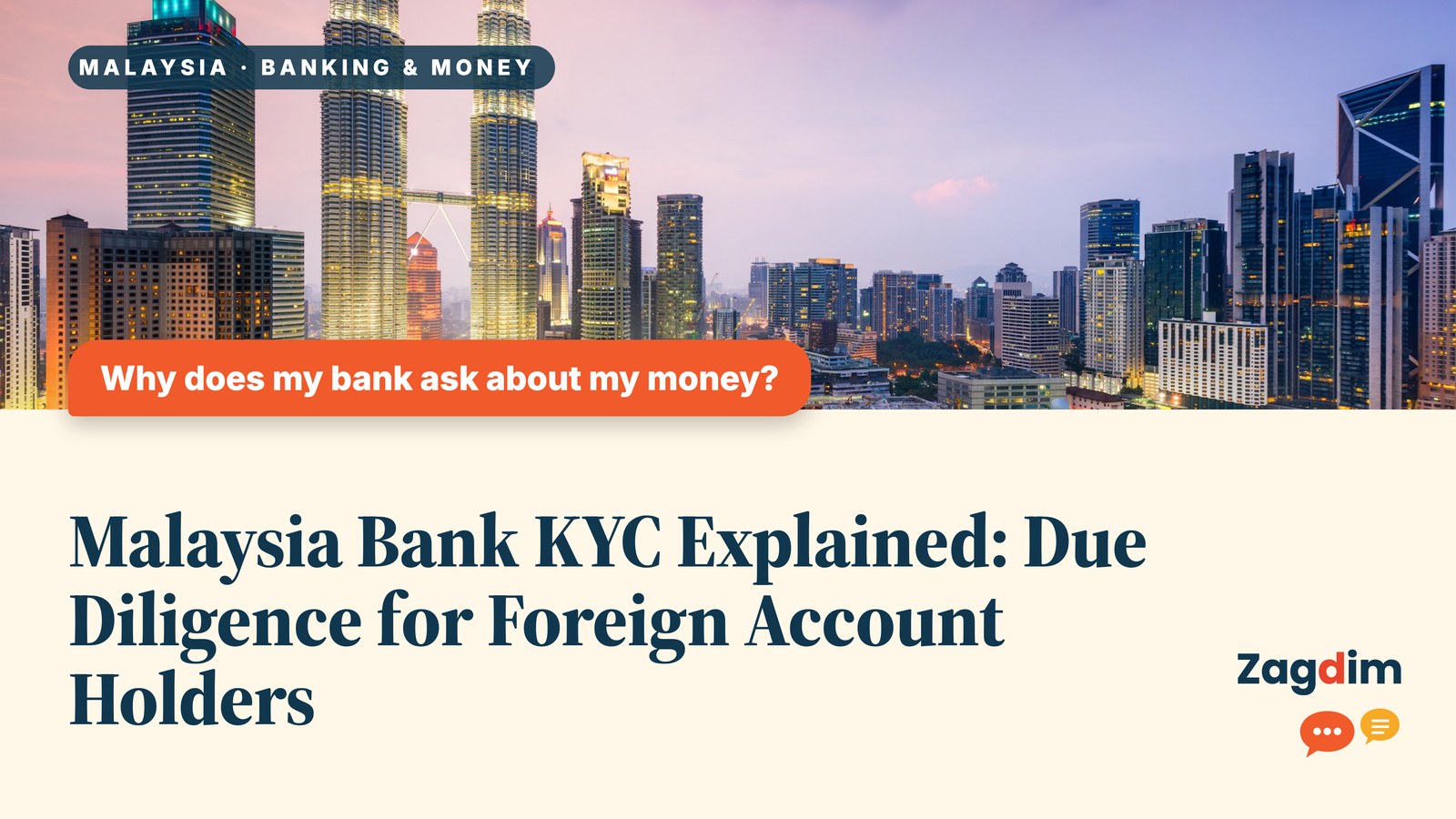
Kuala Lumpur skyline at twilight with Petronas Towers, illustrating Malaysia Bank KYC Explained: Due Diligence for Foreign Account Holders

Image: Zagdim

September 29, 2026
in Living Abroad, Malaysia, Visa & Immigration
Reading Time: 11 mins read
Tags: Banking & Money

When you are preparing to open a bank account in Malaysia, remit funds to buy property, or arrange capital for a company, the bank will often ask where the money comes from, what it will be used for, and what relationship exists between the payer and the recipient.

These questions are usually part of the bank’s customer due diligence. Understanding in advance what the bank needs to confirm lets a customer prepare documents more precisely and plan the timing of payments.

KYC is not something you fill in only once, when opening an account. As income, place of residence, or the purpose of a transaction changes, the bank may need to update its records. This article explains the system, what is actually reviewed, and three common scenarios, to help foreign customers prepare for smoother account opening and fund arrangements.

Three Questions This Article Answers First

  • Why does the bank need to review this: what roles do the law, regulatory requirements, and bank policy each play?
  • What does KYC check: how do identity, beneficial ownership, source of funds, and ongoing review differ?
  • How should a customer prepare: what information should be provided when opening an account, remitting funds, or responding to a review notice?

Who Needs to Understand KYC?

The first group is people preparing to open an account, or who have been asked for more documents or had an application declined. The second is people planning to remit funds for a property purchase, fixed deposit, or company investment, who need to allow time for document verification and processing. The third is existing account holders who have received a request from the bank to update information or explain a transaction.

The depth of review does not depend on the amount alone; it also considers the background of the transaction, the regions involved, the flow of funds, and whether the transaction matches what the bank already knows about the customer. A large amount from a property sale, with a clear source and remittance trail, may not be harder to process than a smaller transaction with a vague background.

Where the System Comes From: AMLA, BNM, and FATF

The main legal basis in Malaysia is the Anti-Money Laundering, Anti-Terrorism Financing and Proceeds of Unlawful Activities Act 2001 (AMLA 2001). Banks are regulated reporting institutions with obligations to carry out customer due diligence, keep records, and report suspicious transactions.

Bank Negara Malaysia (BNM) sets out specific requirements for the financial institutions it regulates. Current policy covers anti-money laundering, counter-terrorism financing, counter-proliferation financing, and targeted financial sanctions, so a bank’s review is not limited to whether the money “comes from crime.”

At the international level, Malaysia became a full FATF member in February 2016. FATF and the APG published their latest mutual evaluation of Malaysia in 2025, reflecting that the system and its enforcement continue to be reviewed. FATF does not directly approve an individual’s bank account; the actual handling remains up to each bank under applicable rules and policy.

In addition, some lawyers, accountants, company secretaries, and real estate agents carry anti-money-laundering obligations when conducting specified business or transactions. So it is not unusual to receive similar document requests when buying property or setting up a company.

What KYC Checks: Four Elements Plus One Separate Obligation

KYC is the common shorthand for “know your customer”; in regulatory documents, the requirement is usually described as customer due diligence (CDD). The parts most directly relevant to a customer can be broken into four areas.

First, confirming identity. For an individual, this usually involves a passport, residency status, address, and occupation; for a company, it involves registration details, directors, authorized persons, and shareholding structure. The exact documents required can vary by account and bank.

Second, identifying the person who ultimately owns or controls the account. A corporate account is not assessed by company name alone; the bank also needs to understand the natural persons behind it, and whether anyone is holding or operating the account on behalf of someone else. Beneficial ownership cannot be determined simply from the bank’s list of authorized signatories.

Third, understanding the purpose and background of the funds. The bank may ask about expected payees and payers, the regions involved, the type of income, and the source of funds. Two concepts are often confused here:

  • Source of funds: how this particular deposit or transfer was obtained, for example salary savings, a property sale, dividends, or a loan.
  • Source of wealth: how the person’s overall assets were built up over time, for example years of running a business, investments, or inheritance.

How deep the bank needs to go depends on applicable rules and the risk assessment. A customer’s explanation can be a starting point, but the bank may still require reliable documents or other information to verify it. Bank statements can show where money moved, but may not on their own prove its original source; a property sale contract may need to be reviewed together with completion and payment records.

Fourth, ongoing update and review. After an account is opened, the bank continues to check whether transactions match the customer’s known background and to update information. A review may be scheduled periodically, or triggered by a change in information or a particular transaction; it does not necessarily mean there is a problem with the account.

Separately, where the conditions for a suspicious transaction report are met, the bank must submit a Suspicious Transaction Report (STR) to the relevant authority. Being asked for more documents does not mean the bank has already filed an STR, and an STR itself is not a finding of a crime. Such reports are subject to confidentiality and tipping-off restrictions, so the bank may not be able to disclose its internal assessment in full.

Higher-risk situations may require enhanced due diligence (EDD). Politically exposed persons (PEPs) are also subject to specific measures, handled according to applicable foreign, domestic, or international-organization status and risk rules; this classification alone does not imply any wrongdoing.

Three Scenarios: When Foreigners Get Asked Questions

Scenario One: Opening an Account

The bank needs to understand the applicant’s identity, purpose for opening the account, and expected use. A foreign customer’s employer, residence, or funds may be spread across different regions, so additional documents are sometimes needed.

It can help to explain the genuine purpose to the target bank in advance, for example receiving a Malaysian salary, covering living expenses, or holding investments, then confirm the corresponding documents. Foreign nationality alone does not automatically mean being classified as high risk, and having complete documents does not guarantee approval either.

Scenario Two: Remittances and Large Transactions

Buying property, making a fixed deposit, injecting capital into a company, or remitting funds after selling an asset can all involve verification of purpose and source. The bank may also need to confirm the relationship between the remitter, the recipient, and the transaction documents.

Before arranging a payment, organize the contract, source of funds, and remittance records, then confirm with the bank whether early submission is needed. If a payment has a contractual deadline, allow extra processing time; contacting the bank early helps with preparation, but does not guarantee the transaction will be completed on time.

Scenario Three: Account Review After Opening

Changing a passport, renewing a visa, changing jobs, moving house, or starting to receive rental income can all trigger a need to update bank information. The bank may also carry out a periodic review even without any major change.

On receiving a notice, first verify the request through the bank’s official channels, then respond within the deadline. If documents are not yet ready, explain what is missing and confirm an arrangement for submitting them later.

If the bank cannot complete the necessary review, it may delay a transaction, restrict certain services, or end the business relationship; the actual outcome depends on the rules and the individual case, and not every request for more documents leads step by step to account closure.

Common Misconceptions About KYC

Misconception One: “If the Bank Asks About My Source of Funds, It Must Think I’ve Done Something Wrong”

Routine identity verification, periodic updates, and transaction explanations are all part of a bank’s normal review process. Being asked a question alone does not mean the bank has concluded there is money laundering involved.

You can ask the bank to specify what information is needed, which transaction it relates to, and the submission deadline, so you can prepare accordingly.

Misconception Two: “I’m a Small Customer, So I Won’t Be Checked”

KYC does not apply only to large customers. Amount, transaction pattern, background, and other risk factors can all affect the review.

Some systems do set transaction or reporting thresholds, but there is no general safe line below which no explanation is ever needed, and transactions should not be deliberately split to avoid review.

Misconception Three: “I Explained It When I Opened the Account, So I Don’t Need to Again”

Banks need to keep information current. An employment letter from years ago may not explain today’s proceeds from a property sale, and an original salary account may not reflect newly added business income.

Keeping important income and transaction documents on hand is more convenient than searching for them again each time the bank asks.

Misconception Four: “I Can Avoid KYC by Switching to a Different Bank”

Different banks may have different customer policies, products, and processes, but the basic due diligence obligation still applies.

If one bank declines an application, you can find out whether it can be supplemented, or check with another suitable bank. Consistent, truthful information should still be provided, and you should not rewrite the background of your funds to suit different banks.

Misconception Five: “If Someone Helps ‘Package’ the Source of Funds Nicely, It Will Get Through”

Professional assistance can include organizing documents, translation, explaining a legitimate transaction, and filling gaps in records, but it cannot involve fabricating contracts, misstating the purpose, or concealing the true payer.

If funds come from a gift, inheritance, or years of accumulated savings, explaining the actual situation directly and confirming what proof the bank will accept is more reliable than using an account that does not match the facts.

Three Typical Scenarios: Getting Through KYC Smoothly

Scenario One: An MM2H Family Preparing Fixed Deposit and Property Funds

Family B’s funds come from selling an overseas property and years of savings. They separately organize the sale contract, completion payment, bank records, and income documents supporting the savings, then confirm the arrangements for receiving the fixed deposit and property payment.

If part of the funds comes from a spouse or other family member, they also explain the relationship and the nature of the payment, rather than only showing the final transfer without being able to explain what came before it.

Scenario Two: An Employment Pass Holder Who Starts Earning Rental Income

Mr. A originally used his account mainly to receive salary, and later bought a property to rent out. He keeps the lease and rental records, and updates his income and purpose information as required by the bank.

If he later has consulting or other business income, besides the bank account’s purpose, he also needs to confirm his work permit and any business qualification and tax arrangements. Updating KYC information by itself does not grant permission to carry out the related work.

Scenario Three: A Company Asked to Explain a Large Incoming Payment

Company C receives a large payment that differs from its usual business income. The directors first confirm whether it is a customer payment, shareholder capital injection, or a shareholder loan, then provide the corresponding documents.

A customer payment can be matched with the contract, invoice, and delivery records; a capital injection or loan is supported with a company resolution, share or loan documents, and information about the payer’s background. Documents should match the actual nature of the transaction; not every incoming payment can be explained with a single invoice.

FAQ: Malaysia Bank KYC

Q1: Why can the bank ask about my source of funds?

The bank must understand the customer and the transaction under applicable AMLA and BNM requirements, and verify the source of funds where needed. The specific questions and depth of documentation vary by transaction and risk.

If a requirement is unclear, you can ask the bank to specify what information is needed and its purpose, and submit it through official channels.

Q2: What documents help explain a source of funds?

Common examples include salary and income records, bank statements, property sale and completion documents, dividend vouchers, investment transaction records, and inheritance or gift documents.

The key is being able to show how the money was obtained and how it reached the current account. A single document may not be enough, and not every request requires submitting everything at once.

Q3: Will I be classified as a high-risk customer?

This is assessed by the bank based on applicable rules and the customer’s background, which may consider business, regions involved, products, transactions, and shareholding structure. It cannot be concluded from foreign nationality or a single amount alone.

Providing complete, truthful information helps with an accurate assessment, but does not guarantee a particular risk rating.

Q4: How should I respond to a bank review request?

First confirm the notice is genuine, then respond to each question with the supporting documents. If you cannot provide something in time, explain proactively and confirm how and when it can be submitted.

Keep the versions you submit and your correspondence; if a request is unclear, ask what is missing first, rather than repeatedly submitting unrelated documents.

Q5: Will KYC keep getting stricter?

This cannot be predicted across the board. The regulatory direction emphasizes matching the level of scrutiny to risk, so higher-risk situations require more verification while lower-risk situations may also see simplified or more convenient arrangements.

For a customer, the more practical approach is to keep information updated, keep important transaction documents, and confirm bank requirements before arranging any payment with a deadline.

Q6: Besides banks, who else might ask for this kind of information?

Lawyers, accountants, company secretaries, and real estate agents may also need to identify a customer, beneficial owner, or verify the background of funds when conducting regulated, specified business.

Whether this applies and what information is needed depends on the service and the scope of the transaction; it cannot be assumed that any information request from someone in a particular industry always has the same basis.

Disclaimer

This article is based on publicly available systems and guidance verified as of September 2026 and does not constitute individual legal or compliance advice. Product policies, document requirements, and review processes can vary by bank. For specific account opening, review, or transactions with a payment deadline, confirm the applicable requirements with the bank and, if necessary, seek help from a qualified professional.

Related in this series:

  • Sending Money Into and Out of Malaysia: What to Prepare First
  • Proving Source of Funds in Malaysia: Property, Banking and Visas
  • Life After Malaysia PR: Work, Property, Family and Travel Rules
  • Malaysia PR vs MM2H vs Work Visa vs Spouse Visa: Which Fits You

Have a question about this guide? Leave a comment below, or ask Zagdim directly.

Life abroad? Ask Zagdim.

Your first stop for international property and global living.

Research and insights. Know what’s changing. Understand what matters.

Sources

  • BNM — AML/CFT/CPF and Targeted Financial Sanctions Policy for Financial Institutions
  • BNM — Customer Due Diligence FAQ for DNFBPs and NBFIs
  • BNM — International Engagement
  • BNM — FATF Recognition of Malaysia’s AML/CFT/CPF Framework
  • FATF — Malaysia
  • FATF/APG — Mutual Evaluation Report of Malaysia 2025
  • HSBC Malaysia — Business Account Opening Requirements

Zagdim AI
All content is researched, written, or authorized for publication by the @Zagdim Overseas team. Sharing and reposting are welcome, but please make sure to credit the source and include the original article link from this website. Any plagiarism or unauthorized use may result in legal action. For article submissions, please contact us via Facebook. Thank you for your support!

For article submissions, press release publication, or interview notices, please contact [email protected]. 

Zagdim Ask

Have a specific question about overseas living, property, visa, or practical arrangements?

Fill in your situation and key concerns through Zagdim Ask. Our team will review your message and get back to you by email where appropriate.

Submit your enquiry →

Similar Topics

Singapore's Immigration & Checkpoints Authority (ICA) Commissioner at an official signing ceremony, with the Singapore state crest and national flag in the background
News

Singapore Confirms Citizenship Age Threshold and Re-Entry Permit Conditions for PRs

October 1, 2026
Matthew Pennycook, Minister of State at the UK's Ministry of Housing, Communities and Local Government, meets with housing-reform stakeholders as the department confirms mandatory property agent licensing and leasehold fee caps
News

UK Government Confirms Property Agent Licensing and Leasehold Fee Caps

October 1, 2026
A vacant undeveloped residential block in Victoria, Australia, with a developed suburb visible in the distance, illustrating the ATO land-banking enforcement case
News

Foreign Investor Fined $508,000 as ATO Tightens Grip on Australian Land Banking

October 1, 2026
Next Post
Panoramic daytime view of the Kuala Lumpur skyline, illustrating What to Do Every Year After Setting Up a Company in Malaysia

What to Do Every Year After Setting Up a Company in Malaysia

Modern building interior with oculus roof Kuala Lumpur, illustrating Malaysia Company Director Liability: Duties and Signing Authority

Malaysia Company Director Liability: Duties and Signing Authority

Aerial view of KLCC towers and park, illustrating Malaysia Corporate Tax Explained: Income Tax, SST and Withholding Tax

Malaysia Corporate Tax Explained: Income Tax, SST and Withholding Tax

Facebook Twitter Youtube

About Us

Zagdim is a global knowledge platform focused on cross-border property, relocation, lifestyle, and location-based decision-making.

We provide insights on overseas real estate, market trends, regional analysis, economic developments, and practical relocation information. Through continuous market observation and on-the-ground research, Zagdim helps readers better understand a place before deciding where to live, invest, buy property, or establish a base abroad.

We currently follow markets including the UK, Japan, Thailand, Malaysia, Germany, Australia, the UAE, Greece, Portugal, and Spain, while continuing to track emerging lifestyle, relocation, and property trends worldwide.

Category

  • Australia
  • Buying & Immigration Guide
  • Cambodia
  • Canada
  • Costa Rica
  • Dubai
  • Encyclopedia
  • Europe
  • Expat Lifestyle Guide
  • Germany
  • Global Reports Analysis
  • Hong Kong
  • Human-Picked
  • Indonesia
  • International Property Buying Guide
  • Japan
  • Japan Market News
  • Kenya
  • Living Abroad
  • Malaysia
  • Mallorca
  • Market Trends Overview
  • News
  • Other Market News
  • Overseas Leasing & Long-Term Stay
  • Philippines
  • Policy Interpretation
  • Portugal
  • Property
  • Property Law & Tax
  • Real Estate & Economic News
  • Real Estate Law & Taxation
  • Relocation, Immigration & Visa
  • Singapore
  • South Korea
  • Spain
  • Switzerland
  • Thailand
  • Thailand Market News
  • UK Market News
  • United Kingdom
  • United States
  • Vietnam
  • Vietnam Market News
  • Visa & Immigration
  • Zagdim Insights
  • Zagdim Property Insights

Email:[email protected]


Add Friends


WhatsApp
Contact Us


Wechat:Zagdim

Work with Zagdim

Put your brand inside the overseas property research process — in English and in Chinese. Reaching buyers, expats and investors across 19 markets.

View partnership packages →

©2026 Zagdim Overseas All Right Reserved

No Result
View All Result
  • Home
  • Zagdim Property Insights
    • Market Trends Overview
    • Policy Interpretation
    • Forest
    • PLACEHOLDER sub-cate for Zagdim Property Insights
  • Global Reports Analysis
    • In-Depth Project Analysis
  • Real Estate & Economic News
    • Thailand Market News
    • UK Market News
    • Germany Market News
    • Japan Market News
  • Buying & Immigration Guide
    • Expat Lifestyle Guide
    • Real Estate Law & Taxation
    • Overseas Leasing & Long-Term Stay
    • Starting a Business & Company Setup
  • Zagdim Ask
  • 中文 EN

©2026 Zagdim Overseas All Right Reserved