





























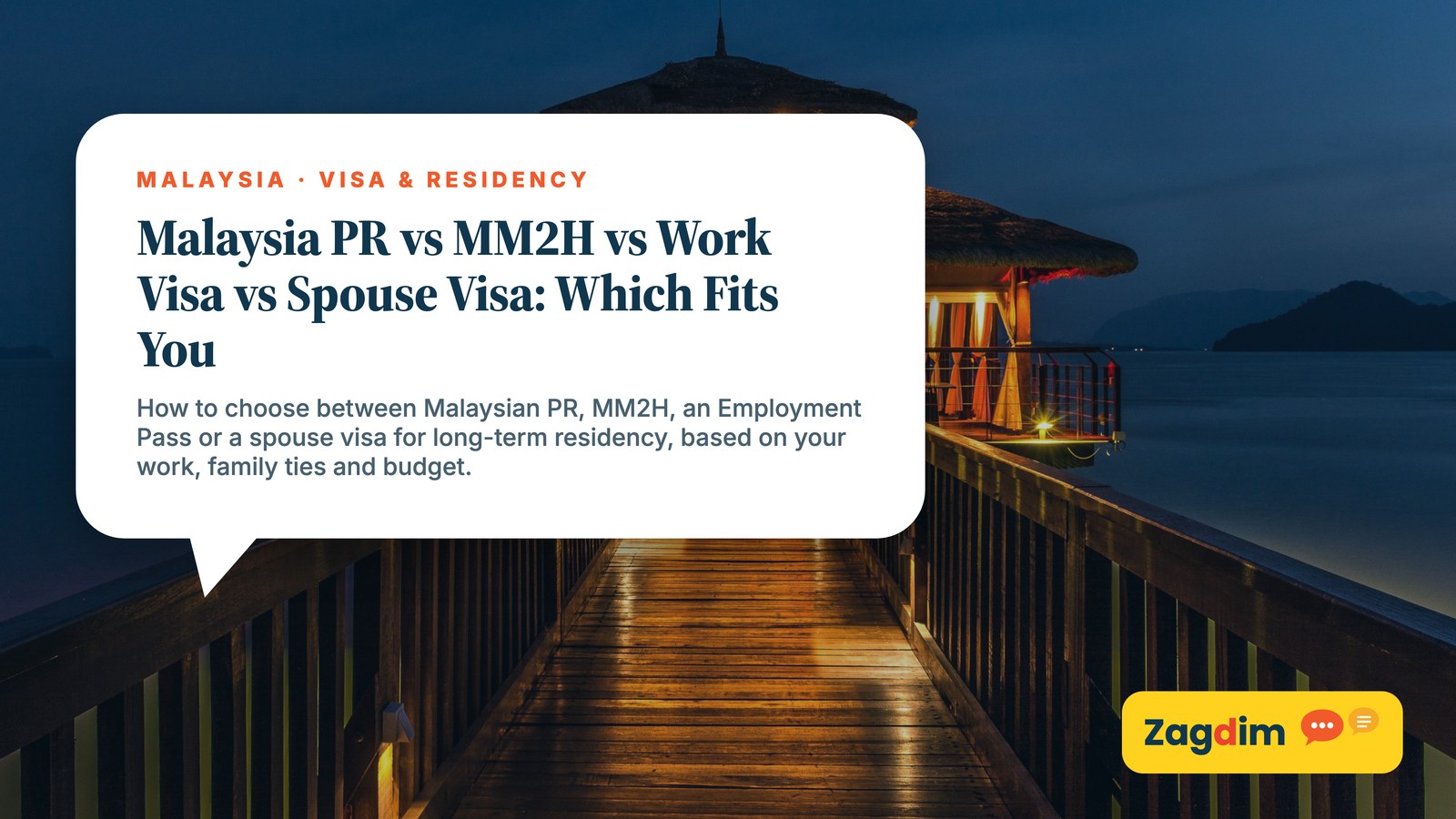
If you are planning a long stay in Malaysia, it helps to start with three questions: do you need to work locally, are you already married to a Malaysian citizen, and can you afford the funding requirements of a long-stay program.
Permanent Residence (PR), MM2H, the Employment Pass, and a spouse-based Long Term Social Visit Pass (LTSVP) each serve a different purpose and come with their own eligibility bar. Your life goals can narrow the field, but you still need to confirm which requirements you actually meet.
In this article, “spouse-based LTSVP” refers specifically to the Long Term Social Visit Pass applied for by the foreign spouse of a Malaysian citizen.
Want Residency With No Time Limit? Start by Assessing PR
If your goal is to settle long-term and stop relying on a time-limited pass, it is worth learning about Permanent Resident (PR) status.
The Entry Permit issued by the Malaysian Immigration Department allows a foreigner to reside in Malaysia legally with no time restriction, though it can still be revoked if the holder breaches the conditions attached to it. Before applying, you must first confirm which application category you actually qualify under.
On processing time, the Minister of Home Affairs told Parliament in February 2026 that, since September 2025, there has been a service commitment to decide new applications within six months. This commitment does not mean an application will necessarily be approved, and it cannot be used to guarantee the date any individual applicant will receive PR.
Because of this, while preparing a PR application, you should also arrange legal residency for the waiting period itself; do not stake a move, a job, or a child’s school enrollment entirely on your expected approval date.
Want to Live Long-Term and Can Meet the Funding and Renewal Requirements? Look Into MM2H
If your main goal is long-term living and you are willing to allocate funds according to the program’s requirements, it is worth looking further into Malaysia My Second Home (MM2H).
This article discusses the federal MM2H program. The term, financial requirements and other conditions differ by category, so before applying you should check the fixed deposit, property purchase, fees and applicable residency requirements together, not just compare the validity periods of the passes.
MM2H itself is not permanent residency. Do not understand participating in the program, or living in Malaysia long-term under it, as something that automatically leads to PR later. If you also intend to apply for PR, you still need to check your eligibility under the relevant category separately.
If you also plan to work, check the rules for the category you choose. For example, the official Platinum category page lists arrangements that allow business, investment and employment activity; do not assume all MM2H categories carry the same work rights.
Already Have a Local Job Offer? Check the Employment Pass First
If you intend to be employed by a company in Malaysia, the Employment Pass (EP) is one of the common work passes. The application is usually handled by the company that intends to hire you, so the first thing to confirm is whether the employer, the position and the application conditions meet the requirements.
The EP has a validity period, and the holder may only work for the company named on the pass. Changing employers requires a fresh application; you cannot simply carry the original pass over to work for a different company.
Whether you can apply for PR later should be assessed separately. Do not treat the number of years you have held an EP as a guarantee of eventually getting permanent residency.
Already Married to a Malaysian Citizen? Look Into the Spouse-Based LTSVP
If your spouse is a Malaysian citizen, it is worth first learning about the spouse-based Long Term Social Visit Pass (LTSVP). The Immigration Department states that this pass can be approved for up to five years, though the actual duration depends on approval and on whether the applicant meets the requirements; not every applicant receives five years on the first approval.
If you also need to work, you can apply for an endorsement to work. Once approved, you can work, run a business or carry out professional work under the approved conditions, without needing to convert to an EP for this purpose.
If you hope to apply for PR later, the Immigration Department has a separate application category for the husbands and wives of Malaysian citizens. You should check the marriage, residency and documentation requirements under your own category; do not treat getting married or holding an LTSVP as automatically leading to PR.
How Do You Decide Which One to Research First?
Start by organizing the following information:
- Work arrangement: Do you already have a job offer, and is the employer willing to handle a work pass application?
- Family relationship: Is your spouse a Malaysian citizen, and can you apply for spouse-based residency and a work endorsement?
- Budget: Beyond living costs, can you afford the MM2H deposit, property purchase and other fees?
- Current eligibility: Do you already meet a PR application category, or do you need to arrange legal residency for the current stage first?
These paths may apply at different stages of your life in sequence. Sorting out your immediate residency and work situation first, and then assessing permanent residency, generally makes for a more workable plan.
FAQ
Q1: If I hold a spouse-based LTSVP, do I have to convert to an EP to work?
Not necessarily. The foreign spouse of a Malaysian citizen can apply for an endorsement to work, and once approved, can work under the approved conditions without converting to an EP. If you currently hold an EP and plan to switch to spouse-based LTSVP residency, you will need to separately confirm the process for canceling the original pass, applying for the new pass, and transitioning the work permission.
Q2: If I hold MM2H for many years, will I automatically get PR?
No, it does not lead there automatically. MM2H provides a time-limited, renewable long-stay arrangement, while PR has to be assessed and applied for separately under the relevant category.
Q3: Can an EP be transferred directly to a new employer?
Changing companies requires a fresh application; you cannot use an existing EP to work for a new company directly. The specific application and pass transition should be confirmed with the new employer and the relevant department.
About This Information
This article is general information, checked as of September 24, 2026. When applying, consult the latest guidance from the Immigration Department and the MM2H governing authority, and confirm the applicable conditions based on your application category, place of residence and personal circumstances.
Have a question about this guide? Leave a comment below, or ask Zagdim directly.
Your first stop for international property and global living.
Research and insights. Know what’s changing. Understand what matters.