






























Compare the Type of Status Before Comparing the Price Tag
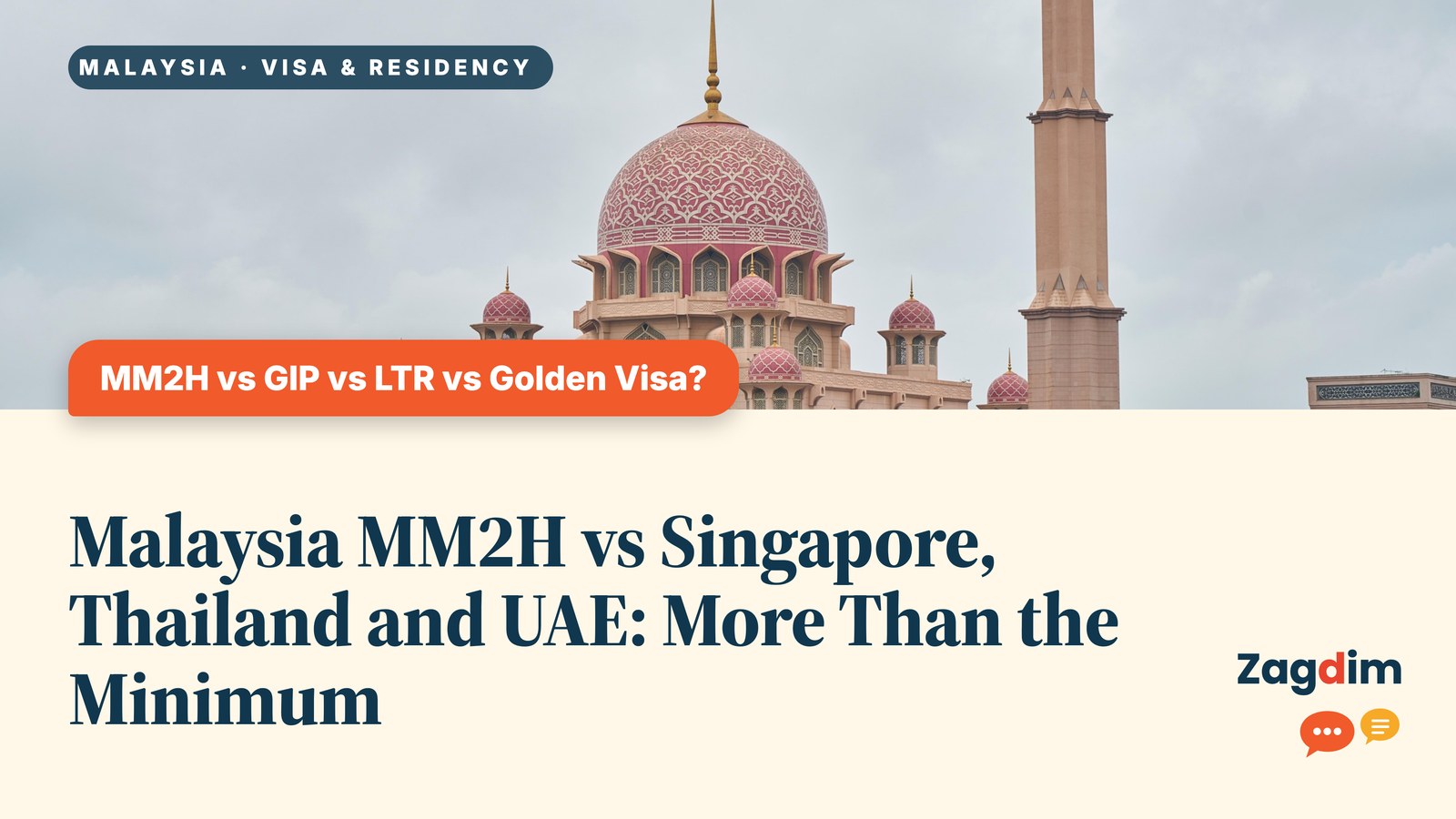
Malaysia’s MM2H, Singapore’s Global Investor Programme (GIP), Thailand’s LTR, and a UAE Golden Visa route often appear side by side in comparison tables for investment residency and migration planning. But each program grants a different kind of status, accepts different kinds of assets, and carries different maintenance requirements. Lining up the lowest investment figure from each program and declaring a winner skips the question of what that money actually buys.
For example, Singapore’s GIP is a pathway to permanent residency. Malaysia’s MM2H and the Thailand and UAE arrangements covered in this article are all fixed-term residency instead. The quoted investment amounts can also refer to different things: a bank fixed deposit, an actual investment, total net worth, or assets under management. These are not necessarily the same kind of money.
This comparison looks at one specific program from each country. It is not a complete list of every residency route available in Malaysia, Singapore, Thailand, or the UAE.
The Four Programs, Money and Status Kept Separate
| Program | Key Financial Requirement | Status and Term |
|---|---|---|
| Malaysia MM2H (federal) | Fixed deposits of USD150,000 (Silver), USD500,000 (Gold), or USD1,000,000 (Platinum); SEZ/SFZ tiers of USD32,000 or USD65,000 depending on age, plus property and fee requirements | Fixed-term residency: Silver 5 years, Gold 15 years, Platinum 20 years, SEZ/SFZ 10 years, renewable if conditions are met |
| Singapore GIP | Option A: at least S$10,000,000 into a Singapore business; Option B: S$25,000,000 into a designated fund; Option C: setting up a single-family office managing at least S$200,000,000, with at least S$50,000,000 allocated as required | Permanent residence (PR) once approved and eligible; subject to re-entry permit and renewal requirements |
| Thailand LTR: Wealthy Global Citizen | Net worth of at least USD1,000,000, holding at least USD500,000 in qualifying Thai investments; health insurance or alternative proof of financial means also required | Ten-year arrangement issued as an initial five years, extendable for a further five years if conditions are met; not PR |
| UAE, illustrated here by the Dubai property Golden Visa route | Qualifying property purchase worth at least AED2,000,000; mortgaged property must also meet bank certification requirements | Currently issued by Dubai as renewable 10-year residency; not PR |
The figures in this table are not all-inclusive quotes, and meeting the financial threshold is not a guarantee of approval. Age, background, documentation, dependents, and source of funds still need to be checked individually for each program.
Malaysia: A Lower Fixed Deposit Does Not Mean That Is the Only Cost
The SEZ/SFZ fixed deposit of USD32,000 applies to applicants aged 50 or older; applicants aged 21 to 49 face a USD65,000 deposit instead. Because the age bands differ, the lowest tier cannot simply stand in for the whole program in a comparison.
The federal MM2H route also involves a property purchase after approval, a residential-holding requirement, permitted length of stay, and related fees. When costing it out, the fixed deposit, property cost, and other fees should be listed separately, with the timing and permitted use of each withdrawal confirmed.
Applicants who instead set up a company to apply through an Employment Pass route are comparing an actual business and an employment relationship, not another version of the MM2H fixed deposit; a company’s paid-up capital should not be treated as equivalent to the deposit.
Singapore: Getting PR Comes With Conditions to Maintain Afterward
The GIP does not only review the investment amount. It also requires a suitable business track record and entrepreneurial background, and each investment option carries its own evaluation and ongoing maintenance requirements.
For example, the business investment option comes with local hiring requirements, while the fund option requires maintaining the designated fund investment. Renewal of the Re-Entry Permit (REP) follows its own applicable rules; PR should not be understood as something that, once the capital is invested, requires no further attention.
A comparison table that places the application fee or estimated processing time under “obligations after approval” ends up missing the items that actually affect the arrangement over the long term.
Thailand and the UAE: Term, Renewal and Asset Conditions Depend on the Route Chosen
Thailand’s LTR ten-year arrangement is split into two five-year stages. For the Wealthy Global Citizen category, extending into the second five years still requires proof of net worth, Thai investment, and health insurance; meeting the requirements in year one should not be assumed to cover the full ten years.
Within that, USD1,000,000 is the net-worth requirement and USD500,000 is the qualifying Thai investment requirement. A qualifying Thai investment can count toward the net-worth total, so the two figures should not simply be added together into a USD1,500,000 payment obligation.
The UAE’s various Golden Visa categories cannot be summed up with a single term length. This article uses the Dubai Land Department’s property investment service as its example, which currently carries a 10-year term; the applicable term and category should be confirmed separately for the specific place and category of application. If the property carries a mortgage, is being prepared for sale, or the investment is being swapped, the paperwork and the effect on residency should be confirmed first.
Common Misreadings
“Whichever place has the lowest minimum deposit is the cheapest.”
Property purchase costs, fees, cost of living, and how long funds stay locked up still need to be added in. Different categories of required funds are not directly comparable to each other either.
“PR and renewable 10-year residency are just different names for the same thing.”
The two differ in legal nature and in what needs to be maintained afterward. The comparison should be made against a family’s residence, work, and long-term plans.
“Every Golden Visa property route runs for five years.”
That does not hold across the board. Dubai’s current version of this service is listed as a renewable 10-year term, and the applicable place and conditions still need to be checked for each specific application.
What to Check Next
Start by deciding what kind of status and what activity rights a family actually needs, then compare eligibility, eligible dependents, what the funds can be used for, and renewal and exit terms item by item. Only after that should the different currencies be converted into one for an estimate, with cost of living and tax added in.
International status and tax arrangements should be confirmed separately with the relevant professionals in each case.
Frequently Asked Questions
Q1: Of these programs, which one grants permanent residency?
Of the programs compared here, Singapore’s GIP is the pathway to Singapore PR. The other programs listed are fixed-term residency, each subject to its own eligibility and approval requirements.
Q2: Is Thailand’s LTR ten-year term granted all at once?
No. It is issued as an initial five years, with a further five years granted only if the applicant still meets the requirements at that point; the mid-term eligibility check should not be overlooked.
Q3: Can the right program be chosen by investment amount alone?
Not advisable. The type of status, work and dependent arrangements, and the ongoing financial and residency requirements also need to be weighed.
Disclaimer
This article is based on official information available as of October 8, 2026, and compares specific programs rather than every residency option in each country; it is not international immigration, legal, tax, or investment advice. The UAE section uses a specific Dubai service as its example and does not represent every emirate or every Golden Visa category.
Sources
MOTAC — MM2H Category Overview; MOTAC — Compulsory Residential Purchase; Singapore EDB — Global Investor Programme; Singapore EDB — GIP Investment Options and REP Changes; Singapore EDB — Summary of GIP Changes (investment and REP conditions); Thailand BOI — LTR Programme; Thailand BOI — Qualification Criteria, Announcement Por. 3/2568; Thailand BOI — LTR Community Day, 19 February 2026 (five-year extension requirements); Dubai Land Department — Golden Visa Application, Investor
Have a question about this guide? Leave a comment below, or ask Zagdim directly.
Your first stop for international property and global living.
Research and insights. Know what’s changing. Understand what matters.