
































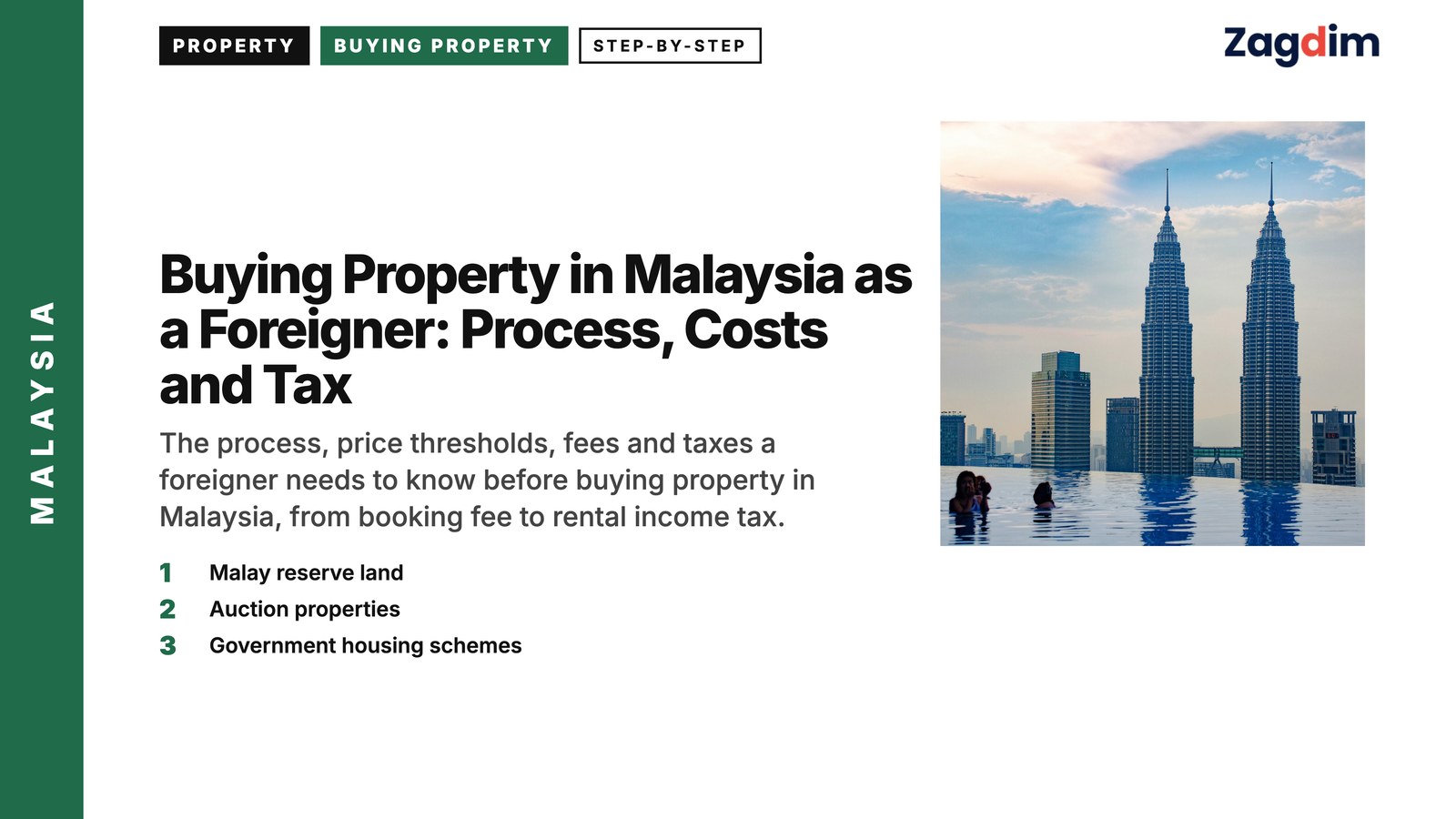
During the pandemic, Malaysia’s property market faced headwinds and prices moved unevenly. But from the fourth quarter of 2021, buyers gradually returned to the market, and transaction volumes reached a recent high, with activity picking up and even exceeding pre-pandemic levels. Since the first quarter of 2022, the number of viewings by buyers in Malaysia has risen sharply, and many buyers have used the opportunity to enter the market. This article covers what you need to know about buying property in Malaysia, including the buying process, restrictions, related costs and taxes, to give investors a foundation for their Malaysian property investment.
Can a Foreigner Buy Property in Malaysia?
Yes, absolutely. Overseas nationals can buy property in Malaysia, and can even hold permanent title to part of the land, though certain restrictions still apply.
First, the Malaysian government requires that a property bought by an overseas buyer must not be priced below RM 1 million (about USD 225,000 at the time); this is the national minimum under the Economic Planning Unit guideline, and each state sets its own threshold, which can differ from it — check the current figure for the specific state with the state land office. In addition, foreign investors are not allowed to buy property or land reserved for Malaysian citizens and indigenous peoples (Bumiputera).
Foreign investors who meet the above conditions still need to obtain approval from the relevant state authority for their purchase application when formally buying a Malaysian property.
Property Choices and the Price Threshold
Almost all property types — residential, industrial and commercial — can be bought on the open market by Malaysians, and foreigners can buy them too, with the following exceptions:
- Malay reserve land
- Land reserved for Malaysia’s indigenous peoples
- Auction properties
- Government housing schemes
- Private housing schemes priced at RM 600,000 or below (this policy has applied since 2020, and is limited to Kuala Lumpur, Labuan and Putrajaya)
In fact, each state in Malaysia sets its own price threshold for foreign buyers, and the figures differ from state to state, so confirm the current threshold with the relevant state authority before committing.
The Buying Process for Foreign Investors in Malaysia
Below are the 10 steps of buying property as an investor in Malaysia, to help investors get familiar with the whole process and its details.
Step 1: Set your buying budget
Based on your personal budget and financial capacity, look into different investment types — apartments or landed houses. Do not overlook costs such as engaging a real estate agent, mortgage broker, accountant and lawyer.
Step 2: Find a property you like
Before buying, get detailed information on the development, the property type and the tenure. Malaysian land tenure is mainly divided into freehold and leasehold (typically 99 years).
Some commonly used Malaysian property websites and their features:
- Property Guru: around 260,000 properties for sale, of which around 400 are new projects. Offers a mortgage calculator, property guides and an agent-finder service (free).
- IProperty: around 200,000 properties for sale, of which around 250 are new projects. Residential properties alone are broken into more than 20 subcategories, which is convenient for buyers with a clear target. Offers a loan-consultation service to help buyers assess their mortgage eligibility and improve their chances of approval.
- Dot Property: around 10,000 properties for sale. Provides data on price, rent and rental-yield trends, plus an agent-finder service.
- Mudah: a large classifieds site under the Carousell auction platform. Its property category lists around 200,000 house/land sale listings, of which around 10,000 are new projects.
- Property Pages: an agent-finder service listing around 1,500 agents across different areas, along with their specialties and BOVAEA registration numbers.
Step 3: View the property in person
Once you have found a property you like, a real estate agent can arrange a site visit so you can check that the property matches its listing information.
Step 4: Reserve the unit and pay a deposit
After the site visit, if you are satisfied with the property, you can pick your unit type and unit number, sign the unit reservation form, and pay a deposit — typically 2–3% of the price (subject to the seller’s requirements).
Step 5: Apply for a home loan
When choosing a bank for your mortgage, make sure to check the details of each bank’s loan package carefully to find the one that suits you best. Not every bank’s package will match your needs and financial situation, so investors need to do some research.
Step 6: Sign the sale and purchase agreement and pay the down payment
After signing the reservation form, you sign the Sale and Purchase Agreement (SPA) within 7–14 days and pay 10% of the price (subject to the seller’s requirements) as the down payment, along with legal fees, which run at roughly 0.4–1% of the price.
Step 7: Sign the Loan Agreement and the Memorandum of Transfer (MOT)
If everything proceeds smoothly, at this stage the buyer should receive the bank’s approved home loan agreement, after which the buyer must decide which bank’s loan to accept.
The Loan Agreement is the legal document covering all the terms and details of the buyer’s home loan. Where circumstances allow, it is worth engaging a lawyer to review it to protect your own interests. At the same time, the buyer and seller sign the Memorandum of Transfer (MOT), the legal document transferring ownership of the property to the buyer.
Step 8: Pay the balance as required
- Buying a completed property: the buyer is required to settle the full amount within three months of signing the sale and purchase agreement (if applying for a loan, the bank must likewise disburse the full loan amount to the developer within three months).
- Buying an off-plan property: payments are made in installments according to construction progress, with the full amount settled once the project is completed (if applying for a loan, the buyer only pays the self-funded portion, with the loan portion disbursed by the bank).
Step 9: Collect the keys to the new home
On the handover date specified in the Sale and Purchase Agreement (SPA), the buyer carries out a final inspection of the property and receives the keys.
When the buyer collects the keys, they will also receive the Certificate of Completion and Compliance for the new home — the legal document certifying that the buyer’s home is complete and safe to occupy.
Step 10: The lawyer handles the transfer of title on the buyer’s behalf.
What Costs Are Involved in Buying Property in Malaysia?
Malaysian property prices vary depending on the type and location of the property.
According to data from the National Property Information Centre (NAPIC), the median price of homes nationwide in Malaysia is roughly between RM 300,000 and RM 500,000. For terrace houses, the median price is RM 300,000 to RM 800,000, while apartment prices sit between RM 300,000 and RM 600,000. Buying costs can be grouped into nine categories: the booking deposit, valuation fee, down payment, legal fees and stamp duty on the sale and purchase agreement and the loan agreement, the stamp duty on the transfer of title, the monthly loan installment, home insurance, the management-fee deposit, and other miscellaneous costs.
Booking Fee
When an investor intends to buy a property, a deposit must be paid to reserve that property or a specific unit. The booking deposit for a developer’s new property varies by developer, and is usually refundable. For a resale (secondhand) property, the deposit is typically 2–3% of the price, and can be deducted from the down payment. For safety, the deposit should be transferred to the agency or the law firm, and never to an individual’s personal bank account, including the seller’s or the agent’s own personal account.
Valuation Fees
When a buyer applies for a bank loan, a valuer will visit the property to carry out a valuation (this only applies to a completed property or a resale property). If the loan application is successful, the buyer must pay the valuer’s valuation fee. If the buyer is paying in cash, no valuation fee is required. A developer’s new property has no valuation fee unless it is already built and close to completion. Generally speaking, the valuation fee for a resale property is around 0.3% of the price. For example, for a property priced at RM 500,000, the valuation fee would not exceed RM 1,500.
Down Payment
Foreigners have the opportunity to borrow up to 60% of the property price; taking the RM 1 million entry threshold as an example, the down payment would be 40%, i.e. roughly RM 400,000. Adding in various other fees, buying a Malaysian property at this level costs around RM 450,000 in total. Some developers now offer incentives such as a lower down payment or a fully furnished unit. Resale properties do not come with such discounts, but any deposit already paid can be used to offset part of the down payment.
Legal Fees and Stamp Duty
Legal fees are paid to a lawyer for preparing the contract on the buyer’s behalf, and stamp duty is a government tax. Once the bank approves the loan, the lawyer will prepare two very important legal documents: the Sale and Purchase Agreement (SPA), which proves the buyer is the new owner of the property, and the Loan Agreement, which is proof of the bank loan — if the loan is not repaid, the bank has the right to repossess the property. For a developer’s new property, part of the legal fees and stamp duty are occasionally waived; for a resale property, it is advisable to get quotes from several law firms before choosing one.
Stamp Duty on the Transfer of Title (MOT)
Within six months to a year after the developer hands over the property, the buyer will receive a lawyer’s letter requesting payment of this fee to complete the transfer of title. If the developer’s new property carries an Individual Title rather than a Master Title, this MOT fee is payable when the sale and purchase agreement is signed. For a resale property, it is payable when the sale and purchase agreement is signed with the seller.
Home Loan
Investors can apply for a mortgage from a Malaysian bank. The figures below are for investors’ reference — the actual mortgage terms depend on the individual unit.
| Malaysia Mortgage | |
|---|---|
| Loan-to-value ratio | 50–80% |
| Interest rate | 4.2–4.6% |
| Loan tenure | 35 years |
Home Insurance
When applying for a bank loan, some banks will require the buyer to purchase home insurance as a condition of the loan, including fire insurance and MRTA (Mortgage Reducing Term Assurance). Banks will generally recommend it, though whether to buy it depends on the buyer’s own risk planning and decision. This cost can be paid as a single lump sum or folded into the monthly installment, and is usually under RM 200.
Management-Fee Deposit
After successfully buying a property, before the keys are handed over to the new owner, the management company may collect a deposit equal to three months of management fees upfront; the amount depends on the property type, and it is worth asking the relevant management company in advance.
Other Miscellaneous Costs
Beyond the costs listed above, it is advisable to set aside additional budget in case of unexpected costs. For example, land tax and assessment tax are not very high, together coming to under RM 1,000–1,500 a year, depending on the property’s area and type. When applying for an electricity connection, the national utility company (TNB) will also collect a deposit of a few hundred ringgit in advance — this varies by state, so it is advisable to check with the utility company.
Taxes Involved in Buying and Selling Property in Malaysia
- Real Property Gains Tax: borne by the seller, payable when the property is eventually sold.
If the property is sold within 5 years of the purchase date, gains tax is charged at 30% of the profit. If the property is sold more than 5 years after the purchase date, gains tax is charged at 10% of the profit.
- Stamp Duty: borne by the buyer. This covers the Sale and Purchase Agreement (SPA), the Memorandum of Transfer (MOT), and loan-related documents. Stamp duty also applies to the loan documents used to finance the purchase. If buying with a loan, the buyer must pay stamp duty equal to 0.5% of the loan amount. Per the tax authority’s rules, stamp duty is calculated on whichever is higher — the property’s transaction price or its market value.
- Land Tax: paid to the government land office, calculated as the property’s area multiplied by a set rate, payable once a year.
- Assessment Tax: paid to the municipal council, similar to Hong Kong’s rates, calculated as the property’s estimated annual rental value multiplied by a set rate, payable twice a year.
- Rental Income Tax: a tax on rental income from a rented-out property. Non-resident individuals pay a flat 30% on Malaysia-sourced rental income, with no personal reliefs available, though property-related expenses such as land tax, assessment tax, fire insurance, mortgage interest, letting costs, renewal costs and property-maintenance costs can still be deducted in arriving at the taxable rental income.
Things to Watch Out For When Buying Property in Malaysia
1. Malaysian completed properties and off-plan properties are paid for differently.
For a completed property in Malaysia, the buyer is required to pay the full amount within three months of signing the purchase contract; for an off-plan property, payment can follow the construction progress, with the full amount settled once the project is completed — a loan application also needs to be completed within the required timeframe.
2. Buying and selling property requires both parties’ lawyers to be present.
Malaysia’s legal system is relatively well developed; for a property purchase to take effect, both parties’ lawyers must be present — each lawyer is responsible for representing their own client’s interests, and the same applies to the loan agreement. If you cannot fly to Malaysia in person, the Malaysian consulate in your own location can witness and sign on your behalf instead.
3. The transfer must be registered at the land registry.
Malaysia does not use gross floor area — figures are all expressed as usable/carpet area — and most properties are handed over with fittings already installed, though parking spaces are usually not included in the sale; a developer may include a parking space as a bonus, depending on the developer.
4. Buying to rent out
According to Malaysia’s *2019 Property Market Report*, the average rental yield in Malaysia is 3–6%, with some prime locations offering a higher yield. If you plan to rent out a Malaysian property, you will be liable for Malaysian income tax on the rental income; non-resident individuals pay this at a flat 30% rate, with no separate monthly withholding mechanism. The taxable amount is calculated as annual rental income minus expenses related to the property, such as agent commission, repair costs, mortgage interest, taxes, insurance premiums, utility bills and the depreciation of the property.
Have a question about this guide? Leave a comment below, or ask Zagdim directly.
Your first stop for international property and global living.
Research and insights. Know what’s changing. Understand what matters.