




























Malaysia’s relatively low property prices attract many overseas buyers to invest here. The country sets a minimum price of RM 1 million (roughly USD 230,000 at the time) for foreign buyers, and, subject to certain conditions, allows foreigners to hold permanent title to part of the land.
The costs of buying property in Malaysia mainly include: various taxes and fees, mortgage-related costs, agent and legal fees, property-inspection fees, and insurance costs. Of these, stamp duty and legal fees are the ones most easily overlooked by buyers, and can throw off your budget for the correct cost of buying a home.
The following sets out a detailed explanation of the stamp duty and legal fee questions that foreign buyers need to know when buying property in Malaysia, for reference by foreign buyers (non-Malaysian residents) looking to invest, immigrate, or buy property in Malaysia. (Ringgit is denoted below as RM.)
Stamp Duty
Stamp duty is a tax or fee charged when a transaction document is stamped. In Malaysia, stamp duty is a statutory tax that must be paid: the buyer must pay it once the relevant property document is stamped, or else be charged a penalty of 5% to 20% of the stamp duty owed.
In the course of buying property in Malaysia, stamp duty generally applies to three types of document: the Sale and Purchase Agreement (SPA), the Loan Agreement (LA), and the Instrument of Transfer (IT).
Sale and Purchase Agreement (SPA): stamp duty is calculated by the number of stamps required on the agreement, at RM 10 per stamp.
Loan Agreement (LA): stamp duty is calculated at 0.5% of the total loan amount (0.5% x RM loan amount).
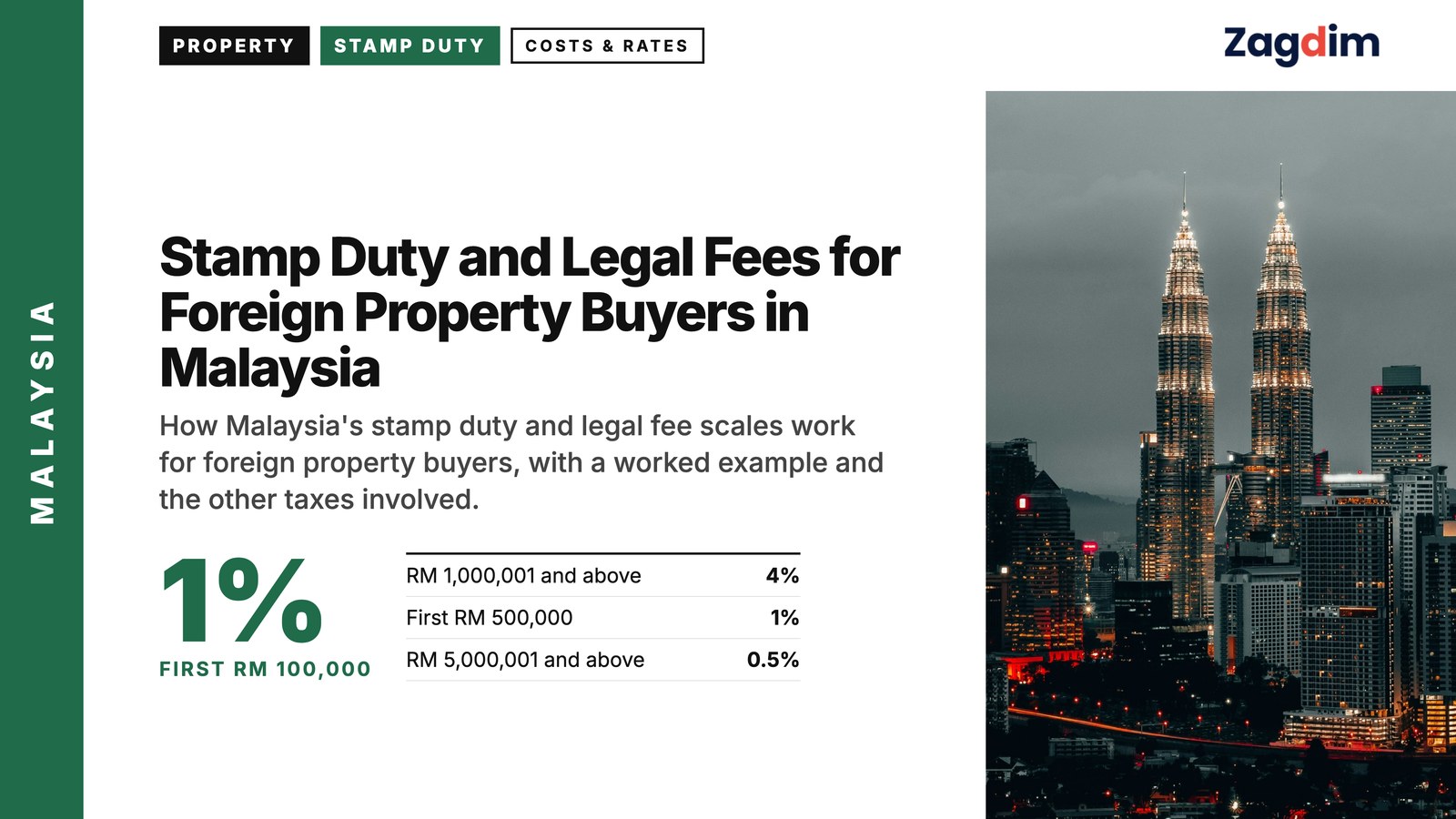
Instrument of Transfer (IT): from 1 January 2026, non-citizens (excluding permanent residents) and foreign-owned companies buying residential property in Malaysia pay a flat 8% stamp duty on the transfer instrument, calculated on the property’s price or the government valuation, whichever is higher (Finance Act 2025 amendment to the Stamp Act 1949). This replaces the previous tiered structure (1% to 4% by price band) for this buyer group; non-residential property still uses the 4% rate. The tiered 1%–4% scale below continues to apply to Malaysian citizens.
| Property Price (RM) | Rate (citizens) |
|---|---|
| First RM 100,000 | 1% |
| RM 100,001–RM 500,000 | 2% |
| RM 500,001–RM 1,000,000 | 3% |
| RM 1,000,001 and above | 4% |
Legal Fees
Legal fees are the cost of engaging a lawyer to help with the purchase. The seller is typically the one who engages a lawyer, and the buyer may also appoint their own lawyer to represent them. In Malaysia, legal fees are calculated on a tiered, cumulative basis according to the property price, with different bands charged at rates from 0.5% to 1%.
| Property Price (RM) | Rate |
|---|---|
| First RM 500,000 | 1% |
| RM 500,001–RM 1,000,000 | 0.8% |
| RM 1,000,001–RM 3,000,000 | 0.7% |
| RM 3,000,001–RM 5,000,000 | 0.6% |
| RM 5,000,001 and above | 0.5% |
A Worked Example
Suppose a buyer, as a foreigner who is not a Malaysian resident, plans to buy property in Malaysia. Under Malaysia’s policy setting the minimum threshold for foreign buyers, this buyer must buy a property of at least RM 1 million. Taking RM 1 million as the example, the stamp duty and legal fees the buyer would need to pay are (all figures in ringgit):
Stamp duty: 100,000 x 1% + 400,000 x 2% + 500,000 x 3% = 24,000
Legal fees: 500,000 x 1% + 500,000 x 0.8% = 5,800
Total: 24,000 + 5,800 = 29,800
Other Taxes
Besides stamp duty, buying property in Malaysia may also involve land tax, assessment tax, and Real Property Gains Tax, briefly outlined here.
Land tax: paid to the government land office, calculated as the property’s area multiplied by a set rate, payable once a year.
Assessment tax: paid to the municipal council, calculated as the property’s estimated annual rental value multiplied by a set rate, payable twice a year.
Real Property Gains Tax: a tax arising on sale, generally borne by the seller, calculated as the sale amount minus the original purchase amount. For a non-Malaysian citizen or permanent resident who sells within the first five years of holding the property, the rate is 30%; from the 6th year onward, it drops to just 10%.
Have a question about this guide? Leave a comment below, or ask Zagdim directly.
Your first stop for international property and global living.
Research and insights. Know what’s changing. Understand what matters.