

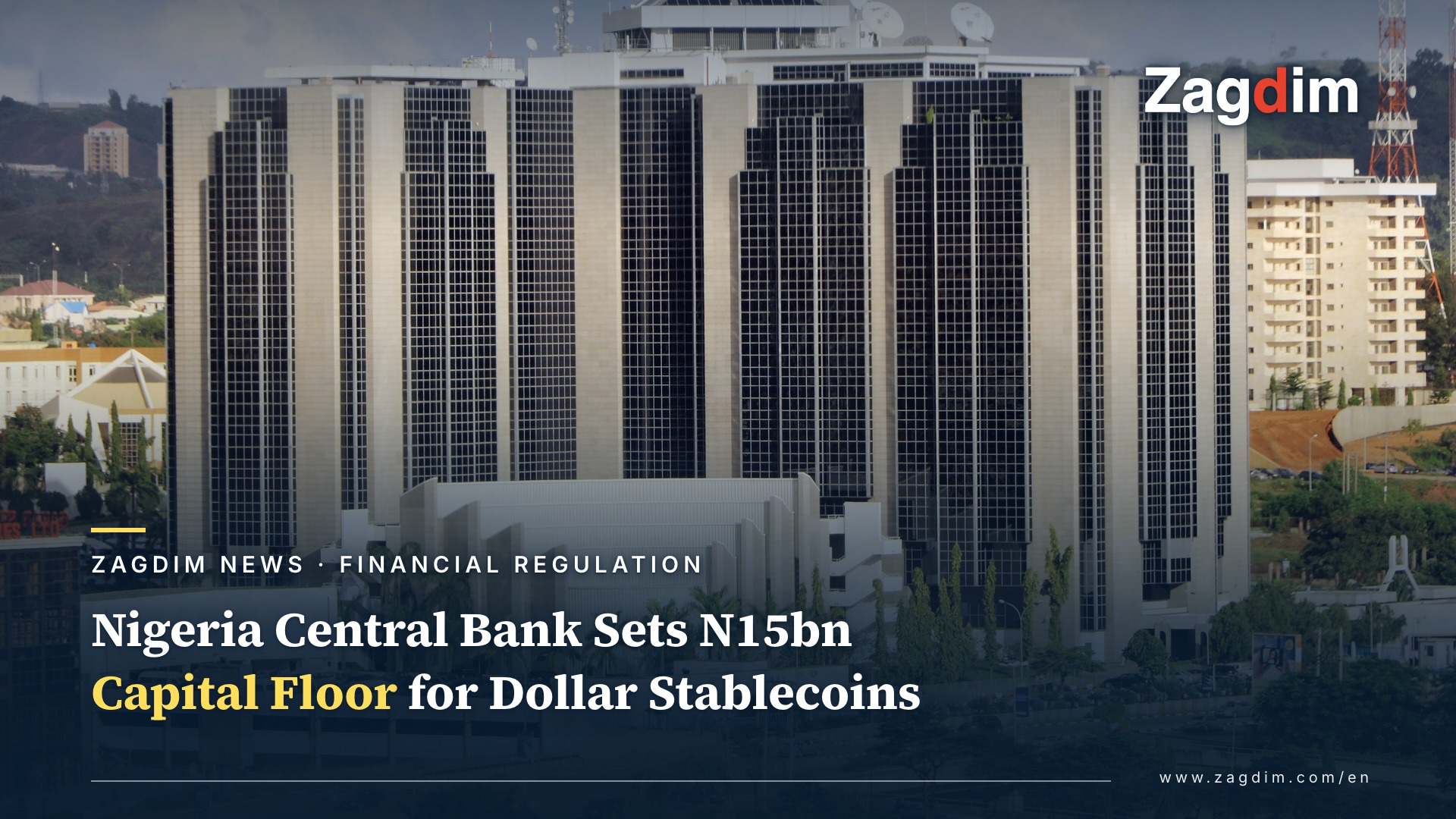
Nigeria’s central bank has told foreign-currency stablecoin issuers they must incorporate locally and hold far more capital before their tokens can keep reaching Nigerian users — a change that lands directly on the peer-to-peer dollar-stablecoin trades many Nigerians use to move money in and out of the country.
Under a circular dated November 5, 2026, the Central Bank of Nigeria (CBN) introduced a formal licensing and capital framework for stablecoins and other virtual asset service providers. Foreign-currency (“Class 2”) stablecoin issuers — the category covering dollar-pegged tokens such as USDT and USDC — can no longer rely solely on licences obtained in other countries. They must set up a Nigerian-incorporated entity, obtain a Class 2 Foreign Currency Issuer Licence from the CBN, and issue their tokens through that local entity. Minimum paid-up capital for Class 2 issuers is set at N15 billion (roughly US$11 million); naira-referenced (“Class 1”) issuers must hold N10 billion, and other non-security virtual asset service providers at least N1 billion.
The regulation also brings peer-to-peer (P2P) conversions between naira and foreign-currency stablecoins inside the formal foreign-exchange framework: providers now need separate, express CBN approval before facilitating such conversions, and the naira leg of each transaction must be settled through, or reported to, a CBN-authorised dealer. The CBN was explicit that P2P approval does not itself authorise foreign-exchange business. Issuers are also barred from paying interest, yield or dividends simply for holding a token, and the CBN confirmed stablecoins are not bank deposits and carry no deposit insurance. Penalties for non-compliance range from a minimum N100 million (plus N1 million per day it continues) for unlicensed activity up to a minimum N500 million for fraud or deliberate misrepresentation, with possible criminal referral.
Nigerian legal analysts who reviewed the framework this week — including Legal 500 Nigeria (November 18) and Babalakin & Co. (November 19) — have laid out the compliance clock operators are now on: AML/CFT obligations applied from day one (November 5); existing operators must complete preliminary CBN registration within 30 days (by roughly December 5); begin supervisory reporting within 60 days (by roughly January 4, 2027); and submit a complete licence application within 180 days (by May 4, 2027). Legal 500 noted that an operator that misses the 180-day deadline must stop the activity until it is licensed. The CBN said the rules do not displace the Securities and Exchange Commission’s separate mandate over security-type virtual assets.
References
Central Bank of Nigeria – Regulations for the Operations of Non-Security Virtual Assets in Nigeria (Circular PSP/DIR/PUB/CIR/001/004) / THISDAYLIVE – CBN Tightens Stablecoin Rules, Sets N15bn Capital Floor for Dollar Tokens / Legal 500 – Stablecoins Come Under CBN Rules: Licences Required, Yield Banned, Reserves Ring-Fenced