































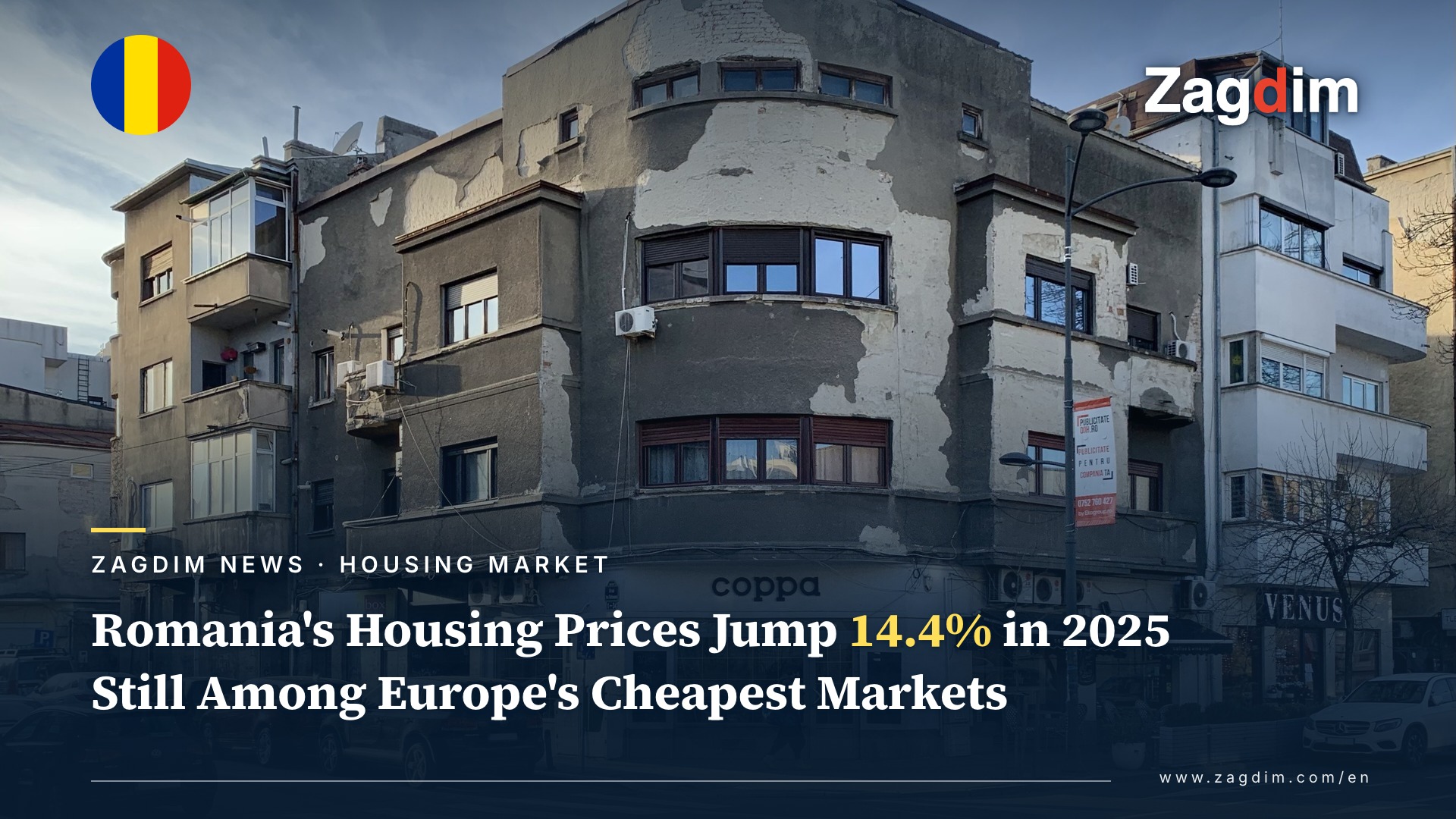
Romania recorded the largest house-price increase of any European country assessed in 2025, according to Agerpres, which put the rise at 14.4% for the year. A separate report from Deloitte, covered by Romania Insider, draws the opposite-sounding conclusion from the same underlying trend: despite that jump, Romania remains among Europe’s cheapest places to buy a home. Both claims are accurate — the explanation is that Romania’s prices are climbing fast precisely because they started so far below the rest of Europe.
What Happened
Agerpres reported that Romanian housing prices rose 14.4% in 2025, the steepest annual increase among the European countries it compared. Independent cross-country trackers put Romania’s 2025 gain in a similar range without necessarily ranking it first: RE/MAX Europe’s “Housing Insider” report, which tracks 11 European residential markets, found Romania’s national average asking price rose by roughly 14% over the year, to about €2,000 per square metre — in that same report, Portugal recorded the largest increase, at 17% (apartments alone up 20%). Eurostat’s official House Price Index, which is the EU’s standard comparative measure, showed Romania’s year-on-year growth running at 6.6% in the third quarter of 2025 and 7.8% in the first quarter of 2026 — below Portugal, Bulgaria, Slovakia and Hungary, which posted the largest quarterly gains across the EU over the same stretch.
The spread between these figures comes down to what each one measures: Agerpres and RE/MAX Europe’s figures track asking prices quoted by sellers and developers (reported by Imobiliare.ro-based industry surveys at roughly 14-15% nationally for 2025, with Craiova up 21% and Bucharest up about 17%), while Eurostat’s index tracks actual transaction prices. Zagdim was not able to independently verify the single named index behind Agerpres’s specific “largest in Europe” ranking, but the magnitude it reports — low-to-mid teens percentage growth for the year — is consistent with multiple separately sourced trackers of the Romanian market.
Meanwhile, Deloitte’s Property Index, the most recent full edition of which uses 2024 data, ranked Romania fourth-cheapest among the 28 countries it assessed, behind only Turkey, Bosnia and Herzegovina, and Albania. Romania’s national average was €1,676 per square metre in 2024 (up 11.5% on 2023) — with Bucharest at €1,757/sqm, Cluj-Napoca (Romania’s priciest city, ahead of the capital) at €2,770/sqm, and Brașov at €1,897/sqm. Among European Union members specifically, only Greece shared Romania’s position below the €2,000/sqm line; by contrast, Luxembourg topped the EU at €8,760/sqm.
Who It Affects
The story matters most to people weighing whether Romania is still a comparatively affordable entry point into EU property — and whether that window is closing. The numbers say both things are still true at once: prices are rising faster, in percentage terms, than in most of Europe, but Bucharest’s average of roughly €1,757/sqm remains a fraction of what buyers pay in capitals further west. For buyers thinking in terms of total budget rather than growth rate, Romania’s absolute price level — not its rate of change — is still the more relevant number for now.
Why Both Can Be True
Romania’s housing market is rising quickly in percentage terms precisely because it is starting from one of the lowest price levels in the EU. A 14% gain on a base of roughly €1,700-2,000/sqm adds far fewer euros than the same percentage would on a Western European base several times larger — which is why Romania can post one of Europe’s steepest annual increases and still rank among its cheapest markets in absolute terms. Global Property Guide’s analysis of Eurostat’s inflation-adjusted series also notes that Romania was one of only six EU countries where 2025 house-price growth, once adjusted for inflation, trailed the inflation rate itself — meaning the real (inflation-adjusted) gain in buying power terms was considerably smaller than the nominal double-digit headline suggests.
What Comes Next
Deloitte Romania’s Irina Dimitriu, quoted in the firm’s Property Index coverage, attributed Romania’s price pressure to constrained new-housing supply — rising construction costs, tighter financing conditions and more complex regulation — and said she expects the trend to continue “at least in the short term,” pointing specifically to the VAT increase to 21% on new homes as a factor likely to keep prices rising. Deloitte’s Marius Vasilescu separately noted that the same supply constraint is also showing up in rents in Romania’s largest cities.
References
Agerpres – Housing Prices in Romania Rise 14.4% in 2025, Largest Increase Among European Countries Assessed / Romania Insider – Deloitte: Romania Remains Among Europe’s Cheapest Housing Markets Despite 14% Price Rise in 2025 / Deloitte Romania – Property Index (Latest Edition, 2024 Data) / RE/MAX Europe – Housing Insider: European Real Estate Insights Report 2025 / Eurostat – House Price Index