






























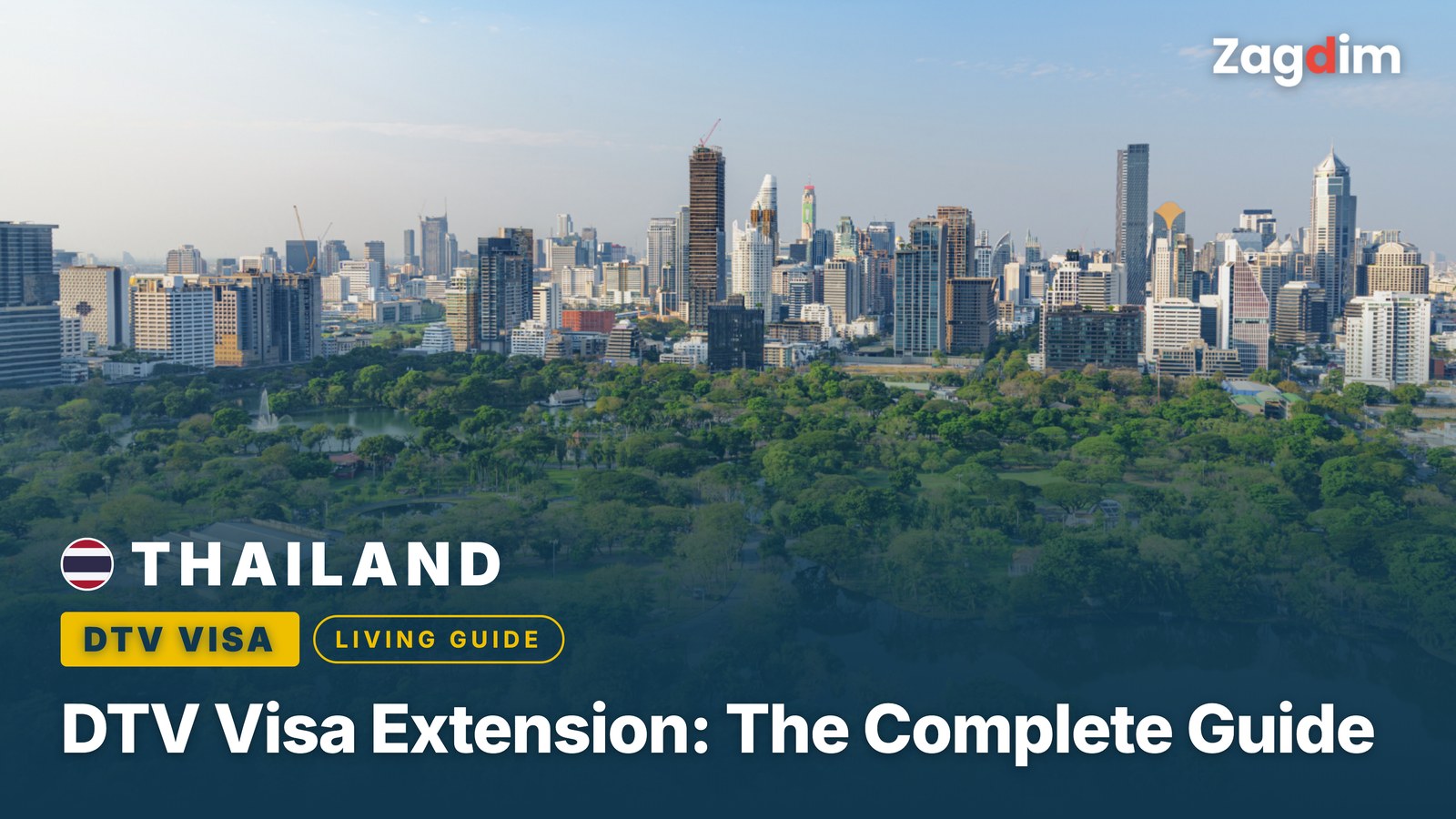
Thailand’s DTV visa, officially the Destination Thailand Visa, is primarily open to remote workers, freelancers, digital nomads, and participants in Thai Soft Power activities. After each entry, a DTV holder is generally permitted to stay for 180 days; anyone wishing to remain longer can apply to Thai Immigration for an in-country extension before that stay period expires. Under the current DTV arrangement, an extension can generally add up to a further 180 days. The extension is not automatic — applicants still need to submit proof of finances, address, and documentation matching their original DTV category, with the final decision resting with Immigration.
Basic Requirements for a DTV Extension
Applicants need to meet the following conditions:
- Must have entered Thailand on a DTV visa
- Must apply from within Thailand
- The reason for the application must match the original DTV category: for example, remote work, freelance work, Thai Soft Power activities, medical treatment, or caring for a family member
- Must demonstrate continued eligibility under the original DTV category
- Must show sufficient financial proof: no less than THB 500,000
- Must show proof of a Thai address: TM.30
- If already in Thailand for more than 90 days, must have a 90-day reporting record
Required Documents
Standard Documents
| Document Category | Document Content |
|---|---|
| Application form | TM.7 application form, plus the STM.2 overstay-penalty acknowledgment form |
| Passport documents | Passport bio-data page, DTV visa page, copy of the latest entry stamp |
| Photo | One 4×6 cm or 2-inch passport-style photo |
| Proof of finances | No less than THB 500,000. This can be shown via a Thai bank account, a verifiable overseas bank account, or a combination of the two; proof of financial support from a company, employer, or guarantor, along with documentation of the relationship, can also be provided |
| Proof of Thai address | Payment or tenancy proof for a hotel, condo, or rented house; if a house or condo, a landlord-certified copy of the title deed can be provided |
| 90-day reporting record | If you have stayed in Thailand for more than 90 days, a copy of your past 90-day reporting record is required |
| TM.30 | The foreigner residence notification record, i.e. the Notification of Residence of Foreigner |
Additional Documents by DTV Category
| DTV Category | Corresponding Category | Proof Required | Documents | Supporting Documents That May Help |
|---|---|---|---|---|
| Remote work / Digital Nomad / Workcation | Telework | Applicant still meets the DTV category, with proof of work | Still-valid overseas employment contract, work history, or past proof of employment | Employer letter, freelance contract, client contract, income records, payment records, portfolio, company documents |
| Thai Soft Power / other activities | Other Activities | Applicant still has proof of the relevant activity | Proof of activity, proof from and extension request to a government agency, proof from a hospital or government medical institution, government invitation and acceptance letters, TCEB proof, photos of activity participation | Course enrollment proof, payment receipts, course schedule, confirmation letter from the school or institution |
| DTV dependents | Dependents | Relationship with the main DTV applicant remains valid | Birth certificate, marriage certificate, adoption papers, or other relationship documents; also requires a copy of passport, proof of address, 90-day reporting record, and TM.30 | Main applicant’s passport, DTV visa details, entry or extension records; family financial or accommodation-arrangement documents if needed |
The DTV Extension Application Process
Step 1: Confirm Your Current Permitted Stay
Applicants should first check the most recent entry stamp in their passport to confirm the date up to which they are permitted to stay. Don’t just look at the DTV visa’s own validity period — what actually determines whether you overstay is the permitted stay date stamped in your passport.
Step 2: Confirm the Relevant Immigration Office
Generally, applicants should apply at the Thai Immigration office covering their place of residence.
For example, if your TM.30 registered address is in Bangkok, you would generally need to go to the relevant Bangkok immigration office; if your registered address is in Chiang Mai, Phuket, Chonburi, or another province, you may need to go to the immigration office in that province.
Step 3: Prepare the Basic Documents
These include:
- TM.7 form
- Passport and copies
- Photo
- Proof of finances
- Proof of Thai address
- TM.30
- 90-day reporting record, if applicable
It’s advisable to sign all copies in advance and bring the originals for Immigration to verify against.
Step 4: Prepare Category-Specific Supporting Documents
This is the key to a smooth DTV renewal. Remote workers need to prove they still have overseas work; Soft Power category applicants need to prove they are still participating in the relevant activity; the medical category needs to prove ongoing treatment arrangements; the dependent category needs to prove the main applicant’s eligibility and the family relationship.
Step 5: Submit the Application at the Immigration Office
Applicants need to submit documents in person at the immigration office. Immigration staff may check documents on the spot and may also request additional supporting documents.
Step 6: Wait for Approval and Receive the Extension Stamp
If the application is approved, Immigration will stamp the new permitted-stay date in the passport.
Summary
In short, the key point of an in-country DTV extension is that the applicant needs to re-demonstrate, at the time of extension, that they still meet the original application conditions. Whether the category is remote work, a Thai Soft Power activity, or dependent status, Immigration will review the applicant’s finances, Thai address, stay record, and ongoing proof for the relevant category on a case-by-case basis. Applicants should therefore prepare their documents well before their stay period expires, especially TM.30, bank proof, the 90-day reporting record, and documents related to the original DTV category. Since document details and the strictness of review can vary somewhat between immigration offices, always follow the latest requirements of the immigration office handling your application.
If you have questions about your Thai visa, long stay, or immigration status, ask Zagdim — Zagdim can help outline your stay purpose, entry history, income sources, and possible visa directions, and connect you with suitable Thailand visa and relocation service resources through ZDelp if needed.
Have a question about this guide? Leave a comment below, or ask Zagdim directly.
Your first stop for international property and global living.
Research and insights. Know what’s changing. Understand what matters.