































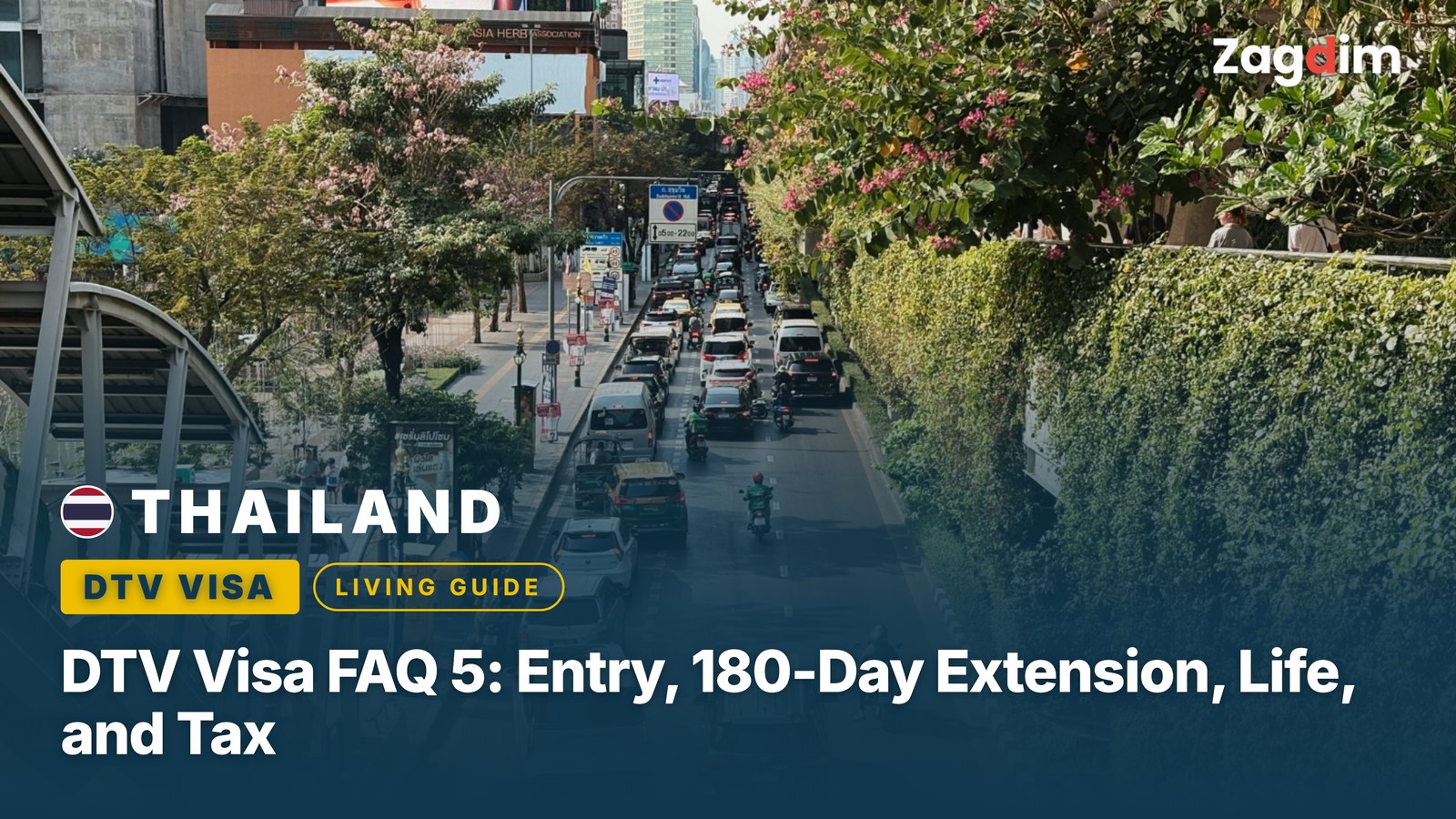
Holding a DTV does not guarantee entry — immigration officers retain discretion to inspect and refuse entry to any traveler. The DTV is a multiple-entry visa: exiting and re-entering gives a fresh 180-day stay, with no need for a separate re-entry permit. The 180-day extension is handled through Form TM.7 at the immigration office covering the registered address, and approval is discretionary — paying the fee does not guarantee approval. Long stays involve two separate filings: the 90-day reporting is done by the foreigner in person, while the TM.30 accommodation notification is the obligation of the landlord or accommodation provider — neither depends on which visa is held. Opening a bank account, applying for a credit card, and getting a driver’s license are mostly assessed case by case by each institution, with no DTV-specific guarantee. Thai tax residency is determined entirely by a day-count rule (180 days or more in aggregate within a calendar year), completely unrelated to visa category — this “180 days” is a different rule from the DTV’s 180-day-per-entry stay limit; the number is the same, but the way it is counted is not.
Once someone has a DTV, the questions that follow are usually not “do I qualify?” but the everyday details: What will an immigration officer ask on entry? How do you extend once the 180 days are up? Can you open a bank account, rent an apartment, or get a driver’s license in Thailand? The point most often overlooked — but one that search volume keeps growing for — is tax: the DTV is a tourist visa, so why might it still make someone a Thai tax resident? This article works through 39 questions grounded in real day-to-day use.
The questions below are grouped by topic.
Entering Thailand and Immigration
Zagdim’s key points:
- Holding a DTV does not guarantee entry — immigration officers retain discretion to inspect and refuse entry to any traveler.
- Accounts differ on whether proof of funds or a return ticket must be shown on entry; the DTV is an e-visa with no physical sticker, and the entry process is the same each time.
- The DTV is a multiple-entry visa by design, so no separate re-entry permit is needed — leaving and re-entering Thailand starts a new 180-day stay.
Q1: Does having a DTV guarantee entry into Thailand?
Zagdim’s quick answer: Not necessarily. Immigration officers at the border retain discretion to inspect and refuse entry to any traveler, and DTV holders are no exception.
Holding a valid visa only means the applicant met the application requirements — it does not guarantee entry. Immigration officers can refuse entry to any traveler based on conditions at the time (for example, suspicion of actual residency intent or inconsistencies in the traveler’s information), and this discretion is not removed simply because someone holds a DTV.
Q2: What else might an immigration officer ask on entry with a DTV?
Zagdim’s quick answer: Common questions cover the purpose of the trip, financial standing, and accommodation arrangements in Thailand; further questioning is more likely only if something in the traveler’s information raises doubts or needs verification.
On entry, an immigration officer may ask general questions about the purpose of the trip, proof of funds, and accommodation. In most cases these are routine — the passport is scanned, the DTV record appears in the system, a stamp is applied, and entry is complete. Further questioning is more likely only if the traveler is unprepared or gives inconsistent answers.
Q3: Is a return ticket needed to enter with a DTV?
Zagdim’s quick answer: Thai Immigration itself has no explicit requirement, but airlines may ask to see a return or onward ticket before boarding.
A return ticket is something many airlines require, for travelers on any visa type, before boarding — it is used to confirm the traveler will not overstay their visa. This is an airline policy, separate from Thai Immigration’s entry checks; Immigration currently has no explicit rule requiring DTV holders to show a return ticket on entry.
Q4: Is a THB 500,000 bank statement still needed on entry?
Zagdim’s quick answer: Accounts are not entirely consistent. In most cases this is a document required at the application stage and does not need to be shown again on entry, though in a minority of cases it has been requested at the border. It’s advisable to keep a way to access this proof on demand when entering.
The THB 500,000 proof of funds is primarily a document requirement at the DTV application stage. It usually does not need to be shown again on entry, though immigration officers have asked for it in a minority of cases. There is no uniform rule on this, and the outcome depends on the discretion of the officer on duty.
Q5: Is the first entry on a DTV different from later entries?
Zagdim’s quick answer: Generally no difference. The DTV is an e-visa and is not affixed to the passport, so in most cases every entry follows the same process.
The DTV is an e-visa with no physical visa sticker. The first entry and subsequent entries generally follow the same process: present the DTV electronic document, receive an entry stamp for that stay, and there is usually no separate “activation” step required.
Q6: Will entering many times in one year draw questions from immigration officers?
Zagdim’s quick answer: So far there is no evidence of DTV holders being singled out simply for entering frequently within a year. The tightened enforcement in 2026 mainly targets people repeatedly re-entering on visa exemption or short-term tourist visas to live long-term; DTV holders enter on a formal visa and are not the target of that enforcement.
Thai immigration enforcement tightened in 2026, with the focus on people repeatedly re-entering on visa exemption or short-term tourist visas to live long-term. DTV holders enter on a formal long-term visa, which is a different pattern from that kind of repeated-entry, long-stay use. So far there is no evidence of DTV holders being singled out simply for entering frequently, but this does not mean that entering however frequently will never attract attention — the outcome still depends on the judgment of the officer at the point of entry.
Q7: Is every re-entry guaranteed to get 180 days?
Zagdim’s quick answer: The DTV itself grants a right to 180 days on each entry, but the actual stamp is applied manually by an immigration officer — check the date yourself after every entry.
The DTV is officially confirmed as a multiple-entry visa allowing a 180-day stay on each entry — that is the right the visa itself confers. But the stamp actually applied to the passport is done manually by the officer on duty, and occasional discrepancies occur (for example, using the original entry date rather than the new one). These discrepancies look more like operational errors than a deliberate policy of granting fewer days. Whatever the cause, check that the entry stamp date is correct immediately after every entry.
Q8: What if an immigration officer stamps the wrong date?
Zagdim’s quick answer: Check the stamp on the spot and ask the officer to correct it immediately. In practice, errors from air entry can usually be corrected at any immigration office, while land-border entry errors usually need to be corrected at the original port of entry.
Check the entry stamp date on the spot when entering, and ask the officer to correct it immediately if there is an error. For air entry, an incorrect stamp can in practice usually be corrected at any immigration office; for land entry, correction usually needs to be done at the original port of entry. The correction itself is normally completed quickly and free of charge.
Q9: Does a DTV need a Re-entry Permit?
Zagdim’s quick answer: Generally no. The DTV is itself a multiple-entry visa, so leaving and re-entering gives a new 180-day stay, and there’s usually no need to apply separately for a re-entry permit to preserve the visa’s validity.
The re-entry permit mechanism is mainly used to preserve the validity of a single-entry visa or an approved residence status. The DTV is designed as a multiple-entry visa, so leaving and re-entering itself produces a new 180-day stay, and a separate re-entry permit is usually not needed. For the more specific scenario of someone who has already obtained the 180-day extension in Thailand and wants to exit and re-enter during that extension period, there is currently no clear guidance — check with the immigration office that handled the extension before leaving.
Q10: Is there a difference between entering by land and by air on a DTV?
Zagdim’s quick answer: The DTV rules themselves should not materially differ by entry channel; the main difference lies in what happens if entry is refused.
DTV holders enter on a formal visa and are not subject to the land-entry frequency limits that apply to visa-exempt travelers. The difference between land and air entry lies mainly in what happens if entry is refused — turned back at a land border versus needing to change flights (which may involve rebooking) at an airport. This is more a practical, operational difference than a difference in the DTV rules themselves based on entry channel.
Q11: Can a DTV holder do frequent visa runs?
Zagdim’s quick answer: Exiting and re-entering is a normal use of the DTV’s multiple-entry design, and there is currently no evidence of DTV holders being singled out for doing this.
Exiting and re-entering (including a so-called visa run) is a use that the DTV’s multiple-entry design already allows, to reset the stay count. The tightened enforcement in 2026 mainly targets people repeatedly re-entering on visa exemption or short-term tourist visas to live long-term; because the DTV is a formal visa, it is not the same pattern. This does not mean that entering and exiting however frequently will never draw attention — the outcome still depends on the judgment of the officer at the point of entry.
For help with a DTV application, ask Zagdim.
The 180-Day Extension
Zagdim’s key points:
- The DTV’s 180-day extension is handled through Form TM.7 at the immigration office covering the applicant’s registered address, and the applicant must appear in person.
- Approval of the extension is at Immigration’s discretion — paying the fee does not guarantee approval — and only one extension is allowed per entry.
- Exiting and re-entering to obtain a fresh 180-day stay is simpler than the formal extension process, and many DTV holders choose this route.
Q12: How do you extend the DTV’s 180 days?
Zagdim’s quick answer: The common current practice is to apply through Form TM.7 at the immigration office covering the address registered under TM.30, and the applicant must appear in person.
Extending the DTV’s 180-day stay is currently commonly done via Form TM.7, which is a general form used for various short-stay extensions in Thailand, not one specific to the DTV. The application is handled at the immigration office covering the applicant’s TM.30-registered address, and the applicant must attend in person.
Q13: What documents are needed to extend the DTV by 180 days?
Zagdim’s quick answer: Commonly prepared documents include Form TM.7, a photo, the passport, and proof of ongoing finances or income; applicants may also be asked to re-present the full set of documents from the original application. There is no officially published checklist.
Commonly prepared documents include Form TM.7, a photo, the passport, and proof of ongoing finances or income (bank statements, an employment letter, or client invoices). Some applicants have also been asked to re-present the full document set from the original application, such as a Soft Power acceptance confirmation letter or the THB 500,000 bank statement, but this is not a universal or standardized requirement. There is no published extension-specific document checklist — check with the receiving immigration office before applying.
Q14: Is a DTV extension guaranteed to give another 180 days?
Zagdim’s quick answer: Not necessarily. The extension is approved at Immigration’s discretion — paying the fee does not guarantee approval.
Whether the extension is approved is at Immigration’s discretion; paying the fee alone does not guarantee approval. Only one extension is allowed per entry — to extend a second time, the only option is to exit and re-enter for a fresh 180-day stay; two consecutive extensions are not possible.
Q15: How far in advance can a DTV extension be applied for?
Zagdim’s quick answer: The general recommendation is to apply 2 to 4 weeks before the current stay expires; the exact application window varies by immigration office.
It is recommended to apply for the extension 2 to 4 weeks before the current stay expires. In practice, applying too close to expiry (for example, 10 days beforehand) may result in the submission being refused. The exact application window varies by receiving office, and there is no standardized number of days — check directly with the receiving immigration office.
Q16: Does a DTV extension require re-proving the THB 500,000?
Zagdim’s quick answer: Yes — a DTV extension requires re-presenting proof of the full THB 500,000, confirmed directly with Thai Immigration.
Zagdim has confirmed directly with Thai Immigration that a DTV extension requires the applicant to re-present a complete bank statement showing the full THB 500,000, not simply proof of ongoing income. Applicants should prepare an up-to-date bank statement meeting the original financial threshold before applying for the extension.
Q17: Does a Workcation extension require resubmitting proof of employment?
Zagdim’s quick answer: It’s advisable to prepare one — applicants are often expected to provide updated proof of ongoing remote work or income.
Applicants under the Workcation category are often expected to provide updated proof of ongoing remote work or income (bank statements, an employment letter, or client invoices) when extending — the extension is not automatically approved based solely on the documents from the original application. It is advisable to prepare the most current supporting documents before applying for the extension.
Q18: What if a Soft Power course has already ended by the time of the DTV extension?
Zagdim’s quick answer: There is currently no clear guidance — check with the receiving immigration office before applying for the extension.
There is no clear guidance on what a Soft Power category DTV applicant should do if the course or activity they originally enrolled in has already ended by the time they apply for the extension. Immigration officers may ask, at entry or extension, whether the applicant is still engaged in the activity claimed in the original application, which suggests the authorities may expect some continuity — but there is no specific rule addressing the “activity has ended” scenario. Check with the receiving immigration office before applying for the extension.
Q19: Do different immigration offices apply the same DTV extension requirements?
Zagdim’s quick answer: Not entirely. Document requirements and interpretations can vary slightly between provincial immigration offices.
For example, some immigration offices are more lenient about extension documents, while others require more complete supporting evidence — practices are not entirely consistent. Check current requirements directly with the immigration office where the application will be handled (determined by the TM.30-registered address).
Q20: Is exiting and re-entering simpler than extending?
Zagdim’s quick answer: For most people, yes. Exiting and re-entering avoids preparing extension documents and paying the extension fee, and is not subject to the “one extension per entry” limit.
Exiting and re-entering for a fresh 180-day stay is simpler than going through the formal extension procedure at Immigration — no extension documents are needed, no fee applies (the extension fee is THB 1,900), and it is not subject to the “one extension per entry” limit. Because of this, many DTV holders choose to exit and re-enter instead of formally extending, though this means spending extra time and transport cost on a trip out and back in — whether it is worthwhile depends on individual circumstances.
Life in Thailand for DTV Holders
Zagdim’s key points:
- The 90-day reporting is handled by the DTV holder personally, while the TM.30 accommodation notification is an obligation of the landlord or accommodation provider — both are general rules unrelated to the type of visa held.
- Opening a bank account, getting a mobile phone plan, applying for a credit card, and getting a driver’s license are mostly assessed case by case by each institution or government agency — there is no DTV-specific guarantee.
- Buying a car or applying for a Certificate of Residence both require a current, valid TM.30 record first; buying a Thai condo has no DTV-specific restriction and follows the general 49% foreign-ownership quota.
Q21: Does a DTV holder need to do the 90-day report?
Zagdim’s quick answer: Yes — this is a general obligation under Thai immigration law for foreigners on a long stay, regardless of visa type.
Under Section 37(5) of the Thai Immigration Act, foreigners staying continuously for more than 90 days must report their residential address every 90 days (TM.47). This is a general legal obligation, not a DTV-specific rule. Failing to report on time carries a THB 2,000 fine, and the report can be filed from 15 days before to 7 days after the due date.
Q22: Can a DTV holder open a Thai bank account?
Zagdim’s quick answer: No — the DTV is a tourist-type visa, and holders cannot open a bank account.
The DTV does not come with a work permit, and most banks’ internal policies favor applicants who hold a work permit — DTV holders cannot open a bank account.
Q23: Can a DTV holder sign a one-year condo lease?
Zagdim’s quick answer: Generally not difficult — landlords are mainly concerned with the tenant’s ability to pay, not the visa category.
Signing a one-year condo lease is generally not difficult, since landlords are mainly concerned with the tenant’s ability to pay rather than the visa category itself. Whether a long-term landlord actually files the TM.30 notification as required by law is a separate matter — it’s advisable to specify clearly in the lease that the landlord is responsible for filing and providing a receipt.
Q24: Can a DTV holder apply for a Thai driver’s license?
Zagdim’s quick answer: It can be attempted, but because the DTV is not classified as a Non-Immigrant visa, whether local Department of Land Transport (DLT) offices accept it is not entirely consistent.
Applying for a Thai driver’s license generally requires a Certificate of Residence, an international driving permit and home-country license, and a medical certificate. Because the DTV is officially classified outside the Non-Immigrant visa category, whether local DLT offices accept DTV holders is not entirely consistent — check with the target office first. On license validity, DTV holders are commonly issued a 2-year license (rather than the 5-year term commonly given to Non-Immigrant or long-term visa holders), but there is no clear official rule confirming this difference — it is for reference only, and the actual outcome depends on what is issued at the counter.
Q25: Can a DTV holder apply for a Certificate of Residence?
Zagdim’s quick answer: In principle, yes, provided there is a current, valid TM.30 accommodation record in the applicant’s name — but whether the application goes smoothly depends on the receiving office.
In principle, DTV holders can apply for a Certificate of Residence (official Form TM.16) through Immigration, provided there is a current, valid TM.30 accommodation record in their name. Because the DTV is officially classified as a tourist-type visa, some receiving offices are not entirely consistent in their willingness to issue this document to DTV applicants — whether the application goes smoothly depends on the particular immigration office, so it’s advisable to confirm before applying.
Q26: Does a DTV holder need to do TM.30?
Zagdim’s quick answer: Strictly speaking, it is not something the DTV holder does themselves — TM.30 is a filing obligation of the landlord or accommodation provider, unrelated to the type of visa held. What the holder needs to do is proactively confirm that the landlord has completed the filing.
Under Section 38 of the Thai Immigration Act, the obligation to file the TM.30 accommodation notification rests with the landlord, homeowner, occupant, or hotel manager who houses a foreigner, and it must be filed within 24 hours of check-in. This is a general legal obligation, not a DTV-specific rule, and not the tenant’s own obligation — but without this filing on record, a later application for the 180-day extension or a Certificate of Residence could be affected. It’s advisable to proactively confirm with the landlord after moving in that the filing has been completed.
Q27: For a DTV holder staying in a hotel or Airbnb, who is responsible for TM.30?
Zagdim’s quick answer: Legally, the filing obligation rests with the landlord or hotel in every case. Hotels typically complete it automatically through their system at check-in, while long-term rentals and Airbnbs depend on how the property is actually operated — it should not be assumed to be the same across the board.
Legally, the party responsible for the TM.30 filing is the same regardless of accommodation type — the landlord, homeowner, occupant, or hotel manager — never the tenant. The difference lies in how it is executed in practice: hotels and formally registered serviced apartments generally complete the filing automatically through their system at check-in registration; landlords renting out ordinary apartments or villas on a long-term basis usually need to file it themselves, and many are not even aware they have this obligation; short-term platforms such as Airbnb are less consistent, depending on how the property is actually operated (whether it is managed hotel-style or let out by an individual landlord) — it should not be assumed that all Airbnb listings follow the same filing pattern as ordinary long-term landlords.
Q28: Can a DTV holder get a mobile phone plan?
Zagdim’s quick answer: Generally yes, with a passport — there is currently no evidence of a DTV-specific restriction or guarantee.
DTV holders can generally apply for a postpaid plan with a Thai telecom operator using their passport, with no evidence of a DTV-specific restriction. Actual approval and plan terms still depend on each operator’s own review — it’s advisable to confirm directly with the store when applying.
Q29: Can a DTV holder apply for a credit card?
Zagdim’s quick answer: A standard unsecured credit card is generally difficult to obtain; some banks offer a secured credit card backed by a cash deposit.
Most banks require a work permit and verifiable Thai income for a standard unsecured credit card, which DTV holders typically do not meet. Some banks offer a secured credit card backed by a cash deposit (the deposited funds are locked, with a credit limit around 85% of the deposit amount). This is a general workaround for foreigners without a work permit, not a DTV-specific product.
Q30: Can a DTV holder buy a car?
Zagdim’s quick answer: Buying a car with cash has no legal obstacle related to visa category, but registering it in one’s own name requires a Certificate of Residence first; financing a car purchase generally requires a work permit.
Buying a car with cash has no legal obstacle based on visa category. But registering the car in one’s own name requires first obtaining a Certificate of Residence (which in turn needs a current, valid TM.30), and a Thai driver’s license is usually also a document needed in practice. Financing a car purchase through a bank loan generally requires a work permit; DTV holders without one sometimes handle this in practice through a large deposit or negotiating with the dealer, which is a workaround rather than standard bank policy — individual outcomes still depend on the dealer and the bank.
Q31: Can a DTV holder buy a Thai condo?
Zagdim’s quick answer: Yes — there is no DTV-specific restriction, and the general 49% foreign-ownership quota applies.
There is no DTV-specific restriction on DTV holders buying a Thai condo. How much can be bought and what proportion can be held follows the general rule under Thailand’s Condominium Act: the saleable floor area in any one building held by foreigners must not exceed 49%, with the remaining 51% held by Thai nationals. This rule applies to all foreigners and does not vary by visa category. Owning a condo does not by itself confer any residence right — DTV holders must still maintain lawful stay status under the visa rules.
Tax
Zagdim’s key points:
- Thai tax residency is determined entirely by a day-count rule, completely unrelated to the type of visa held — the DTV carries no special treatment or exemption.
- Staying in Thailand for 180 days or more in aggregate within a calendar year makes a person a Thai tax resident — this is a full-year cumulative count, and it is a different rule from the DTV’s 180-day-per-entry stay limit.
- Only foreign-sourced income that is remitted into Thailand falls within the tax net; tax advisors themselves disagree on whether spending on a foreign credit card in Thailand counts as remittance.
Q32: Does staying in Thailand more than 180 days on a DTV mean owing Thai tax?
Zagdim’s quick answer: If total time spent in Thailand within a calendar year reaches 180 days or more, that makes a person a Thai tax resident. This rule applies uniformly to everyone, and the DTV carries no special treatment.
Thai tax residency is determined entirely by the day-count rule under Thai tax law, and is completely unrelated to visa category. As long as total time spent in Thailand within a calendar year reaches 180 days or more, that makes a person a tax resident. DTV holders are subject to the same rule and get no special treatment or exemption from holding a DTV (this differs from the separate foreign-income exemption arrangement available to certain LTR categories).
Q33: Working remotely on a DTV — is foreign salary taxable in Thailand?
Zagdim’s quick answer: Look at this in two layers: first, whether the person is a Thai tax resident (whether total time in Thailand within the year reaches 180 days or more); second, whether that foreign salary is remitted into Thailand. Amounts not remitted fall outside the tax net.
To work out whether this foreign salary is taxable in Thailand, two things need to be confirmed first. First, whether total time spent in Thailand within the year reaches 180 days or more, making the person a Thai tax resident (if not a tax resident, Thailand’s tax net is not relevant at all). Second, if the person is already a tax resident, and the salary is earned working remotely for a foreign employer with both the employer and the place of work overseas, it counts as foreign-sourced income. Under the rule effective from 1 January 2024, a Thai tax resident is taxed on foreign-sourced income only if that income was earned in or after 2024, was earned in a year the person was a Thai tax resident, and is remitted into Thailand; income earned before 2024 is not taxed when remitted. If the salary stays in an overseas account and is never remitted to Thailand, it falls outside the tax net regardless. Whether spending in Thailand on a foreign credit or debit card counts as “remittance” is something tax advisors disagree on, and official guidance does not currently address this scenario clearly — it remains an unresolved point of dispute.
Q34: The DTV is a tourist visa — why might it still lead to Thai tax residency?
Zagdim’s quick answer: Because tax residency is determined entirely by day count, unrelated to visa category — tax law and immigration law are two completely separate sets of criteria.
Under immigration regulations, the DTV is classified as a special tourist-type visa — that is a classification under immigration law. Thai tax residency, on the other hand, is determined by the day-count rule under tax law. These are two entirely separate legal systems that do not affect each other — a person can hold a “tourist-type” visa and still become a tax resident simply by staying in Thailand long enough. This is a point many people overlook.
Q35: With several entries in a year, how is the 180 days counted?
Zagdim’s quick answer: It is a cumulative count across the full year, not restarted separately for each entry; the Thai Revenue Department’s official wording is “aggregating.”
The original wording in the Thai Revenue Department’s provision is that a person becomes a tax resident by “an aggregate stay of 180 days or more” within any calendar year — meaning the days spent in Thailand across multiple entries within the same calendar year are added together, not counted separately or reset for each entry. The counting period is the calendar year from January 1 to December 31, not the DTV visa’s entry cycle. This is a completely different rule from the DTV visa’s own “up to 180 days per entry” stay limit — the numbers just happen to be the same; the two should not be confused.
Q36: If a foreign company pays salary directly into an overseas account, does Thailand tax it?
Zagdim’s quick answer: The same two-step test as the previous question applies: first, whether the person is a Thai tax resident; second, whether the money is remitted into Thailand. Amounts not remitted fall outside the tax net, though whether spending on a foreign card in Thailand counts as remittance remains unresolved.
This scenario is similar to the previous one — first confirm whether time spent in Thailand this year already makes the person a tax resident. If so, this salary (paid directly by a foreign company into an overseas account) is generally foreign-sourced income, and a Thai tax resident is taxed only on the portion of foreign-sourced income that is remitted into Thailand. As with the previous answer, this remittance-based rule applies to income earned in or after 1 January 2024; income earned before that date is not taxed when remitted. If none of it is ever transferred into a Thai bank account, that income falls outside the tax net. The greyer area is whether spending on a foreign credit or debit card in Thailand counts as “remittance” — tax advisors disagree, official guidance does not currently address this scenario clearly, and this remains an unresolved point of dispute among tax advisors. It’s advisable to consult a qualified tax advisor rather than assume any one account is necessarily correct.
Q37: Does a DTV holder need to apply for a Thai Tax ID?
Zagdim’s quick answer: If the person is already a Thai tax resident with taxable income, a Tax ID is usually needed in practice to file a return. Whether it is also needed when there is no taxable income at all is not entirely consistent across accounts.
If a person is already a Thai tax resident and has taxable income (including foreign-sourced income remitted to Thailand), a Thai Tax Identification Number is usually needed in practice to file a tax return. Whether a Tax ID is also required for someone who merely stays 180 days or more but has no taxable income at all is a point on which tax advisors do not fully agree — it’s advisable to confirm the specific situation with a qualified tax advisor.
Q38: Must a DTV holder always file a Thai personal income tax return?
Zagdim’s quick answer: Not simply because someone becomes a tax resident — the filing obligation is triggered by whether taxable income reaches a certain threshold.
The obligation to file a Thai personal income tax return is triggered by whether taxable income reaches a certain threshold, not simply by becoming a tax resident. The commonly cited thresholds are THB 120,000 in annual taxable income for a single filer and THB 220,000 for a married couple filing jointly, but these figures come from tax advisor sources — it’s advisable to confirm the actual threshold with a qualified tax advisor or the Revenue Department before deciding whether a filing is required.
Q39: Will income from Hong Kong, Taiwan, or the UK be double-taxed?
Zagdim’s quick answer: Thailand has formal double taxation agreements with both Hong Kong and the United Kingdom. With Taiwan, a similar arrangement was signed between quasi-official bodies on each side; whether double taxation can be fully avoided depends on individual circumstances.
The Thailand–Hong Kong double taxation agreement was signed and took effect in 2005, which can be verified on the Hong Kong Inland Revenue Department’s official page. The Thailand–UK double taxation agreement is listed on the Thai Revenue Department’s own official English page. Because Thailand and Taiwan do not have formal diplomatic relations, a corresponding arrangement was instead signed by two quasi-official bodies — the Thailand Trade and Economic Office (Taipei) and the Taipei Economic and Trade Office in Thailand. In nature this is not a formal treaty between states, but it functions in a similar way. Whether these agreements can actually help a given individual fully avoid double taxation depends on the rules for determining dual residency and each jurisdiction’s domestic law — it’s advisable to consult a qualified tax advisor for individual circumstances.
Disclaimer
This article is a general information summary and does not constitute immigration, legal, or tax advice. The 90-day reporting requirement, the TM.30 accommodation notification, the determination of Thai tax residency (180 days or more in aggregate within a calendar year), and the scope of taxation (foreign-sourced income remitted to Thailand) are based primarily on the Thai Immigration Act and current Thai Revenue Department rules; the Thailand–Hong Kong and Thailand–UK double taxation agreements were also checked against official primary-source pages. Practices around the entry process, 180-day extension details, bank account opening, driver’s license applications, mobile plans, credit cards, and car purchases may vary between institutions or receiving offices, and should not be treated as settled conclusions — check the specific situation directly with the relevant immigration office, bank, or institution. Whether spending on a foreign credit card counts as “remitting to Thailand,” and whether a DTV extension requires re-presenting a full set of financial proof, are two points where accounts currently conflict; this article presents both accounts honestly without picking one as definitive. The DTV visa’s own “up to 180 days per entry” stay limit and the “180 days or more in aggregate within a calendar year” rule for determining Thai tax residency are two completely different matters that merely share the same number — they should not be confused.
Data current as of September 2026.
Have a question about this guide? Leave a comment below, or ask Zagdim directly.
Your first stop for international property and global living.
Research and insights. Know what’s changing. Understand what matters.