































Thailand Employee Welfare Fund Contributions Now Start on 1 January 2027: Firms With 10 or More Staff Pay 0.25% of Wages on Each Side
Under a royal decree published in the Royal Thai Government Gazette on 22 October 2026, the Thailand Employee Welfare Fund (กองทุนสงเคราะห์ลูกจ้าง) starts collecting on 1 January 2027, and employers with 10 or more employees must deduct 0.25% of each employee’s wages every payday and add 0.25% of their own.
On 24 October 2026, the Thai news outlet Thairath reported the decree, which pushes the start back three months from 1 October 2026, citing floods that hit businesses and workers in affected areas. Thailand’s Department of Labour Protection and Welfare (DLPW, กรมสวัสดิการและคุ้มครองแรงงาน) posted the decree on its website on 22 October.
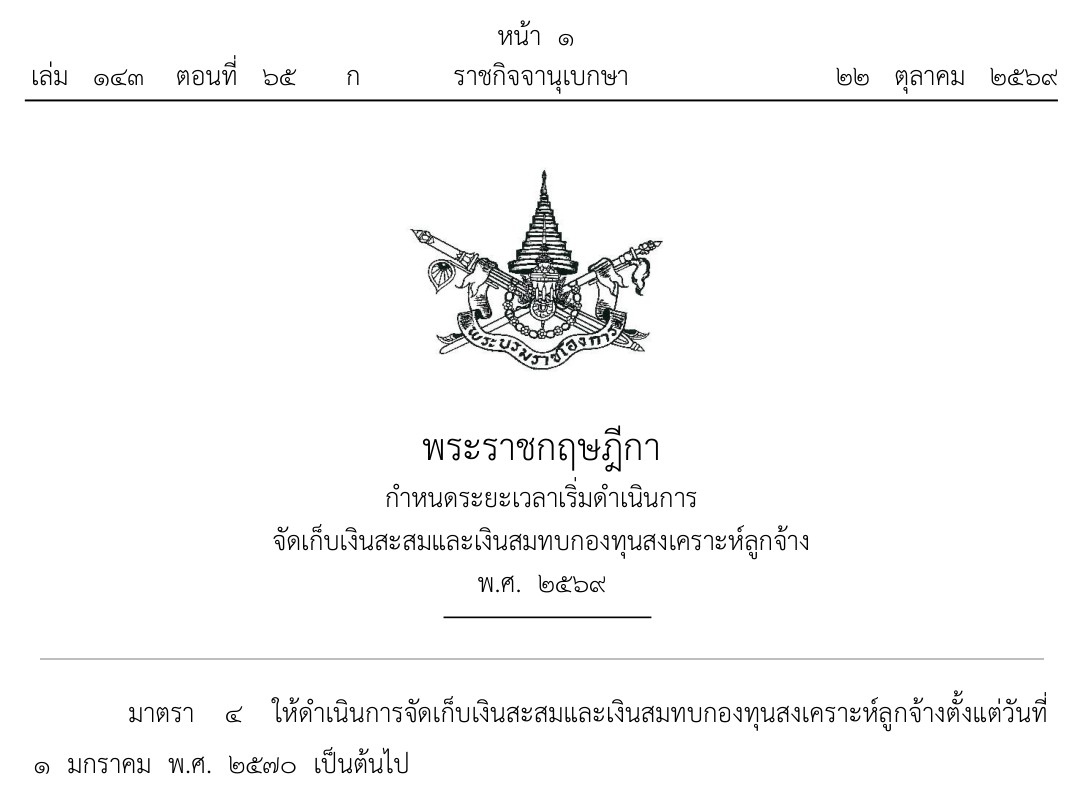
The fund has been delayed, not cancelled. This guide uses the latest delay as a starting point to answer what foreign business owners and foreign employees in Thailand most often ask: whether they have to pay, how much, from when, whether a provident fund gets them out of it, and how the money comes back when someone leaves.
Key Points
- Who should pay attention: foreigners who run or manage companies in Thailand, including foreign-owned firms and companies with Board of Investment (BOI) promotion, and foreign employees working in Thailand on a work permit. Anyone planning to set up a Thai company or take a posting in Thailand may also want to read on.
- Nationality does not matter: in a firm with 10 or more employees in total, foreign staff count towards the headcount and must contribute. Only firms whose entire workforce is in a provident fund (PVD) are exempt.
- The rate is 0.25% each for employer and employee, on actual wages with no ceiling. On a salary of THB 50,000 a month, each side pays THB 125. When employees leave, they get back their own savings, the employer’s share and any returns.
- The common mistakes are assuming a provident fund exempts everyone, assuming foreigners are excluded, and treating the delay as a reason not to prepare. Each can leave a company under-deducting or under-paying from January 2027.
Who Has to Join the Employee Welfare Fund and Who Is Exempt?
The legal basis is section 130 of the Labour Protection Act B.E. 2541 (1998): employees of a business with 10 or more staff are members of the fund, unless the employer has set up a provident fund or provides its own leaving and death assistance under a ministerial regulation. The details below come from the DLPW’s Employee Welfare Fund Q&A (EP1):
| Situation | Join the fund? |
|---|---|
| 10 or more employees in total, counting every branch of the same employer | Yes. For example, three branches with 8 staff each make 24, so the employer must join |
| Related companies that are separate legal entities, each with fewer than 10 staff | No. Shared directors or a shared building do not make them one employer |
| Foreign workers, staff on probation, temporary, daily and fixed-term staff, people rehired after 60 | All count towards the headcount and must join |
| Every employee is already in a provident fund (PVD) | Exempt |
| Only some employees are in a provident fund | Those outside the PVD must join |
| Staff on probation who cannot yet join the provident fund | Join the fund first, and may stop contributing after moving into the PVD |
| Headcount falls below 10 after joining | Contributions continue |
| Private-school teachers and education staff, private universities, government bodies, non-profits, marine fishing and similar | Outside the compulsory scheme |
Businesses outside the compulsory scheme can join voluntarily if both employer and employees agree. There is no upper age limit, so employees over 60 keep contributing.
How Is the Thailand Employee Welfare Fund Calculated? Rates, Examples and Deadlines
Rates are set by ministerial regulation, and section 131 of the Labour Protection Act caps them at 5% of wages. The current rate regulation, published on 15 September 2025, sets the same rate for both sides:
| Period (current regulation) | Employee savings | Employer contribution |
|---|---|---|
| Phase 1: 1 October 2026 to 30 September 2031 | 0.25% of wages | 0.25% of wages |
| Phase 2: from 1 October 2031 | 0.5% of wages | 0.5% of wages |
The rates do not change with the move to 1 January 2027. According to Thai media reports, the cabinet approved in principle on 14 October 2026 a revised rate regulation to match the new start date. Until it is published, the phase dates in the current regulation and DLPW notices apply.
Worked Examples on THB 30,000 and THB 50,000 a Month
Contributions are based on “wages” as defined in section 5 of the Labour Protection Act, meaning pay for normal working hours, including paid holidays and paid leave. Unlike social security, the Employee Welfare Fund has no wage floor or ceiling. At the phase 1 rate of 0.25%:
| Monthly salary | Employee deduction | Employer contribution | Total paid in |
|---|---|---|---|
| THB 30,000 | THB 75 | THB 75 | THB 150 |
| THB 50,000 | THB 125 | THB 125 | THB 250 |
On THB 50,000 a month, employee and employer each pay THB 1,500 a year. These examples are Zagdim’s calculations at the current rate; the actual amount depends on the wages paid each period.
When to Pay
Employers deduct on every payday and pay in by the 15th of the month after the month in which wages were paid. What counts is the month the wages were actually paid, not the month they were earned. Late or short payments attract a surcharge of 5% a month on the unpaid amount under section 131, and an employer cannot escape liability by saying it never deducted the money.
How Many Times Has the Fund Been Delayed? A Timeline
All three entries below come from decrees and regulations published in the Royal Thai Government Gazette:
| When | What happened |
|---|---|
| Originally 1 October 2025 | Planned start of collection |
| September 2025 | A decree delayed the start by a year to 1 October 2026; the current rate regulation was published at the same time |
| 22 October 2026 | A new decree delayed the start by three months to 1 January 2027, citing floods |
The 2026 decree repeals the 2025 delay decree and takes effect from 1 October 2026, so wages for October to December 2026 are not subject to deductions.
Foreign Employees and Foreign-Owned Companies: What Applies
Do Foreign Employees Have to Contribute?
Yes. The DLPW Q&A states that Thai nationals, foreigners and migrant workers are all covered once a firm has 10 or more staff in total. Foreign employees are registered with, in order of preference, a passport number, a non-Thai identity card (pink card) number or a work permit number.
Do Secondees Count?
It depends on who the employer is. If an overseas company sends an employee to work with a Thai partner and keeps paying them from abroad, and the Thai company neither hired nor pays them, the Thai company is not their employer and does not enrol them. If a Thai company hires and pays the person, they are that company’s employee.
Do Foreign Owners and Managing Directors Join?
A managing director (กรรมการผู้จัดการ) who works under the company’s direction and draws wages is an employee and must join. One with full management authority who is not supervised by anyone is not an employee. Consultants, independent contractors and students on course-based internships are not employees either.
Is There a Separate Exemption for BOI or Foreign-Owned Companies?
Neither the Labour Protection Act nor the DLPW Q&A sets out a separate exemption for foreign-owned or BOI-promoted companies. The tests are the same: headcount, and whether every employee is in a provident fund.
What Employers Should Prepare Now
Before deductions start on 1 January 2027, companies can work through the checklist in the DLPW Q&A (EP2):
- Count employees across all branches and confirm whether the business falls within the compulsory scheme.
- Check whether the company has a provident fund and which employees are not yet in it, such as staff on probation or those who chose not to join.
- Apply for an account and PIN on the DLPW’s electronic system (EWF), register the business and its staff on form สกล.3 or สกล.3/1, and obtain the electronic registration certificate สกล.4.
- Collect passport or work permit numbers for foreign employees.
- Update payroll to deduct 0.25% on every payday, match it with an employer contribution, and pay in by the 15th of the following month.
- Ask employees to register on the system, check their contribution records and name a beneficiary on form สกล.5.
Employees with no wages in a month must still be reported, with wages entered as 0.
How Employees Get the Money Back When They Leave
Under section 133 of the Labour Protection Act, when an employee leaves, the DLPW pays out the employee’s own savings, the employer’s contributions and the investment returns. This applies whether the employee resigns, is dismissed, reaches the end of a contract or retires. Employees claim on form สกล.6.
If an employee dies, the money goes to the beneficiary named on form สกล.5. Without one, it is shared equally among children, spouse and parents.
Employees who stop contributing after moving into a provident fund cannot withdraw what is already in the Employee Welfare Fund at that point. They claim it when their employment ends.
Common Misconceptions About the Employee Welfare Fund
- “The delay means it has been scrapped.” The decree only moves the start date to 1 January 2027; the legal duty remains. Practical tip: use the extra three months to register and update payroll.
- “We have a provident fund, so nobody pays.” Only firms with every employee in a provident fund are exempt. Practical tip: check staff on probation in particular.
- “Foreign staff are not covered.” The DLPW Q&A says nationality makes no difference. Practical tip: register foreign staff with their passport numbers.
- “Only head-office staff count.” Every branch of the same employer is counted together. Practical tip: if all branches add up to 10, the firm must join.
- “High earners are capped.” There is no wage ceiling, unlike social security. Practical tip: calculate deductions for highly paid expatriates on their actual wages.
Scenarios: Three Companies and Employees in Thailand
Scenario 1: A Foreign-Owned Trading Company With 12 Staff
Mr Lin runs a trading company in Bangkok with 10 Thai employees and 2 foreign employees on work permits, and no provident fund. With 12 staff in total, the company is in the scheme, and all 12 must join. From January 2027, it deducts 0.25% of each employee’s wages on payday, adds 0.25% of its own, and pays in by the 15th of the following month.
Scenario 2: A Foreign-Owned Firm With a Provident Fund and New Hires on Probation
A foreign-owned manufacturer has 40 employees, and its provident fund only admits staff who have passed probation. Employees already in the PVD stay out of the fund, but 5 staff on probation must join the Employee Welfare Fund first. Once confirmed and enrolled in the PVD, they can ask to stop contributing, and claim what they have paid in when they eventually leave.
Scenario 3: An Engineer Seconded by a Parent Company Abroad
Mr Chen is sent by his Taiwanese parent company to support a Thai client’s factory. His salary is paid by the parent company, and the Thai factory has no contract with him and pays him nothing. Under the DLPW Q&A, the Thai factory is not his employer and does not enrol him. If he is later hired and paid by the parent’s Thai subsidiary, the subsidiary’s headcount decides.
Thailand Employee Welfare Fund: Frequently Asked Questions
When do Thailand Employee Welfare Fund deductions start?
Under the decree published in the Royal Thai Government Gazette on 22 October 2026, collection starts on 1 January 2027. It was due to begin on 1 October 2026 but was pushed back three months because of floods, so wages for October to December 2026 are not subject to deductions.
Do foreign employees pay into the Thailand Employee Welfare Fund?
Yes. The DLPW Q&A states that Thai nationals, foreigners and migrant workers all count, and a firm with 10 or more staff in total must enrol them. Foreign employees are registered with a passport, pink card or work permit number. Secondees who are paid by an overseas employer are not employees of the Thai company.
My company has 8 employees. Do we have to join?
Under section 130 of the Labour Protection Act, the compulsory scheme covers businesses with 10 or more employees, counting every branch of the same employer. Below 10, joining is not required, though employer and staff can join voluntarily. If headcount later reaches 10, the company must join.
How much is deducted from a THB 80,000 monthly salary?
There is no wage ceiling, so at 0.25% of actual wages, the employee pays THB 200 a month and the employer adds another THB 200. Under the current regulation, both rates rise to 0.5% in phase 2, with the date set by the published regulation.
We already have a provident fund. Do we still need to join?
Firms whose entire workforce is in a provident fund are exempt. If only some staff are in the PVD, the rest must join the fund; a common case is new hires on probation who cannot yet join the PVD. With the employer’s consent, an employee can also belong to both.
Can I get the money back when I leave Thailand?
Under section 133 of the Labour Protection Act, when an employee leaves, the fund pays out their own savings, the employer’s contributions and the returns. Employees claim on form สกล.6, and this applies after resignation, dismissal, the end of a contract or retirement.
What happens if an employer pays late?
Under section 131, late or short payments attract a surcharge of 5% a month on the unpaid amount, and an employer cannot avoid liability by saying it never deducted the money. A labour inspector can order the employer to comply, and failing to do so can lead to criminal and civil liability.
Running a Business or Working in Thailand? Ask Zagdim
If you run a company, employ staff or work in Thailand and have questions about the Employee Welfare Fund, provident funds or life in Thailand, tell us about your situation at Ask Zagdim.
Life abroad? Ask Zagdim.
Your first stop for international property and global living.
Research and insights. Know what’s changing. Understand what matters.
Newsletter for overseas updatesSubscribe →
Important Disclaimer
This article is general information and does not constitute legal, tax or financial advice. It is based mainly on royal decrees and ministerial regulations published in the Royal Thai Government Gazette in 2025 and 2026, the Labour Protection Act, and the Employee Welfare Fund Q&A published by Thailand’s Department of Labour Protection and Welfare. Whether a particular company is covered, and how an individual’s status is assessed, is for the authorities to decide; consult a qualified Thai employment law professional where needed.
The Thailand Employee Welfare Fund rules in this article are current as of 25 October 2026; check the Royal Thai Government Gazette and the Department of Labour Protection and Welfare for the latest notices.
References
Royal Thai Government Gazette – Royal Decree on the Period for Starting Collection of Savings and Contributions to the Employee Welfare Fund B.E. 2569 (22 October 2026) / Royal Thai Government Gazette – Ministerial Regulation on Employee Welfare Fund Savings and Contribution Rates B.E. 2568 (15 September 2025) / Department of Labour Protection and Welfare – Royal Gazette publishes delay of Employee Welfare Fund collection to 1 January 2027 (22 October 2026) / Department of Labour Protection and Welfare – Employee Welfare Fund Q&A EP1: Membership / Department of Labour Protection and Welfare – Employee Welfare Fund Q&A EP2: Registration and Payment / Thairath – Royal decree delays Employee Welfare Fund collection to 1 January 2027 (24 October 2026) / HFocus – Cabinet approves delay of Employee Welfare Fund deductions to January 2027 (October 2026)