





























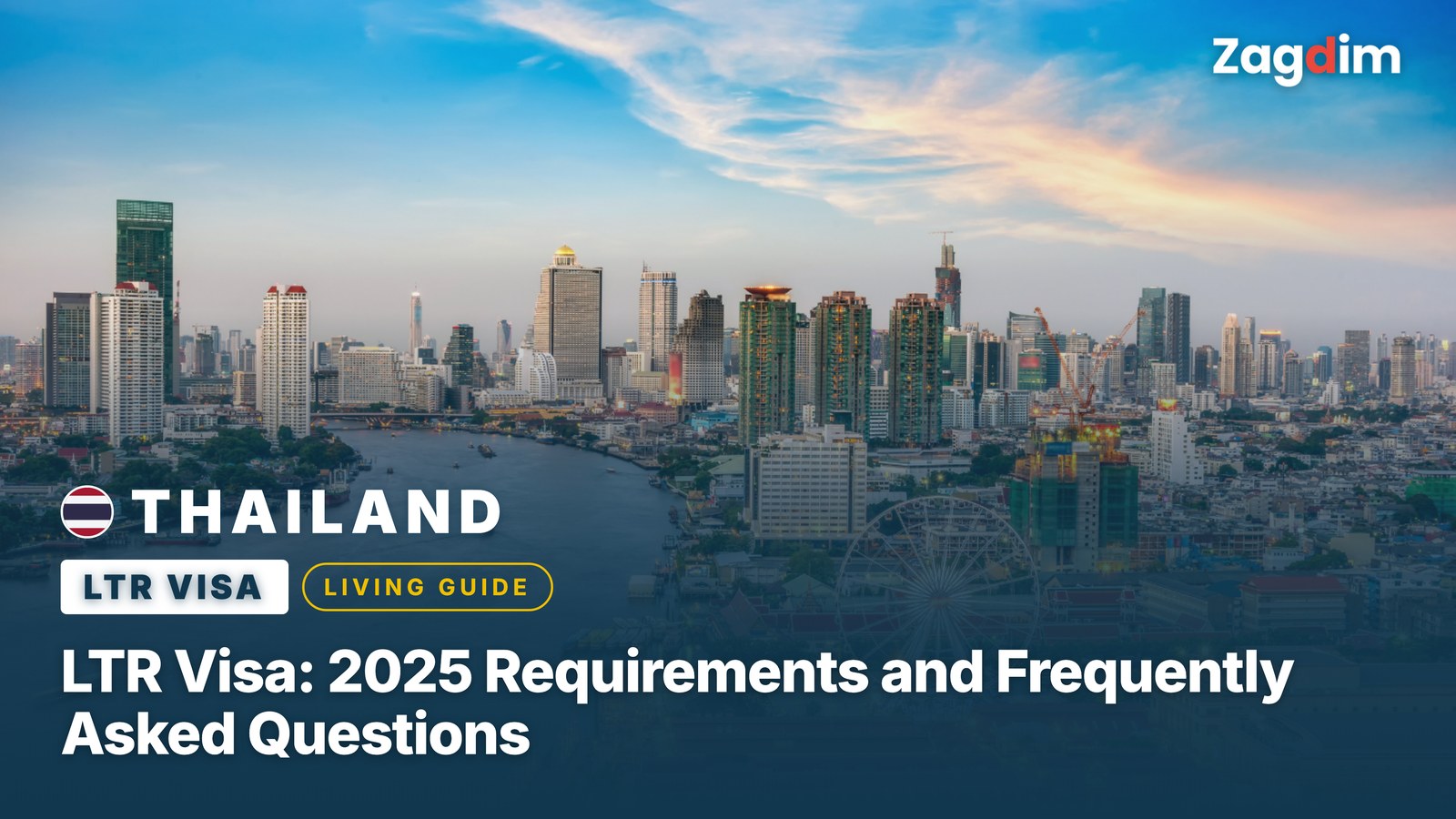
Thailand’s Long-Term Resident Visa (LTR Visa) is designed to attract high-potential foreign nationals, including investors, retirees, remote workers, and highly skilled professionals, offering up to 10 years of residence along with a range of exclusive benefits. The visa is administered by Thailand’s Board of Investment (BOI), has been in effect since September 1, 2022, and underwent a series of refinements in 2025 that significantly lowered application thresholds.
I. LTR Visa Categories and Eligibility
The LTR Visa is divided into five categories, each with its own specific eligibility conditions:
1. Wealthy Global Citizens
- Asset requirement: at least USD 1,000,000 in assets.
- Investment requirement: at least USD 500,000 invested in Thai government bonds, equity in a Thai-registered company, or real estate.
- Income requirement: annual income of at least USD 80,000 (from 2025, the annual income requirement has been removed; only the asset and investment conditions need to be met).
- Health insurance: health insurance of at least USD 50,000, or a bank deposit of at least USD 100,000 held in a Thai or overseas bank account for at least 12 months.
LTR Visa Wealthy Global Citizen — details
2. Wealthy Pensioners
- Age requirement: 50 years or older.
- Income requirement: annual income of at least USD 80,000; if annual income falls between USD 40,000 and 80,000, an investment of at least USD 250,000 in Thai government bonds, equity in a Thai company, or real estate is required.
- Health insurance: same as above.
LTR Visa Wealthy Pensioner — details
3. Work-from-Thailand Professionals
- Employment contract: an employment contract with a Thai or overseas company.
- Work experience: at least 5 years of relevant work experience within the 10 years before applying.
- Company requirement: currently employed at a publicly listed company, or at a company with total revenue of at least USD 150 million over the past 3 years (from 2025, this has been lowered to USD 50 million).
- Health insurance: health insurance of at least USD 25,000.
LTR Visa Work-from-Thailand Professional — details
4. Highly-Skilled Professionals
- Field of work: employed in one of Thailand’s targeted industries, such as technology, innovation, or disaster and risk management.
- Income requirement: annual income of at least USD 80,000; if holding a relevant master’s degree, the income requirement can be lowered to USD 40,000.
- Work experience: at least 5 years of relevant work experience within the 10 years before applying.
- Health insurance: same as above.
LTR Visa Highly Skilled Professional — details
5. Spouses and Dependents
- Eligibility: the spouse and children under 20 of an LTR Visa holder.
- Number limit: a maximum of 4 dependents in total per LTR Visa holder. BOI has announced plans to expand eligible dependents to include parents and remove this cap, but the change awaits implementation by Thailand’s Ministry of Interior and is not yet in effect.
- Health insurance: each dependent must provide health insurance of at least USD 25,000.
II. LTR Visa Benefits
1. Length of stay: a 10-year, multiple-entry visa.
2. Reporting requirement: report to Immigration once a year, replacing the 90-day reporting requirement of other visa types.
3. Work permit: eligible to apply for a Digital Work Permit and begin working immediately.
4. Tax benefits: for Highly Skilled Professionals, personal income tax on Thai-sourced income is set at a flat rate of 17%.
5. Simplified work permit application: the annual fee for a work permit application is THB 3,000, and the requirement for employers to hire 4 Thai employees for every 1 foreign employee is waived.
6. Airport clearance: fast-track immigration clearance at international airports.
III. Points to Note After Holding a Thailand LTR Visa
After obtaining a Thailand Long-Term Resident Visa (LTR Visa), holders must comply with relevant rules, or the visa may be revoked. Points to note include:
- The principal applicant and all dependents must report their residence status to Thai Immigration once a year (the 90-day reporting requirement no longer applies).
- Once the visa is granted and a work permit application has been submitted, holders may begin working immediately without waiting for the permit to be issued.
- Once the LTR visa is terminated or expires, the work permit is automatically invalidated as well.
IV. Thailand LTR Visa FAQ
1. Can I apply for an LTR visa while holding another Thai visa?
Yes. As long as you meet the eligibility requirements, you can convert your existing visa to an LTR visa while in Thailand.
2. How long does it take to process an LTR visa?
Generally around 4–8 weeks. If documents are missing or incorrect, BOI may request additional documents, extending the review period. If applying from overseas, processing speed at the relevant embassy may also cause delays.
3. What happens if my application is rejected?
There’s no need to panic. You can reapply after resolving the reason for rejection. Contacting a professional through us can help identify the reason for the rejection and improve your chances of success on your next application.
4. Can LTR visa holders buy property in Thailand?
As with other foreign nationals, LTR visa holders cannot purchase land in their own name, but can purchase condominium units or houses, or obtain land-use rights through a long-term lease.
5. Can I use an LTR visa to apply for a Thai work permit?
It depends on your LTR category. For example, the “Work-from-Thailand” category cannot apply for a work permit, but “Highly-Skilled Professionals” can.
6. Can my dependents work in Thailand?
Yes. Dependents can apply for a work permit once they hold an LTR visa, but must also meet the relevant employment regulations.
7. Do I need to reapply for entry permission after leaving Thailand?
No. The LTR is a multiple-entry visa, so you may freely enter and exit Thailand during its validity period by presenting the visa page, and you are entitled to fast-track immigration clearance.
8. Do LTR visa holders still need to report to Immigration every 90 days?
No. LTR visa holders only need to report once a year, one of its more convenient advantages compared with other visa types.
9. How does the LTR visa differ from Thailand’s Elite Visa?
The LTR visa is aimed mainly at professionals and active investors, while the Thailand Elite Visa is a tourism-category visa suited to frequent long-stay visitors, valid for 5–20 years and comparatively simple to apply for, but does not allow employment at a local Thai company — only remote work is permitted.
10. Do I need health insurance to apply for an LTR visa?
Yes. All applicants must provide health insurance of at least USD 50,000, or show a Thai bank account balance of over USD 100,000.
11. Do I need to already have an employer to apply?
If applying under the “Highly-Skilled Professionals” or “Work-from-Thailand Professionals” categories, an employment contract is required; if applying under “Wealthy Global Citizens” or “Wealthy Pensioners,” no employment contract is required.
12. Can social security or a pension count as proof of income?
Yes. Social security and government pensions can be counted as passive income for income calculation purposes, applicable to the “Pensioners” category. If the amount does not meet the requirement, other supplementary income is needed.
13. Can a same-sex spouse apply as an LTR dependent?
Yes. Since January 2025, Thailand has officially recognized same-sex marriage, granting it the same legal rights as opposite-sex marriage, including the ability to apply for an LTR visa as a dependent family member.
14. Which government body issues the LTR visa?
The LTR visa is not processed by Immigration, but by Thailand’s Board of Investment (BOI), since it was established to promote economic development.
15. Does the LTR visa also require filling out a TDAC (Thailand Digital Arrival Card)?
Yes. LTR visa holders need to complete the arrival card within 3 days before entry.
V. Summary
For applicants, Thailand’s LTR visa is not just a residence benefit — it is an institutional gateway to a new stage of asset consolidation and life restructuring. Whether your focus is global tax planning, the next generation’s education opportunities, a regional operating base, or building a flexible Asian life base you can step back from or lean further into, the LTR offers a higher degree of freedom than traditional relocation options. From a single 10-year grant, to flexible tax design, to comprehensive support for family structures, this system is especially suited to those planning for the next five to ten years.
If you’re wondering: does my asset structure qualify? Which category suits me best? Can this align with my existing investment direction? Ask Zagdim for an initial review of your conditions and a match against the system, to help you assess whether this step is right for you while avoiding unnecessary detours and blind spots.
Related information:
- Thailand Long-Term Resident Visa (LTR Visa): 2025 Latest Requirements and FAQ
- 2025 Thailand LTR Visa Complete Guide: Eligibility, the Four Main Programs, Benefits, Process, Application Fees, and FAQ
- Thailand Long-Term Resident LTR Visa Application Assistance
Have a question about this guide? Leave a comment below, or ask Zagdim directly.
Your first stop for international property and global living.
Research and insights. Know what’s changing. Understand what matters.