

































Can a Dubai Landlord Selling a Property Make You Move Out? The Law Says 12 Months’ Written Notice
A Dubai landlord selling a property and seeking to repossess it must, under Article 25(2) of Dubai’s tenancy law as amended by Law No. 33 of 2008, give the tenant at least 12 months’ notice before the eviction date, served through a Notary Public or by registered mail — and only once the lease has expired. If the flat is sold mid-tenancy, Article 28 of Law No. 26 of 2007 means the buyer simply becomes your landlord and the lease runs to its end.
The question comes round every year because Dubai’s rental market turns over fast. On 20 September 2026, the legal Q&A column in Khaleej Times published a reader’s question: a tenant in Dubai whose landlord had suddenly announced a sale and asked them to leave, wanting to know how much notice the law requires, whether they can be made to leave before the lease ends, and whether a buyer inherits the tenancy. The reply came from Dubai-based lawyer Ashish Mehta.
This guide sets out the provisions of Dubai’s tenancy law that deal with being asked to leave. Every rule below is taken from the Dubai Legislation portal.
Key Points
- Who needs to take note: anyone renting or working in Dubai, anyone preparing to move there long term, and owners of rented property in Dubai who want to know when they can take it back.
- The rule that matters most: once a lease expires, a Dubai landlord may repossess on only four grounds, and each requires at least 12 months’ notice before the eviction date, served through a Notary Public or by registered mail.
- The second key point: a Dubai landlord selling up does not cancel your lease. As long as the lease has a fixed term, the buyer becomes your landlord and the tenancy runs to its end.
- The easiest trap to fall into: a lease that is not registered with RERA (Ejari) cannot be taken to the authorities if a dispute arises.
When a Dubai Landlord Can Ask a Tenant to Leave: Two Separate Sets of Rules
Tenancy in Dubai is governed by Law No. 26 of 2007, as amended by Law No. 33 of 2008. Whether a landlord can ask you to leave depends first on one distinction: during the lease term, or after the lease has expired. Different articles apply, and the grounds are not the same.
After the Lease Expires: Four Grounds Only, With 12 Months’ Notice
Article 25(2) uses the words “only if” — after expiry, the grounds on which a landlord may seek eviction are an exhaustive list of four. All four below come from Article 25(2) as amended by Law No. 33 of 2008:
| Ground | Article | Conditions attached |
|---|---|---|
| Demolition and reconstruction, or adding structures that prevent the tenant using the property | Art. 25(2)(a) | Owner must obtain the required permits |
| Property needs restoration or comprehensive maintenance that cannot be done while occupied | Art. 25(2)(b) | Requires a technical report issued or certified by Dubai Municipality |
| Owner’s own use, or use by a first-degree relative | Art. 25(2)(c) | Owner must prove they own no other suitable property |
| The owner wishes to sell the property | Art. 25(2)(d) | No further condition in the text |
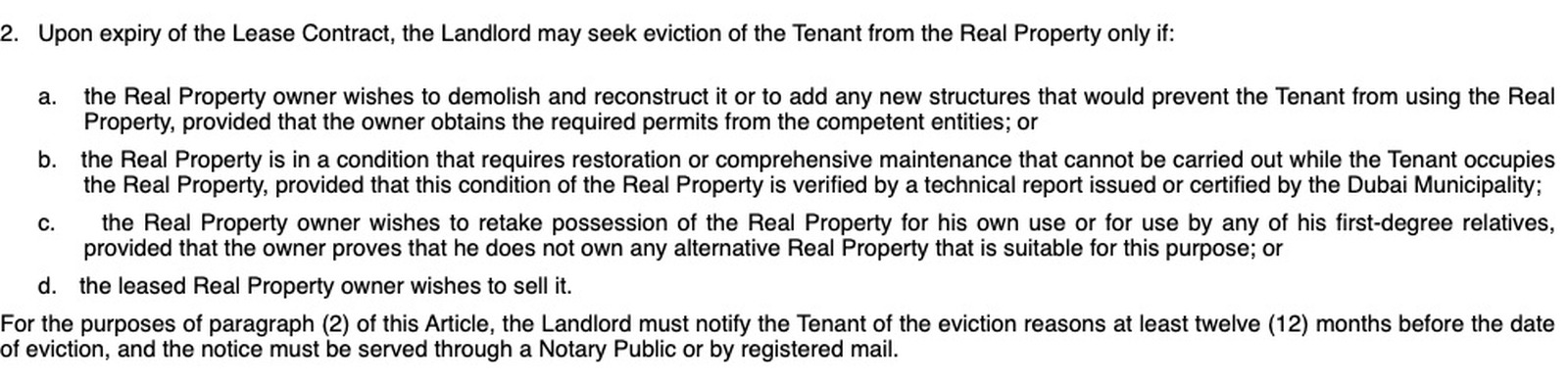
All four share the same notice rule: the landlord must give notice at least 12 months before the eviction date, and that notice must be served through a Notary Public or by registered mail. The text is strict about the method of service, and this is where things most often go wrong in practice — a phone call, a WhatsApp message, an email or word passed through an agent do not meet what the article requires.
During the Lease Term: A Different List Entirely, and It Does Not Include a Sale
Article 25(1) covers situations where the landlord seeks repossession before the lease has expired. The items below all come from Article 25(1) as amended by Law No. 33 of 2008:
| Situation | Grace period or threshold |
|---|---|
| Tenant fails to pay rent | 30 days from service of notice |
| Subletting without the landlord’s written approval | Eviction applies to tenant and subtenant alike |
| Property used for illegal purposes, or against public order or morals | No grace period in the text |
| Commercial premises left vacant without valid reason | 30 consecutive days, or 90 non-consecutive days in a year |
| Tenant’s alterations endanger the property beyond restoration, or damage caused deliberately or by gross negligence | No grace period in the text |
| Property used for a purpose other than the one leased, or in breach of planning, construction or land use regulations | No grace period in the text |
| Property is likely to collapse | Landlord must prove it by a technical report issued or certified by Dubai Municipality |
| Tenant fails to meet obligations under the law or the lease | 30 days from service of notice |
| Government authorities require demolition for urban development | No grace period in the text |
Set the two lists side by side and the key difference is plain: a Dubai landlord selling appears only in Article 25(2), which deals with expiry — not in Article 25(1), which deals with the lease term. While the lease is running, wanting to sell is not a legal ground for asking a tenant to leave.
What Happens to the Lease After a Dubai Landlord Sells
Article 28 of Law No. 26 of 2007 is direct: transferring ownership to a new owner does not affect the tenant’s right to continue occupying the property under the existing lease, provided that lease has a fixed term.

In practice: the flat changes hands, the lease does not. The buyer steps into the previous landlord’s position, and the terms, rent and duration all continue to expiry. A buyer cannot ask a tenant to leave simply because they have just bought the property — to repossess for their own use or to sell again, they must go back to Article 25(2): 12 months’ notice, through a Notary Public or by registered mail.
That phrase “fixed term” is worth noting. It is precisely why a tenancy in Dubai should always be a written lease with clear start and end dates, and properly registered.
After Repossessing for Own Use, a Dubai Landlord Cannot Re-Let Straight Away
Article 26 (as amended in 2008) addresses an obvious worry: what if the landlord says they need the property themselves, evicts the tenant, and then lets it to someone else?
The article provides that where the Tribunal awards the landlord possession for their own use or that of a first-degree relative, the landlord may not let the property to a third party for at least 2 years in the case of residential property, or 3 years for non-residential property, counted from the date of repossession. If they do, the tenant may ask the Tribunal to award fair compensation.
One warning: a great many articles still say “1 year”. That figure comes from the original 2007 version of Article 26 and was replaced by Law No. 33 of 2008 with the 2-year and 3-year periods. Use the amended version.
After Demolition or Renovation, the Former Tenant Has First Refusal
Where the landlord repossessed in order to demolish, rebuild, renovate or refurbish, Article 29 (as amended in 2008) gives the former tenant a way back: once the work is complete, they hold a right of first refusal, with rent determined under the criteria in Article 13.
The window is short — the tenant must exercise it within 30 days of being notified by the landlord. After that the right cannot be claimed.
Renewal, the 90-Day Notice, and How Much Rent Can Rise in Dubai
Besides being asked to leave, the other cluster of questions tenants in Dubai run into is renewal and rent increases. These are often confused with one another, so it helps to separate them.
| Matter | The rule |
|---|---|
| Automatic renewal (Art. 6, Law No. 26 of 2007) | If the tenant stays on after expiry without objection from the landlord, the lease renews on the same terms, for the original term or one year, whichever is shorter |
| Amending lease terms, including rent (Art. 14 as amended in 2008) | Either party must notify the other no less than 90 days before the lease expires, unless otherwise agreed |
| No agreement on renewal (Art. 13 as amended in 2008) | The Tribunal determines a fair rent using the criteria in Article 9 |
| Lease registration (Art. 4, Law No. 26 of 2007) | Leases must be registered with RERA; judicial authorities and government departments may not consider a dispute over an unregistered lease |
| Death of either party (Art. 27, Law No. 26 of 2007) | The lease does not expire on the death of landlord or tenant; the relationship continues with the heirs |
The ceiling on rent increases is set by Article 1 of Decree No. 43 of 2013, on a five-band scale based on how far the current rent sits below the average rental value of similar units:
| How far current rent is below the average rental value | Maximum increase on renewal |
|---|---|
| Up to 10% below | No increase permitted |
| 11%–20% below | 5% |
| 21%–30% below | 10% |
| 31%–40% below | 15% |
| More than 40% below | 20% |
“Average rental value of similar units” is determined by the Rent Index approved by RERA. Dubai Land Department launched the Smart Rental Index on 2 January 2025, using artificial intelligence and a building classification system to assess rental values — taking in technical and structural characteristics, quality of finishes and maintenance, location and spatial value, and services such as maintenance, cleaning and parking.
Worth noting: these increase rules apply to special development zones and free zones, including the Dubai International Financial Centre (DIFC), not only to ordinary communities.
Common Misunderstandings: Five Things Tenants in Dubai Get Wrong
One: “My landlord says they’re selling, so I have to move”
Why that is incomplete: wanting to sell is one of the four grounds in Article 25(2), which applies after expiry, and it still requires at least 12 months’ notice through a Notary Public or by registered mail. During the lease term, a Dubai landlord selling is not on the list of grounds for asking a tenant to leave.
Practical note: check whether what you received is a valid notice in the form the article requires, and whether there are 12 months or more between the notice date and the date you are asked to leave.
Two: “The flat was sold, so my lease is gone”
Why that is incomplete: Article 28 states plainly that a transfer of ownership does not affect the tenant’s right to continue occupying under the existing lease, provided it has a fixed term. The buyer steps into the previous landlord’s position.
Practical note: keep the full written lease and registration records; if a new owner asks to renegotiate or wants you out early, the existing lease terms are your baseline.
Three: “Rent in Dubai can’t go up in the first two years”
Why that is incomplete: that was the original Article 9 of the 2007 law. It was replaced in full by Law No. 33 of 2008, and the current text contains no two-year freeze. Increases are now governed by the five bands in Decree No. 43 of 2013, and the process by the 90-day notice in Article 14.
Practical note: when a rent increase notice arrives, first check whether it came at least 90 days before expiry, then use the Rent Index to check the increase against the cap.
Four: “He told me in person and sent a WhatsApp, so that counts as notice”
Why that is incomplete: Article 25 is explicit about service — a Notary Public or registered mail. Other methods do not meet what the article requires.
Practical note: whether receiving or sending notice, keep proof of service; in a dispute it is the most basic document you will need.
Five: “Dubai’s rules apply across the UAE”
Why that is incomplete: every law cited here belongs to the Emirate of Dubai. Abu Dhabi, Sharjah and the other emirates have their own tenancy laws, with different figures and procedures.
Practical note: if you move emirate, check the local rules again — do not carry Dubai’s 12-month notice across.
Worked Examples: Three Situations Tenants Actually Face
One: Eight months left on the lease and the landlord wants to hand over to a buyer next month
Background: a one-year lease running to next May; in September the landlord says a buyer has been found and asks you to leave by the end of October.
The problem: the landlord is using “it’s already sold” as grounds to move you out early.
How to handle it: under Article 25(1), wanting to sell is not among the grounds for repossession during the lease term; under Article 28, a transfer of ownership does not affect the existing lease. Set out the legal basis in writing and keep a record of the exchange.
What not to overlook: if both sides agree to end the lease early on agreed compensation, that is a negotiated termination and a different matter from statutory repossession — the terms are whatever you both agree.
Two: A registered letter saying the property will be repossessed for own use in a year
Background: the landlord gives notice by registered mail that they will repossess for their own use in 12 months.
The problem: the form and period look compliant, and the tenant wants to know what protection remains.
How to handle it: confirm that notice date and eviction date are a full 12 months apart; note that Article 25(2)(c) requires the landlord to prove they own no other suitable property. After repossession, the landlord may not let residential property to a third party for at least 2 years, and the tenant may ask the Tribunal for fair compensation if they do.
What not to overlook: whether a breach occurred and what compensation follows are decided case by case by the Rental Disputes Centre.
Three: The landlord is demolishing the whole building
Background: the landlord gives 12 months’ notice through a Notary Public, on the ground of demolition and reconstruction.
The problem: the tenant has lived there for years and wants to return once the work is done.
How to handle it: under Article 29, the tenant holds a right of first refusal over the rebuilt, renovated or refurbished property, with rent set under the Article 13 criteria; it must be claimed within 30 days of being notified.
What not to overlook: first refusal does not mean renewing at the old rent — the new rent is determined under the statutory criteria.
FAQ: A Dubai Landlord Selling and Repossessing Property
How much notice must a Dubai landlord selling a property give before a tenant has to move?
Under Article 25(2) as amended by Law No. 33 of 2008, the landlord must give notice at least 12 months before the eviction date, served through a Notary Public or by registered mail. The requirement covers all four grounds for repossession after expiry, not just a sale.
My lease hasn’t ended — can a Dubai landlord selling the flat make me leave?
No. Article 25(1) sets out the situations in which a landlord may seek repossession during the lease term, and a sale is not among them; wanting to sell appears only in Article 25(2), which deals with expiry. If both parties agree to end the lease early, that is a separate, negotiated matter.
If the flat I rent in Dubai is sold mid-lease, does the buyer become my landlord?
Yes. Article 28 of Law No. 26 of 2007 provides that a transfer of ownership does not affect the tenant’s right to continue occupying under the existing lease, provided it has a fixed term. The buyer steps into the previous landlord’s position and the terms and duration continue to expiry.
My landlord evicted me for own use and then let the flat to someone else — what can I do?
Article 26 (as amended in 2008) provides that where the Tribunal awards possession for the landlord’s own use or that of a first-degree relative, the landlord may not let to a third party for at least 2 years for residential property, or 3 years for non-residential, from the date of repossession; if they do, the tenant may ask the Tribunal for fair compensation. Whether a breach occurred, and how much is awarded, is decided case by case by the Rental Disputes Centre. Note that the widely repeated “1 year” comes from the superseded 2007 text.
My landlord notified me by WhatsApp — does that count?
Article 25 requires service through a Notary Public or by registered mail. Absent some other legal basis, a message, a phone call or a verbal notice does not meet the method of service the article requires. Keep proof of service whether you are receiving or sending notice.
How much can rent rise in a year in Dubai?
Under Article 1 of Decree No. 43 of 2013, the maximum increase on renewal depends on how far the current rent sits below the average rental value of similar units: no increase where it is up to 10% below; 5% where 11%–20% below; 10% where 21%–30% below; 15% where 31%–40% below; and 20% where more than 40% below. Average rental value is determined by the Rent Index approved by RERA. Under Article 14, a party seeking to change the rent must give notice no less than 90 days before expiry.
What happens if my Dubai lease is not registered with Ejari?
Article 4 of Law No. 26 of 2007 requires leases governed by that law to be registered with RERA, and provides that judicial authorities and government departments may not consider a dispute or claim over an unregistered lease. An unregistered lease effectively loses its entry point into the formal process.
Where do tenancy disputes in Dubai go?
The Rental Dispute Settlement Centre (RDC), under Dubai Land Department, is the dedicated body for landlord and tenant disputes. Filing a case carries a fee; the amount and the procedural timelines should be taken from the RDC’s own published schedule (this article did not obtain the official fee page, and figures circulating elsewhere should not be relied on).
Do Dubai’s repossession rules apply in Abu Dhabi or Sharjah?
No. Law No. 26 of 2007, Law No. 33 of 2008 and Decree No. 43 of 2013 are all laws of the Emirate of Dubai. Abu Dhabi, Sharjah and the other emirates have their own tenancy laws, with different notice periods, grounds and increase rules. They cannot be applied across emirates.
Still Have Questions? Ask Zagdim
For more on renting, signing and living in Dubai, Ask Zagdim.
Life abroad? Ask Zagdim.
Your first stop for international property and global living.
Research and insights. Know what’s changing. Understand what matters.
Get overseas change alerts → When a change affects you, we’ll write.
Important Disclaimer
This article is general information and does not constitute legal advice. It is based on the English texts of Law No. 26 of 2007, Law No. 33 of 2008 and Decree No. 43 of 2013 as published on the Dubai Legislation portal, together with material published by Dubai Land Department. The English versions of those laws themselves state that interpretation and application should be based on the Arabic original, which prevails in the event of conflict. Laws may be updated, and individual cases are decided by the competent authorities on their own facts. The rules here apply only in the Emirate of Dubai; other emirates have their own laws. Where your own interests are at stake, consult a legal professional qualified to practise in the UAE.
Rules current as of September 2026; refer to the Dubai Legislation portal and Dubai Land Department for the latest position.
References
Dubai Legislation – Law No. (33) of 2008 Amending Law No. (26) of 2007 Regulating the Relationship between Landlords and Tenants in the Emirate of Dubai / Dubai Legislation – Law No. (26) of 2007 Regulating the Relationship between Landlords and Tenants in the Emirate of Dubai / Dubai Legislation – Decree No. (43) of 2013 Determining Rent Increase for Real Property in the Emirate of Dubai / Dubai Land Department – Dubai Land Department launches ‘Smart Rental Index 2025’ / Dubai Land Department – Rental Index / Khaleej Times – Can your landlord in Dubai evict you to sell property? What UAE law says