
































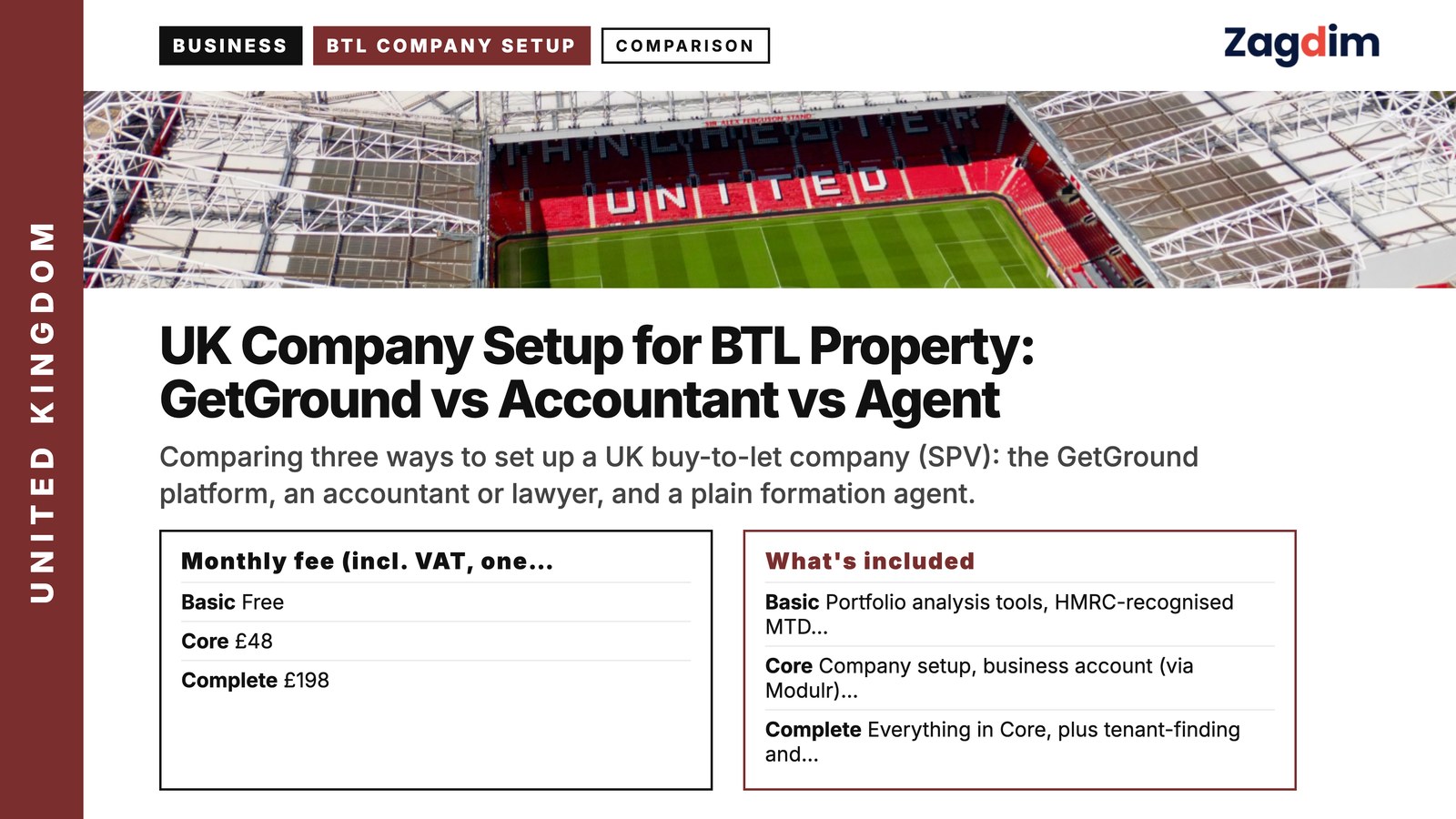
GetGround is a UK property-technology (PropTech) and financial-technology (FinTech) platform, founded in 2018, offering a subscription-based one-stop service (Core plan from £48/month including VAT) for setting up a buy-to-let (BTL) property company, plus a business account, bookkeeping and annual tax filing (current as of August 2026). This article checks each service and fee item against primary sources, and compares it with two other ways of setting up a company: a traditional accountancy or law firm, and a plain formation agent.
Why the Way You Set Up a Company Matters Before You Hold UK Buy-to-Let Property Through It
In the UK, renting out residential property for investment is called buy-to-let (BTL). Holding a BTL property through a limited company (commonly called an SPV) lets mortgage interest be deducted in full as a business expense, with company profit taxed at a Corporation Tax rate of 19% to 25% (2026/27 tax year) — a structurally different tax treatment from holding the property personally. Once an overseas buyer decides to hold through a company, the next question follows immediately: who sets the company up, and who maintains it afterwards.
Zagdim’s editorial team has reviewed the current UK market and grouped the setup options into three: a one-stop platform, a traditional accountancy or law firm, and a plain formation agent. All three can legally set up the same type of company; they differ in scope, cost structure, and how friendly they are to a buyer based overseas. The breakdown below checks each fact against primary official sources; methodology and sources are at the end of the article.
The Basic Process for Setting Up a UK Limited Company
Whichever route you use, the framework is the same: decide the share structure, register with Companies House (official fee £100, current as of February 2026), complete director identity verification (a statutory requirement since November 2025, which can be done online from overseas), open a business account, and only then move on to buying property and applying for a mortgage. Once a company is formed, it has fixed annual filing obligations — a confirmation statement, annual accounts, and a Corporation Tax return — with penalties for missing deadlines. The UK has no nationality or residency requirement for directors or shareholders, so the whole process can be completed remotely.
The difference between the three routes is how much of this process someone else handles for you.
Route One: A One-Stop Platform — What Is GetGround?
GetGround is a UK PropTech and FinTech platform founded in 2018. Its website states it has served more than 30,000 investors, with platform assets exceeding £2 billion, and a Trustpilot rating of 4.7 (as of August 2026). Its core product is the subject of this article: setting up and maintaining a BTL property company (a limited company that holds rental property).
Breaking Down GetGround’s Fees
Its pricing is subscription-based, and understanding this is key to comparing the three routes. The subscription has three tiers (August 2026 prices, all rising with the number of properties held):
| Tier | Monthly fee (incl. VAT, one property) | What’s included | Contract terms |
|---|---|---|---|
| Basic | Free | Portfolio analysis tools, HMRC-recognised MTD tax-filing software, personal finance account | No contract |
| Core | £48 | Company setup, business account (via Modulr), day-to-day bookkeeping, annual accounts and Corporation Tax return filing, Companies House annual confirmation statement, personal self-assessment, remortgage referral, investment advice | Upgrade anytime, 30 days’ notice to cancel |
| Complete | £198 | Everything in Core, plus tenant-finding and letting management (in partnership with UK letting-agency chain Leaders Roman Group), landlord insurance (arranged via Superscript), quarterly portfolio review | Minimum 12-month contract (tied to the letting and insurance services) |
The Core tier is what this article is about — there is no separate setup fee; setup itself is included in the subscription.
How should this monthly fee be understood? On the Core plan, that comes to about £576 a year (£48 × 12) — you are not buying a single action, but bundling the setup fee, annual accounting and filing, company secretarial work and bookkeeping tools all into one monthly fee. Compared with Route Three: an agent package is a one-off £102 to £200 that only completes registration — everything after that (the account, bookkeeping, annual filing) has to be arranged and paid for separately, item by item. For a buyer who holds only one property and has no accountant of their own, the two totals may not differ that much; the difference is who has to handle the admin. Conversely, a buyer who already has a trusted UK accountant, or who holds multiple properties, needs to compare item by item — the monthly fee rises with the number of properties, which needs to be factored in when planning a portfolio.
On setup speed, the fastest is within one working day, typically 2–3 working days, depending on individual circumstances — when Zagdim interviewed GetGround’s Hong Kong lead in July 2022, its main selling point was already “a company set up in as little as one day,” and four years on that speed still holds, while the service scope has expanded from company setup to bookkeeping, tax filing and sourcing properties. The company provides a ready-made legal document pack drafted for property transactions (articles of association, shareholder agreement, shareholder loan documents, etc.), a company secretarial service and a London registered address; its “GG-XXX” standard company-naming format is recognised by lenders and law firms, reducing friction in mortgage approval. Mortgage referral is provided through two FCA-authorised representative entities (FRN 917537 and 454811). At the end of 2025, GetGround acquired the property-sourcing platform BuyAssociation, bringing property sourcing into its scope as well.
Two points that matter to Chinese-speaking readers: GetGround provides Chinese-language support; among overseas customer cases, one buyer obtained a mortgage offer within five weeks.
Who this suits: buyers based overseas who want to hand setup, the business account, bookkeeping and tax filing all to one platform, without assembling their own team. The trade-off is the ongoing monthly fee — the longer you hold the company, the higher the total cost, which needs to be weighed against the other two routes below.
Route Two: A Traditional Accountancy or Law Firm
Set up and maintained on a case-by-case basis by a practising UK accountant or law firm. The advantage is a bespoke service: where the shareholding structure is complex (multiple investors, family arrangements), where tax residency spans several countries, or where there are specific succession considerations, this is the only route that can cover everything fully. Costs are quoted case by case and are generally higher than a platform subscription or an agent package; how communication is handled also depends on the firm, and not all offer a Chinese-language service.
Who this suits: buyers with a complex structure who need something designed by hand rather than applying an off-the-shelf template.
Route Three: A Plain Formation Agent, Assembled Yourself
Company formation agents in the market complete a single action — registration — at a low price: on top of the £100 official fee, an all-inclusive package runs around £102 to £200. After registration, the business account, bookkeeping, annual filing, and meeting mortgage lenders’ requirements on company paperwork are all your own responsibility.
What you save is the service fee; what you take on instead is the time cost of assembling every step yourself, and there are a fair number of pitfalls: for example, BTL mortgage lenders generally require the company to be registered only under property-related business codes (the market convention is four codes: 68100, 68201, 68209 and 68320) with no other trading activity — getting the code wrong can directly affect mortgage approval later.
Who this suits: buyers who are familiar with how a UK company operates, already have an accountant, and only need the single action of “registration.”
How the Three Routes Compare
| One-stop platform | Accountancy/law firm | Plain formation agent | |
|---|---|---|---|
| Cost structure | Monthly subscription (from £48, incl. VAT) | Quoted case by case | One-off £102–£200 |
| Scope | Setup + account + bookkeeping + annual filing | Bespoke, full coverage | Registration only |
| Remote-friendly | High, fully online | Depends on the firm | Registration itself is online; the rest is self-managed |
| Best for | Wanting everything covered, no need to assemble a team | Complex cases | Experienced self-managers |
Two points often get overlooked in comparisons: first, a platform subscription is an ongoing cost — the total bill over ten years of holding looks completely different from three years; second, an agent package’s “cheap” price does not include the accounting and filing costs that come every year afterwards — that bill has to be paid sooner or later.
A Few More Things to Think Through Before You Decide
Holding through a company isn’t right for everyone. If the purpose of buying is for a child’s education and personal use rather than letting, Stamp Duty on a company buying a residential property over £500,000 may be charged at a flat 17% — in that case, holding through a company is mostly not advantageous, and the structure needs a separate assessment. One property, one company is market convention, making mortgages and future individual sales easier, but it is not a hard rule. Annual obligations need to go on the calendar: a confirmation statement, annual accounts (due within nine months of the year end), and a Corporation Tax return — each with a different deadline. Tax framework: company profit up to £50,000 is taxed at 19%, and above £250,000 at 25%; whether this is better than holding personally depends on your personal tax band and long-term plans — an independent tax professional should be consulted before any major decision.
Where People Usually Get Stuck
Information on all three routes is easy enough to find; the hard part is judging which one fits your own situation — especially when you are based overseas and also have to juggle accounts, mortgages and time zones. This is exactly the point where many buyers look for help in their own language, and where ZDelp can help: clarifying your situation, connecting you to the right platform or local professional, and staying in the communication loop to help follow up.
Questions about setting up a UK BTL property company? ask Zagdim.
GetGround FAQ
How is GetGround’s fee calculated?
It is subscription-based, priced by number of properties: the Basic tier is free (tax-filing software and analysis tools); the Core tier is £48/month including VAT (one property), already including company setup, business account, bookkeeping and full annual filing, with no separate setup fee; the Complete tier is £198/month including VAT, adding letting management and landlord insurance, with a minimum 12-month contract. The monthly fee rises as the number of properties increases.
Is GetGround a legitimate company?
GetGround was founded in the UK in 2018; its website states more than 30,000 investors and over £2 billion in platform assets (as of August 2026); mortgage referral is provided through two FCA-authorised representative entities (FRN 917537 and 454811), and insurance is arranged through FCA-authorised Superscript. Registration and regulatory status can be checked directly against the public records at Companies House and the FCA Register.
Does GetGround offer a Chinese-language service?
Yes. GetGround provides Chinese-language support, and English is also available.
What is the difference between setting up a company yourself and using GetGround?
Registering directly with Companies House yourself costs only the £100 official fee, but the business account, bookkeeping, annual filing, and company paperwork that mortgage lenders will accept all have to be arranged yourself. GetGround’s subscription bundles these steps into a monthly fee — the difference is not “can you do it,” but who handles the admin and how the total cost is spread out; the longer you hold the property, the more worth working out the total-cost gap between the two routes becomes.
Conclusion
Holding UK property through a company is decided before you even sign anything: choose the right way to hold it, choose the right way to set it up, and every year’s tax and filing afterwards becomes routine; choose wrong, and the cost of fixing it is far higher than what you saved at the start. None of the three routes is objectively better — only more or less suited. Questions about your own situation? ask Zagdim.
Further Reading
- Zagdim’s 2022 interview with GetGround’s Hong Kong lead, “A UK Company Set Up in a Day to Hold Property”
*This article is for general information only and does not constitute legal, tax or investment advice; rates and rules may change, and official announcements govern implementation details — an independent professional should be consulted before any major decision.*
*Data current as of: 25 August 2026. Facts in this article were checked item by item by Zagdim’s editorial team against official and primary sources; operational details about GetGround’s fees, timelines and Chinese-language support were separately confirmed in writing by GetGround to Zagdim (August 2026).*
Have a question about this guide? Leave a comment below, or ask Zagdim directly.
Your first stop for international property and global living.
Research and insights. Know what’s changing. Understand what matters.
Sources
- *GOV.UK — “Set up a private limited company”
- Companies House — “Verifying your identity for Companies House”
- Companies House — “Companies House fees”
- HMRC — “Corporation Tax rates and reliefs”
- HMRC — “Restricting finance cost relief for individual landlords”
- GOV.UK — “Stamp Duty Land Tax: corporate bodies”
- The Mortgage Works — “Limited company lending criteria”
- NRLA — “Should you set up a buy-to-let SPV?”
- GetGround — official website
- Zagdim — “A UK Company Set Up in a Day to Hold Property: Interview with GetGround’s Hong Kong Lead”*