
































Setting up a UK company to hold property is one of the most popular choices among investors. In certain circumstances, holding UK property through a company gives the owner a more favourable tax treatment, which is why so many investors set up a UK company. Setting up a company in the UK follows a different process from setting up one in Hong Kong, and there are a number of points to watch for. This article sets out what UK company registration requires, how three-way holding through a company is taxed and how profit is typically extracted, and — because deciding *who* handles the setup matters as much as knowing the steps — compares the three common routes to getting it done.
What Setting Up a UK Company Requires
Decide the Company Name
The name must be appropriate, must not be identical or too similar to an existing UK company’s name or trademark, and must not suggest any connection to the UK government.
Decide Who the Directors and Company Secretary Will Be
These are the two most important roles in a company. A company must have at least one director aged 16 or over (there is no nationality requirement); the director must publicly disclose where they provide their services, and is legally responsible for running the company and ensuring its accounts and reports are properly prepared. A company secretary is not legally required; if appointed, the role cannot be held by the company’s own auditor. (No official source was found for a bankruptcy-specific restriction on the secretary role, as distinct from directors.) UK company law does not set out specific rules for what a company secretary’s duties are; in practice, this depends on the employment contract between the secretary and the company, interpreted alongside the rules of English common law and equity.
Decide the Shareholders or Guarantors
As a company limited by shares, shareholder information (names and addresses) must be publicly disclosed at formation, along with the type, number and total value of shares to be issued, and shareholder rights (how much dividend they receive, whether their shares can be redeemed for cash, whether they can vote on certain company matters, how many votes each share carries). A company limited by shares has shareholders and shares, not guarantors: if the company has to shut down, shareholders must pay for their shares in full, which is why a low share value (for example, £1) is often chosen to limit their liability. Guarantors and a ‘guaranteed amount’ apply only to a company limited by guarantee (usually a non-profit or charity), which must have at least one guarantor.
Decide the Company’s Person with Significant Control (PSC)
This means naming a shareholder with significant control over the company — someone who holds more than 25% of the company’s shares. A PSC’s personal information must be registered on the central public register at Companies House.
Decide How the Company Will Operate
A company must provide a memorandum of association and articles of association. The memorandum is a legal statement signed by all the company’s initial shareholders/guarantors, confirming in writing their intention and agreement to form the company. If registering online, the memorandum is generated automatically through the UK government’s designated website; once the company is successfully registered, the memorandum cannot be updated or amended. The articles of association set out how the company is permitted to operate, and these rules should be agreed between the company’s shareholders/guarantors, directors and company secretary.
Decide the Company’s Registered Office Address
This address must be in the UK. A PO box can be used, but it must be accompanied by an actual address and postcode; a home address can also be used as the registered office, to make sure official correspondence is always delivered safely.
Decide the Company’s SIC Code
This means identifying the nature and category of the company’s economic activity. Companies House provides an online search tool to help applicants identify the SIC code relevant to their business.
Submit the Application
Once the above materials are ready, the application can be submitted to Companies House. Applications can be submitted online, by post, or through a registration agent acting on the applicant’s behalf. Applicants should download and submit form IN01. If an application is rejected, all submitted documents are returned, and the applicant is asked to correct any errors or missing information. Once the company is successfully registered, the applicant receives a certificate of incorporation from Companies House confirming the company has been lawfully formed.
Ongoing Obligations After Formation
Once a company is successfully registered in the UK, its directors must make sure the company is registered with HM Revenue & Customs (HMRC) so it can pay Corporation Tax, and must keep the following records on an ongoing basis:
- Details of the company’s directors, shareholders and company secretary (if any)
- The results of any shareholder votes and resolutions
- A commitment that the company will repay a loan by a set date, and its acceptance of repayment
- Any guarantee the company has given
- Transactions where a third party purchases the company’s shares
- Any loan or mortgage secured against the company’s assets
- PSC registration
- Financial and accounting information
Why Hold Property Through a Company?
Holding UK property through a UK company may bring tax advantages. Holding UK property and letting it under a company name means rental income is taxed at the Corporation Tax rate rather than at personal income tax rates. A corporate owner can first deduct operating expenses from income to reduce the final taxable profit; deductible expenses include the accountant’s annual audit fee, viewing-trip travel costs, and mortgage interest, among others. By contrast, holding a property personally means rental income is added to the owner’s other personal income after personal and property tax-free allowances, and taxed on the progressive personal income-tax bands; a landlord with substantial income of their own, combined with rental income from multiple properties, can end up paying tax at the 40% band.
There are three main ways to extract profit from a company that holds property:
- Dividend payments — a dividend is a payment the company makes to its shareholders, moving profit from the investor’s company account into a personal account. In practice, investors hold regular board meetings, review the funds available in the account, and then declare a dividend to be paid. A UK-resident investor receives a tax-free dividend allowance each year — currently £500 (from the 2024/25 tax year onward; it was £1,000 in 2023/24 and £2,000 up to 2022/23); a non-UK-resident investor’s dividends from a UK company are also not subject to UK withholding tax.
- Director’s/owner’s loan repayments — a director’s or owner’s loan is a legal agreement between the company and the investor. The investor personally lends money to the company to buy the property, and the company then gradually repays that loan to the investor. According to GOV.UK, the company does not pay Corporation Tax on money a director lends it. If the investor charges interest, the interest is a business expense for the company and personal income for the investor, to be reported on a Self Assessment tax return; the company pays the interest after deducting basic-rate (20%) Income Tax and reports that tax to HMRC every quarter on form CT61.
- Pension contributions — an investor who is also a director of their own company can have the company pay employer contributions into a registered pension scheme on their behalf. According to HMRC guidance, employer contributions are deducted as an expense in working out the company’s taxable profits, provided they meet the ‘wholly and exclusively’ rule. Employer contributions count towards the director’s annual allowance (£60,000 in the current tax year). Age 55 relates to taking money out: you can usually take money from a pension pot from age 55, depending on the scheme’s rules.
Setting up a UK company involves more steps than in some other jurisdictions, and requires registering or filing with several different authorities, but the tax treatment and reliefs available still make holding property through a company attractive to many owners; because of the legal and tax responsibilities involved, seeking professional advice is recommended.
Three Ways to Get the Company Set Up
Deciding to hold through a company still leaves one more question: who sets it up, and who keeps it running afterwards. There are three common approaches on the UK market, and they differ significantly in scope and cost structure.
Route One: A One-Stop Platform (GetGround)
GetGround is a UK PropTech/FinTech platform, founded in 2018, offering a subscription-based service (from £48/month including VAT for the Core tier) that covers company setup, a business account, bookkeeping and annual filing all in one, with no separate setup fee. Setup can take as little as one working day, typically 2–3 working days. The platform provides a ready-made legal document pack for property transactions, a company secretarial service and a London registered address, and its standard “GG-XXX” company-naming format is recognised by lenders and law firms, which reduces friction at the mortgage-approval stage. This route suits a buyer based overseas who wants setup, the account, bookkeeping and filing all handled by one provider, in exchange for an ongoing monthly fee.
Route Two: A Traditional Accountancy or Law Firm
Set up and maintained case by case by a practising UK accountant or solicitor. This is the only route that can fully cover a complex shareholding structure — multiple investors, family arrangements, tax residency spanning several countries, or specific succession needs. Costs are quoted case by case and are generally higher than a platform subscription or an agent package; not every firm offers a Chinese-language service.
Route Three: A Plain Formation Agent
Company formation agents complete the single action of registration at a low price — on top of the £100 official Companies House fee, an all-inclusive package runs around £102 to £200. Everything after registration — the business account, bookkeeping, annual filing, and making sure the company’s paperwork meets mortgage lenders’ requirements — is left to the buyer to arrange. Lenders generally require the company to be registered only under property-related SIC codes (market convention: 68100, 68201, 68209, 68320), with no other business activity; choosing the wrong code can directly affect mortgage approval later.
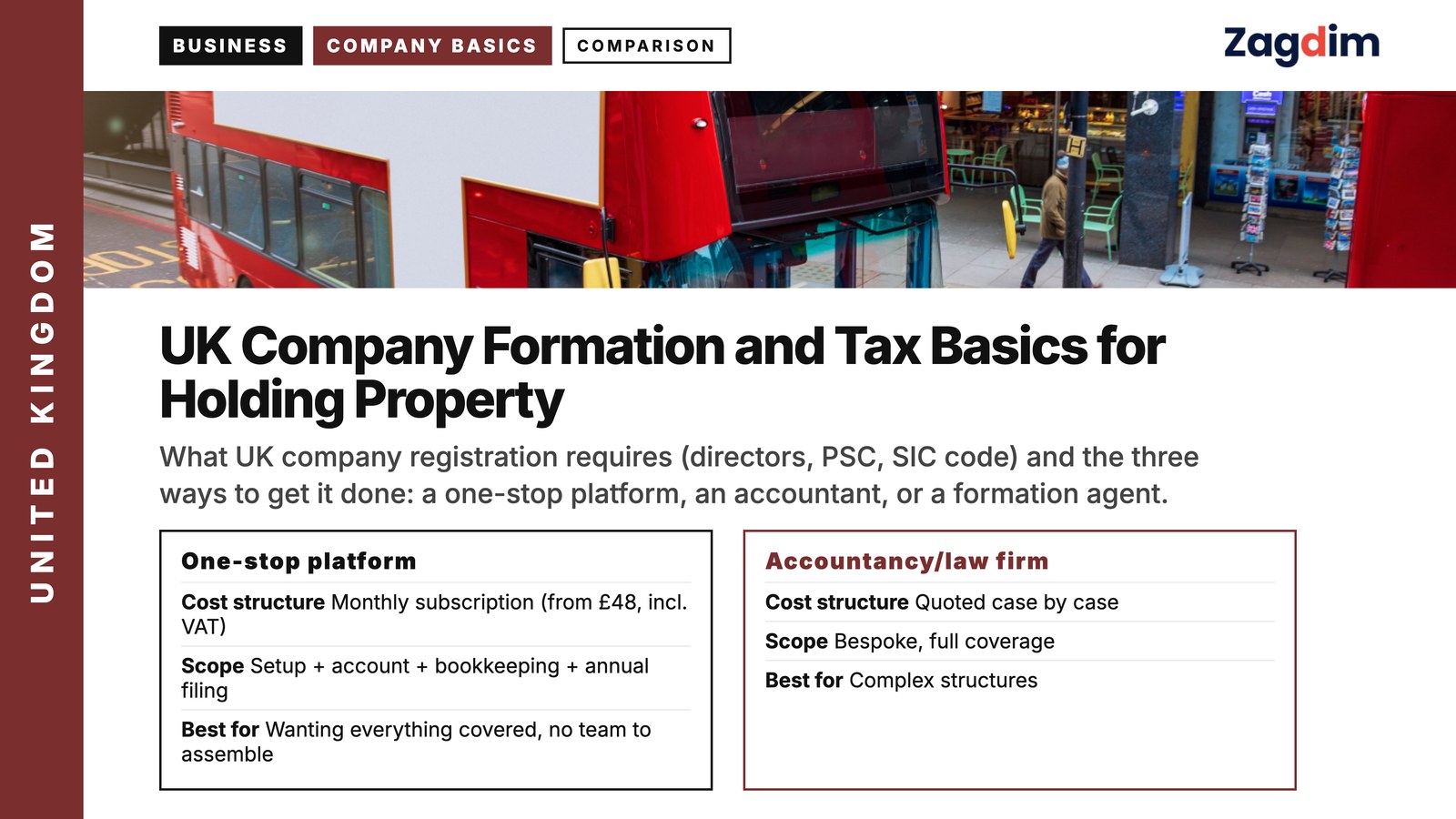
| One-stop platform | Accountancy/law firm | Formation agent | |
|---|---|---|---|
| Cost structure | Monthly subscription (from £48, incl. VAT) | Quoted case by case | One-off £102–£200 |
| Scope | Setup + account + bookkeeping + annual filing | Bespoke, full coverage | Registration only |
| Best for | Wanting everything covered, no team to assemble | Complex structures | Experienced self-managers, already have an accountant |
A platform subscription is an ongoing cost — the total bill over ten years of holding looks very different from three years. A formation agent’s low upfront price does not include the accounting and filing costs that arrive every year afterwards; that bill has to be paid sooner or later either way.
Tax Treatment: What to Check Before You Decide
Company profit is taxed at the Corporation Tax rate — currently 25% (the main rate) on profits over £250,000 and 19% (the small profits rate) on profits of £50,000 or less, with Marginal Relief available on profits between £50,000 and £250,000; these thresholds are reduced for short accounting periods and for companies with associated companies. This structural difference from personal income tax is the main reason many investors choose to hold through a company, but whether it actually works out better than holding personally depends on the buyer’s own tax bracket, income sources and long-term holding plan — an independent tax professional should be consulted before deciding.
Whichever of the three routes you use, and whichever way you plan to hold the property, the underlying registration requirements — company name, directors and secretary, shareholders and PSC, memorandum and articles, registered address, SIC code — do not change. What changes is how much of the process someone else does for you, and what that costs. Questions about your own situation? Ask Zagdim.
Further Reading
- “Shareholders, Directors and the Person with Significant Control (PSC): What Is the Best Shareholding Structure for a BTL Company?”
- “Setting Up a UK Company: Common Market Questions and Key Points to Note”
- “A UK Company Set Up in a Day to Hold Property: Interview with GetGround’s Hong Kong Lead”
*This article is for general information only and does not constitute legal, tax or investment advice; rates and rules may change and official announcements govern implementation details — an independent professional should be consulted before any major decision.*
Have a question about this guide? Leave a comment below, or ask Zagdim directly.
Your first stop for international property and global living.
Research and insights. Know what’s changing. Understand what matters.
Sources
- *GOV.UK — “Set up a private limited company”
- Companies House — “Verifying your identity for Companies House”
- Companies House — “Companies House fees”
- HMRC — “Corporation Tax rates and reliefs”
- HMRC — “Restricting finance cost relief for individual landlords”
- GOV.UK — “Stamp Duty Land Tax: corporate bodies”
- The Mortgage Works — “Limited company lending criteria”
- NRLA — “Should you set up a buy-to-let SPV?”
- GetGround — official website
- Companies House — IN01 form and guidance*