
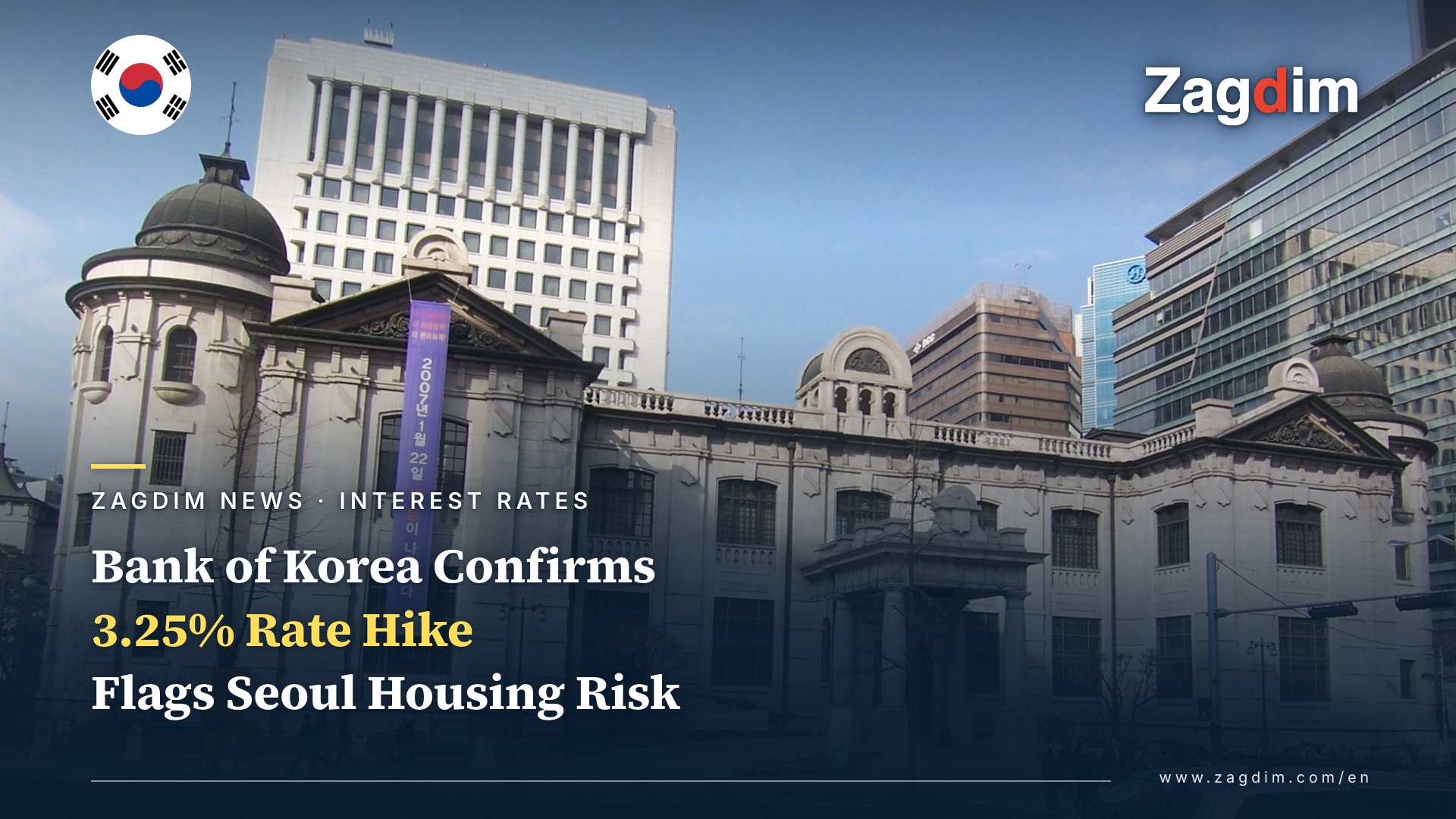
South Korea’s central bank has turned a two-day-old expectation into fact. The Bank of Korea’s Monetary Policy Board voted 5-2 on November 26 to raise its Base Rate by 25 basis points, from 3.00% to 3.25% — the third increase since July, after a pause in October. For anyone who owns property in South Korea, or is weighing buying one, this is no longer a forecast: it is a formal increase in the official rate that feeds into bank loan pricing nationwide. The BOK’s own statement named the Seoul-area housing market and household debt as financial-stability risks it is still watching, which points to continued pressure on borrowing costs rather than relief.
Two of the board’s seven members, Hwang Kunil and Lee Soohyung, voted against the move and proposed holding the rate at 3.00%. The majority judged the hike appropriate because, in the BOK’s words, “domestic economic growth has further strengthened, inflation is projected to remain above the target level for a considerable time, and financial stability risks persist.” The bank sharply raised its growth forecasts — to 3.9% for 2026 and 4.1% for 2027, up from 3.3% and 2.9% in its August outlook — crediting strong semiconductor exports and investment. Both headline and core consumer-price inflation stood at 2.8% in October, driven mainly by personal-services and durable-goods prices; the BOK now projects inflation at 2.7% this year and 2.4% next year, both revised up from its August forecasts.
The decision follows hikes in July and August that took the rate from 2.50% to 3.00%, then a unanimous hold on October 22 while the board assessed the effect of those earlier moves, according to The Korea Herald. In Thursday’s statement, the BOK said household loan growth has accelerated — in both housing-related and other loans — and that while price gains have slowed in some higher-priced parts of Seoul, prices “continued to rise sharply” in lower- and mid-priced areas of the city and in parts of Gyeonggi Province, with expectations of further gains “still remain[ing] high.” It added that the board will “continue to pay attention to the financial imbalance risks related to the housing market in Seoul and its surrounding areas and to household debt.”
The clearest gauge available so far on loan costs is the BOK’s own October lending-rate data, published a day before the hike: the average rate on new bank loans was 4.64%, up for a seventh straight month, with new deposit rates at 3.62%. Those figures do not yet reflect Thursday’s increase — the BOK’s November lending-rate data will not be released until late December — but every base-rate rise this year has fed through into bank lending rates, and this one is expected to be no exception, only a matter of timing. Separately, The Korea Times reported in September that some variable-rate mortgage borrowers were already facing rates near 8%, and quoted Lee Eun-hyung, a research fellow at the Korea Research Institute for Construction Policy, saying the market “has already gone through significant demand-side tightening” and that rate moves alone are unlikely to push many more owners to list homes for sale.
On what comes next, the BOK said only that it “will decide on matters such as the timing of further increases in the Base Rate” while it monitors inflation, growth and financial stability — it gave no date or target level for a future move. Zagdim covered the market’s expectation of this hike before it was confirmed; that earlier report is still available for reference.
References
Bank of Korea – Monetary Policy Decision & Opening Remarks to the Press Conference (November 26, 2026) / Bank of Korea – Interest Rates (October 2026) / SBS News – Bank of Korea Raises Base Rate by 0.25 Percentage Points to 3.25%… Citing Strong Growth / The Korea Times – Rate Hikes Fail to Cool Korea’s Housing Expectations, Mortgage Demand / The Korea Herald – BOK Holds Key Rate Steady at 3% After 2 Consecutive Rate Hikes