
An amended Ministry of Finance ordinance on reporting under Japan’s Foreign Exchange and Foreign Trade Act took effect on 1 April 2026. A non-resident who acquires real estate in Japan must now file a report with the Minister of Finance, through the Bank of Japan, within 20 days of acquisition, even when the home is for their own use or is bought from another non-resident. The old exemption for owner-occupied property now covers only rights such as leaseholds; buying the property itself (ownership) must, in principle, be reported.
Zagdim interviewed Toshiki Watanabe, Representative Partner of Japan Real Estate LLC, a Tokyo real estate company, and a Licensed Real Estate Broker and Gyoseishoshi Lawyer. He points out that the duty to report lies with the buyer, but buyers living abroad rarely file with the Bank of Japan themselves; in practice the brokerage that handled the sale, or a judicial scrivener or gyoseishoshi lawyer, usually helps prepare the report and files it on the buyer’s behalf. His one reminder to readers:
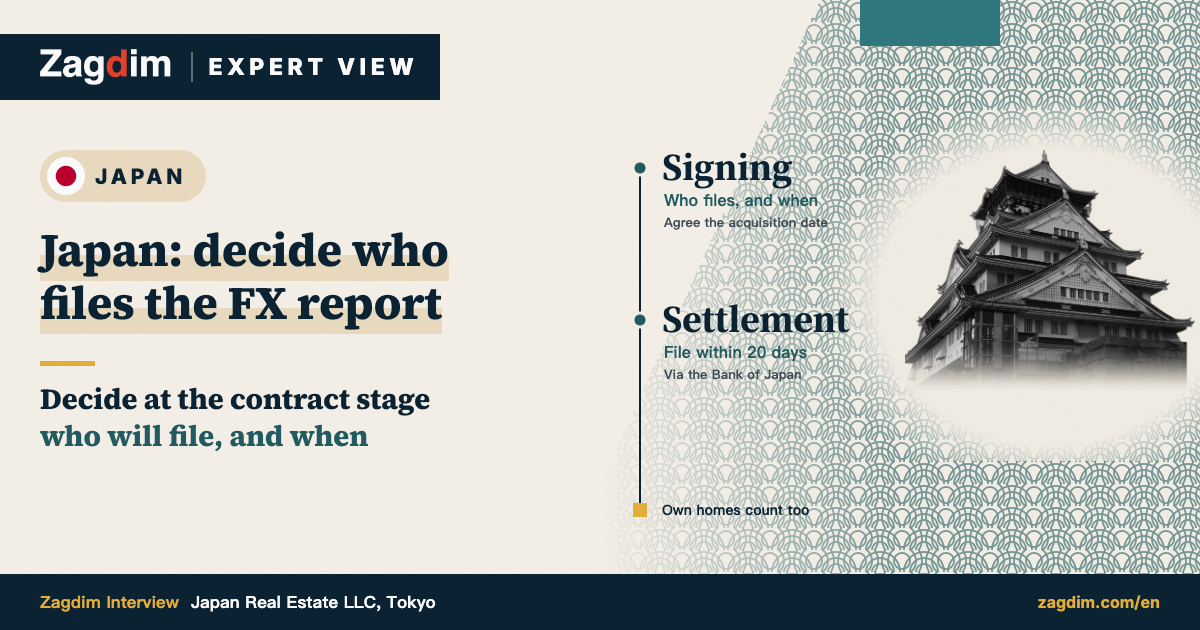
“The deadline is 20 days from the settlement date. Decide at the contract stage who will file the report, and when.”
(Translated by Zagdim from the original Japanese.)
Key Points
- Owner-occupied homes are now reportable: from 1 April 2026, a non-resident acquiring real estate itself (ownership) in Japan must report it even if they will live there. The exemption now covers only rights such as leaseholds acquired for residential, non-profit or office use. The Ministry of Finance states that holiday homes and second homes are not residential use.
- Buying from another non-resident is now reportable: purchases where the seller is also a non-resident have been covered since April 2026.
- 20 days, in Japanese, through the Bank of Japan: the report must be written in Japanese and filed within 20 days of acquisition through the Bank of Japan; an agent resident in Japan can file it.
- Mr Watanabe’s practice: decide “who will file and when” when the sale contract is signed, have the information and a draft ready before settlement, and file within a few days of settlement.
- Where buyers trip up: assuming owner-occupied or holiday homes need no report, and letting the 20 days run out while busy after settlement with travel and remittances.
Who Should Pay Attention
- Buyers living outside Japan who are viewing property there or have already signed
- Anyone planning to buy in joint names with a spouse or family, or through an overseas company
- Anyone buying from an owner who also lives abroad
- Anyone who bought in Japan after April 2026 and is not sure whether a report was filed
1. What Changed: Owner-Occupied Homes and Purchases from Non-Residents Are Now Reportable
What the rules say. The Ministry of Finance announced the amended ordinance on 20 February 2026, effective 1 April 2026. It added two kinds of acquisition to the post-acquisition reporting requirement: real estate in Japan acquired for residential, non-profit or office use; and real estate in Japan, or rights relating to it, acquired from another non-resident.
According to the Ministry’s FAQ (June 2026 edition), for acquisitions on or after 1 April 2026 only three cases are exempt, and all are limited to “rights relating to real estate”: rights acquired for the residence of the non-resident, their relatives or employees; rights acquired by a non-resident carrying on non-profit activities in Japan for those activities; and rights acquired for the non-resident’s own office. Rights relating to real estate means leaseholds, superficies, mortgages and similar rights; ownership is not included. The Ministry adds that holiday homes and second homes are not residential use. There is no threshold for price or floor area, and acquisitions by inheritance or bequest, or at a price of zero yen, must also be reported.
On who counts as a non-resident, the Ministry refers to its guidance on the interpretation of foreign exchange laws: foreign nationals are in principle presumed to be non-residents, while those working at an office in Japan, or who have been in Japan for six months or more since entry, are presumed to be residents.
What Mr Watanabe says. Explaining purchases from non-residents, he notes that since the April 2026 amendment, transactions where the seller is also a non-resident must be reported too, and cautions: “Some people, going by how things used to work, assume that ‘no report is needed’, so this needs care.”
What this means for readers. If you live abroad and buy a property in Japan, whether to live in, as a holiday home or to let, and whoever you buy from, you must in principle report it. Only renting, rather than buying, a home for your own use may fall outside the requirement.
2. Who Files, and When: Decide at the Contract Stage
What the rules say. Under Article 12 of the reporting ordinance, a non-resident who acquires real estate must prepare one report in the prescribed form (Form 22) and submit it to the Minister of Finance through the Bank of Japan within 20 days of the acquisition. The Ministry explains that besides the acquirer, an agent resident in Japan (such as a real estate brokerage) can file it; the form and guidance exist only in Japanese and the report must be completed in Japanese; the Bank of Japan is the filing office, and resident agents are asked to file online.
What Mr Watanabe says. He says the duty to report lies with the non-resident who acquired the property, but people living abroad rarely file with the Bank of Japan themselves; in practice the brokerage that handled the sale, or a judicial scrivener or gyoseishoshi lawyer, usually helps prepare the report and files it on the buyer’s behalf. The information needed includes the acquirer’s name, address and nationality (for a company, its name, location and representative); the property’s location, type and floor area; the acquisition price; the purpose of acquisition; details of the seller; and the acquisition date. He says the 20 days run from the day ownership is acquired, which is usually the day of settlement and handover.
On how to keep to the 20 days, he says: “Our practice is to decide, when the sale contract is signed, ‘who will file and when’, to have the necessary information ready by settlement, and to file within a few days of settlement.”
The steps he sets out:
| When | What to do |
|---|---|
| 1. Around signing | Check whether a report is needed (even for your own home, acquiring the real estate itself must in principle be reported; holiday and second homes are not residential use) and decide who will file |
| 2. Before settlement | Gather the information on the acquirer, property, price and purpose, and prepare a draft report |
| 3. Settlement and handover | The acquisition date is fixed |
| 4. Within 20 days of acquisition | File with the Minister of Finance through the Bank of Japan |
| 5. After filing | Give the buyer a copy to keep for later procedures, such as a sale |
Zagdim’s note: the Ministry’s FAQ explains that the “acquisition date” is not fixed by law; it may be, for example, the date the sale contract is signed, the date ownership transfers, or the date an inheritance is settled, and should be entered as appropriate. If the 20th day is not a Bank of Japan business day, the deadline moves to the next business day; reports sent by post must arrive by the deadline. Counting from settlement, as Mr Watanabe describes, is his firm’s practice. Which date counts as the acquisition date can be agreed with whoever will file, at the time of signing.
What this means for readers. The report has to be written in Japanese and filed in Japan, which is hard to handle yourself from abroad. At signing, settle three things: who will file, which date will be used as the acquisition date, and who will gather the information before settlement.
For how the report fits together with settlement, registration and the steps after purchase, see Zagdim’s interview with judicial scrivener Tamotsu Hasegawa: The 20-Day Foreign Exchange Report Is Only One Step.
3. Where Buyers Trip Up: Assuming No Report Is Needed, and Losing Track After Settlement
What the rules say. The Ministry’s FAQ states that holiday homes and second homes are not residential use, and that the residential exemption covers only rights such as leaseholds, not the purchase of the property itself.
What Mr Watanabe says. “Where buyers most often trip up is the assumption that ‘I will live there myself, so no report is needed’ or that ‘a holiday home surely counts as residential use’, and being so caught up after settlement with travelling home and sorting out remittances that the 20 days run out.”
What this means for readers. Do not decide whether to report on the basis of “I will live there” or “it is only a holiday home”. In the days around settlement buyers are usually busy with remittances, handover and travel, and the 20-day deadline is easily squeezed out; arranging who will file at signing means you do not have to remember it yourself afterwards.
4. Joint Names and Overseas Companies: What Needs Extra Care
What the rules say. The Ministry’s FAQ explains that when property is bought in joint names, each purchaser must file a separate report, with floor area and price entered according to their share; several properties acquired at around the same time can be combined in one report, provided each is itemised. When a non-resident company acquires property, the report gives the company’s name and its representative’s name, the country or region where the company is located as its nationality, and the company’s line of business.
What Mr Watanabe says.
- Joint names: he says every non-resident co-owner is an acquirer, so whether a report is needed should be checked for each share, and the reports for those who need one should be gathered and filed; where some co-owners are residents of Japan the treatment differs, so he recommends checking early.
- Overseas companies: he says the company reports as the acquirer; preparing early the corporate documents needed for registration (such as documents showing the company exists and an affidavit by its representative) also makes it easier to keep the report consistent.
What this means for readers. Joint owners do not file a single report between them; each co-owner who lives abroad needs their own. If you are buying through an overseas company, the company documents are needed for both registration and the report, and can be prepared together before signing.
5. If the 20 Days Have Already Passed
What the rules say. The Ministry’s FAQ states that a report must still be filed after the deadline has passed, as soon as possible, with a brief note in the margin explaining why it could not be filed on time. Under Article 71(1)(iii) of the Foreign Exchange and Foreign Trade Act, failing to report or filing a false report can be punished by up to six months’ imprisonment or a fine of up to JPY 500,000.
What Mr Watanabe says. He says that once you realise a report was missed, it is important to consult the Bank of Japan’s office as soon as possible and file with an explanation of the delay; above all, do not leave it.
What this means for readers. If you bought in Japan after April 2026 and are not sure whether a report was filed, ask the brokerage or judicial scrivener who handled the purchase first; if it was not filed, file it as soon as possible and state the reason for the delay. Judicial scrivener Tamotsu Hasegawa explains more about late reports in a separate interview.
What Readers Can Do Now
- Check whether you are a non-resident. Foreign nationals are in principle presumed to be non-residents; those working at an office in Japan, or in Japan for six months or more since entry, are presumed to be residents. If unsure, ask the agent who will file, or ask the Ministry of Finance.
- At signing, agree who will file and which date counts as the acquisition date. Hand over the information early: the acquirer’s name, address and nationality (for a company, its name, location and representative); the property’s location, type and floor area; the price, purpose and seller details.
- In joint names, one report per co-owner living abroad. If buying through an overseas company, prepare the company documents early.
- After settlement, get a copy of the report and keep it with your title documents. Mr Watanabe notes that the copy should be kept, as it may be needed for later procedures such as a sale.
- If the deadline has passed, file as soon as possible, with a note in the margin explaining the delay.
If you live abroad, are preparing to buy in Japan and are unsure how to arrange this report, tell the Zagdim Reader Desk about your situation. The Reader Desk will understand your needs and identify suitable professionals.
Glossary
- Foreign Exchange and Foreign Trade Act (FEFTA): Japan’s foreign exchange law. The post-acquisition report on real estate acquired by non-residents is set out in this Act and in the Ministry of Finance ordinance on reporting of foreign exchange transactions.
- Non-resident: a status under the Act, not the same as nationality or visa. Foreign nationals are in principle presumed to be non-residents.
- Settlement (kessai): the day the buyer pays the balance, the seller hands over the property and the transfer of ownership is registered.
- Resident agent: a person living in Japan who prepares and files the report on behalf of a non-resident, such as a real estate brokerage.
- Licensed Real Estate Broker (takuchi tatemono torihikishi): Japan’s national qualification for real estate transactions, responsible for explaining key matters to buyers.
- Gyoseishoshi Lawyer (gyoseishoshi): Japan’s national qualification for preparing and filing official documents on behalf of others.
About This Article
This article is a Zagdim interview: Zagdim received Toshiki Watanabe’s written reply on 24 November 2026 (in Japanese, translated into English by Zagdim). He explained that his answers describe general practice and are not advice on individual cases. Quotations and paraphrases were confirmed in writing by Mr Watanabe on 25 November 2026.
The official rules are based on the Ministry of Finance’s announcement of 20 February 2026, its overview page and FAQ (June 2026 edition) on reporting of real estate acquired by non-residents, and Article 12 of the reporting ordinance (version in force from 1 April 2026) on e-Gov, all read and checked on 25 November 2026.
Deciding who files at the contract stage, counting 20 days from settlement, filing within a few days of settlement, and the preparation for joint names and overseas companies are Mr Watanabe’s explanations based on practice, not official conclusions. This article is general information and not legal advice; whether and how a particular acquisition must be reported depends on the explanations of the Ministry of Finance and the Bank of Japan, and readers should consult a professional.
Experts interviewed
Toshiki Watanabe | Japan Real Estate LLC, Representative Partner (Licensed Real Estate Broker, Gyoseishoshi Lawyer) | Real Estate Brokerage Licence, Governor of Tokyo (1) No. 113344
References
Ministry of Finance, ‘Partial amendment of the Ministerial Ordinance on Reporting of Foreign Exchange Transactions’ (in Japanese), 20 February 2026 / Ministry of Finance, ‘Reporting of acquisition of real estate in Japan by non-residents: overview’ (in Japanese) / Ministry of Finance, FAQ on filing the report on acquisition of real estate in Japan or rights relating to it (in Japanese), June 2026 / e-Gov Laws, Ministerial Ordinance on Reporting of Foreign Exchange Transactions, Article 12 (in Japanese) / Bank of Japan, reports under the Foreign Exchange and Foreign Trade Act (in Japanese)