
An amended Ministry of Finance ordinance on reporting under Japan’s Foreign Exchange and Foreign Trade Act took effect on 1 April 2026. A non-resident who buys property in Japan must now file a report with the Minister of Finance, through the Bank of Japan, within 20 days of acquisition, even when the home is for their own use or is bought from another non-resident. The report is tied to the ownership registration on settlement day and to tax and registration duties that continue after the purchase, and buyers living abroad can easily miss one link in that chain.
Zagdim interviewed Tamotsu Hasegawa, Representative Judicial Scrivener of MUSCLE Judicial Scrivener’s Office in Tokyo. He points out that the report can only be prepared in Japanese, so in practice it is usually filed online by an agent resident in Japan, such as a judicial scrivener or a brokerage. He also notes that buyers living abroad most often get stuck on the cost and effort of Japan’s procedures, none of which can be skipped. His one sentence for readers:
“Do not skip any of Japan’s procedures, and consult a Japanese judicial scrivener or another professional before you decide to buy.”
(Translated by Zagdim from the original Japanese.)
Key Points
- Owner-occupied homes are now reportable: from 1 April 2026, a non-resident acquiring ownership of property in Japan must report it even if they will live there. The exemption now covers only rights such as leaseholds acquired for residential, office or similar use. Holiday homes and second homes are not residential use.
- How to file: the report must be written in Japanese and filed through the Bank of Japan within 20 days; an agent resident in Japan files it online. Mr Hasegawa says the supporting documents can be digital copies rather than originals.
- The report is tied to registration: a judicial scrivener applies for the ownership registration on settlement day. Buyers living abroad need to prepare documents such as a sworn affidavit early, and decide on a “domestic contact” in Japan.
- If the deadline was missed: the report must still be filed, with a short note in the margin explaining the delay. Failing to report or filing a false report carries penalties, and Mr Hasegawa warns against leaving it.
- The purchase is not the end: a tax agent for fixed asset tax, real estate acquisition tax, tax returns on rental income, and duties to register a change of address within two years and an inheritance within three years.
Who Should Pay Attention
- Buyers living outside Japan who are viewing property there or have already signed
- Anyone who bought in Japan after April 2026 and is not sure whether a report was filed
- Anyone planning to buy in joint names, through an overseas company, or through a foreign company’s Japan branch
- Owners living abroad who have not yet appointed a tax agent or registered a change of address
Mr Hasegawa’s Six Steps
He explains that he cannot describe individual cases because of his duty of confidentiality, so he sets out the general steps instead:
| Step | When | What to do |
|---|---|---|
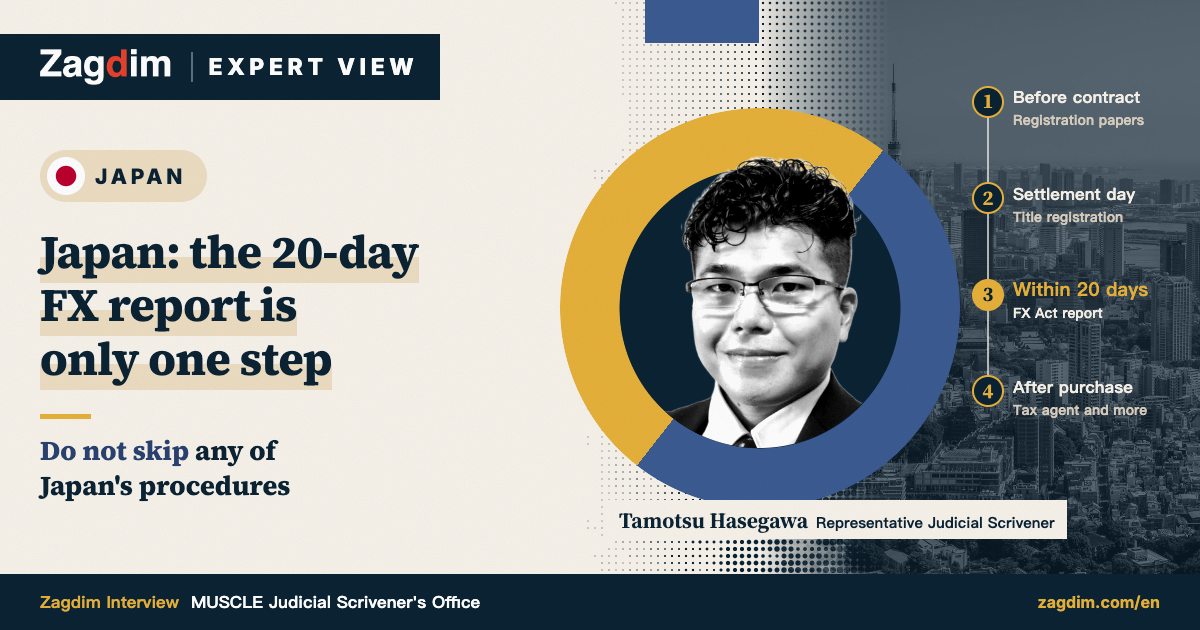
| STEP 1 | Before deciding to buy | Check whether you are a “non-resident” under the Foreign Exchange Act. From 1 April 2026, acquiring ownership must be reported even for your own home; only rights such as leaseholds for residential or office use are exempt. Holiday homes and second homes are not residential use |
| STEP 2 | Before signing the sale contract | Decide who will prepare and file the report (the real estate company, a judicial scrivener, etc.). The judicial scrivener confirms the buyer’s identity and intention to buy in advance. Prepare home-country official documents and a sworn affidavit certified by a notary or similar. Decide who will be your “domestic contact” |
| STEP 3 | Settlement day | Pay the price; the judicial scrivener applies for the ownership registration the same day. In practice this is treated as the acquisition date for counting the 20 days |
| STEP 4 | Within one to two weeks of settlement (guide) | Prepare the report from the certificate of registered matters, the sale contract and other documents; in joint names, one report per co-owner |
| STEP 5 | Within 20 days of settlement | File with the Bank of Japan; a resident agent files online, and a report sent by post must arrive by the deadline. Always keep a copy of the filed report |
| STEP 6 | After the purchase | Once registration is complete, receive and safely keep the registration identification information (commonly called the title certificate). Handle tax matters such as appointing a tax agent for fixed asset tax |
At STEP 1 he adds a warning: “‘No report is needed if you are buying to live in it’ was the rule before the amendment. Please be careful.”
1. How to File: In Japanese, Online Through an Agent, With Digital Copies
What the rules say. Under Article 12 of the reporting ordinance, a non-resident who acquires real estate in Japan must prepare one report in the prescribed form (Form 22) and submit it to the Minister of Finance through the Bank of Japan within 20 days of acquisition. The Ministry of Finance FAQ (June 2026 edition) explains that the report exists only in Japanese and must be completed in Japanese; an agent resident in Japan may file it, and such agents are asked to file online; the acquisition date is not fixed by law and may be, for example, the contract date or the date ownership transfers; if the 20th day is not a Bank of Japan business day, the deadline moves to the next business day; and a report sent by post must arrive within the deadline.
What Mr Hasegawa says. He says the duty to report lies with the overseas resident who acquired the property, but because the report must be prepared in Japanese, in practice it is usually filed online by an “agent resident in Japan” such as a judicial scrivener or a brokerage. What is needed is the report itself and the documents used to check its contents: the sale contract (acquisition price and date), the certificate of registered matters (location and real property number), the acquirer’s address and nationality, and the purpose of acquisition. He says none of these need to be originals; digital copies are fine. The acquisition date can be chosen from the contract date, the date ownership transfers and so on, and he says the settlement date (the date ownership transfers) is generally used in practice.
He says: “The most important thing is to decide, before the property is settled, who will file the report and by when.”
What this means for readers. The real property number comes from the certificate of registered matters, so the report usually cannot be completed until the settlement registration is done. What buyers can do is give the agent digital copies of the contract and identity documents before settlement, and ask whether the report will be filed online or by post; by post, what counts is when it arrives, not when it is sent.
For deciding at the contract stage who files the report and which date counts as the acquisition date, see Zagdim’s interview with Toshiki Watanabe of Japan Real Estate LLC: Buying Property in Japan from Abroad? Decide Who Files the 20-Day Foreign Exchange Report When You Sign.
2. The Report Is Tied to Settlement Registration: Documents Overseas Buyers Should Prepare Early
What the rules say. The Ministry of Justice explains that from 1 April 2024, when an overseas resident (an individual or a company) is registered as owner, the application must include “domestic contact” details, meaning the name, address and so on of a contact in Japan; an owner with no such contact may state that instead. Where a third party acts as the domestic contact, documents such as that person’s consent must be attached. The Ministry of Justice also explains that for a foreign national living abroad who becomes the registered owner, proof of address can take the form of a sworn affidavit: a document in which the person writes their name and address, swears they are true, and has it certified by a notary in their home country or country of residence.
What Mr Hasegawa says. He says the judicial scrivener applies for the ownership registration on settlement day, so the buyer’s identity and intention to buy are confirmed in advance. Buyers living abroad need to prepare official documents from their home country and a sworn affidavit certified by a notary or similar (as proof of address) for the registration. He warns that in some countries these take several weeks or more to prepare, so preparation should start early. Since April 2024, owners living abroad must register a “domestic contact”, and he says who that will be should also be decided before signing.
What this means for readers. The 20-day reporting clock only starts from the settlement registration, but the affidavit needed for that registration may take longer than the report itself. Before signing, ask the judicial scrivener which documents are needed and where to have them notarised, and decide who your domestic contact will be.
3. Joint Owners, Overseas Companies, Japan Branches of Foreign Companies, and Purchases from Non-Residents
What the rules say. The Ministry of Finance FAQ explains that in a joint purchase each buyer files a separate report, with floor area and price according to their share; for a non-resident company, the report gives the company name and representative, and the nationality field shows the country or region where the company is based. The April 2026 amendment also brought acquisitions from another non-resident into the reporting requirement. Article 6 of the Foreign Exchange and Foreign Trade Act provides that a non-resident’s branch, office or similar establishment in Japan is deemed a resident, even if its head office is abroad.
What Mr Hasegawa says.
- Joint owners: he says each co-owner prepares a separate report, with floor area and price stated according to their share.
- Overseas company: he says the report gives the company name and the representative’s name, and the nationality field shows the country where the company is based.
- Japan branch of a foreign company: he says that when a foreign company’s Japan branch acquires property, the branch is a “resident of Japan” under the Foreign Exchange Act, so this report does not apply.
- Buying from a non-resident: he says that since the amendment, such purchases on or after 1 April 2026 must also be reported.
What this means for readers. For a foreign company buying in Japan, buying through the overseas company itself and buying through a branch already established in Japan lead to different status under the Foreign Exchange Act. If you plan to buy through a company, first confirm which entity will be the registered acquirer, then whether a report is needed.
4. What to Do If More Than 20 Days Have Passed
What the rules say. The Ministry of Finance FAQ explains that a report must still be filed after the deadline has passed, as soon as possible, with a brief note in the margin explaining why it could not be filed on time. Under Article 71(1)(iii) of the Foreign Exchange and Foreign Trade Act, failing to report or filing a false report is punishable by imprisonment of up to six months or a fine of up to 500,000 yen.
What Mr Hasegawa says. He says that on noticing a missed report, it should be filed promptly, with a brief note in the margin on why it could not be filed on time. He warns: “Failing to report, or filing a false report, can lead to penalties, so it is important not to leave it.”
What this means for readers. A late report is filed the same way as an ordinary one, with an added explanation of the delay. If you bought after April 2026 and are not sure a report was filed, ask the judicial scrivener or brokerage that handled the registration for a copy; if there is none, ask an agent resident in Japan to prepare a late filing.
5. Where Buyers Get Stuck: Finding It Expensive or a Hassle, and Wanting to Skip Steps
What the rules say. Article 177 of Japan’s Civil Code provides that the acquisition, loss or change of real rights in real property cannot be asserted against third parties unless registered as the law requires.
What Mr Hasegawa says. He says buyers living abroad most often get stuck on the “cost” and “effort” of Japan’s procedures: buying property in Japan involves the real estate company’s brokerage fee, the judicial scrivener’s fee, registration and licence tax and other costs, and judicial scriveners strictly confirm the buyer’s identity and intention to buy, sometimes asking to see an original passport or to confirm by online interview. He says: “You may feel it is ‘expensive’ or ‘a hassle’. But these steps are based on Japanese law and business practice, and they cannot be skipped.”
He gives examples of serious problems that skipping steps can cause: paying the price to a fraudster posing as the seller and never obtaining the property; failing to register the transfer of ownership and being unable to assert ownership against third parties; and forgetting the report or tax procedures and later facing penalties or late-payment charges.
What this means for readers. A judicial scrivener asking for an original passport or a video call is part of how registration works, not an obstacle. Buyers who are abroad and cannot see things in person have all the more reason to let these checks be completed as required.
6. What Still Needs to Be Done After the Purchase
What the rules say. Under Article 355 of the Local Tax Act, a person liable for fixed asset tax who has no address or similar in the municipality must appoint a tax agent and notify the mayor (or obtain approval to appoint someone else). Under Article 76-5 of the Real Property Registration Act, a registered owner whose name or address changes must apply to register the change within two years; the Ministry of Justice explains this duty took effect on 1 April 2026. Under Article 76-2 of the same Act, a person who inherits ownership must apply for inheritance registration within three years of learning of it; the Ministry of Justice explains this duty took effect on 1 April 2024.
What Mr Hasegawa says. He says the foreign exchange report is not the only thing to do after buying. Owners also need to appoint a “tax agent” in Japan and notify the municipality (in Tokyo’s 23 wards, the metropolitan tax office) in order to pay the annual fixed asset tax; pay real estate acquisition tax, a one-off tax after purchase; file a Japanese income tax return if the property is let; register any change of address or name within two years; and, when the owner dies, the heirs must complete inheritance registration within three years. He says: “Managing all of this yourself while living abroad is not easy.”
What this means for readers. Keep the copy of the report, the registration identification information and the tax agent paperwork together. When you move house or change the name on your passport, remember the Japanese registration too; you will need these documents if you sell or if your family inherits. For purchase and holding taxes, see Japan Property Taxes: Registration, Acquisition, Fixed Asset; for paying tax bills from abroad, see How Overseas Owners Receive and Pay Japan Property Tax Bills.
What Readers Can Do Now
1. Before deciding to buy, check whether you are a non-resident. Foreign nationals are in principle presumed to be non-residents; those working at an office in Japan, or who have been in Japan for six months or more since entry, are presumed to be residents.
2. Before signing, settle three things. Who will prepare and file the report; which documents the registration needs and where to have the affidavit notarised; and who your domestic contact will be.
3. Before settlement, give the agent digital copies. The sale contract, identity and address documents and the purpose of acquisition; after the settlement registration, the agent adds the real property number from the certificate of registered matters.
4. File within 20 days of settlement, and keep the copy with the registration identification information.
5. If the deadline has passed, file as soon as possible. Note the reason for the delay in the margin of the report.
6. Arrange the post-purchase procedures. A tax agent, real estate acquisition tax, rental income returns, and registering any change of address or name within two years.
If you live abroad, are preparing to buy in Japan and are not sure how to arrange the report and registration, you can tell the Zagdim Reader Desk about your situation. The reader desk will understand your needs and identify suitable professionals. For how the settlement registration works, see Japan Property Transfer Registration: Closing, Scrivener Fees, Taxes.
Glossary
- Foreign Exchange Act: Japan’s Foreign Exchange and Foreign Trade Act. The post-acquisition report for non-residents acquiring Japanese real estate is set out in this Act and the ordinance on reporting foreign exchange transactions.
- Non-resident: a status under the Foreign Exchange Act, not the same as nationality or visa. Foreign nationals are in principle presumed to be non-residents.
- Judicial scrivener (shiho-shoshi): a Japanese national qualification for handling property and company registration and related procedures.
- Settlement (kessai): the day the buyer pays the price in full, the seller hands over the property, and the judicial scrivener applies for the ownership registration.
- Domestic contact: a contact in Japan recorded in the register when an overseas resident becomes the registered owner of Japanese property.
- Sworn affidavit: a document in which a person writes their name and address and swears they are true, certified by a notary, used as proof of address for people living abroad.
- Registration identification information: identification data issued to the owner when ownership registration is completed, commonly called the title certificate; needed when selling.
- Tax agent: a person appointed by an owner without an address in Japan to handle Japanese tax matters on their behalf.
About This Article
This is a Zagdim interview: Zagdim received Mr Hasegawa’s written answers on 24 November 2026 (in Japanese, translated by Zagdim). He explained that he cannot describe individual cases because of his duty of confidentiality, and that his answers describe general steps. The quotations and paraphrases in this article were confirmed in writing by Mr Hasegawa on 26 November 2026.
The rules described are based on the Ministry of Finance announcement of 20 February 2026 and its FAQ (June 2026 edition); Article 12 of the reporting ordinance, Article 6 of the Foreign Exchange and Foreign Trade Act, Articles 73-2, 76-2 and 76-5 of the Real Property Registration Act, Article 355 of the Local Tax Act and Article 177 of the Civil Code, as published on e-Gov; and Ministry of Justice pages on domestic contacts, proof of address for owners living abroad, and the mandatory registration of address changes and inheritances. The Ministry of Finance materials were read on 23 and 25 November 2026, and the others on 26 November 2026.
That digital copies are sufficient, that the settlement date is used as the acquisition date in practice, that the report is prepared within one to two weeks of settlement, that affidavits can take several weeks or more, that a foreign company’s Japan branch falls outside the report, that the metropolitan tax office handles tax agent notifications in Tokyo’s 23 wards, and the points on real estate acquisition tax and rental income returns, are Mr Hasegawa’s explanations from practice, not official conclusions. This article is general information and not individual legal advice; whether and how a particular case must be reported should be checked against guidance from the Ministry of Finance, the Bank of Japan and the Legal Affairs Bureau, with a professional.
Experts interviewed
Tamotsu Hasegawa | MUSCLE Judicial Scrivener’s Office, Representative Judicial Scrivener (Tokyo Judicial Scriveners’ Association, Registration No. 9255)
Zagdim expert profiles: Tamotsu Hasegawa | MUSCLE Judicial Scrivener’s Office
References
Ministry of Finance, “外国為替の取引等の報告に関する省令の一部を改正します(令和8年2月20日)” / Ministry of Finance, FAQ on reports of acquisition of real estate in Japan under the Foreign Exchange Act (June 2026) / e-Gov, Ordinance on Reporting Foreign Exchange Transactions, Article 12 / e-Gov, Foreign Exchange and Foreign Trade Act, Article 6 / e-Gov, Real Property Registration Act, Articles 73-2, 76-2 and 76-5 / e-Gov, Local Tax Act, Article 355 / e-Gov, Civil Code, Article 177 / Ministry of Justice, “令和6年4月1日以降にする所有権に関する登記の申請について” / Ministry of Justice, “外国居住の外国人や外国法人が所有権の登記名義人となる登記の申請をする場合の住所証明情報について” / Ministry of Justice, “住所等変更登記の義務化特設ページ” / Ministry of Justice, “相続登記の申請義務化について”