


























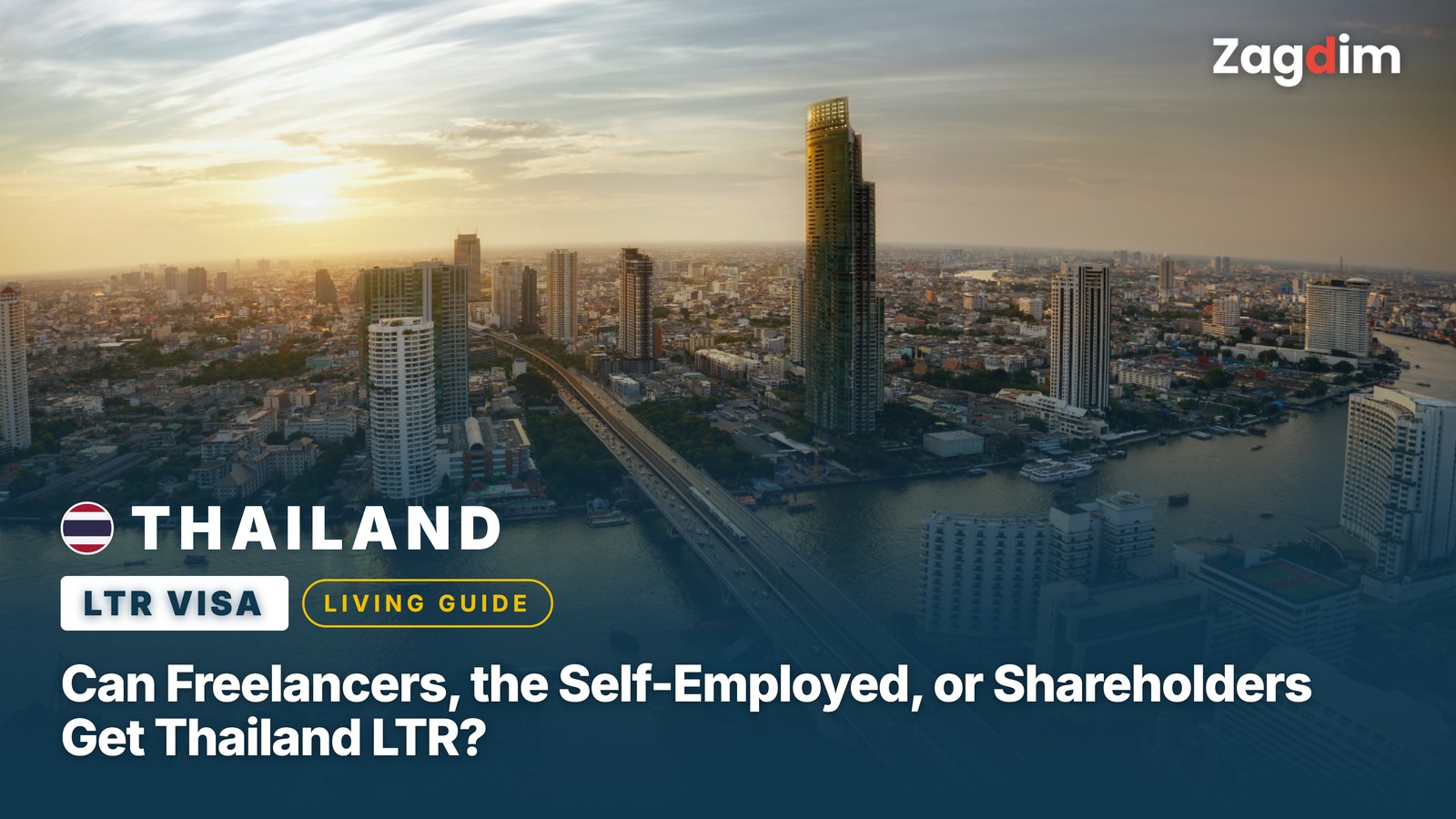
It can be checked — but it cannot be decided purely on labels like “Freelancer,” “Self-Employed,” “Founder,” or “Shareholder.”
Thailand’s LTR visa is administered by BOI under a 5+5 year, 10-year-maximum structure. Its four main categories are not divided by job label; instead each looks separately at income, employer, nature of work, assets, investment, age, and financial safeguards.
So the real question isn’t:
“Can a Freelancer apply for LTR?”
It’s:
**”Which LTR category does my income and work structure actually match?”**
Two people who both describe themselves as “running their own business” can end up with completely different outcomes: one might be a freelancer with no fixed employer, while another owns an overseas company with tens of millions of dollars in annual revenue and also draws a salary as its employee. These two cannot be assessed the same way under WFTP.
First, the Map: What Do the Four LTR Categories Actually Assess?
| LTR Category | Core Assessment |
|---|---|
| Work-from-Thailand Professionals (WFTP) | **Personal income + qualifying overseas employer + remote employment relationship + combined safeguard** |
| Highly-Skilled Professionals (HSP) | **Personal income + targeted industry/designated profession + work arrangement in Thailand + combined safeguard** |
| Wealthy Global Citizens (WGC) | **Global assets + investment in Thailand + combined safeguard** |
| Wealthy Pensioners (WP) | **50+/retired status + passive income + Thailand investment if applicable + combined safeguard** |
Each of the four sets of conditions stands on its own — you cannot combine the strengths of different categories.
For example:
A WFTP company that doesn’t meet the employer threshold can’t make up for it with WGC-style assets; an applicant who doesn’t meet HSP’s targeted-industry requirement can’t automatically pass just because their personal income is high.
# Freelancers: The Bigger Problem Is Usually Not Income, but the “Employer”
Freelancers most often think of WFTP first, simply because the name itself is Work-from-Thailand Professionals.
But WFTP’s institutional purpose isn’t broadly “anyone who can work online” — it’s:
Being physically in Thailand while working remotely for a qualifying overseas employer.
BOI’s current WFTP employer requirements include:
A listed company; or a private company that has operated for at least 3 years and had combined revenue of at least USD 50 million over the past 3 years; or a wholly owned subsidiary of one of the above qualifying companies.
So a typical freelancer who:
Works with a dozen-plus clients, has no fixed employer, and invoices by project,
cannot conclude that WFTP is established just by earning over USD 80,000 a year.
The WFTP company requirement still needs to be independently satisfied.
Having a Big Client Doesn’t Mean You Have a Qualifying Employer
For example, say you consult for a US listed company and earn USD 100,000 a year from it.
That company itself may meet WFTP’s company-size condition, but the next question remains:
Are you its employee, or an outside freelancer/contractor?
WFTP’s official conditions use an employment relationship with the overseas employer, and require documents such as an employment letter as proof.
So:
Having one very large client ≠ automatically having a qualifying employer.
The actual contractual relationship still needs to be checked against BOI’s requirements.
# Freelancers Should Also Compare DTV Workcation
If your actual working pattern is freelance work, remote work, or digital nomad life, without an overseas employer that meets WFTP’s requirements, DTV Workcation is often a closer fit for this kind of work structure.
DTV’s Workcation category explicitly covers scenarios such as digital nomad, remote worker, freelancer, and uses proof of funds of at least THB 500,000 plus corresponding work/professional documents as its application framework.
But DTV and LTR are not the same system.
WFTP is a 5+5-year LTR structure, with a longer stay arrangement and LTR benefits available on each entry; DTV, by contrast, is a 5-year multiple-entry visa, with a maximum stay of 180 days per entry, extendable once under the applicable rules.
So for freelancers, what’s really worth comparing is:
Whether you have the employer relationship WFTP requires, and what stay pattern you actually need.
If you want to know whether you qualify for DTV, ask Zagdim.
# Self-Employed: First Work Out Which Kind of “Self-Employed” You Are
“Self-employed” can actually describe many different legal and business structures.
A person could be:
- Taking on work as an individual;
- Operating as a sole proprietor;
- Owning their own limited company;
- Simultaneously a shareholder, director, and employee of a company.
These structures don’t mean the same thing for WFTP.
If you simply collect payment from clients as an individual, you’ll usually run into the “who is the employer” question first.
If you’ve set up an independent overseas company that formally employs you and pays you a salary, you can then check one layer deeper: whether the company itself meets WFTP’s overseas employer threshold.
# Business Owners: WFTP Assesses the Company, Not the “Founder” Title
If you own your own company, being a Founder or shareholder is not itself an automatic exclusion under BOI’s public conditions.
What actually needs checking happens at two levels.
The first level is the company:
Is it listed? If not, has it operated for at least 3 years? Has its combined revenue over the past 3 years been at least USD 50 million? Or is it a wholly owned subsidiary of a qualifying company?
The second level is your relationship with the company:
Does the company genuinely employ you as an employer? Do you have a verifiable position, salary, employment letter, tax/income records, and a remote-work arrangement?
So:
**”I have a company” and “I have an employer that qualifies for WFTP” are not the same statement.**
The USD 50 Million Threshold Is About Revenue, Not Net Worth or Valuation
This threshold is easy to misread.
The current requirement for a private company is:
Operated for at least 3 years + combined revenue over the past 3 years of at least USD 50 million.
For example:
| Year | Company Revenue |
|---|---|
| Year 1 | USD 12m |
| Year 2 | USD 17m |
| Year 3 | USD 23m |
| **3-year total** | **USD 52m** |
This is what’s checked against the USD 50 million threshold.
None of the following can substitute for it directly:
A company valuation of USD 50 million; a founder’s personal net worth of USD 50 million; registered capital of USD 50 million; a company that has raised USD 50 million in funding.
BOI looks at revenue.
“Subsidiary” Doesn’t Mean Any Ownership Relationship Counts
The current WFTP conditions include a wholly owned subsidiary path.
But BOI uses the term wholly owned subsidiary.
So a company that is 30%, 51%, or 80% owned by a listed parent cannot qualify simply because it’s commonly referred to as a “subsidiary.”
The actual shareholding must meet BOI’s full-ownership relationship requirement.
# Can You Pay Yourself a Salary?
This question can’t be answered by looking at the salary figure alone.
For example, say you own a Hong Kong company that pays you USD 120,000 a year in salary.
On the income side, that may already meet WFTP’s USD 80,000 path.
But if the company’s combined revenue over three years is only USD 4 million, the company threshold still isn’t met.
Conversely, if the company’s revenue is USD 100 million over three years but your own average income over the past two years is only USD 30,000, the company’s scale alone can’t make up for your personal income either.
So WFTP’s basic structure is:
Personal income meets the threshold + company qualifies + employment/remote-work relationship is established + combined safeguard meets the threshold.
It’s not a points system.
# How Is WFTP’s Personal Income Assessed Now?
The general path requires an average personal income over the past two years of at least USD 80,000/year.
If your average income over the past two years is at least USD 40,000 but under USD 80,000, current official announcements also offer an additional-qualification path, including a master’s degree or higher, holding intellectual property, or having raised at least USD 1 million in Series A funding.
So a startup founder whose company meets the employer requirement, but whose own average income over the past two years is only USD 50,000, shouldn’t be ruled out simply on “income under USD 80,000” — the lower-income path’s additional qualifications should also be checked.
# Company Shareholders: Holding Shares Is Not Itself an LTR Category
“Shareholder” describes your ownership stake in a company — it doesn’t mean you’re necessarily that company’s employee, and it doesn’t mean dividends and salary are the same kind of income.
So a shareholder should first look at their actual income and asset structure before deciding which LTR category is the closest fit.
50 or Older, Mainly Living on Dividends: Look at Wealthy Pensioner First
If a shareholder is already 50 or older and meets the retirement status requirement, and their main income comes from dividends, rent, interest, or realized capital gains, Wealthy Pensioner is often worth checking before WFTP.
The current core income paths for Wealthy Pensioner are:
Passive income of at least USD 80,000/year;
or:
Passive income of at least USD 40,000, under USD 80,000/year, plus at least USD 250,000 in qualifying Thailand investment.
For example, a major shareholder in a company who retires and no longer draws a salary, but legally receives USD 100,000 in dividends each year.
This income is completely different in nature from “the company paying USD 100,000 in salary.”
The former can be checked against Wealthy Pensioner’s passive income; the latter is employment income, and doesn’t automatically become passive income just because you also happen to be a shareholder.
# High Assets but No Qualifying Employer: Look at WGC
If the applicant is under 50 and doesn’t have the overseas employer WFTP requires, but has relatively high personal assets, Wealthy Global Citizens can be checked.
Following the 2025 update, WGC has removed its original personal income threshold.
The core conditions now are:
Global assets of at least USD 1 million + investment in Thailand of at least USD 500,000 + combined financial safeguard.
Qualifying Thailand investment can include government bonds, equity in designated companies, or Thai real estate.
So WGC’s institutional logic is quite different from WFTP’s:
**WFTP looks at who you work for; WGC looks at how many assets you have, and how much of that you’ve placed into qualifying assets in Thailand.**
This distinction matters especially for successful business owners, company shareholders, or founders who have exited day-to-day operations.
# Shareholder and Executive: HSP May Also Be Worth Checking
Being a shareholder doesn’t mean you’re limited to WGC or WP.
If you’re still actively working at the company, and the company’s activities fall within BOI’s targeted industries, or your own work falls under a designated professional field, HSP is also worth checking.
The current HSP assessment doesn’t just look at the company name — it looks at whether the company’s primary business operations fall within a targeted industry, or whether the applicant’s position falls under one of BOI’s designated professional fields.
For example, among company shareholders:
One person may simply hold shares and collect dividends — closer to WP or WGC;
Another may be the company’s AI technical director, doing professional work in Thailand that falls within a targeted industry — closer to HSP.
The shareholder status hasn’t changed — what’s changed is the work and income structure.
# A Quick Table for Freelancers, the Self-Employed, and Shareholders
| Actual Situation | First Direction Worth Checking |
|---|---|
| Has a large qualifying overseas employer, works remotely from Thailand | **WFTP** |
| Freelancer or remote worker with no qualifying employer | **DTV Workcation** |
| Own overseas company meets WFTP’s large-employer threshold | **WFTP** |
| Company is small, but personal assets and Thailand investment are high | **WGC** |
| 50+, retired, living mainly on dividends/rent/investment income | **WP** |
| Shareholder and professional executive, work falls under BOI’s targeted industries | **HSP** |
This table isn’t an application conclusion — it just helps decide which set of conditions is worth spending time on first.
# All Three Profiles Share One Thing: The Combined Financial Safeguard
Whichever category you end up pursuing — WFTP, HSP, WGC, or WP — there’s still the combined financial safeguard layer.
The main applicant can choose one of three:
At least USD 50,000 in medical coverage; valid Thai social security; or at least USD 100,000 in bank deposits, maintained for at least 12 months.
So even if:
Your company is large enough, your income meets the threshold, and your assets are sufficient,
the combined safeguard is still a separate, independent requirement.
# Even After You Get LTR, Your Status Structure Can’t Fully Change
Another important point: LTR’s conditions are not checked only once, on the day you apply.
BOI officially states:
“Every condition and requirement must be maintained during the length of the visa…”
In other words, all conditions and requirements must be maintained for the duration of the visa, and the official examples explicitly include employment status.
This matters especially for freelancers, business owners, and shareholders.
For example, if you applied under WFTP and later sold your company or ended the employment relationship, or your company no longer meets the original corporate eligibility, you cannot simply assume your existing LTR is unaffected.
Likewise, if you switch employers after obtaining HSP, BOI’s current FAQ requires confirming that the new company still meets the targeted-industry qualification first; if it does, a change can be processed — it isn’t simply a matter of resigning and dealing with it afterward.
LTR is a 5+5 structure, and eligibility must also be reconfirmed before the end of the first 5-year period.
So when choosing an LTR category, it’s not enough to ask:
“Can I apply today?”
You should also ask:
**”Will I be able to maintain this work, company, income, or asset structure over the next few years?”**
# A Few Common Misunderstandings
“Freelancers can never apply for LTR.”
Not the case.
Being a freelancer isn’t itself an excluded status under LTR, but a typical freelance structure often doesn’t meet WFTP’s overseas employer requirement.
If your other assets, age, or professional qualifications are met, WGC, WP, or HSP can still be checked; and DTV Workcation directly covers freelancer scenarios.
“My income is over USD 80,000, so as a freelancer I can go straight for WFTP.”
Not enough.
USD 80,000 only satisfies the personal income group. WFTP also has requirements for the overseas employer company and the employment relationship.
“If I own my own company, that automatically counts as having an employer.”
Company ownership alone doesn’t determine it.
You still need to check whether the company meets WFTP’s company threshold, and whether an employment and remote-work relationship acceptable to BOI can be established between you and the company.
“If my own company pays me a high salary, that’s enough to pass WFTP.”
Not necessarily.
The company still has to separately meet the listing requirement, or the combined 3-year USD 50 million revenue requirement, or the qualifying wholly owned subsidiary requirement.
“A USD 50 million valuation is enough.”
Not true.
WFTP’s private-company threshold looks at combined revenue over the past three years, not valuation.
“Company shareholders can only go for WGC.”
Not true.
Someone 50+ living mainly on dividends and other passive income can check WP; a shareholder-and-executive whose work matches a targeted industry or professional field may also check HSP.
“Dividends and salary from my company are both income, so they can all go toward WP.”
You need to look at the nature of the income first.
Dividends can be checked against passive income; salary, director’s fees, and other employment income cannot simply become retirement-style passive income just because the paying company is one you hold shares in.
# Frequently Asked Questions
Q1: Can a freelancer apply for LTR?
That status doesn’t automatically exclude you. But WFTP requires a qualifying overseas employer, so a freelancer working purely with multiple clients needs to first confirm whether the employment requirement is met. Without a qualifying employer, you can compare DTV Workcation, and separately check WGC, WP, or HSP based on your own circumstances.
Q2: Can I apply for WFTP if I run a one-person company?
Headcount is not the main threshold.
The company first has to meet WFTP’s employer conditions — for example, a private company must have operated for at least 3 years with combined revenue over the past 3 years of at least USD 50 million — and you also need to establish a qualifying employment and remote-work relationship.
Q3: Does the company need to hit USD 50 million every year?
No.
The current condition is combined revenue of at least USD 50 million over the past 3 years.
Q4: What if the company is a subsidiary of a large company?
It can be checked, but BOI’s current wording is wholly owned subsidiary, so the actual 100% ownership relationship needs to be confirmed.
Q5: I’m a company shareholder and receive dividends each year — can I go for LTR?
If you’re 50 or older and meet the retirement status requirement, you can check Wealthy Pensioner. Dividends are a passive income type that can be checked.
If you’re under 50 but your assets and Thailand investment meet WGC’s requirements, you can check the WGC path instead.
Q6: What about a shareholder who is also CEO?
Don’t decide based on the “CEO” or “shareholder” title alone.
If you’re genuinely working remotely for a qualifying overseas employer, WFTP can be checked; if your work is at a company that matches BOI’s targeted industries or professional fields, HSP may be a better-fitting framework.
Q7: I’m under 50 and don’t have a large employer — which LTR path is left?
You can look at WGC first.
The current WGC conditions don’t require a personal income level, but do require global assets of at least USD 1 million, plus qualifying Thailand investment of at least USD 500,000.
Q8: Which non-LTR route do freelancers most often compare against?
DTV Workcation.
It explicitly targets scenarios such as digital nomad, remote worker, and freelancer, though its stay structure and benefits differ from LTR, so it should be compared based on your actual lifestyle.
If you’d like help comparing your options, ask Zagdim.
Disclaimer
This article is a general information summary and does not constitute immigration, legal, corporate governance, investment, or tax advice.
Labels such as Freelancer, Self-Employed, Founder, Director, and Shareholder cannot by themselves substitute for an actual eligibility review. LTR eligibility across categories — including personal income, employer relationship, company revenue, targeted industry, assets, investment, retirement status, and combined financial safeguard — is subject to Thailand’s Board of Investment (BOI) LTR official website, the regulations applicable at the time of application, and case-by-case review.
DTV Workcation is subject to the Ministry of Foreign Affairs of Thailand and the current rules applied by the relevant Thai embassy or consulate.
Information current as of September 2026.
Have a question about this guide? Leave a comment below, or ask Zagdim directly.
Your first stop for international property and global living.
Research and insights. Know what’s changing. Understand what matters.
Sources
- Thailand BOI LTR official website — current eligibility for the WFTP, HSP, WGC, and WP categories, and the combined financial safeguard.
- BOI Announcement No. Por. 3/2568 — WFTP personal income of USD 40,000/80,000, the USD 50 million overseas employer threshold, wholly owned subsidiary provisions, WGC assets and investment, and WP income and investment requirements.
- BOI 2025 LTR Eligibility — updated WFTP, WGC, and HSP eligibility, including WGC’s removal of the personal income threshold and adjustments to WFTP’s company threshold.
- BOI Targeted Industries / FAQ — HSP’s targeted industries, professional fields, and employer-change arrangements.
Further reading:
1. Thailand LTR Visa Highly Skilled Professional: Eligibility, Process, Fees, and FAQ | Highly Skilled Professional
2. Thailand LTR Visa Wealthy Global Citizen: Eligibility, Process, Asset Requirements, and FAQ | Wealthy Global Citizen
3. Thailand LTR Visa Work-from-Thailand Professional: Eligibility, Income Standards, and FAQ | Work-from-Thailand Professional
4. Thailand LTR Visa Wealthy Pensioner: Eligibility, Process, Fees, and FAQ | Wealthy Pensioner