































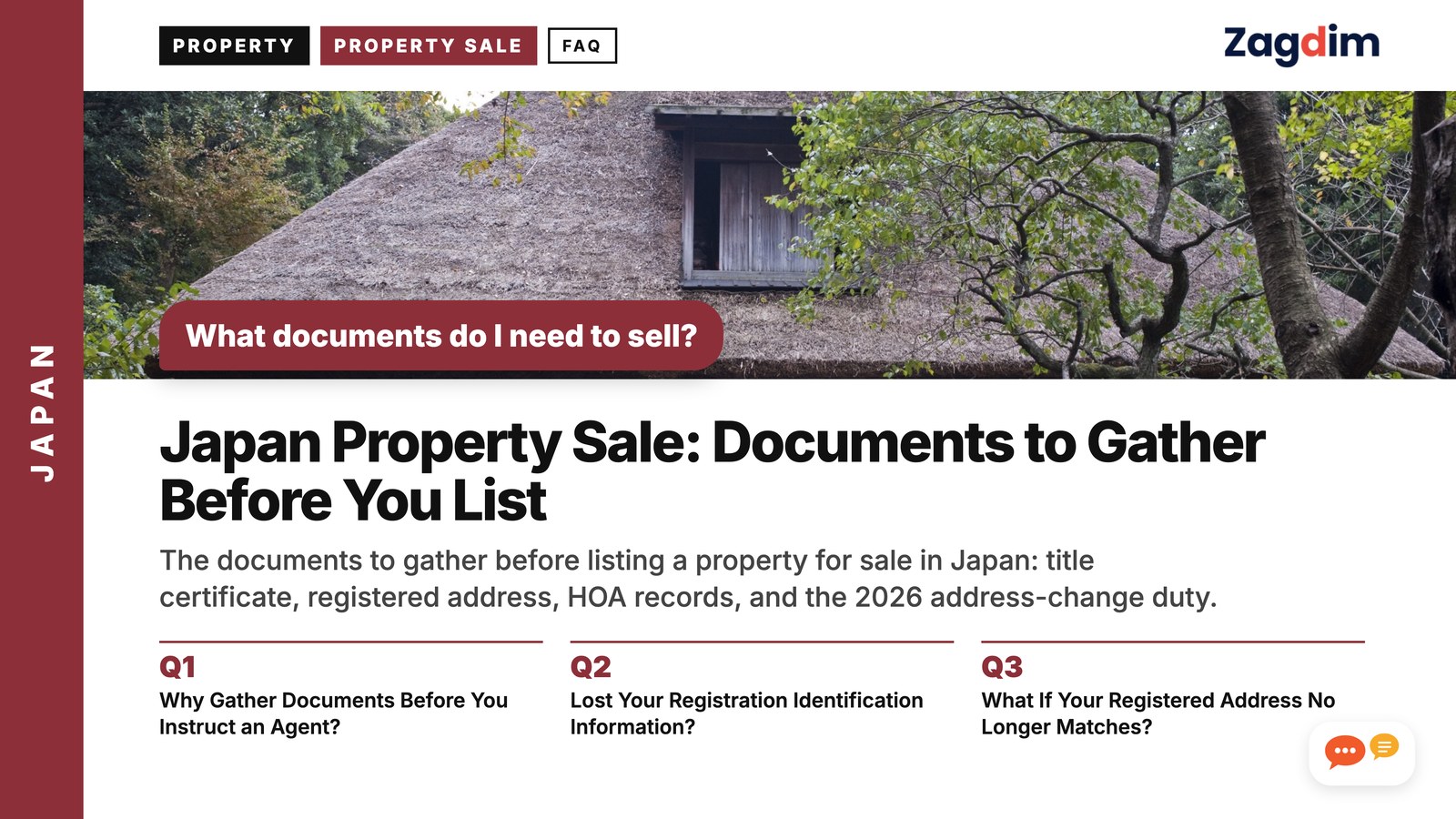
This article is part of Zagdim’s Japan property wiki series. It sets out the documents a foreign owner should gather before instructing an agent to sell a Japan condominium or detached house (ikkodate), where to obtain each one, and the duty to register an address change that takes effect from April 2026. For the full process, see the main article, Selling Property in Japan as a Foreigner: Buyers, Taxes, Signing Abroad, and Transferring Funds.
Why Gather Documents Before You Instruct an Agent?
In Japan, the ownership transfer registration and the handover of the property happen on the same day: the final payment and the registration of the transfer of ownership are completed together. If the paperwork is incomplete, that day’s registration may not go through. For an owner living overseas, some documents cannot be reissued, and others must be notarized locally before being sent to Japan, so it is worth starting early.
The Short Answer
Before listing the property, confirm five categories of documents: the registration identification information or the former title certificate; whether the name and address on the registry still match your current ones (if not, an address-change registration is needed, and this has been mandatory since April 1, 2026); the purchase contract and expense receipts (needed for the tax return); the condominium’s management documents and the fixed asset tax notice; and mortgage records if the loan has not been paid off. Owners living overseas also need a notarized document in place of the seal registration certificate (inkan shomei), and must appoint a tax administrator.
Document Checklist: What to Prepare and Where to Get It
| Document | Purpose | Where to Get It |
|---|---|---|
| Registration identification information notice (issued from 2005) or title certificate (toukishiki, issued before 2005) | Proves you are the registered owner; checked at the ownership transfer | Issued when you purchased the property; cannot be reissued |
| Fixed asset tax and city planning tax notice | States the tax amount, which is prorated at handover | Keep the most recent notice; if lost, apply to the municipal office for a fixed asset tax valuation certificate |
| Management rules (kanri kiyaku), general meeting minutes, and long-term repair plan (for condominiums) | Let the buyer understand the building’s rules and repair fund | Held by the management association or management company; you can ask the management company for a copy |
| Sale and purchase contracts (from when you bought and when you sell) | Prove the transaction price and acquisition cost for the tax return | Obtained when you purchased; newly signed when you sell |
| Receipts for agent commission, stamp duty, and similar costs | Prove the transfer expenses for the tax return | Kept by you |
| Mortgage balance certificate and repayment schedule (if the mortgage is not yet paid off) | Needed to cancel the mortgage registration at handover | From the lending bank |
| Notarized document in place of the seal registration certificate, and proof of address | Needed for the ownership transfer registration | Drafted by a judicial scrivener (shiho shoshi) and notarized locally |
Lost Your Registration Identification Information?
For registrations made from 2005 onward, the registry issues a 12-character alphanumeric registration identification code. Before that, it issued a paper certificate of registration (commonly called the title certificate). Neither can be reissued if lost. If it is lost, the registry office’s prior-notification system can be used instead, or a judicial scrivener (shiho shoshi) can prepare identity-confirmation information. Tell your agent and judicial scrivener as early as possible if this applies to you.
What If Your Registered Address No Longer Matches?
For owners living overseas, this is the item to deal with first.
- The transfer registration must show the history of address changes. If the address on the registry differs from your current address, the transfer filing must include a document proving the change of address. A foreign national living overseas can have the history of address changes written up and notarized as a sworn affidavit. Proof of the current address itself can be an official certificate of residence issued by your country of residence, or a notarized affidavit of address. If you lived in Japan and moved before July 8, 2012, proving the address change from that period may require the old Foreign Resident Registration record (gaikokujin toroku genpyo) rather than a certificate of residence (juminhyo).
- Registering an address change is now mandatory. Since April 1, 2026, a registered owner whose name or address changes must file for a change-of-registration within two years of the change. If a change happened before April 1, 2026, and was never registered, it must be registered by March 31, 2028. Failing to register without a valid reason can result in a fine of up to 50,000 yen (a non-criminal administrative penalty, karyo). If a registrar identifies a violation, they will first issue a notice with a deadline, and only refer the matter to the court if it remains unregistered after that.
- Owners living overseas must file the registration themselves. The “smart” change-of-registration system, under which the Legal Affairs Bureau updates an address automatically using the national resident registry network, does not apply to owners living overseas. If your name or address changes, you must file the registration yourself within two years.
- When registering an overseas address, note the domestic contact person requirement. When changing the registered address from a Japan address to an overseas one, or from one overseas address to another, if a domestic contact person (kokunai renrakusaki to naru mono) has not yet been registered, you must either supply that person’s details at the same time or declare that you have none.
Which of these applies depends on how many times you have moved since buying the property and how long you lived in Japan.
Why Start Gathering Tax Documents Now?
If the sale produces a profit, you must file a final tax return (kakutei shinkoku) by March 15 of the following year. Capital gain = transaction price − (acquisition cost + transfer expenses). The documents you have determine how much you can deduct:
- Purchase contract: proves the acquisition cost. If this cannot be found, the acquisition cost can only be estimated at 5% of the transaction price, which can make the tax bill higher.
- Sale contract: proves the transaction price.
- Receipts for agent commission and stamp duty: prove the transfer expenses.
For how the tax amount is calculated, see How Much Tax Do You Pay When Selling Property in Japan? Calculating the 10.21% Withholding, 30.63% Short-Term, and 15.315% Long-Term Rates.
What Else Should You Check Before Selling?
- Resale restrictions on pre-sale units: some developers include anti-flipping clauses in new condominium contracts, such as a ban on marketing the unit for sale before handover. This is a contract term, not a law. If you bought the property off-plan, check your purchase contract before selling.
- Whether the property is in a designated “special monitoring area”: under the Act on the Review and Regulation of the Use of Land in Important Areas, both parties must file a notification when signing a land-ownership transfer contract inside a designated special monitoring area. Confirm this with your agent before signing.
- Proration of fixed asset tax: fixed asset tax and city planning tax are billed for the full year to whoever owns the property on January 1. At handover, these are usually prorated by the number of days based on the handover date, but the contract terms govern.
- Comparable transaction prices: the Ministry of Land, Infrastructure, Transport and Tourism’s Real Estate Information Library lets you look up transaction prices and published land values, and has an English interface.
What’s the Next Step?
Once the documents are in order, for how to arrange the notarized affidavit in place of the seal certificate and appoint a tax administrator, see Selling Property in Japan From Abroad: Notarized Affidavits, Tax Administrators, and Domestic Contacts. For the overall process, return to the main article, Selling Property in Japan as a Foreigner: Buyers, Taxes, Signing Abroad, and Transferring Funds.
FAQ
I’ve lost the title certificate for my Japan property. Can I still sell it?
Yes. Neither the title certificate nor the registration identification information can be reissued, but the transfer can still go through using the registry office’s prior-notification system, or by having a judicial scrivener prepare identity-confirmation information.
An owner moved back to their home country and never updated their registered address in Japan. Will they be fined?
An address change from before April 1, 2026 must be registered by March 31, 2028; a change after that date must be registered within two years. Failing to register can result in a fine of up to 50,000 yen, but a notice will be sent first.
What management documents do I need to sell a Japan condominium?
The management rules, general meeting minutes, and long-term repair plan. These are normally held by the management association or management company, and you can ask the management company for a copy.
Glossary
- Registration Identification Information (touki shikibetsu joho): the 12-character registration code that replaced the paper title certificate from 2005 onward.
- Title Certificate (touki-zumi sho): the paper proof of ownership issued before 2005.
- Fixed Asset Tax (kotei shisan zei): the annual property tax paid by whoever owns the property on January 1.
- Management Rules (kanri kiyaku): a condominium’s management rules.
- Long-Term Repair Plan (chouki shuzen keikaku): a condominium’s plan for future major repairs and the funding for them.
- Non-Criminal Administrative Fine (karyo): an administrative penalty, not a criminal punishment.
- Identity-Confirmation Information (honnin kakunin joho): a document prepared by a judicial scrivener confirming your identity when the title certificate is lost.
Have a question about this guide? Leave a comment below, or ask Zagdim directly.
Your first stop for international property and global living.
Research and insights. Know what’s changing. Understand what matters.
Sources
This article was compiled by Zagdim research. The statutory sections have been checked against the text of the law (Verified by Zagdim); industry practices are labeled separately. Information was checked as of October 9, 2026. The mandatory address-change registration, the “smart” change-of-registration system, and the domestic contact person requirement are based on Ministry of Justice pages; the special monitoring area designation is based on a Cabinet Office page; the 5% estimate for an unknown acquisition cost is based on National Tax Agency guidance. The document checklist, the non-reissuance of the registration identification information and its workarounds, the ways to prove an address history, the Foreign Resident Registration record, the proration of fixed asset tax, and pre-sale resale restrictions are compiled from industry operators or trade associations. The documents required can differ by Legal Affairs Bureau branch and by the judicial scrivener handling the transaction; follow the actual requirements given to you.
References
Nomu Real Estate Solutions – 売却時の必要書類 / at home – マンション売却の必要書類 / Ministry of Justice – 住所等変更登記の義務化について / Ministry of Justice – 検索用情報の申出について / Ministry of Justice – 令和6年4月1日以降にする所有権に関する登記の申請について / Plaza Homes – Selling property in Japan as a foreigner / Real Estate Transaction Promotion Center – 外国人売主の印鑑証明書等の代替 / National Tax Agency – No.3258 取得費が分からないとき / Real Estate Companies Association – 分譲マンションの投機的短期転売問題にかかる取組み / Cabinet Office – 重要土地等調査法 / Ministry of Land, Infrastructure, Transport and Tourism – 不動産情報ライブラリ
Important Notice
This article is a general information summary and does not constitute individual legal or real estate transaction advice. Information was checked as of October 9, 2026. Registration and document requirements may be updated; follow the current requirements of the Legal Affairs Bureau, the judicial scrivener handling your transaction, and the relevant Japanese authorities.