





























Information as of 19 September 2026 | Editor Pick
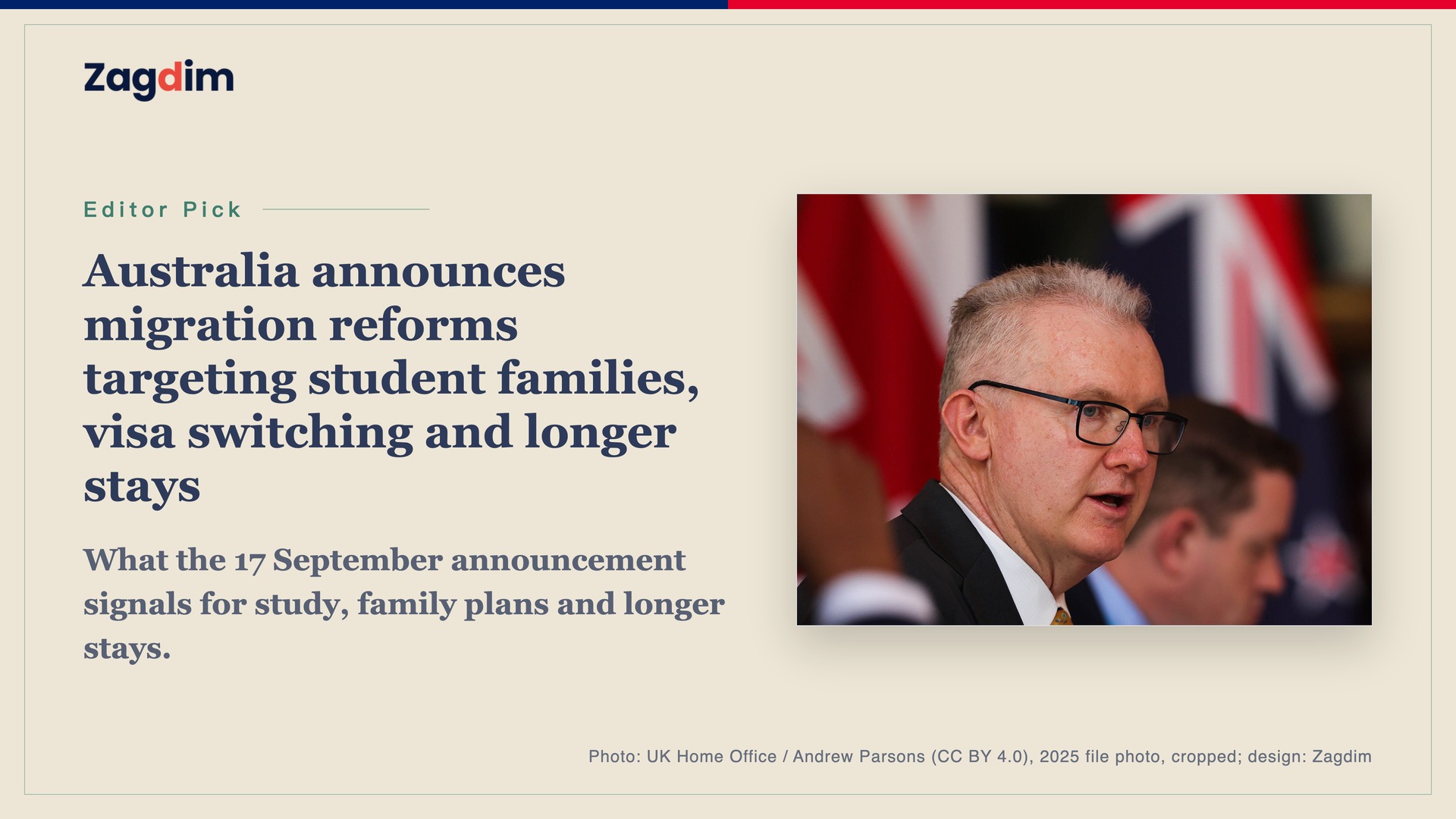
Australia’s Minister for Home Affairs and Minister for Immigration and Citizenship, Tony Burke, used his National Press Club address in Canberra on 17 September 2026 to announce plans to restrict family accompaniment for international students and graduates, tighten onshore applications by visitors, and introduce ballots for second and third working holiday years. He also outlined changes to skilled migration points and processing priorities, including greater recognition of housing construction trades.
The announcement signals closer government control over how temporary residence continues and who can accompany the primary visa holder. This article examines the measures announced in the speech. Commencement, transition rules and operational requirements need to be checked separately for each measure; the package should not be treated as a single set of rules taking effect on the day of the address.
The policy signal: closer control over what happens after arrival
Burke organised the announcement around entry, continued residence and departure. He argued that parts of the system had followed employer and education-provider demand, while public expectations now required greater government control over numbers. He linked that change to housing supply and workforce needs, and explained that some broader reforms would require legislation.
Zagdim’s reading is that the announcement reduces the predictability of a plan built around arriving temporarily and arranging a longer stay afterwards. Family accompaniment, further study and another working holiday year would each face more explicit restrictions or selection. The practical question extends beyond obtaining the first visa: every subsequent step needs a viable basis of its own.
Student families face a different planning equation
Burke announced plans to end routine family attachment to international student and Temporary Graduate visas, commonly known as subclass 485 visas. He also identified exceptions involving Pacific and ASEAN arrangements and certain courses, including PhDs. Their precise eligibility and coverage need to be confirmed in the implementation documents.
He said existing families already in Australia, with family members attached to the visa, would be accommodated rather than separated by this change. That statement should not be extended automatically to pending applications, relatives still overseas or family members seeking to join later. Families need to distinguish the primary applicant’s course and visa from each dependant’s location and application stage.
Course transfers and further study are different questions
The speech separated extensions, transfers and progression after completing a course. Burke said genuine extensions—for example following serious illness or the collapse of an education provider—would remain. Transfers to a different course would require a new visa application so that the study arrangement could be assessed again.
For further study after completion, the announced direction was progression to a higher qualification, such as a bachelor’s degree followed by a master’s. Repeatedly enrolling at the same or a lower level to prolong residence would face restrictions. Burke nevertheless explicitly supported legitimate movement from study into relevant employment and potentially permanent residence. The government’s criticism of visa hopping should not be applied to every change of visa.
Visitors and working holidaymakers face tighter continuation rules
The government plans to attach No Further Stay conditions more widely to future visitor visas, restricting applications for other visas from within Australia. Burke described this as a measure for future visa grants, said relevant families already in Australia would not be affected, and expressly distinguished protection applications. Arriving as a visitor and then applying onshore would therefore become a less dependable planning assumption; the announcement does not establish that every onshore route has already closed.
For working holidaymakers covered by the proposed ballot arrangements, Burke announced 45,000 second-year places and 5,000 third-year places in his 17 September speech. Relevant regional work requirements would remain as eligibility conditions for entering the ballot. These are proposed continuation allocations, not first-year places or separate allocations for every nationality.
The change would add selection after the work requirement: completing the work would qualify someone to enter the ballot rather than assure a further place. UK arrangements are constrained by the Australia–UK Free Trade Agreement and cannot simply be treated as identical. Burke said slower processing for UK applicants would continue for now, while normal processing would be restored for primary applications subject to the regional-work framework.
Skilled migration would give more weight to practical demand
Burke outlined a redesigned points test with the ability to give selected skills greater recognition. He said housing trades would receive the qualification points associated with a university qualification when the new arrangements were implemented. He also proposed revised processing priorities involving construction, agriculture, fisheries, resources and teaching.
The signal is more selective recognition of workforce needs. It does not promise permanent residence to someone enrolling in a trade course, nor did the speech supply a complete new points table that every applicant could use. Education choices, recognition of skills and visa eligibility remain separate questions.
What the six areas mean for everyday plans
The following table describes the directions announced on 17 September, rather than their commencement dates. Protection-system changes in particular still involve legislation, and other measures also require their implementation documents to be checked.
| Area | Announced direction | Planning question |
|---|---|---|
| Student and graduate families | Restrict routine family attachment, with exceptions and arrangements for existing onshore families | When and on what basis can a partner or children accompany the applicant? |
| Study pathways | Reassess transfers; require upward progression after completion | Does the next course fit the new framework? |
| Visitors | Extend No Further Stay conditions on future visas | Can the next application be made from Australia? |
| Working holidaymakers | Ballots for second and third years, retaining relevant regional work eligibility | What remains uncertain after completing the work? |
| Skilled migration | Rework points and processing priorities | How does the skill match Australia’s workforce needs? |
| Protection and agent regulation | Address unmeritorious claims and amend agent conduct rules; some reforms require legislation | A protection application is not an ordinary extension strategy |
On protection visas, Burke said the government wanted to address knowingly unmeritorious claims used to prolong residence while preserving a system for people who genuinely need protection. He also proposed changes to migration-agent conduct rules so that agents encouraging such claims could face sanctions or deregistration. These statements describe the minister’s policy objective and do not establish whether an individual protection claim is genuine.
The next stage is implementation, application by application
The speech gives prospective residents a reason to revisit assumptions about family accompaniment, further courses and additional working holiday years. The next documents that matter are commencement provisions, visa coverage, nationality or course exceptions, and transition rules for pending applications and existing holders. Those details determine which plans need adjustment.
People planning a longer stay should separate their education, employment, family and permanent-residence objectives and examine the connection between them. The speech supports legitimate educational and employment progression, but a plan should not depend only on finding another way to remain after arrival. The available material also does not establish a universal filing deadline before which every applicant would preserve the previous arrangements.
Frequently asked questions
Has Australia already banned every student or graduate from bringing family?
The 17 September announcement sets out a restriction on routine family accompaniment; it does not establish an immediately effective ban covering every student and graduate. Burke identified Pacific and ASEAN arrangements and certain courses, including PhDs, as exceptions. He also said existing onshore families whose members were already attached to a visa would be accommodated. These boundaries matter: a primary applicant already in Australia is not necessarily in the same position as an entire family already there. Nor should a pending application, an overseas relative and a later dependant application automatically be treated alike. Families should identify each person’s location, application stage and connection to the primary applicant’s visa, then compare those facts with the implementation and transition rules. The announcement warrants reviewing plans, but it does not by itself establish a family’s exemption or prove that submitting an application early protects the previous arrangements.
Does the visa-hopping crackdown end the possibility of moving from study to work or permanent residence?
Burke explicitly distinguished legitimate progression from repeated visa and course changes used to prolong residence. His positive example involved completing study, gaining needed skills, finding relevant work and potentially moving into permanent residence. The announcement therefore does not support a claim that all migration opportunities after study have been removed. Equally, support for that general pathway does not mean every graduate qualifies for the next visa. The study measures preserve genuine extensions, would require a new visa application for a course transfer, and direct further study after completion towards a higher qualification. Each stage should have an educational or employment rationale and meet the applicable criteria. A course should not be chosen solely for the time it might add in Australia, and proposed recognition of housing trades is not a permanent-residence guarantee. Implementation rules remain necessary to establish individual eligibility.
Would completing regional work still secure a further working holiday year?
Under the scheme Burke announced on 17 September, relevant regional work would qualify an applicant to enter a ballot, adding a selection step before further residence. He specified 45,000 second-year places and 5,000 third-year places. Those figures describe the proposed continuation allocations; they are not first-year allocations or separate allowances for each nationality. The practical change is that completing the work and securing another year would become distinct stages. UK arrangements are constrained by the Australia–UK Free Trade Agreement and should not be treated as identical; the speech also separately addressed UK processing speed. Start dates and transition provisions need to be checked against subsequent documents, particularly for people already in Australia, currently completing the work or preparing another application. The announcement cannot be treated as an operational ballot applying to everyone today, but neither should an additional year be assumed certain while the details are being settled.
Planning study, family accompaniment or a longer stay in Australia?
Ask Zagdim if you want help understanding how the announced changes relate to your plans.
This article provides policy analysis, not individual immigration legal advice. Application decisions should be checked against the rules in force and personal circumstances.
References
ABC News, Tony Burke’s full National Press Club address / Gilton Valeo Lawyers, Migration Reform 2026: What Minister Burke’s Announcement Means for You / Pathways to Aus, Tony Burke’s 17 Sept 2026 Announcement