






























Information current as of 19 September 2026
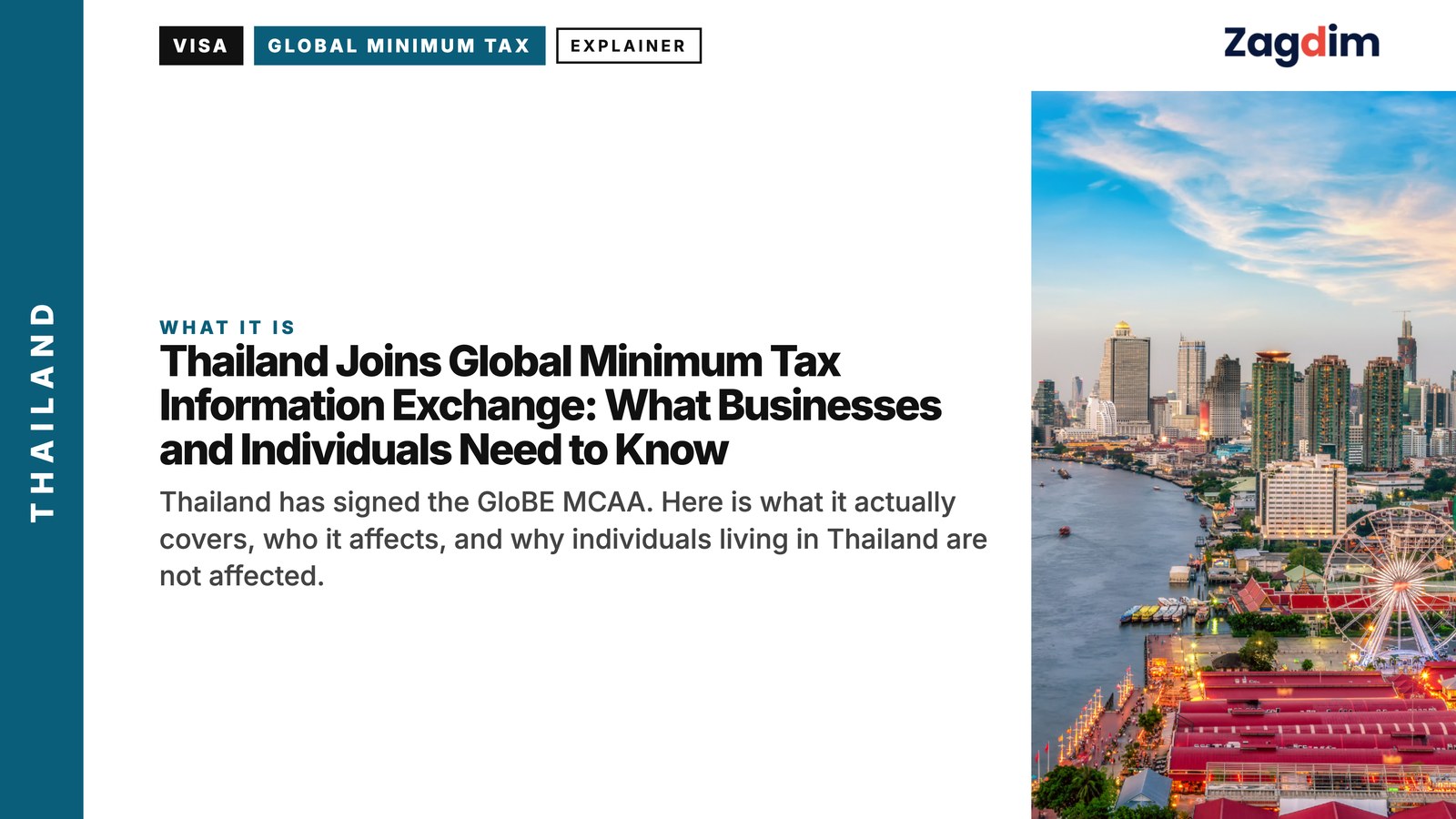
Thailand’s Revenue Department announced on 15 September 2026 that the country had signed an agreement for exchanging information under the global minimum tax framework. The first point to understand is who this agreement covers: the information being exchanged belongs to large multinational enterprise groups that meet the relevant revenue threshold. It does not apply to every foreign-owned business in Thailand, nor is it directed at expatriates generally.
Whether a business falls within the framework depends mainly on the consolidated revenue of the group to which it belongs. A group may be within scope if its annual consolidated revenue reached €750 million in at least two of the four fiscal years preceding the year being assessed. The rules can cover both foreign multinational groups operating in Thailand and Thai multinational groups investing overseas.
If you live in Thailand as an individual, own a home here or remit overseas income into the country, this information-exchange agreement does not affect you. It does not introduce a new personal tax, filing requirement or obligation to provide information, and it does not change Thailand’s existing personal income tax rules. Whether an individual’s income is taxable continues to be determined under those existing rules.
For anyone operating a business in Thailand, the first step is not to begin calculating the global minimum tax. It is to establish whether the Thai company belongs to a multinational group that meets the revenue threshold. An independently operated small business does not enter the framework simply because its shareholders are foreign or because it has customers overseas. The entities that need to prepare for this system are members of multinational groups that fall within its scope.
What information will be exchanged?
The agreement is formally known as the Multilateral Competent Authority Agreement on the Exchange of GloBE Information. Thailand’s announcement refers to it as the GloBE MCAA, while the Organisation for Economic Co-operation and Development (OECD) signatory list uses the term GIR MCAA.
The agreement deals with the exchange of the GloBE Information Return, or GIR. The return gives tax authorities information they can use to assess risk and examine the potential top-up tax liabilities of different entities within a multinational group.
A large multinational group may operate in several countries, and the tax authority in each jurisdiction may need access to information about the group. Under the exchange system, participating jurisdictions can share GIR information, reducing the need for the group to submit the same material separately in multiple places. One purpose of the arrangement is therefore to reduce duplicated reporting for large multinational businesses.
For an affected business, the practical questions include which group entity will file the return, what information the Thai company must provide to the group, and which Thai filing or notification requirements still apply. Reducing duplicated reporting does not mean that every local procedure in Thailand disappears once the agreement is in place. Businesses must still establish their local obligations.
Tax liability and information exchange follow different timelines
The two timelines can easily be confused. Thailand’s Emergency Decree on Top-up Tax already applies to accounting periods beginning on or after 1 January 2025. The Revenue Department set out this commencement date in its announcement of 27 December 2024 and confirmed it again in an announcement dated 30 December 2025.
Thailand, however, does not expect to begin its first exchanges of GIR information with partner jurisdictions until December 2027 at the latest. The 2027 date concerns the expected first exchange of information; it is not the date on which Thailand’s top-up tax began to apply. A business cannot assume that it may wait until 2027 to address its tax position simply because the exchange of information has not yet started.
| Date | Confirmed development | What it means |
|---|---|---|
| Accounting periods beginning on or after 1 January 2025 | Thailand’s top-up tax legislation applies | A business must assess the rules according to its applicable accounting period |
| 4 August 2026 | Thailand signed the agreement | The signing date is different from the date of the public announcement |
| 15 September 2026 | The Revenue Department announced the signing | This is the publication date of the announcement behind the current news |
| By December 2027 | Thailand expects to make its first GIR exchanges with partner jurisdictions | This is an information-exchange date, not a postponement of tax obligations |
The specific deadlines for filing, notification and payment must still be checked against the applicable rules and the accounting year of the business concerned.
Start with the size of the group, then examine the effective tax rate
Thailand’s top-up tax framework mainly concerns large multinational groups operating in the country. This includes Thai groups investing abroad and foreign groups investing in Thailand. The relevant starting point is not the turnover of one Thai company, but the consolidated financial statements of the ultimate parent entity.
A group may meet the threshold if its annual consolidated revenue reached €750 million in at least two of the four accounting periods immediately preceding the period under review. The €750 million figure is a group revenue threshold. It is not an individual’s asset value, the turnover of the Thai subsidiary alone, or simply the amount one company earned in Thailand.
A Thai company may therefore be relatively small but still need to assess the framework at group level if it belongs to a multinational group that meets the threshold. An independent small business, by contrast, is not treated as a qualifying multinational group merely because it has foreign shareholders or overseas customers.
Consider a hypothetical example. A Thai company may have modest revenue of its own but belong to a multinational group whose consolidated revenue meets the €750 million threshold. That Thai company may still need to help the group prepare GIR information. A small business operated independently in Thailand by a foreign owner would not fall within the framework solely because its shareholder is foreign or it serves customers abroad, provided it does not belong to a multinational group meeting the threshold.
The OECD’s global minimum tax framework uses a 15% minimum effective tax rate, calculated for the group’s relevant income and taxes on a jurisdictional basis. Where the effective rate is below that level, top-up tax may then be calculated under the applicable rules. This does not mean that a business can calculate its liability by multiplying its turnover by 15%.
The calculation may involve adjustments to income, the substance-based income exclusion and any available safe harbours. A company’s headline corporate tax rate is therefore not enough, on its own, to determine whether top-up tax is payable or how much would be due. This article explains the structure of the system; it does not calculate the liability of any particular business.
Which businesses in Thailand need to act, and which individuals are unaffected?
The table below provides a first way to identify how the agreement may relate to different situations.
| Your situation | How the agreement relates to you | What to establish first |
|---|---|---|
| A Thai entity within a large multinational group | The entity may be involved in GIR reporting and top-up tax arrangements | Whether the group meets the threshold, how the entity is classified, who files, and how the effective tax rate is calculated |
| A business or property investment held through a company | First establish which group the company belongs to; the fact that the asset or activity involves property does not by itself determine whether the framework applies | Whether the company is included in consolidated group accounts and which Thai obligations apply |
| An independent small business | Foreign ownership alone does not cause the business to meet the group threshold | Whether a group relationship exists and which revenue basis applies; ordinary corporate tax obligations remain separate |
| An individual buying a home, retiring or living in Thailand | The agreement does not affect the individual | Existing personal tax rules remain unchanged |
| An individual receiving overseas income or remitting money to Thailand | The agreement does not affect the individual | Any personal tax treatment of the overseas income continues to be determined under the existing income tax rules |
Overseas pensions, rental income and investment income received by individuals belong to a separate area of personal income tax. The Revenue Department’s guidance on taxation for people living in Thailand considers factors such as the source of the income, residence status, the year in which the income arose, when it was remitted, and whether foreign tax credits may be available under an applicable tax treaty.
The GIR agreement does not replace those existing tests. The purpose here is to define the boundary of the global minimum tax information-exchange system, rather than to determine whether any particular category of personal income is taxable or exempt.
What should affected businesses in Thailand do next?
The development makes co-ordination within large multinational groups increasingly important. A business can begin by organising its group structure, consolidated revenue figures, relevant accounting periods and internal reporting responsibilities. A tax adviser can then confirm the applicable calculations and the company’s local obligations in Thailand.
Where an investment assessment includes tax incentives, the business should examine two separate questions: what tax incentives the business receives, and how those incentives affect the group’s effective tax rate in Thailand. The two questions should not be treated as interchangeable.
For professionals assisting businesses in Thailand, the first questions are whether the Thai company is included in a multinational group’s consolidated financial statements and whether that group meets the €750 million revenue threshold. If a reader is simply living in Thailand as an individual, buying a home or remitting overseas income, this agreement does not require that person to prepare additional information or make a new filing.
Frequently asked questions
Does Thailand’s participation in the information exchange mean individuals must pay 15% tax on overseas income?
No. The agreement does not change the tax rules that apply when an individual lives in Thailand, buys a home or remits overseas income, and it does not create a new personal filing obligation.
The GloBE MCAA announced by the Revenue Department on 15 September 2026 concerns the exchange of GIR information for large multinational enterprise groups. The OECD’s 15% figure is the minimum effective tax rate used under the global minimum tax framework and calculated on a jurisdictional basis. It cannot be applied directly to an individual’s overseas pension, rental income, investment income or remittance.
An individual’s position still depends on matters such as tax residence, the source of the income, the year in which it arose, the timing of any remittance and the application of relevant tax treaties. Being outside the corporate global minimum tax framework does not, by itself, mean that an individual has no other personal income tax obligations.
In practice, it helps to separate personal income from company income, identify who earned the income and who owns the asset, and then give a tax adviser the relevant years and remittance details. If an asset is held through a company, it may also be necessary to establish whether that company belongs to a multinational group within the framework. This article distinguishes the scope of the different systems; it does not determine whether a particular item of income is taxable or exempt.
If the Thai company is small, does that mean the global minimum tax cannot apply?
Not necessarily, because the Thai company’s own turnover is not the only figure that matters. Under the Revenue Department’s explanation of the top-up tax decree dated 27 December 2024, the threshold is based on the consolidated financial statements of the ultimate parent entity. The relevant test is whether the group recorded annual revenue of at least €750 million in at least two of the four accounting periods immediately preceding the period under review.
A relatively small Thai subsidiary may therefore still need to establish its position, provide information and take part in the group’s reporting arrangements if it belongs to a multinational group that meets the threshold. An independent small business does not reach the group threshold merely because its shareholder is foreign or because it has customers overseas.
For people operating a business or investing in property through a company, the starting point is the ownership and group structure. The type of asset, the size of the individual project or the headline tax rate of one company does not settle the question. The business should first organise its corporate relationships, consolidated accounts and accounting periods, then consider the effective tax rate and the applicable rules. Meeting the revenue threshold also does not mean that the tax can be calculated by multiplying turnover by the minimum rate.
Can businesses wait until the first exchange in 2027 before taking action?
The expected date of the first information exchange should not be treated as a postponement of a company’s tax obligations. The Revenue Department’s announcement of 15 September 2026 states that Thailand expects to make its first exchanges of GIR information with partner jurisdictions by December 2027. Thailand’s top-up tax legislation, however, already applies to accounting periods beginning on or after 1 January 2025, a point the Revenue Department confirmed again in its announcement of 30 December 2025.
Information exchange, company filing, notification and tax payment are separate parts of the system. The requirements for each must be checked against the applicable rules and the company’s own accounting year. A business can already identify whether the relevant information should be prepared by group headquarters, a designated filing entity or the local Thai company, and establish which calculations and documents the Thai entity must provide.
One purpose of the exchange mechanism is to reduce the need for multinational groups to submit the same information in several jurisdictions. The signing announcement does not say that every local procedure in Thailand will be removed. For affected businesses and the professionals supporting them, the expected 2027 exchange marks progress in international tax co-operation, while filing and payment obligations still need to be assessed separately.
Considering a property investment or business operation in Thailand?
If you are unsure whether the first issue to examine is personal income tax, corporate taxation or group-level top-up tax, you can ask Zagdim. We can help organise the questions and identify the areas that require further research.
This article provides general information and policy analysis. It does not constitute tax, legal or investment advice for any individual case.
References
Thailand Revenue Department, “Thailand Signs the GloBE MCAA” / OECD, “Signatories of the GIR MCAA” / Thailand Revenue Department, “Emergency Decree on Top-up Tax Officially Promulgated” / OECD, “Global Minimum Tax” / OECD, “Global Anti-Base Erosion Model Rules (Pillar Two) — GloBE Information Return” / Thailand Revenue Department, “How Do Foreigners Living in Thailand Pay Tax?” / Thailand Revenue Department, “Draft Secondary Legislation under the Emergency Decree on Top-up Tax”