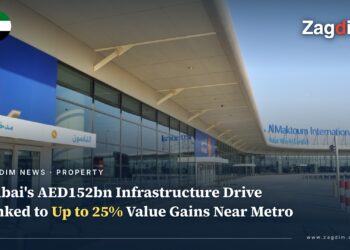











Dubai’s Roads and Transport Authority (RTA) is forecasting land and property value gains of up to 25 per cent around stations on the new Dubai Metro Blue Line, according to a market study by W Capital Real Estate Brokerage reported by Arabian Business. The figure applies specifically to areas near the Blue Line’s planned stations, not to Dubai property values as a whole.
The RTA forecast sits inside a wider picture: three disclosed Dubai infrastructure schemes carry a combined investment of $41.4 billion (AED 152 billion). The Blue Line itself accounts for $5.6 billion (AED 20.5 billion) across 30 kilometres and 14 stations, running through Al Jaddaf, Dubai Festival City, Dubai Creek Harbour, Ras Al Khor, International City, Dubai Silicon Oasis, Dubai Academic City, Mirdif and Al Warqa. The RTA projects the line will serve a combined population above one million, with 200,000 daily passengers by 2030 rising to about 320,000 by 2040, and more than $15.4 billion (AED 56.5 billion) in quantified economic, social and environmental benefits through 2040.
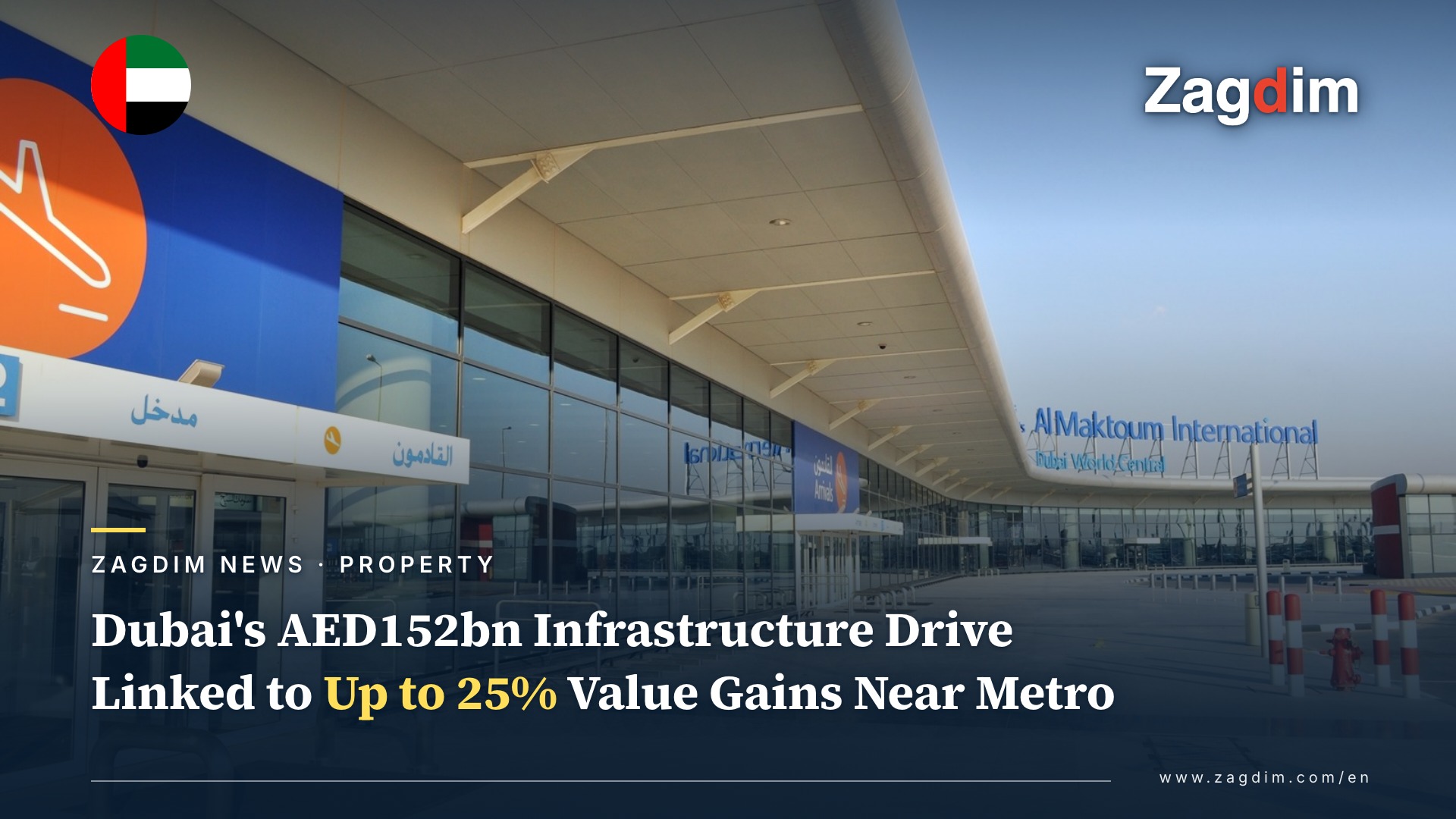
The largest single item is the Al Maktoum International Airport expansion, at $34.9 billion (AED 128 billion), targeting capacity for 260 million passengers a year across five parallel runways and 400 aircraft gates. W Capital says airport-linked employment, logistics and commercial activity are already showing up in nearby transaction data: it recorded 2,869 real estate deals in Dubai South in June 2026 alone, worth about $898 million (AED 3.3 billion). The third quantified scheme, phase one of the Fourth Federal Corridor — a roughly 80-kilometre road running from Al Faya Road in Abu Dhabi to Al Shnouf Road in Sharjah — carries about $953 million (AED 3.5 billion) and is designed to cut a 35-minute journey to about 14 minutes.
W Capital names a fourth catalyst, Etihad Rail’s planned passenger links across 11 cities and areas including Dubai, Abu Dhabi, Sharjah and Fujairah, though its investment figure is not included in the $41.4 billion total. W Capital places all four projects within the Dubai 2040 Urban Master Plan’s “20-minute city” concept, and separately projects more than $272 billion (AED 1 trillion) of new Dubai real estate development over the next five years.
W Capital Chairman Walid Al Zarooni, quoted in the study, cautioned that actual property performance “will still reflect supply, demand, construction quality and surrounding community maturity” and depends on “infrastructure completion timing” — not infrastructure spending alone. That caveat sits alongside separate reporting the same week: Arabian Business and Khaleej Times both reported Dubai asking rents falling by as much as 22 per cent in popular areas, with achieved rents down more than 12 per cent in Dubai Marina, Business Bay and JVC and listings up 55 per cent — a different metric (rents and listing volume, not capital values near new transit nodes), but one that cuts against a simple reading of this week’s infrastructure story as unambiguously bullish for every part of the Dubai market.