
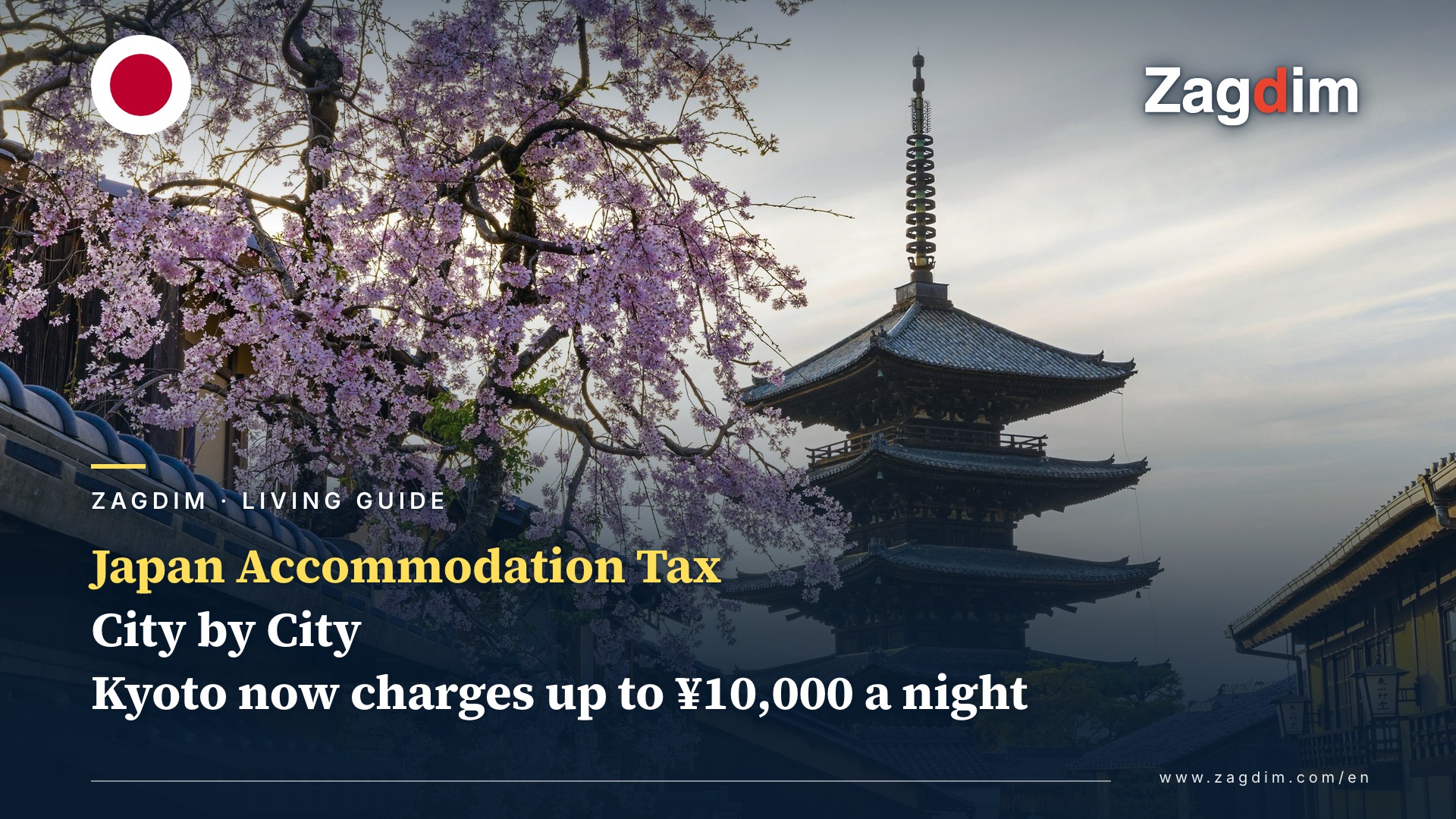
Japan accommodation tax in Kyoto now reaches ¥10,000 per person per night: five tiers since March 2026, with about ¥13,169 million budgeted this year
According to Kyoto City, the Japan accommodation tax charged in Kyoto (宿泊税, shukuhaku-zei) has been set in five tiers by the per-person nightly room rate since 1 March 2026, and a room rate of ¥100,000 or more now carries ¥10,000 per person per night, the highest tier anywhere in Japan; Kyoto City’s FY2026 budget expects about ¥13,169 million from the tax.
Yomiuri TV reported on 7 November 2026, half a year after the increase, that the extra revenue is being used on measures in tourist areas such as litter collection around Fushimi Inari Taisha; the report was carried by Yahoo! News Japan. Kyoto is not the only place with the tax. Tokyo, Osaka Prefecture, Hokkaido (including towns such as Sapporo, Niseko and Kutchan), Kanazawa and Fukuoka City each set their own accommodation tax, with different rates and methods, and Tokyo has already decided to change its system from April 2027.
This guide sets out the main city rates, how the tax is calculated and paid, and what owners who run minpaku or short-term rentals in Japan must collect and file.
Key Points
- Who should pay attention: anyone planning a trip or business stay in Japan, and overseas owners who run minpaku or short-term rentals in Japanese property.
- Japan accommodation tax is set by each local government and charged per person per night. Kyoto’s top tier is ¥10,000; Tokyo, Osaka, Kanazawa and Fukuoka mostly charge ¥100 to ¥500; most of Hokkaido adds a prefectural and a municipal layer.
- The rate follows the night of stay, not the booking date. Prepaying on a booking site does not always cover the tax.
- Hotel, ryokan and minpaku operators are “special collection agents” (特別徴収義務者): they collect the tax from guests and file it with the local government. Tokyo brings minpaku into the tax only from April 2027.
Japan Accommodation Tax Rates by City
All amounts below are per person per night. Each area defines the room rate slightly differently; Kyoto City uses the room-only rate (room charge plus service charge), excluding meals and consumption tax. Official notices from each local government prevail.
| Area | Room rate per person per night | Tax | Source |
|---|---|---|---|
| Kyoto City | Under ¥6,000 | ¥200 | Kyoto City (from 1 March 2026) |
| Kyoto City | ¥6,000 to under ¥20,000 | ¥400 | Same |
| Kyoto City | ¥20,000 to under ¥50,000 | ¥1,000 | Same |
| Kyoto City | ¥50,000 to under ¥100,000 | ¥4,000 | Same |
| Kyoto City | ¥100,000 or more | ¥10,000 | Same |
| Tokyo | Under ¥10,000 | Not taxed | Tokyo Metropolitan Government (current system) |
| Tokyo | ¥10,000 to under ¥15,000 | ¥100 | Same |
| Tokyo | ¥15,000 or more | ¥200 | Same |
| Osaka Prefecture | Under ¥5,000 | Not taxed | Osaka Prefecture (from 1 September 2025) |
| Osaka Prefecture | ¥5,000 to under ¥15,000 | ¥200 | Same |
| Osaka Prefecture | ¥15,000 to under ¥20,000 | ¥400 | Same |
| Osaka Prefecture | ¥20,000 or more | ¥500 | Same |
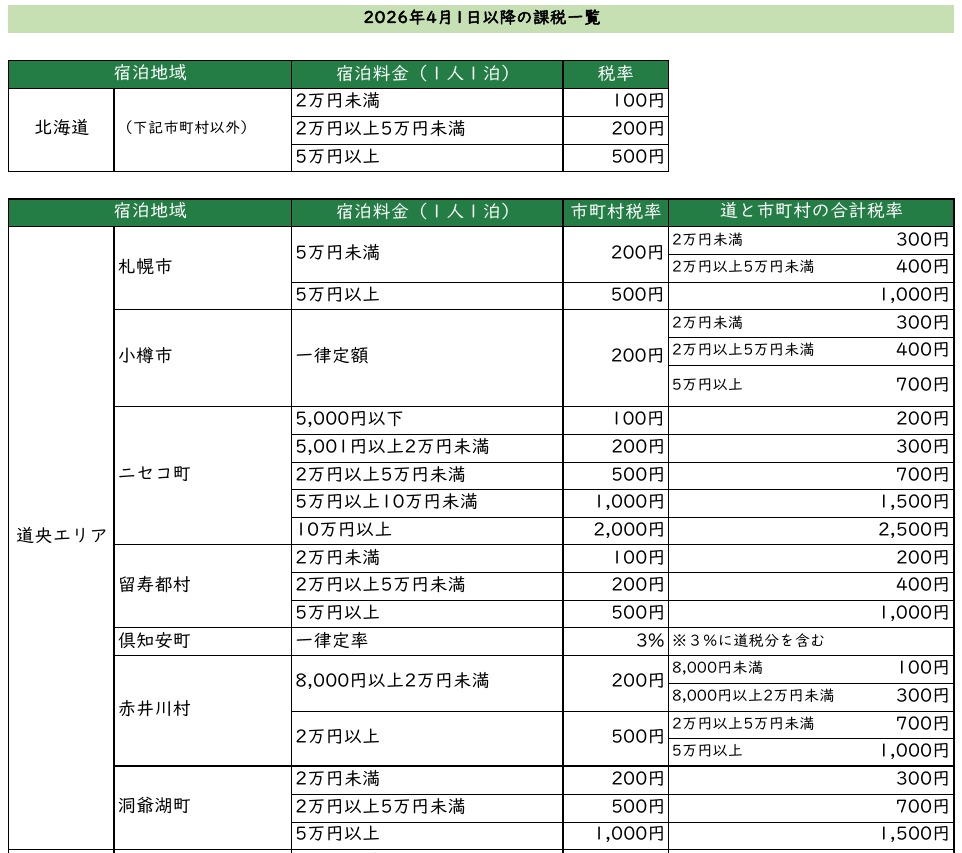
| Hokkaido (towns without their own tax) | Under ¥20,000 / ¥20,000 to under ¥50,000 / ¥50,000 or more | ¥100 / ¥200 / ¥500 | Hokkaido Government (from 1 April 2026) |
| Sapporo (prefectural plus city tax) | Under ¥20,000 / ¥20,000 to under ¥50,000 / ¥50,000 or more | ¥300 / ¥400 / ¥1,000 | Hokkaido rate list |
| Kutchan (prefectural plus town tax) | Flat | 3% of the room rate | Hokkaido rate list |
| Kanazawa | Under ¥5,000 | Not taxed | Kanazawa City (from 1 October 2024) |
| Kanazawa | ¥5,000 to under ¥20,000 / ¥20,000 or more | ¥200 / ¥500 | Same |
| Fukuoka City (city plus prefectural tax) | Under ¥20,000 / ¥20,000 or more | ¥200 / ¥500 | Fukuoka City |
Tokyo has decided that from stays on 1 April 2027 it will charge 3% of the room rate, with stays under ¥13,000 per person per night not taxed, and will extend the tax from hotels and ryokan to simple lodging (簡易宿所) and minpaku.
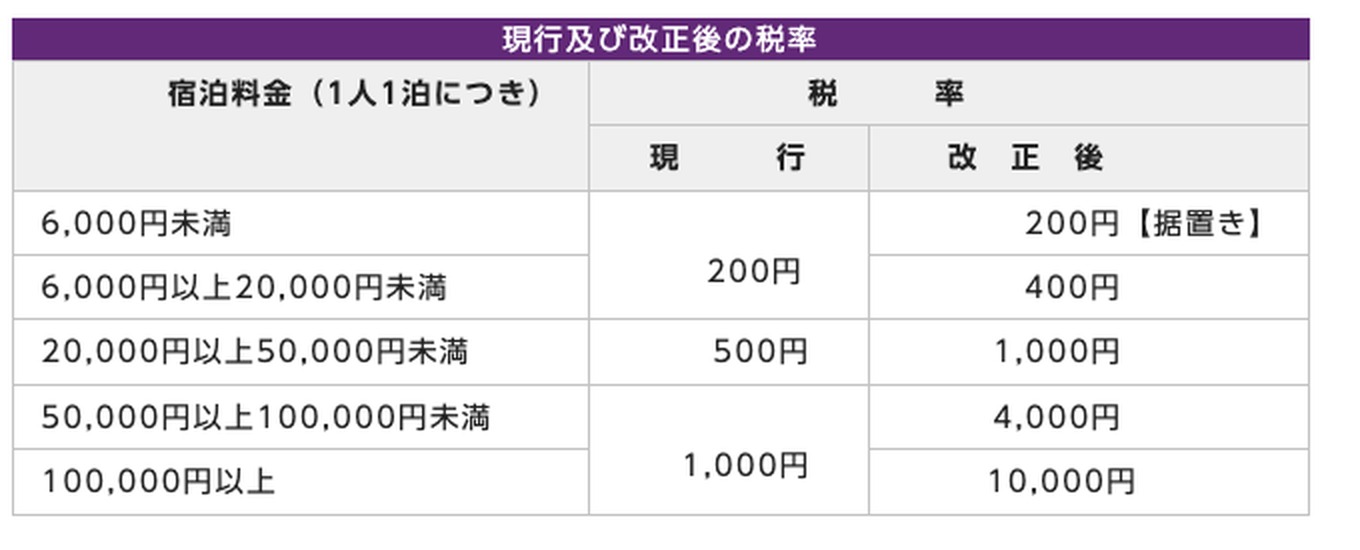
How Do Kyoto’s Old and New Accommodation Tax Rates Compare?
Kyoto kept the ¥200 rate under ¥6,000 and raised every other tier. The comparison below follows Kyoto City’s revision notice on its accommodation tax page:
| Room rate per person per night | Until end of February 2026 | From 1 March 2026 |
|---|---|---|
| Under ¥6,000 | ¥200 | ¥200 |
| ¥6,000 to under ¥20,000 | ¥200 | ¥400 |
| ¥20,000 to under ¥50,000 | ¥500 | ¥1,000 |
| ¥50,000 to under ¥100,000 | ¥1,000 | ¥4,000 |
| ¥100,000 or more | ¥1,000 | ¥10,000 |
Kyoto City’s FY2026 budget lists accommodation tax revenue of ¥13,169 million, against ¥5,914 million in the FY2025 budget, mainly because of the March rate change. This is a budget estimate, not actual revenue.
Why Does Hokkaido’s Accommodation Tax Come in Two Layers?
Hokkaido introduced a prefecture-wide accommodation tax from 1 April 2026, and towns including Sapporo, Otaru, Hakodate, Asahikawa, Niseko and Kutchan charge their own tax on top. Staying there means paying both. Sapporo’s combined rate is ¥300 to ¥1,000; Niseko has five tiers with a combined ¥200 to ¥2,500; Hakodate’s combined rate is ¥200 to ¥2,500; Kutchan charges a flat 3% of the room rate, which already includes the prefectural share.
How Japan Accommodation Tax Is Calculated and Paid
The unit is per person per night, not per room. Two people staying three nights pay the tax six times. When several guests share a room, the room rate is converted to a per-person nightly figure under each area’s rules before the tier is applied.
The rate depends on the night of stay. Kyoto City says stays on or after 1 March 2026 are taxed at the new rate whenever the booking was made; if the old amount was collected at booking, the accommodation must collect the difference.
The tax is normally paid to the accommodation, which passes it to the local government. Kyoto City notes that the tax is sometimes included in what a booking site or travel agent charges, and sometimes not. Guests who prepaid online may still be asked to pay at check-in, so it is worth checking the booking confirmation or asking the property.
Kyoto and Hokkaido exempt pupils (university students excluded) and accompanying staff on school trips and other school-run events. Children on ordinary family holidays are not exempt; local rules prevail.
Running a Minpaku or Short-Term Rental: Your Collection Duty
Guests are the taxpayers, but collection and filing fall on whoever runs the accommodation. For overseas owners operating a minpaku or short-term rental in Japan, that means charging the tax along with the room rate and filing it with the local government on schedule.
| Area | Who collects | Filing and payment | Source |
|---|---|---|---|
| Kyoto City | Hotel and ryokan operators and registered minpaku hosts; guests at unlicensed lodgings are also taxed | Monthly return, paid by the end of the following month | Kyoto City |
| Osaka Prefecture | Hotels, ryokan, simple lodging, special-zone minpaku and registered minpaku | Filed with Osaka Prefecture | Osaka Prefecture |
| Hokkaido | Hotels, ryokan, simple lodging and registered minpaku | Collected with the room rate and filed with Hokkaido | Hokkaido Government |
| Kanazawa | Licensed lodging operators and registered minpaku hosts | Monthly return, paid by the end of the following month | Kanazawa City |
| Fukuoka City | Lodging operators (boarding houses excluded) and registered minpaku hosts | Monthly return by the end of the following month; Fukuoka City collects the city and prefectural tax together | Fukuoka City |
| Tokyo | Currently hotels and ryokan only; simple lodging and minpaku added from April 2027 | Registration for minpaku and simple lodging opened on 1 July 2026 | Tokyo Metropolitan Government |
Owners who use a registered minpaku management company should check who collects the tax, who files the returns, and whether the platform price already includes it. For whether a property can be used as a minpaku at all, see our guide Are Short-Term Rentals and Minpaku Legal in Japan?.
Common Misunderstandings About Japan Accommodation Tax
- “The tax is the same everywhere in Japan.” It is not. Each local government sets its own tax; some use fixed tiers, some a percentage, and most of Hokkaido has two layers.
- “I prepaid online, so there is nothing to pay at the hotel.” Not necessarily. Booking-site prices may exclude the tax, which the property then collects at check-in.
- “It is charged once per room.” It is charged per person per night, so both guests and nights multiply it.
- “A room booked before the change keeps the old rate.” In Kyoto, the new rate applies by the night of stay, regardless of booking date.
- “Minpaku guests pay the tax office themselves.” Guests pay the operator, and the operator files. Owners who use a management company still need to confirm someone is doing it.
Japan Accommodation Tax Examples
A family of four spending two nights in Kyoto
A family of four books a family room in Kyoto City at ¥60,000 a night. Split by head, that is ¥15,000 per person per night, in the ¥6,000 to under ¥20,000 tier, so ¥400 each per night. Four people for two nights is eight charges, or ¥3,200 in total. If the booking-site price excludes the tax, this is paid on arrival.
A ski trip to Niseko
Two people stay five nights in Niseko at a room rate of ¥30,000 per person per night. That falls in the ¥20,000 to under ¥50,000 tier, where the combined prefectural and town tax is ¥700 per person per night, or ¥7,000 for the stay. In Kutchan the tax would instead be 3% of the room rate, prefectural share included.
An overseas owner running a minpaku in Osaka
An owner living abroad has an Osaka flat registered as a minpaku and managed by a management company. She needs to confirm whether her listed price includes the tax, who collects it from guests, and who files with Osaka Prefecture. At a room rate of ¥8,000 per person per night, Osaka’s tax is ¥200 per person per night.
Japan Accommodation Tax FAQ
Where do I pay Japan accommodation tax?
Japan accommodation tax is normally paid at the accommodation, which collects it for the local government. Some booking sites and travel agents include it in their price and some do not, so check the booking confirmation or ask the property before you travel.
Do children pay Japan accommodation tax?
Kyoto and Hokkaido only exempt pupils and accompanying staff on school trips and other school-run events; children on family holidays are not separately exempt. If the per-person nightly room rate is below an area’s threshold, no tax is charged, for example under ¥5,000 in Osaka or under ¥10,000 in Tokyo.
How is the tax worked out if breakfast is included?
Kyoto City calculates the tax on the room-only rate (room charge plus service charge), excluding meals and consumption tax. For a plan with breakfast, the meal portion is taken out before the tier is applied. Definitions differ slightly by area, so local notices prevail.
How will Tokyo’s accommodation tax change in 2027?
From stays on 1 April 2027, Tokyo will charge 3% of the room rate, with stays under ¥13,000 per person per night not taxed, and the tax will extend from hotels and ryokan to simple lodging and minpaku. Stays up to the end of March 2027 remain at ¥100 or ¥200.
Do minpaku hosts in Japan file the accommodation tax themselves?
In Kyoto, Osaka, Hokkaido, Kanazawa, Fukuoka and other areas with the tax, a registered minpaku operator is the special collection agent and must collect the tax from guests and file it. Kyoto, Kanazawa and Fukuoka generally require a monthly return paid by the end of the following month. Owners using a management company can set out in the contract who is responsible.
What does Kyoto spend its accommodation tax on?
Kyoto City says the tax funds measures to make Kyoto a more attractive international cultural tourism city and to promote tourism. Yomiuri TV reported on 7 November 2026 that the extra revenue is being used in tourist areas, including litter collection around Fushimi Inari Taisha.
Travelling to Japan or Running a Minpaku? Ask Zagdim
If you are unsure how much accommodation tax applies where you are staying, or you run a minpaku in Japan and want to understand collection and filing, Ask Zagdim.
Life abroad? Ask Zagdim.
Your first stop for international property and global living.
Research and insights. Know what’s changing. Understand what matters.
Newsletter for overseas updatesSubscribe →
Disclaimer
This article is general information and is not tax or legal advice. It is based mainly on information published between 2020 and November 2026 by Kyoto City, the Tokyo Metropolitan Government, Osaka Prefecture, the Hokkaido Government, Kanazawa City and Fukuoka City. The calculations are illustrative; the actual tax depends on the property’s calculation and local rules. Rates, thresholds and coverage may change. Minpaku operators should confirm filing details with the local tax office and, where needed, a Japanese tax accountant (zeirishi).
Rates and rules are current as of 9 November 2026; official notices from each local government prevail. Next review: around Tokyo’s change on 1 April 2027.
References
Kyoto City – 宿泊税について (Accommodation tax) / Kyoto City – FAQ for accommodation operators on the March 2026 rate change / Kyoto City – FY2026 budget summary / Tokyo Metropolitan Government – Accommodation tax revision (30 June 2026) / Osaka Prefecture – Osaka Prefecture accommodation tax / Hokkaido Government – Accommodation tax / Kanazawa City – Accommodation tax / Fukuoka City – Accommodation tax / Yomiuri TV – Kyoto accommodation tax six months after the increase (via Yahoo! News Japan, 7 November 2026)