

First Winter in Canada Starts With Early Darkness: Toronto’s Sun Sets at 4:40 p.m. from 5 to 13 December 2026
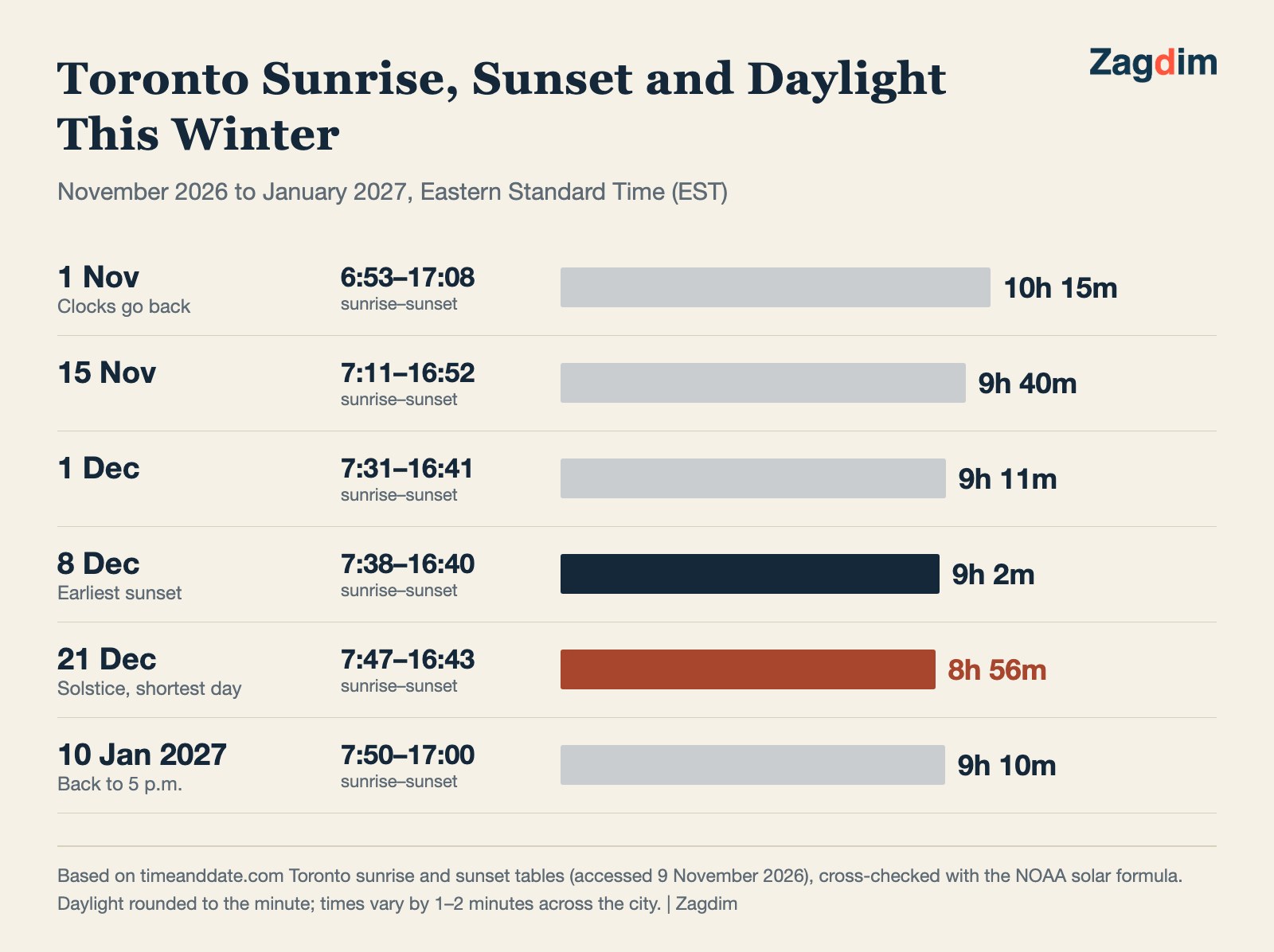
For anyone facing a first winter in Canada, the first change is usually the light: in Toronto the sun sets at 4:40 p.m. from 5 to 13 December 2026, and the winter solstice on 21 December brings only about 8 hours 56 minutes of daylight, according to timeanddate.com’s Toronto sunrise and sunset tables.
Narcity Canada reported on 6 November 2026 that 7 November would be Toronto’s last 5 p.m. sunset of the year, with the next one not until 10 January 2027. The outlet also noted that Toronto’s earliest sunsets come earlier than those in Vancouver, Calgary, Edmonton and Winnipeg. Toronto left daylight saving time on 1 November 2026, so when the clocks went back an hour, evenings suddenly turned dark much sooner.
Using Toronto as the example, this guide covers what newcomers most often need to sort out before their first Canadian winter: when it gets dark, mood and vitamin D, heating and electricity in a rental, winter tyre rules, and the free winter activities the city offers.
Key Takeaways
- Who should pay attention: newcomers, international students and work-permit holders spending their first winter in Canada, especially those living in Toronto or Ontario, or planning to drive to Quebec in winter.
- Toronto’s earliest sunsets (4:40 p.m.) fall between 5 and 13 December, and the shortest day is the 21 December solstice (about 8 hours 56 minutes); sunrise keeps getting later, reaching about 7:51 a.m. from late December into early January.
- Health Canada advises people aged 51 and over to take a daily 400 IU vitamin D supplement; CAMH says seasonal affective disorder (SAD) usually appears in autumn or winter.
- Where the landlord supplies heat, Toronto rental units must be kept at 21°C or above from 1 October to 15 May; winter tyres are mandatory in Quebec from 1 December to 15 March, but not in Ontario.
Daylight During Your First Winter in Canada: Toronto Sunrise and Sunset, November to January
All times below come from timeanddate.com’s Toronto sunrise and sunset tables (accessed 9 November 2026), in Eastern Standard Time (EST), cross-checked with the US National Oceanic and Atmospheric Administration (NOAA) solar position formula; times vary by 1–2 minutes across the city:
| Date | Sunrise | Sunset | Daylight | Note |
|---|---|---|---|---|
| 1 November 2026 | 6:53 a.m. | 5:08 p.m. | 10h 15m | Daylight saving time ends |
| 7 November 2026 | 7:01 a.m. | 5:00 p.m. | 9h 59m | Last 5 p.m. sunset of the year |
| 15 November 2026 | 7:11 a.m. | 4:52 p.m. | 9h 40m | |
| 1 December 2026 | 7:31 a.m. | 4:41 p.m. | 9h 11m | |
| 5–13 December 2026 | 7:35–7:42 a.m. | 4:40 p.m. | About 9h | Earliest sunsets of the year |
| 21 December 2026 | 7:47 a.m. | 4:43 p.m. | 8h 56m | Solstice, shortest day |
| 10 January 2027 | 7:50 a.m. | 5:00 p.m. | 9h 10m | Back to a 5 p.m. sunset |
Between 1 November and 21 December, Toronto loses about 1 hour 19 minutes of daylight. The earliest sunset does not fall on the solstice but about two weeks before it; after the solstice, sunsets get later, but sunrise keeps slipping until early January, so dark mornings last into the new year. Canada returns to daylight saving time on 14 March 2027, which pushes evening darkness back by an hour.
For workers and students, this means that on December weekdays you may leave home just after sunrise and finish class or work after dark. Allow for lighting and road conditions when walking home or waiting at a bus stop or car park.
Mood and Health in Your First Winter in Canada: Seasonal Affective Disorder (SAD) and Vitamin D
What CAMH Says About Seasonal Affective Disorder
Ontario’s Centre for Addiction and Mental Health (CAMH) describes seasonal affective disorder (SAD) as a type of depression that occurs during the same season each year. Researchers think it is linked to changes in sunlight exposure, and it usually happens in autumn or winter. The signs are the same as for major depression: mainly a sad, despairing mood present most days and most of the day, lasting more than two weeks and affecting work, school or relationships. Other symptoms include changes in appetite and weight, sleep problems, loss of interest, withdrawal, fatigue and trouble concentrating.
The risk factors CAMH lists include being a woman, living far from the equator, being young, and having a family history of SAD or depression. On treatment, CAMH says light therapy is the main treatment, and other depression treatments such as medication and psychotherapy are also effective; more exercise and more time outdoors may also help.
This is CAMH’s general information and cannot be used for self-diagnosis. If low mood is affecting your life, you can see a family doctor, your school’s health centre, or the support resources listed on CAMH’s website. In an emergency, call 911.
Health Canada’s Vitamin D Advice
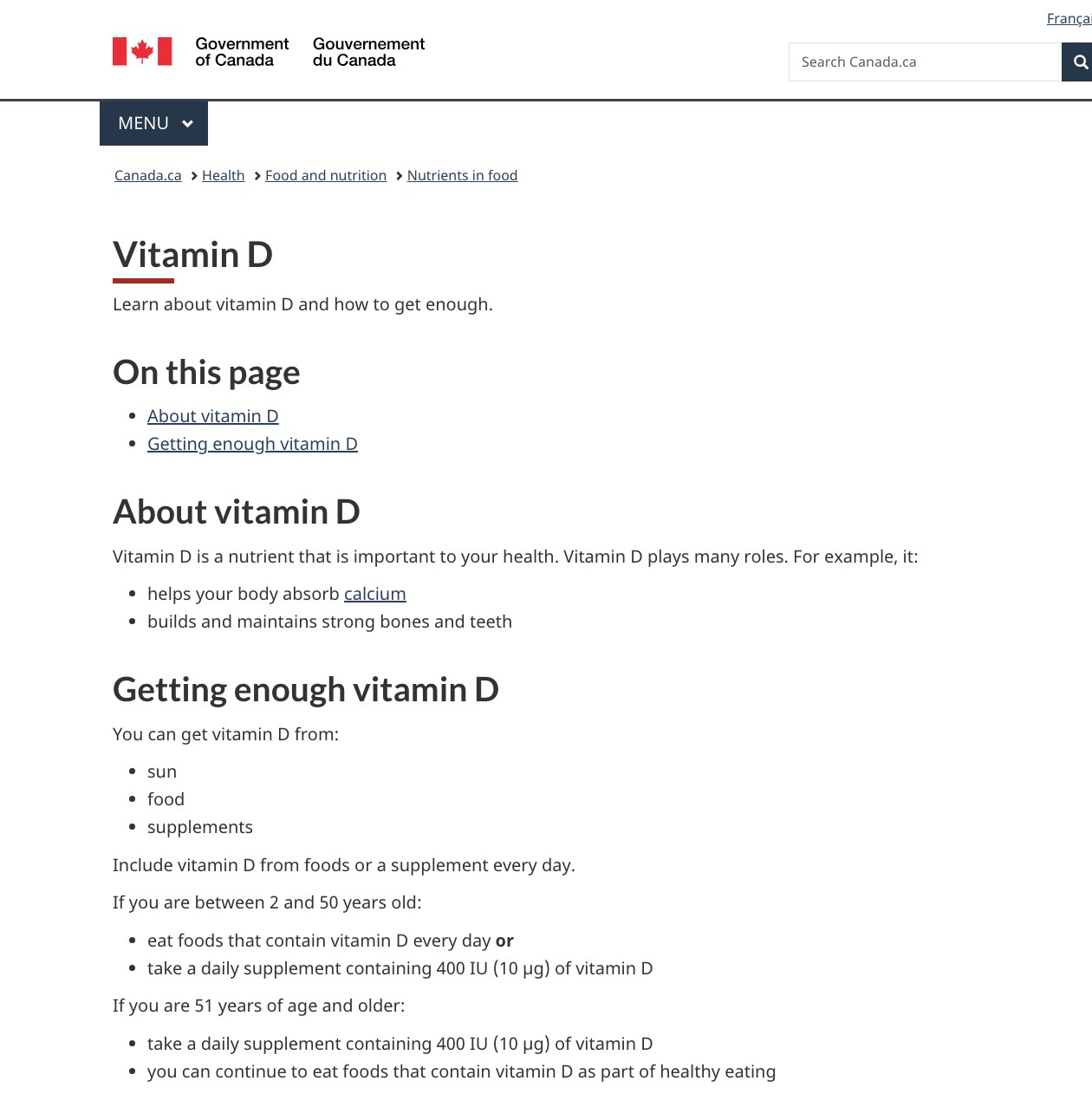
Health Canada explains that your body can make vitamin D when exposed to sunlight, and that season is one of the factors that can reduce how much it makes. The advice below comes from Health Canada’s official pages:
| Age | Health Canada advice | Recommended Dietary Allowance (RDA) |
|---|---|---|
| 2–50 years | Eat foods that contain vitamin D every day, or take a daily supplement containing 400 IU (10 µg) | 600 IU (15 µg) |
| 51–70 years | Take a daily supplement containing 400 IU (10 µg); you can continue to eat foods that contain vitamin D | 600 IU (15 µg) |
| Over 70 years | As above | 800 IU (20 µg) |
The advice column comes from Health Canada’s “Vitamin D” page; the RDA column comes from Health Canada’s “Dietary reference intakes tables”. These values assume minimal sun exposure, and the tolerable upper intake level for adults is 4,000 IU (100 µg) a day from all sources.
Health Canada lists food sources of vitamin D such as egg yolk, soft margarine, fatty fish like salmon, lower fat milk and fortified plant-based beverages. If you have a chronic condition, are pregnant or take other medication, ask a doctor or pharmacist about supplements.
Heating and Electricity in Your First Winter in Canada: Toronto Landlords Must Keep Units at 21°C
Toronto’s Indoor Temperature Rule for Rentals
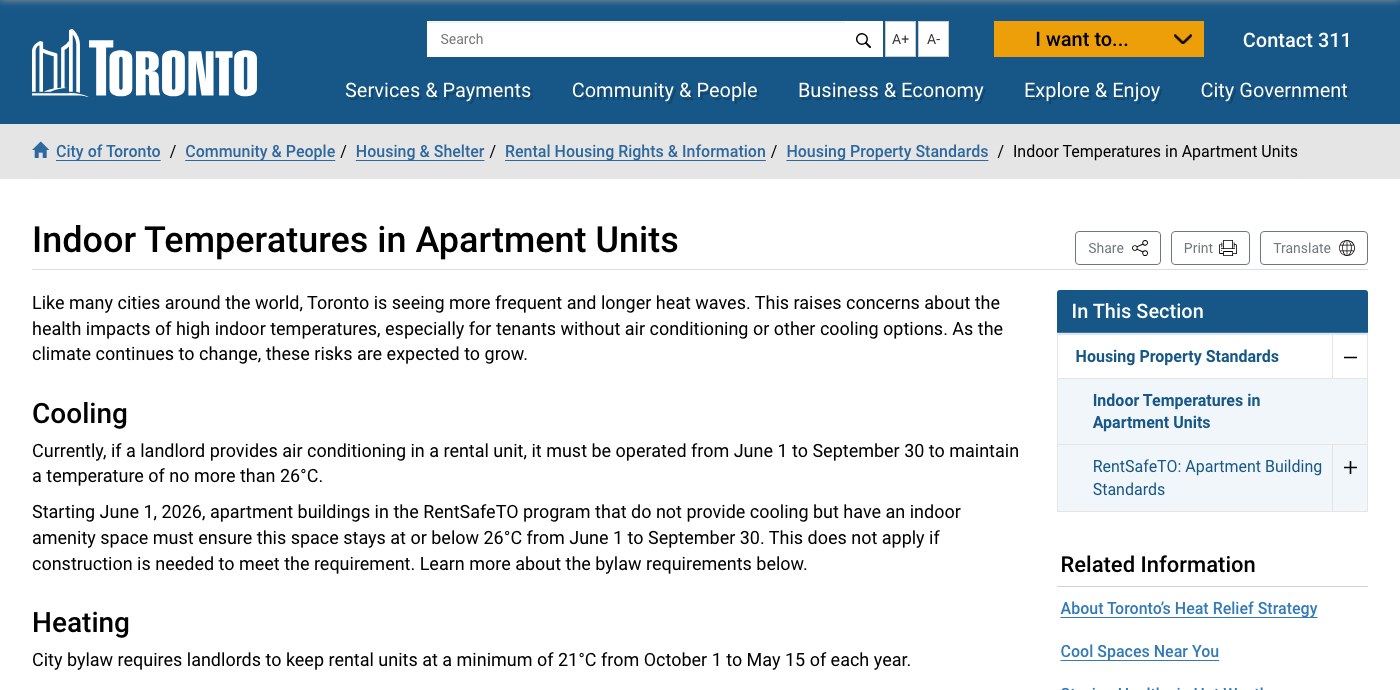
The City of Toronto requires landlords who provide heat to keep rental units at a minimum of 21°C from 1 October to 15 May each year. No heat is an urgent repair, and landlords must respond within 24 hours. Tenants should first report the problem to the landlord or property manager; if it is not fixed in time, they can call 311 or report it to the City online.
Who pays for heat, electricity and water depends on the lease. Ontario’s Standard Form of Lease has a section that sets out whether the landlord or the tenant is responsible for each; check it before signing so winter bills do not come as a surprise.
Ontario’s Winter Electricity Prices: Winter Hours from 1 November
If your lease says you pay for electricity, it helps to know Ontario’s regulated price plans. Toronto Hydro publishes the following residential prices for 1 November 2026 to 30 April 2027 (per kWh, excluding delivery and other charges):
| Plan | Hours | Price per kWh | Source |
|---|---|---|---|
| Time-of-Use (TOU) off-peak | Weekdays 7 p.m.–7 a.m.; all day weekends and statutory holidays | 9.1¢ | Toronto Hydro |
| Time-of-Use (TOU) mid-peak | Weekdays 11 a.m.–5 p.m. | 14.6¢ | Toronto Hydro |
| Time-of-Use (TOU) on-peak | Weekdays 7–11 a.m. and 5–7 p.m. | 18.9¢ | Toronto Hydro |
| Ultra-Low Overnight (ULO) overnight | Every day 11 p.m.–7 a.m. | 3.7¢ | Toronto Hydro |
| Ultra-Low Overnight (ULO) on-peak | Weekdays 4–9 p.m. | 37.7¢ | Toronto Hydro |
| Tiered | Up to 1,000 kWh a month / above 1,000 kWh | 11.2¢ / 13.2¢ | Toronto Hydro |
With early sunsets, the hours when you turn on lights, cook and run electric heaters fall right in the weekday 5–7 p.m. on-peak window. Which plan you are on, and whether you can switch, is a question for your electricity provider.
Winter Tyre Rules for Your First Winter in Canada: Mandatory in Quebec, Not in Ontario
If you drive in winter, first check which province your vehicle is registered in:
| Item | Quebec | Ontario |
|---|---|---|
| Are winter tyres mandatory? | Yes: from 1 December to 15 March each year | No |
| Vehicles covered | Motor vehicles registered in Quebec, including rental vehicles; trailers and vehicles registered outside Quebec are exempt | — |
| What counts | Tyres must carry the required pictogram (three-peak mountain and snowflake) or be studded | The province advises looking for the three-peak mountain snowflake symbol and fitting four winter tyres, never mixing types |
| Fine | $200–$300 | — |
| Other | The province suggests waiting a few weeks after 15 March before switching back | You could get an auto insurance discount; ask your insurer |
| Source | Government of Quebec, “Requirements for winter tires” | Government of Ontario, “Winter driving” |
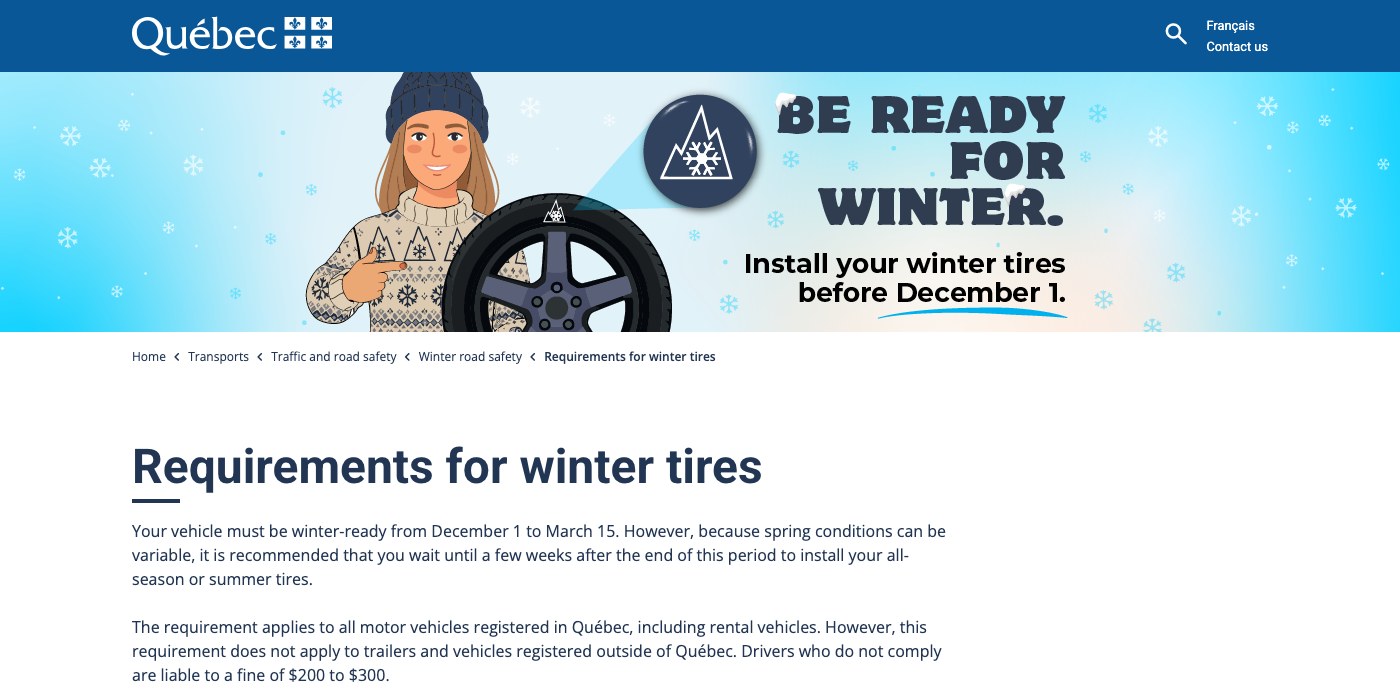
Cars rented or bought in Toronto are usually registered in Ontario, where winter tyres are not mandatory. Roads still freeze and snow over, so whether to fit them is worth discussing with your insurer, rental company or dealer.
Winter Activities in Your First Winter in Canada: Toronto’s Free Outdoor Rinks
Early darkness does not mean staying indoors. The City of Toronto began opening its outdoor rinks on 29 November 2025, with most open by 6 December, and has more than 50 outdoor artificial ice rinks and skating trails. Leisure skating is free, and the Skate Lending Library lends skates, helmets and skating aids at no cost, with no reservation needed. Check the City of Toronto for 2026–27 opening dates.
Common Misunderstandings About a First Winter in Canada
- “The earliest sunset is on the solstice”: Toronto’s earliest sunsets fall between 5 and 13 December. The solstice (21 December) is the shortest day, but sunsets are already getting later by then.
- “It only gets dark early because the clocks went back”: The end of daylight saving time moves evening darkness an hour earlier, but daylight also shrinks steadily through November and December, by about 1 hour 19 minutes between 1 November and 21 December.
- “Young people don’t need to think about vitamin D”: Health Canada advises people aged 2 to 50 to eat foods containing vitamin D every day or take 400 IU; the daily supplement advice is for people 51 and over.
- “Being cold indoors is just part of winter”: In Toronto, rental units where the landlord supplies heat must be kept at 21°C or above from 1 October to 15 May, and no heat is an urgent repair.
- “Winter tyres are mandatory everywhere in Canada”: They are mandatory in Quebec but not in Ontario; other provinces set their own rules.
Scenarios: Three Newcomers Facing a First Winter in Canada
Scenario 1: An international student who arrived in Toronto in September
She rents a room near campus, and it is dark by the time class ends at 6 p.m. She checks her lease to see who pays for heat and electricity, finds heat is included in the rent, and saves her landlord’s contact details; if the room drops below 21°C and nothing is done, she knows she can call 311. She also saves her school health centre’s details and plans daytime walks outdoors from November.
Scenario 2: A work-permit holder in Toronto who plans weekend drives to Montreal
His car is registered in Ontario, where winter tyres are not mandatory, and Quebec’s rule only covers vehicles registered in Quebec. Highways can still be snowy and icy, so he asks his insurer whether winter tyres earn a discount and by when they need to be fitted.
Scenario 3: A newcomer family who moved with parents in their sixties
The family is living through about nine hours of daylight for the first time. Following Health Canada’s advice that people 51 and over take a daily 400 IU vitamin D supplement, they ask the family doctor to confirm the parents’ supplements so they do not clash with other medication. They are also applying for benefits; for child benefit eligibility, see our guide Can Newcomers and Work-Permit Families Get the Canada Child Benefit?.
First Winter in Canada: Frequently Asked Questions
What is the earliest sunset in Toronto in winter?
According to timeanddate.com’s Toronto tables, the earliest sunsets of the year fall between 5 and 13 December 2026, at 4:40 p.m. The last 5 p.m. sunset of 2026 was on 7 November, and the next will be on 10 January 2027. Actual times vary by a minute or two across the city.
How short is the shortest day during a first winter in Canada?
In Toronto the shortest day is the 21 December solstice, with sunrise at 7:47 a.m. and sunset at 4:43 p.m., about 8 hours 56 minutes of daylight. Days are shorter further north, and cities such as Vancouver and Calgary have different sunset times, so check local tables.
Do I need to take vitamin D during my first winter in Canada?
Health Canada advises people aged 2 to 50 to eat foods that contain vitamin D every day or take a daily 400 IU supplement, and people 51 and over to take a daily 400 IU supplement while continuing to eat vitamin D foods. The adult upper limit is 4,000 IU a day. Ask a doctor or pharmacist about your own situation.
Could feeling low in winter be seasonal affective disorder?
CAMH describes SAD as depression that returns in the same season each year, usually autumn or winter, with a low mood most days lasting more than two weeks and affecting daily life. Low mood has many causes and you cannot diagnose this yourself; if it affects your life, see a family doctor or school health centre, and call 911 in an emergency.
Is my Toronto landlord responsible if my rental is too cold?
Yes. The City of Toronto requires rental units where the landlord provides heat to be kept at a minimum of 21°C from 1 October to 15 May. Report no heat to your landlord first; they must respond within 24 hours. If it is not fixed, call 311 or report it to the City online.
Do I have to fit winter tyres when driving in Ontario?
Ontario does not require winter tyres, but the province advises fitting four matching winter tyres with the three-peak mountain snowflake symbol, and you could get an insurance discount, so ask your insurer. Quebec is different: vehicles registered in Quebec must have winter tyres from 1 December to 15 March, with fines of $200 to $300.
Facing Your First Winter in Canada? Ask Zagdim
If you have just moved to Canada and still have questions about renting, daily life or local rules, Ask Zagdim.
Life abroad? Ask Zagdim.
Your first stop for international property and global living.
Research and insights. Know what’s changing. Understand what matters.
Newsletter for overseas updatesSubscribe →
Disclaimer
This article is general information and is not medical, legal or financial advice, and it cannot be used for self-diagnosis or to decide supplement doses. It is based mainly on material published between 2022 and November 2026 by Health Canada, CAMH, the City of Toronto, the Government of Ontario, the Government of Quebec and Toronto Hydro, with sunrise and sunset times from timeanddate.com’s astronomical tables. Rules, prices and times can change, so check the latest official guidance, and consult a doctor or pharmacist about health questions.
Rules and figures are current as of 9 November 2026; check Health Canada, the City of Toronto and the Government of Quebec for the latest updates. Next review: after Ontario’s winter electricity prices are set in November 2027.
References
timeanddate.com – Sunrise and sunset times in Toronto, December 2026 / timeanddate.com – Sunrise and sunset times in Toronto, November 2026 / timeanddate.com – Sunrise and sunset times in Toronto, January 2027 / Health Canada – Vitamin D / Health Canada – Dietary reference intakes tables: Reference values for vitamins / CAMH – Seasonal affective disorder / City of Toronto – Indoor Temperatures in Apartment Units / Government of Ontario – Guide to Ontario’s standard lease / Toronto Hydro – Residential rates and charges / Government of Ontario – Winter driving / Gouvernement du Québec – Requirements for winter tires / City of Toronto – City of Toronto kicks off the winter season as it begins to open outdoor ice rinks (29 November 2025) / Narcity Canada – Facebook post (6 November 2026)