
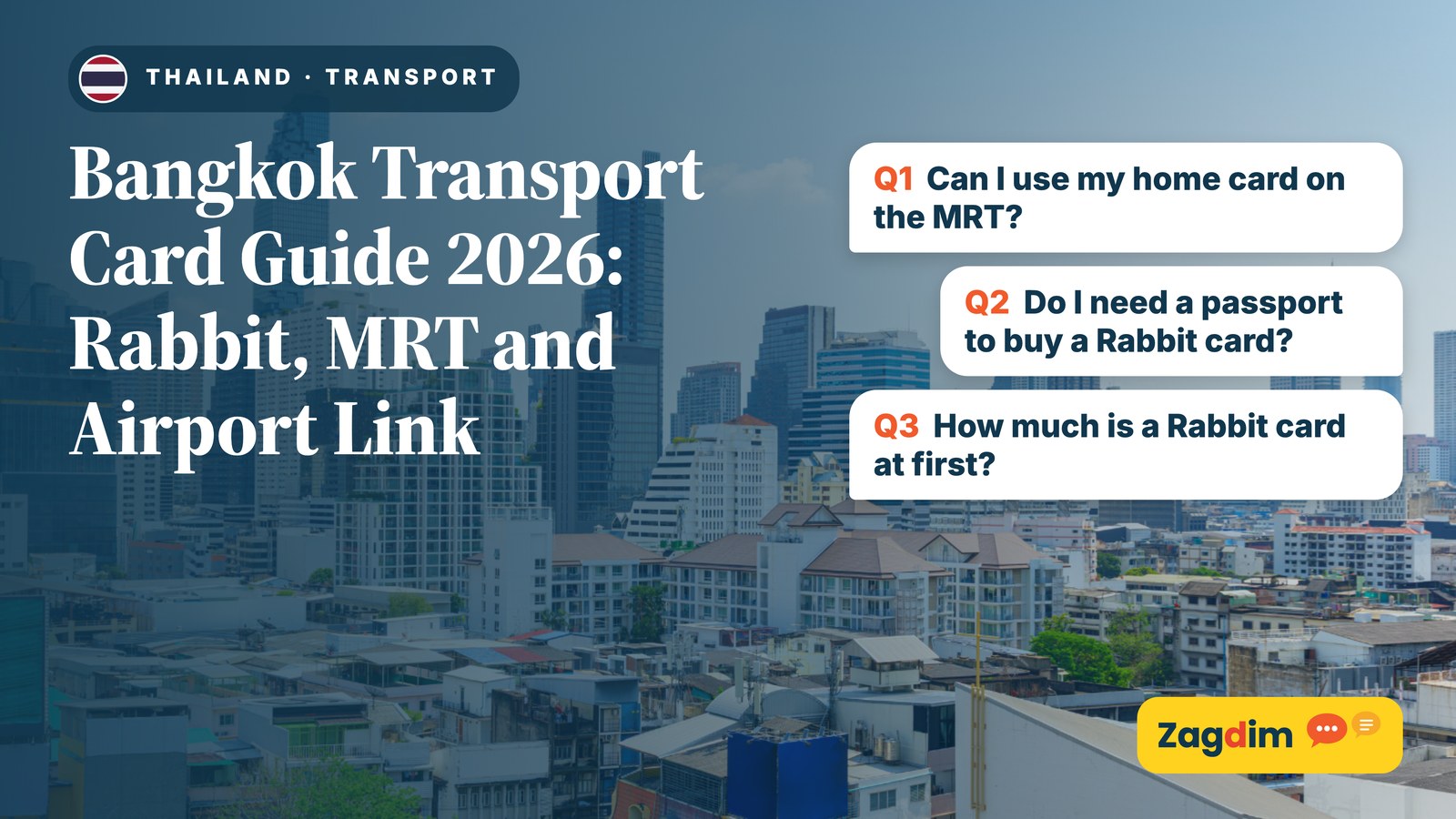
How you pay on Bangkok’s MRT changed in 2026. The Mass Rapid Transit Authority of Thailand (MRTA) announced on 27 February 2026 that all four MRT lines (Blue, Purple, Yellow and Pink) accept contactless bank card payment (the announcement does not give separate effective dates per line, saying only that it can be used directly). On the Blue and Purple lines only, the old MRT and MRT Plus stored-value cards stopped being accepted from 1 June 2026. For a visitor, the credit card in your wallet may now work as a ticket, but each line accepts different card types, and the BTS runs on a separate system built around the Rabbit card. This guide to paying for Bangkok transport covers Rabbit cards, contactless bank cards, single-journey tickets and the Airport Rail Link for two kinds of rider, short-stay visitors and long-stay residents.
The short answer: the four MRT lines and the Airport Rail Link (ARL) let you tap through the gate with a bank card that carries the contactless symbol. On the Blue and Purple lines, however, the listed debit cards are limited to five Thai banks, so Zagdim recommends that visitors from overseas use a credit card. For the BTS, have a Rabbit card or buy a single-journey card from a ticket machine. A Rabbit card works on the BTS, Yellow Line, Pink Line, BRT and Chao Phraya Express Boat, but not on the Blue or Purple lines. The two official explanations describe the first-purchase price differently, so check the notice at the station on the day.
This guide answers:
- Which payment method works best for a short-stay visitor, and which for a long-stay resident?
- Where do you buy a Rabbit card, do you need a passport, what do you pay the first time, and can you get the remaining balance back?
- For credit and debit cards issued in Hong Kong, Taiwan, mainland China, Singapore or Malaysia, which lines can you tap directly?
- What do you do if you miss a tap and are charged the maximum fare, if an old MRT card is retired, or when the 40 baht Red and Purple line cap expires?
Key Points
- Who this is for: visitors to Bangkok for tourism, family visits or property viewing, whether their cards were issued in Hong Kong, Taiwan, mainland China, Singapore or Malaysia, and people who live or commute in Bangkok long term.
- Four MRT lines accept cards: the Blue, Purple, Yellow and Pink MRT lines support EMV contactless payment, but the list of accepted card types differs by line. On the Blue and Purple lines the listed debit cards are limited to Krungthai, Krungsri, Kasikorn, SCB and UOB. The Yellow Line lists Visa, Mastercard and UnionPay credit cards issued overseas, and the Pink Line lists Visa, Mastercard and UnionPay debit cards issued overseas.
- Airport Rail Link: since 8 November 2025, every station accepts credit or debit cards with the contactless symbol tapped at the gate. Smart Pass and tokens still work.
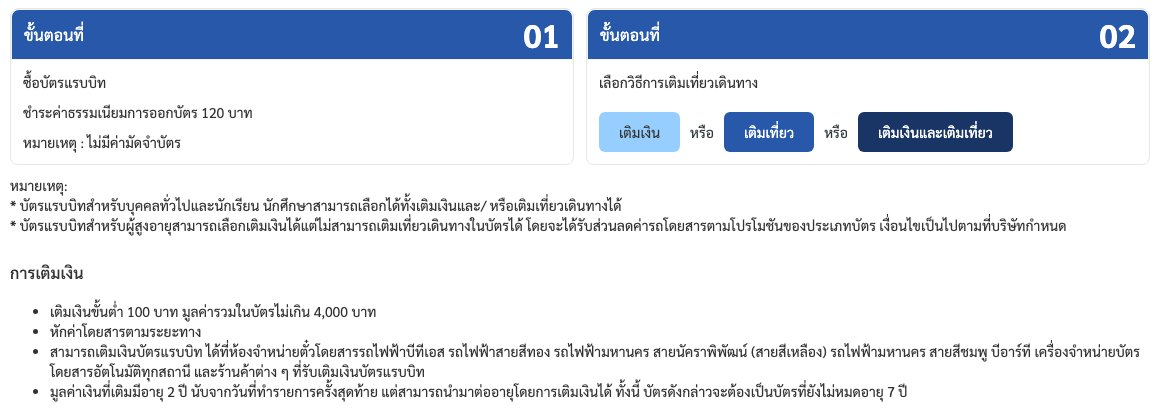
- Rabbit card: works on the BTS, Yellow Line, Pink Line, BRT and Chao Phraya Express Boat. The BTS card sales page states an issuing fee of 120 baht with no deposit. The Rabbit customer support page states 200 baht for a standard card (a 100 baht issuing fee plus 100 baht initial value). The minimum top-up is 100 baht per top-up, and the maximum balance on the card is 4,000 baht.
- Missed taps are charged the maximum fare: on the Blue and Purple lines, a contactless payment with a missing entry or exit record is charged the maximum fare.
- Check the status of fare measures: the maximum daily fare of 40 baht for adults on the Red and Purple lines runs to 30 November 2026 under the announcement, and an extension is still at the proposal stage. The second phase of a flat 20 baht fare on all lines was announced as cancelled by cabinet resolution in the government’s announcement of 23 June 2026.
First, Work Out Which Case You Are
Which payment method you use depends on whether you are a short-stay visitor or a long-stay resident, and which lines you will ride. Bangkok’s rail network is run by several operators, each with its own lines, so the way you pay follows the route. Find your case first, then read the matching section.
| Your situation | A combination that works well | What to check first |
|---|---|---|
| Short-stay visitor, mainly riding the MRT and Airport Rail Link | An overseas credit card with the contactless symbol, tapped directly at the gate | Whether your card is listed for the line you will ride; bring the physical card |
| Short-stay visitor who will ride the BTS | A BTS single-journey card, or buy a Rabbit card and top it up | The Rabbit first-purchase price follows the station notice; refunding the remaining value requires returning the card |
| Long-stay resident or commuter | A Rabbit card (with passport registration completed) plus contactless bank cards | Only a registered card can be stopped and refunded after loss; the expiry date of the Red and Purple line cap |
For example, a visitor arriving with a Visa credit card issued by a Hong Kong bank can tap directly at the Blue Line gates. To change to the BTS the same day, they buy a single-journey card from a BTS ticket machine or buy a Rabbit card.
Payment Methods Compared
Four payment methods each cover different routes, and no single card covers everything. The table below sets out who can use each, where to buy, whether ID is needed and where it works.
| Payment method | Who can use it | Where to buy | ID needed | Where it works |
|---|---|---|---|---|
| Rabbit card (stored value) | Visitors and residents | BTS stations, per the BTS card sales explanation | Whether to show a passport when simply buying a card follows the rules on the spot; foreigners need a passport for identity verification and to use My Rabbit | BTS, MRT Yellow and Pink lines, BRT, Chao Phraya Express Boat |
| Bank card contactless (EMV Contactless) | People holding a listed card type | Nothing to buy; use your own card | No separate registration | MRT Blue, Purple, Yellow and Pink lines, Airport Rail Link; accepted cards differ by line |
| BTS single-journey card | All passengers | BTS ticket machines | No | BTS |
| MRT Blue and Purple line single-journey token | All passengers | Blue and Purple line ticket machines (adult single-journey tokens) and ticket offices | No | MRT Blue and Purple lines |
| Airport Rail Link token, Smart Pass | All passengers | Airport Rail Link stations | No | Airport Rail Link |
**Glossary | EMV Contactless:** the contactless payment standard for bank cards. The card carries a contactless symbol of four curved lines, and tapping at a gate pays the fare without buying a ticket first.
A few easy misunderstandings:
- The QR on a BTS ticket machine is a way to pay, not a QR ticket. BTS explains that you can scan a QR code to pay at the machine, but what you get is a single-journey card, and you still use that card to enter and exit the gates.
- A Rabbit card does not work on the MRT Blue and Purple lines. The MRT lines listed on the Rabbit customer support page are the Yellow and Pink lines.
- Whether a bank card can be tapped directly at BTS gates is not stated in BTS’s official ticketing explanation. Ask at the ticket office when you arrive, because the explanation lists Rabbit cards and single-journey cards.
How to Buy and Top Up a Rabbit Card
Rabbit cards are sold at BTS stations, with a minimum top-up of 100 baht each time and a maximum of 4,000 baht on the card. Rabbit is Bangkok’s stored-value transport card, used in a similar way to Hong Kong’s Octopus or Taiwan’s EasyCard, though the routes it covers are different. If you ride the BTS a lot or live in Bangkok, Zagdim recommends buying one.
First-purchase price: whether you pay 120 baht or 200 baht the first time depends on which official explanation applies, since the two are worded differently. Check the notice at the station on the day before you buy.
| Official explanation | What it says |
|---|---|
| BTS card sales page | Issuing fee of 120 baht, no deposit |
| Rabbit customer support page | Standard card priced at 200 baht, of which the issuing fee is 100 baht and the initial value is 100 baht |
Top-ups and validity:
- The minimum top-up is 100 baht each time, and the total value on the card cannot exceed 4,000 baht.
- Stored value is valid for 2 years from the last transaction.
- The card itself is valid for 7 years.
Do you need a passport? Foreigners need to take a passport to a BTS ticket office to complete Rabbit identity verification and to use My Rabbit. Whether you must show a passport when simply buying a physical card follows the rules at the counter, so Zagdim recommends carrying your passport with you.
Zagdim recommends that long-stay residents complete registration: under Rabbit’s rules, if a card is lost, only a registered cardholder can apply to have the card stopped and the balance returned.
How Contactless Bank Cards Work, With Accepted Cards by Line
To pay by contactless bank card, you tap the same card with the contactless symbol at the gate when you enter and when you exit, so there is no queue to buy a ticket. But each operator lists its own accepted card types for its line, so you cannot apply one line’s rules to another.
| Line | Credit cards listed | Debit cards listed |
|---|---|---|
| MRT Blue and Purple lines (BEM) | Visa, Mastercard, UnionPay (the BEM page says Thai and overseas issuing banks; follow the current list for overseas UnionPay cards) | Only five Thai banks: Krungthai, Krungsri, Kasikorn, SCB, UOB |
| MRT Yellow Line (EBM) | Visa, Mastercard and UnionPay credit cards issued by Thai and overseas banks | Follow the Yellow Line’s current list |
| MRT Pink Line (NBM) | Follow the Pink Line’s current list | Visa, Mastercard and UnionPay debit cards issued by overseas banks |
| Airport Rail Link | Credit cards with the contactless symbol | Debit cards with the contactless symbol |
How to use it:
- Check that the card has the contactless symbol and is on the list for the line you will ride.
- On entry, tap the card against the reader at the gate.
- On exit, tap the same card again.
- After the trip, check the charge in your card issuer’s transaction history.
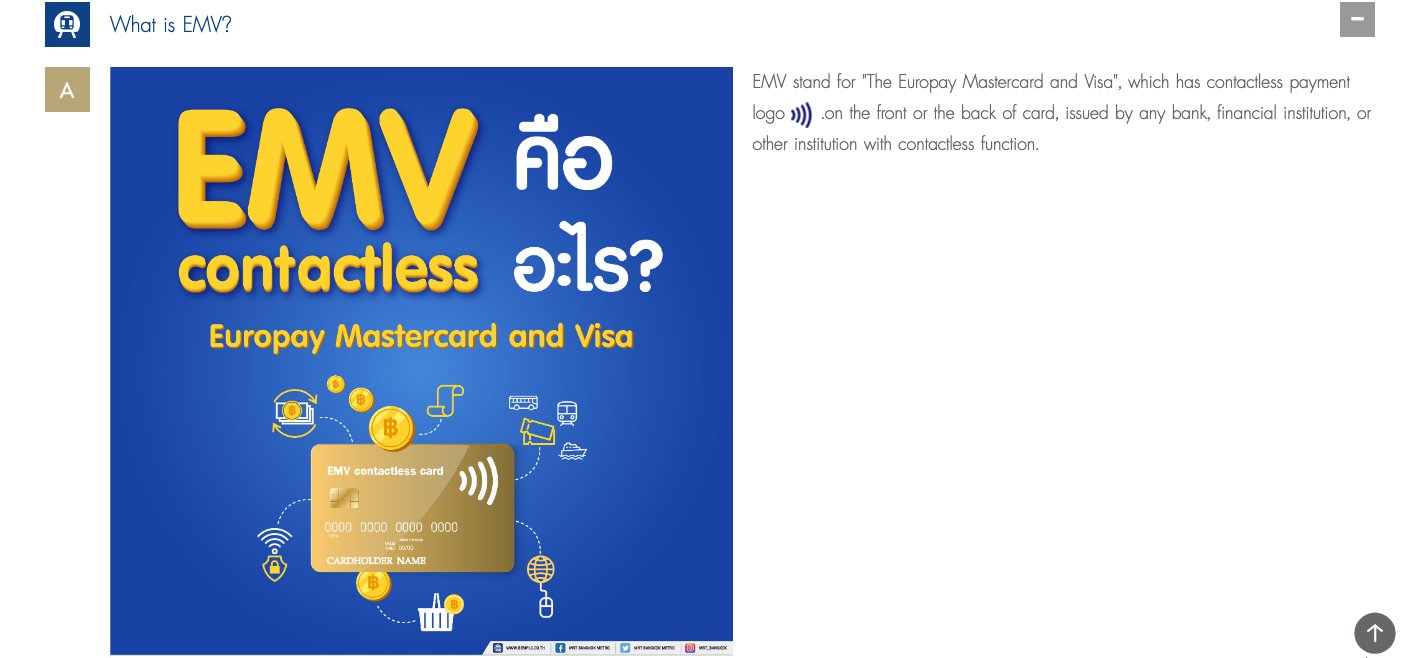
For example, a visitor flying in from Taipei carries a Visa debit card issued by a Taiwan bank. That card is not among the five Thai banks listed for the Blue and Purple lines, so before riding the Blue Line Zagdim recommends switching to a credit card or buying a single-journey token.
Phone wallets and watches: the operators’ explanations do not state that Apple Pay, Google Pay or a watch can replace the physical card, and the explanations focus on physical cards. Zagdim recommends carrying the physical card and treating phone payment as a backup.
How to Pay on the Airport Rail Link
Since 8 November 2025, every Airport Rail Link station accepts credit or debit cards with the contactless symbol, tapped directly at the gate, and Smart Pass and tokens are still available. Zagdim recommends checking before you land that your card works.
- The transport listed on the Rabbit customer support page does not include the Airport Rail Link, so do not expect to ride it with a Rabbit card.
- When using a bank card, tap in and out with the same card.
- If you have no contactless card, buy a token at the station.
The 40 Baht Cap on the Red and Purple Lines, and 2027 Common Fares
These three fare measures are at different stages. The announcement period for the daily cap on the Red and Purple lines runs to 30 November 2026, the second phase of the flat 20 baht fare on all lines has been cancelled by cabinet resolution, and the 2027 common fare has been approved by cabinet. Check which measure is actually in force before you ride.
| Measure | Details | Status (as of 14 November 2026) |
|---|---|---|
| Red and Purple line daily cap | On the two Red Line branches and the MRT Purple Line, a maximum of 40 baht a day for adults and 30 baht a day for students | Announcement period 1 December 2025 to 30 November 2026. On 25 October 2026 the government announced that the relevant committee is considering an extension to 31 December 2027, which the Ministry of Transport will submit to cabinet. No cabinet approval had been seen as of the checking date |
| Second phase of the flat 20 baht fare on all lines | Approved on 8 July 2025, with an announcement period of 1 October 2025 to 30 September 2026 | The government announced on 23 June 2026 that cabinet resolved to cancel it; registration eligibility was limited to Thai people holding a 13-digit Thai ID number |
| 2027 common fare | For rail transit in Bangkok and nearby cities, a maximum first-section fee of 17 baht and a maximum single trip of 45 baht, with no repeated first-section fee | Approved by cabinet on 3 November 2026, for 1 January 2027 to 31 December 2027; a government explanation of 13 October described 1 January as the target start date |
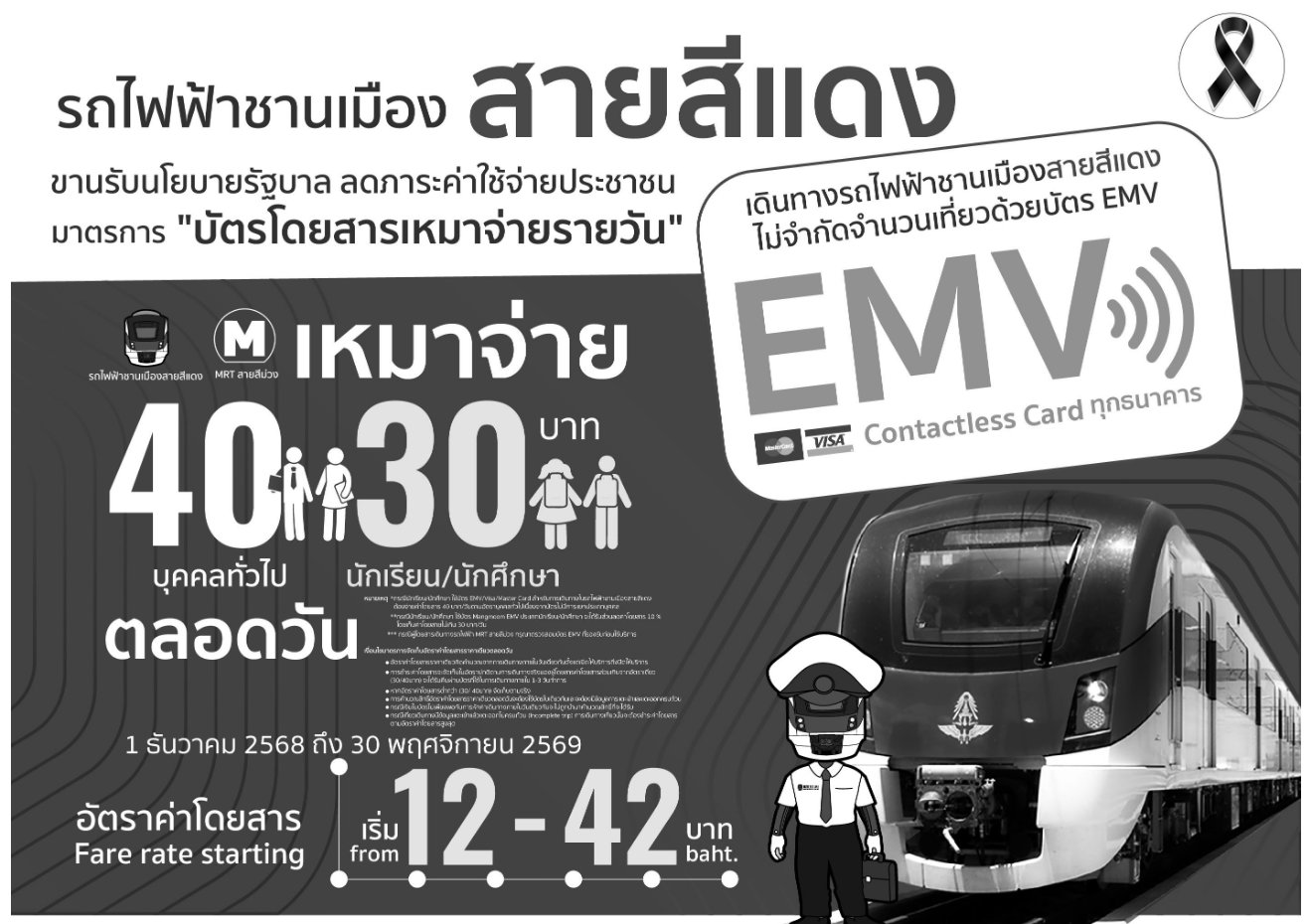
What this means for you:
- The daily cap is charged first and refunded after: MRTA explains that during the cap period the actual fare is charged first, and the amount above the cap is refunded within 3 working days. Which tickets and cards qualify follows the current SRTET and MRTA announcements.
- If you visit Bangkok after December: the extension is still only a proposal. Check the SRTET announcement before you leave to see whether it continues from 1 December.
- The 2027 common fare is not a cap at the gate: the mechanism in the government’s 13 October 2026 explanation is that the normal fare is charged first, and the difference is then refunded through the “เป๋าตัง” (Pao Tang) app to registered Thai people who qualify. Foreign visitors should not assume they can get the same net fare.
The 15 Baht Credit When Changing to the Yellow or Pink Line
When you change from the Blue Line at Lat Phrao station to the Yellow Line, or from the Purple Line at Nonthaburi Civic Center station to the Pink Line, you can get a 15 baht credit on the entry fee if you tap in with the same EMV card within 30 minutes of exiting. The conditions are specific, and using a different card means no credit.
- Yellow Line: within 30 minutes of exiting the Blue Line at Lat Phrao station, enter the Yellow Line with the same EMV card to get a 15 baht credit on the entry fee.
- Pink Line: within 30 minutes of exiting the Purple Line at Nonthaburi Civic Center station, enter the Pink Line with the same EMV card to get a 15 baht credit on the entry fee.
- On both lines the fare is charged as usual first and refunded afterwards. This is a transfer credit at designated stations, not a free transfer across the whole network.
Common Situations: Missed Taps, Returning a Card, Balances
Missed taps, balances on old cards and Rabbit card refunds are each handled differently. Questions about charges and old cards on the Blue and Purple lines go to the ticket office at stations on those lines, and refunding a Rabbit card balance requires returning the card. Work out which case you are in, then go to the right counter.
- Missed tap, charged the maximum fare: BEM’s rule is that on the Blue and Purple lines, a contactless payment with a missing entry or exit record is charged the maximum fare at the time. Zagdim recommends tapping the same card both on entering and exiting, and walking through only once you see the gate open. If you have a question about a charge, ask at the ticket office of a station on that line.
- Old MRT or MRT Plus card still has a balance: the Blue and Purple lines stopped accepting these two cards from 1 June 2026. The balance can be refunded under BEM’s rules, so ask at the Blue and Purple line ticket offices how to apply.
- Refunding a Rabbit card balance: you must return the card when you apply to have the value refunded; without returning the card there is no refund of the balance. The BTS card sales page says no deposit is charged, while the refund terms on the Rabbit customer support page still mention a deposit, so how much can actually be refunded depends on the balance read on the spot and the card type.
- Lost Rabbit card: only a registered cardholder can apply to stop the card and have the balance returned. If an unregistered card is lost, you cannot get the balance back.
Can Your Cards From Hong Kong, Taiwan, Singapore or Malaysia Be Used?
Visa and Mastercard credit cards with the contactless symbol, issued in Hong Kong, Taiwan, Singapore or Malaysia, can be tapped directly on the MRT Blue, Purple and Yellow lines and the Airport Rail Link. Debit cards and UnionPay cards depend on the line. The cards that can be tapped at Bangkok gates are the bank cards that the operators list, so check whether yours is a credit or a debit card, then compare it against the line.
| The card you hold | MRT Blue and Purple lines | MRT Yellow Line | MRT Pink Line | Airport Rail Link |
|---|---|---|---|---|
| Visa or Mastercard credit card issued in Hong Kong, Taiwan, Singapore or Malaysia (with contactless symbol) | Yes | Yes | Follow the Pink Line’s current list | Yes (with contactless symbol) |
| Visa or Mastercard debit card issued in those places (with contactless symbol) | Warning: not among the five Thai banks listed | Follow the Yellow Line’s current list | Yes | Yes |
| UnionPay card issued in mainland China and similar places | Credit cards: follow the Blue and Purple lines’ current list; debit cards: warning, outside the listed range | Credit cards: yes | Debit cards: yes | Follow the Airport Rail Link’s current list |
- WeChat Pay and Alipay: you can scan a QR code to pay at BTS ticket machines to buy a single-journey card, and the official explanation lists WeChat, Alipay or a mobile banking app. That a merchant can accept them does not mean every account registered in your home country can pay, so Zagdim recommends checking the overseas payment function in the app before you leave.
- Transport cards from home: for Bangkok, prepare the Rabbit, bank card or single-journey ticket listed above. Octopus, EasyCard, EZ-Link and Touch ‘n Go cards are not among the payment methods covered in this guide.
Which Agencies You Will Deal With
Paying to ride in Bangkok involves BTS, Rabbit, MRTA, BEM, EBM, NBM and SRTET, each responsible for different routes and tickets.
| Agency | Responsible for | When you deal with it |
|---|---|---|
| **BTS** (Bangkok Mass Transit System) | BTS routes, single-journey cards, Rabbit card sales and foreigner registration | Riding the BTS, buying or registering a Rabbit card |
| **Rabbit** (Bangkok Smartcard System) | Rabbit card prices, refunds and loss rules | Returning a card, a lost card |
| **Mass Rapid Transit Authority of Thailand** (MRTA) | Policy announcements and fare measure explanations for MRT lines | Checking the scope of EMV and cap refunds |
| **BEM** (Bangkok Expressway and Metro) | Tickets and contactless payment rules for the MRT Blue and Purple lines | Riding the Blue and Purple lines, missed taps, refunds on old cards |
| **EBM**, **NBM** | Contactless card types and transfer credits for the MRT Yellow and Pink lines | Riding the Yellow and Pink lines |
| **SRTET** (SRT Electrified Train) | Daily cap announcements and fare information for the Red and Purple lines | Riding the Red Line, checking whether the cap offer continues |
FAQ
Does a short-stay visitor need to bring a passport to buy a Rabbit card?
Whether you must show a passport when simply buying a physical card follows the rules at the counter, and Zagdim recommends carrying it. Foreigners who want to complete Rabbit identity verification and use My Rabbit need to take their passport to a BTS ticket office.
How much does a Rabbit card cost the first time?
The first time you pay 120 baht or 200 baht. The two official explanations differ, so go by the notice at the station on the day. The BTS card sales page states an issuing fee of 120 baht with no deposit, and the Rabbit customer support page states 200 baht for a standard card, including a 100 baht issuing fee and 100 baht initial value.
Can a Rabbit card be used on the MRT and the Airport Rail Link?
Among MRT lines, only the Yellow and Pink lines are listed, and the Airport Rail Link is not in the listed range. The Rabbit customer support page lists the BTS, the MRT Yellow and Pink lines, BRT and Chao Phraya Express Boat, and does not list the MRT Blue and Purple lines or the Airport Rail Link. For those lines, use a listed bank card or a single-journey ticket.
Can a foreign-issued debit card be tapped directly on every MRT line?
Not on every line. On the Blue and Purple lines the listed debit cards are limited to five Thai banks (Krungthai, Krungsri, Kasikorn, SCB and UOB). The Pink Line lists Visa, Mastercard and UnionPay debit cards issued overseas, and the Airport Rail Link accepts debit cards with the contactless symbol.
Can I enter the Airport Rail Link with a credit card?
Yes. Since 8 November 2025, every Airport Rail Link station accepts credit or debit cards with the contactless symbol tapped at the gate, and Smart Pass and tokens are still available.
Until when does the 40 baht daily cap on the Red and Purple lines run?
The announcement period runs to 30 November 2026. The government’s announcement of 25 October 2026 said an extension to 31 December 2027 was being considered and was at that time still a proposal to be submitted to cabinet. Whether it continues after December follows the SRTET announcement.
What do I do if I miss a tap or am charged the maximum fare?
If you have a question about a charge, ask at the ticket office of a station on that line. On the Blue and Purple lines, a contactless payment with a missing entry or exit record is charged the maximum fare, so Zagdim recommends tapping the same card when entering and exiting.
Important Notice
This guide is general information and does not constitute financial, tax or legal advice. It is based on announcements from the Thai government and the websites of operators including the Mass Rapid Transit Authority of Thailand (MRTA), BTS, Rabbit, BEM, EBM, NBM and SRTET, checked on 14 November 2026. Fares, accepted card lists, card sale prices and concessions change, so please rely on the latest announcements from each operator and your card issuer. The payment methods listed in this guide are a compilation of information, not recommendations or rankings, and do not mean a personal card will definitely pass through a gate.
Have a question about this guide? Leave a comment below, or ask Zagdim directly.
Your first stop for international property and global living.
Research and insights. Know what’s changing. Understand what matters.
Sources
- BTS: Rabbit card issuing and top-up explanation
- BTS: how to use single-journey card ticket machines
- Rabbit: Customer Support (prices, usable transport, card return and loss)
- Rabbit: My Rabbit FAQ (identity verification for foreigners)
- Mass Rapid Transit Authority of Thailand (MRTA): announcement of EMV Contactless on four MRT lines and end of MRT and MRT Plus cards
- Mass Rapid Transit Authority of Thailand (MRTA): explanation of Red and Purple line daily cap refunds
- BEM: EMV Contactless usage guide
- BEM: EMV Contactless terms of use
- BEM: single-journey tokens and ticket machines
- EBM: Yellow Line EMV payment explanation
- NBM: Pink Line EMV payment explanation
- Thai Government Public Relations Department: Airport Rail Link introduces EMV Contactless
- SRTET: announcement of the Red and Purple line daily cap measure
- Thai Government: proposal to extend the Red and Purple line cap
- Thai Government: approval of the 2027 common fare measure
- Thai Government: explanation of the 2027 fare difference refund mechanism
- Thai Government: resolution cancelling the second phase of the flat 20 baht fare
- Thai Government Public Relations Department (Trat radio): approval and implementation period of the second phase of the 20 baht fare
- Thai Government Public Relations Department: registration eligibility for the 20 baht scheme