
Getting your yen right is worth about one good dinner. Getting it wrong can mean small losses at the airport, at the ATM and at the checkout. There is also a major change to know about: for goods bought from 1 November 2026, Japan’s tourist tax-free shopping becomes “pay the tax-inclusive price, then get it refunded when you leave.” The familiar “tax-free at the register” no longer applies.
The short answer: exchange part of your yen before you leave and top up at a Japanese ATM; when a card terminal or ATM asks which currency to charge, choose Japanese yen (JPY); and for tax-free goods bought from 1 November, complete the customs confirmation before you check in your luggage, or you will not get the tax back.
This guide answers:
- Where should you exchange yen: airports, city exchange shops or automatic exchange machines, and which accept Hong Kong dollars, Taiwan dollars, Chinese yuan, Singapore dollars and ringgit?
- Which ATMs should you use in Japan, how much can you withdraw and what do they charge?
- Do you still need much cash, given Suica, paying for trains by card, Alipay and WeChat Pay?
- How does the refund system work from November, and how much cash must you declare on arrival?
Key Points
- Who should pay attention: travellers visiting Japan for tourism, family visits or property viewing, whether you hold a Hong Kong, Taiwan, mainland China, Singapore or Malaysia passport or travel from those places, and overseas property owners who travel to Japan often.
- Japan is using less cash: according to the Ministry of Economy, Trade and Industry (METI), the cashless payment ratio in Japan reached 58.0% in 2025. Small shops and regional transport may still take cash only, so carry some.
- ATMs: Seven Bank (7-Eleven) allows up to 100,000 yen per withdrawal on overseas cards (30,000 yen for magnetic stripe transactions), and Japan Post Bank allows 50,000 yen. AEON Bank has announced that from 16 December 2026 it will charge 880 yen per withdrawal on overseas Visa, Mastercard and UnionPay cards.
- Where people overpay: when an ATM or card terminal offers to charge you in your home currency (dynamic currency conversion, DCC). Choose yen and let your card issuer convert.
- New refund system: for goods bought from 1 November 2026, you pay the tax-inclusive price in the shop, leave Japan within 90 days of purchase, and have the goods confirmed by customs before checking in luggage. In principle the refund follows only after that confirmation, and timing and method differ by shop.
- Cash declaration: cash and similar payment instruments worth more than 1 million yen in total must be declared to customs.
How Much Cash Do You Still Need in Japan?
You still need some yen cash, but less than Japan’s reputation as a cash society suggests. METI announced on 31 March 2026 that the cashless payment ratio in Japan was 58.0% in 2025, worth 162.7 trillion yen. The figure published a year earlier for 2024 was 42.8% (the two releases may not use the same basis, so do not compare the increase directly).
The ratio is calculated against total household consumption spending across Japan (excluding imputed rent on owner-occupied housing), not against visitors specifically. On an actual trip:
- More shops in cities accept cards or phone payments, and FamilyMart and 7-Eleven also accept Alipay+ and WeChat Pay (see below).
- Small restaurants, shrines and temples, markets, rural buses and some other transport may still take cash only.
- A physical Welcome Suica can only be topped up with yen cash, not by credit card. This is another reason to carry cash.
Zagdim recommends carrying some yen cash, paying mainly by card, and topping up with an ATM if cash runs low.
Where to Exchange Yen
You can exchange part of your money at a local bank or licensed shop before you leave, withdraw at a Japanese ATM, or use city shops and machines, with airport counters as a convenient last resort.
| Method | Best for | Watch out for |
|---|---|---|
| ✅ Exchange part at a local bank or licensed exchange shop before you leave | People who want cash the moment they land | Compare several shops’ yen selling rates |
| ✅ Withdraw cash at a Japanese ATM | People whose card is enabled for overseas withdrawals | Check the fee per withdrawal and the per-withdrawal limit; choose yen at the DCC prompt |
| ✅ City exchange shops and automatic exchange machines | People holding Hong Kong dollar, Taiwan dollar or yuan cash | Accepted currencies differ by shop; check the rate first |
| ⚠️ Airport exchange counters | Urgent needs | Convenient, but compare rates first; exchange only enough for the ride into town and a first meal |
| ⚠️ Ordinary city bank branches | Not recommended | Some banks have stopped the service, for example Sumitomo Mitsui Banking Corporation; check before you go |
Airport Exchange: Convenient, but Compare First
Airport counters are convenient, but rates and accepted currencies differ by operator, so compare before you exchange.
- Narita Airport: the airport website lists GPA, the Chiba Bank, the Keiyo Bank and Travelex as exchange operators. It also warns that rates and accepted currencies may differ between shops, so check the operator’s site or ask at the counter.
- Haneda Airport: there is a foreign currency exchange counter in the arrivals hall on level 2 of Terminal 3. The website states it is open 24 hours, though it may pause at night for maintenance.
- Kansai Airport: Travelex and Kiyo Bank have exchange points on level 1 of Terminal 1, and there is a 24-hour automatic currency exchange machine in the international arrivals area on level 1 of Terminal 2.
City Exchange: Who Takes Hong Kong Dollars, Taiwan Dollars, Yuan, Singapore Dollars and Ringgit?
Travelex Japan and the SMART EXCHANGE machine list all five currencies, and Daikokuya lists four but not ringgit.
| Operator | Hong Kong dollar | Taiwan dollar | Chinese yuan | Singapore dollar | Ringgit | Notes |
|---|---|---|---|---|---|---|
| Travelex Japan | ✅ | ✅ | ✅ | ✅ | ✅ | Its foreign currency purchase list names all five |
| Daikokuya (Yurakucho ITOCiA branch) | ✅ | ✅ | ✅ | ✅ | Not listed | Fees are included in the posted rate, not charged separately; accepted currencies differ by branch |
| SMART EXCHANGE automatic machine (Shimbashi Station branch) | ✅ | ✅ | ✅ | ✅ | ✅ | Foreign currency to yen only, no coins; no fee beyond the rate shown on screen |
Points to note:
- “No separate fee” does not mean the mid-market rate. Daikokuya says its fee is built into the posted rate, and SMART EXCHANGE says it exchanges at the rate shown on the machine with no other fee. What matters is how many yen you get for your Hong Kong dollars, not whether a fee is listed.
- Every shop and machine is different. The table lists specific branches and machines named on the operators’ websites, and Zagdim recommends checking the one you plan to use before you go.
- Do not make a wasted trip to a city bank. For example, Sumitomo Mitsui Banking Corporation ended foreign currency exchange at its branches at the end of March 2022 and refers customers to Travelex Japan.
Travelling From Five Places: What 10,000 Yen Costs
At mid-market rates, 10,000 yen costs about HK$497, NT$2,054, ¥422, S$81 or RM258. The figures below use the European Central Bank reference rates of 28 October 2026 (Taiwan dollars use the Taiwan Futures Exchange US dollar/Taiwan dollar reference rate of 27 October 2026). These are mid-market rates. Actual exchanges always cost a little more, so treat the table as a rough guide only.
| Travelling from | Approx. cost of 10,000 yen (mid-market) | Suggested approach |
|---|---|---|
| 🇭🇰 Hong Kong | About HK$497 | Exchange part before you leave. Travelex, Daikokuya and the automatic machines in Japan also take Hong Kong dollars. |
| 🇹🇼 Taiwan | About NT$2,054 | Exchange part before you leave. Some places in Japan also take Taiwan dollars; check the location first. |
| 🇨🇳 Mainland China | About ¥422 (yuan) | Exchange part before you leave. FamilyMart and 7-Eleven take Alipay+ and WeChat Pay (confirm your account can pay overseas first). |
| 🇸🇬 Singapore | About S$81 | Exchange part before you leave and use a card for the rest. |
| 🇲🇾 Malaysia | About RM258 | Exchange part before you leave. Some locations (such as Daikokuya Yurakucho) do not list ringgit, so check first. |
Japanese ATMs: Three Compared
Seven Bank allows the most per withdrawal at 100,000 yen, while Japan Post Bank and AEON Bank allow 50,000 yen.
| ATM | Limit per withdrawal (overseas cards) | ATM fee | Card networks accepted |
|---|---|---|---|
| Seven Bank (inside 7-Eleven stores) | 100,000 yen (30,000 yen for magnetic stripe transactions) | Varies by card brand | Visa, PLUS, Mastercard, Maestro, Cirrus, UnionPay, American Express, JCB, Discover, Diners Club |
| Japan Post Bank (post offices) | 50,000 yen | 220 yen (tax included) per withdrawal on some overseas cards; your issuer may charge extra | Visa, PLUS, Mastercard, Maestro, Cirrus, JCB, UnionPay, Discover |
| AEON Bank | 50,000 yen | 75 yen (tax included) per withdrawal on UnionPay cards; for other cards, follow AEON’s current notices. **From 16 December 2026**, 880 yen per withdrawal on Visa, Mastercard and UnionPay cards | UnionPay, Mastercard, Visa, JCB, Discover |
Reminders:
- The per-withdrawal limit is not a daily limit. How much you can take out per day also depends on your card issuer’s settings.
- Two fees are counted separately: the ATM fee charged in Japan, plus any overseas withdrawal or foreign transaction fee charged by your card issuer. Ask your own bank about the latter.
- If you are travelling in December, note AEON. The 880 yen fee announced by AEON Bank is a new rate from 16 December 2026. It had not taken effect at the end of October, so Zagdim recommends checking again before you leave.
The Big Card and ATM Trap: “Pay in Your Home Currency?”
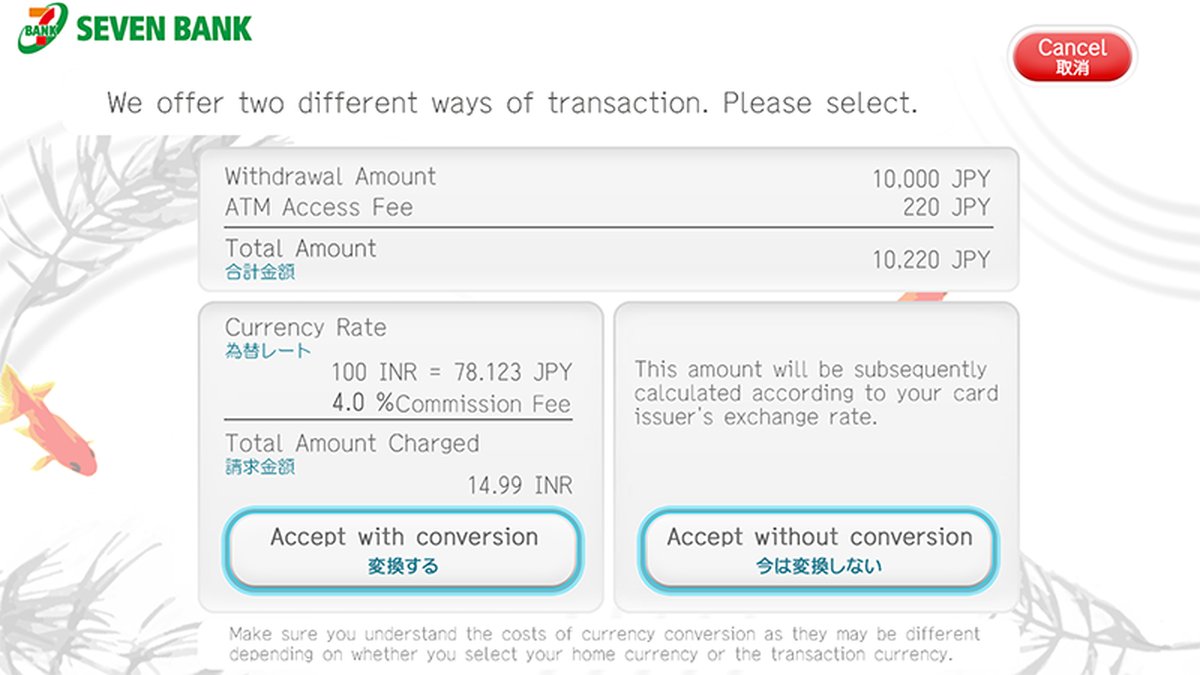
When you withdraw cash or pay by card in Japan, the screen may ask: “Pay in Hong Kong dollars (or Taiwan dollars, yuan, Singapore dollars, ringgit)?” This is called dynamic currency conversion (DCC), and the better answer is to choose yen.
- Seven Bank explains that if you choose your home currency, the home-currency amount is fixed at the time of withdrawal. If you choose yen, the transaction is first settled in yen and the home-currency amount is fixed later, when the charge is billed.
- Visa rules require shops and ATMs to let the cardholder choose. They cannot decide for you.
Zagdim recommends that when the screen asks, you choose yen (JPY), and let your card issuer convert when the charge is billed. Before choosing your home currency, read the exchange rate and fee shown on the screen and compare them with your card issuer’s terms.
Transport Cards, Paying for Trains by Card, Alipay and WeChat Pay
Visitors can use a Welcome Suica or TOURIST PASMO, tap a contactless card at Tokyo Metro gates, or pay with Alipay+ and WeChat Pay at FamilyMart and 7-Eleven.
- Physical Welcome Suica (the visitor version of Suica): valid for 28 days including the day of purchase, with no deposit at purchase. It can only be topped up with yen cash (the mobile version follows different rules), has a balance cap of 20,000 yen, and the remaining balance generally cannot be refunded. An ordinary Suica requires a 500 yen deposit at purchase.
- Anonymous Suica and PASMO: JR East, PASMO and other operators have announced that sales resumed on 1 March 2025 (availability at each station depends on stock).
- TOURIST PASMO: no deposit, valid for 28 days from the day of issue (including that day).
- Paying for trains by contactless card: Tokyo Metro accepts physical Visa, Mastercard, JCB, American Express, Diners Club, Discover and UnionPay cards by tapping at the gate across the whole network. However, you cannot enter at Nakano Station on the Tozai Line, and you cannot transfer directly to JR East. This is not available across Japan, so check other regions separately.
- Alipay and WeChat Pay: FamilyMart’s website confirms Alipay+ and WeChat Pay can be used in its stores. Tell the staff your payment method at checkout and show the app’s barcode. 7-Eleven’s payment list also names WeChat Pay and Alipay+. A shop accepting these does not mean accounts registered in every region can pay, so Zagdim recommends checking the overseas payment function in the app before you leave.
The New Tax Refund System From November 2026: Pay the Tax-Inclusive Price, Get It Back on Departure
Japan’s National Tax Agency has announced that tax-free shopping changes to a refund method (refund-type system) from 1 November 2026. The old and new systems are separated by the date the goods are sold (delivered), not the departure date; for special cases such as purchases across midnight, follow the shop’s explanation. The new system changes the refund procedure. Tax-free treatment is still for eligible “non-residents,” such as visitors who enter on a short stay.
| Item | Bought on or before 31 October 2026 | Bought from 1 November 2026 |
|---|---|---|
| What you pay in the shop | The tax-free price | The tax-inclusive price, refunded afterward |
| Minimum purchase | 5,000 yen or more before tax at one shop on one day (general goods and consumables counted separately) | 5,000 yen or more before tax at one shop on one day (no longer split by category) |
| Consumables cap and special packaging | Cap of 500,000 yen, special packaging required | Abolished |
| Key to the refund | Not applicable | Leave Japan within 90 days of purchase, with customs confirmation before checking in luggage |
Three things to remember under the new system:
- Paying the tax-inclusive price at the register is normal. Japan’s standard consumption tax rate is 10%, and 8% for food (alcohol and dining in do not qualify for 8%). Zagdim recommends keeping the receipt and asking how the refund will be paid.
- Complete the customs confirmation before checking in luggage. Once luggage is checked in, confirmation is no longer possible and you will not get the tax back.
- If one item from a purchase is missing, the whole purchase loses tax-free status. On departure, all the goods in the same purchase record must be with you.
The refund method depends on the shop. The National Tax Agency lists possible methods including bank transfer, credit card refund, app transfer, or cash collected after confirmation at the port of departure. The refund may be handled by the tax-free shop itself or by a refund operator it appoints. For the full process, who qualifies and what to do at the airport, see Zagdim’s separate guide, “How Do Foreign Visitors Claim Tax Refunds on Shopping in Japan? The Process, Who Qualifies and Notes After the November 2026 Change.”
Cash Declaration When Entering Japan
Japan Customs rules: if you carry cash and similar payment instruments worth more than 1 million yen in total into or out of Japan, you must submit a “Declaration Form for Carrying Payment Means, etc. (支払手段等の携帯輸出・輸入申告書).” Gold bullion (90% purity or higher) over 1 kilogram must also be declared.
- The total includes yen and foreign currency cash, cheques (including traveller’s cheques), promissory notes, and securities such as stocks and government bonds.
- Foreign currency is converted to yen using the rate published on the Customs website.
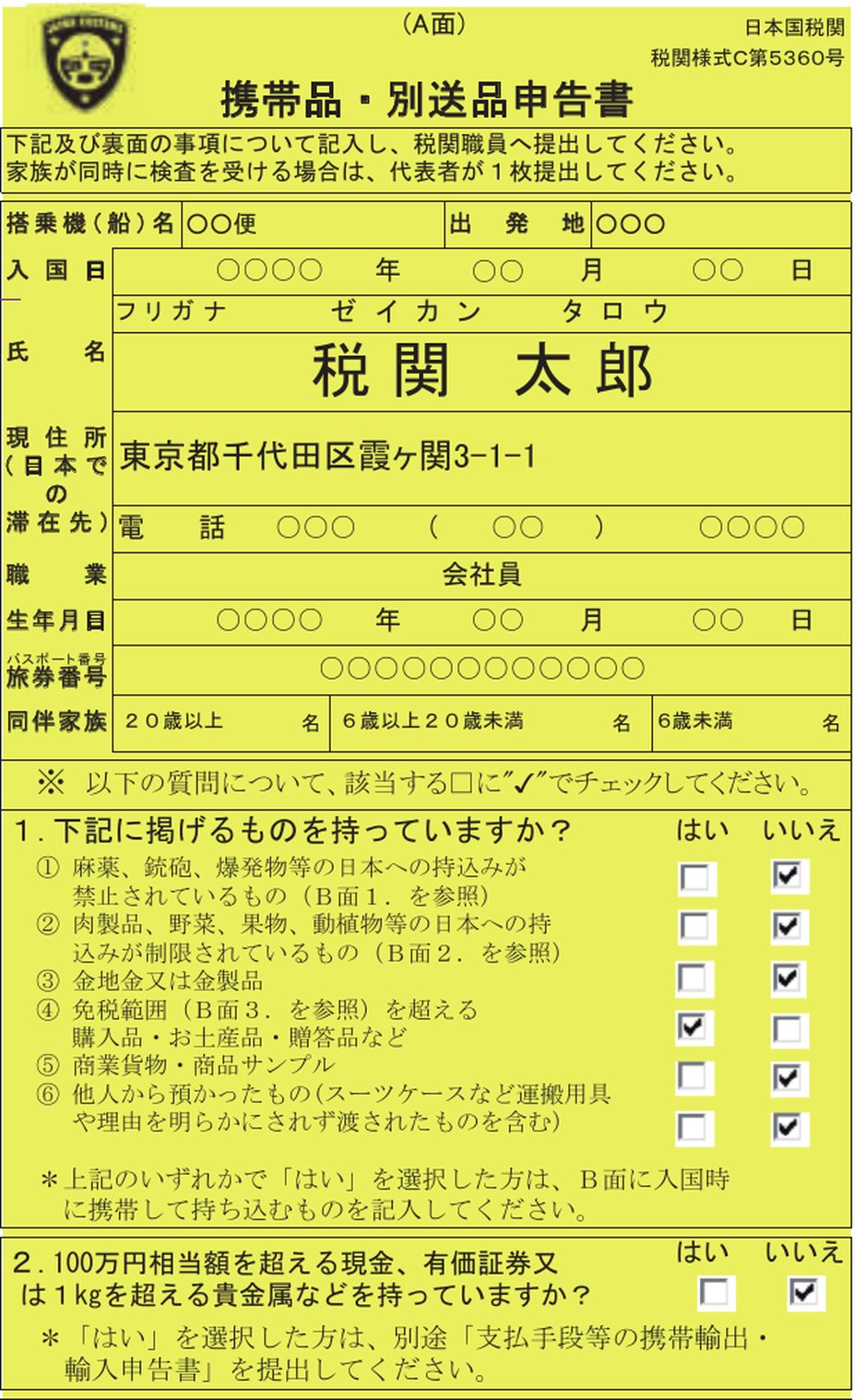
- If you tick “Yes” to the cash question on the “Declaration of Baggage and Unaccompanied Articles” form on arrival, you must still submit the separate payment means declaration. The two forms do not replace each other.
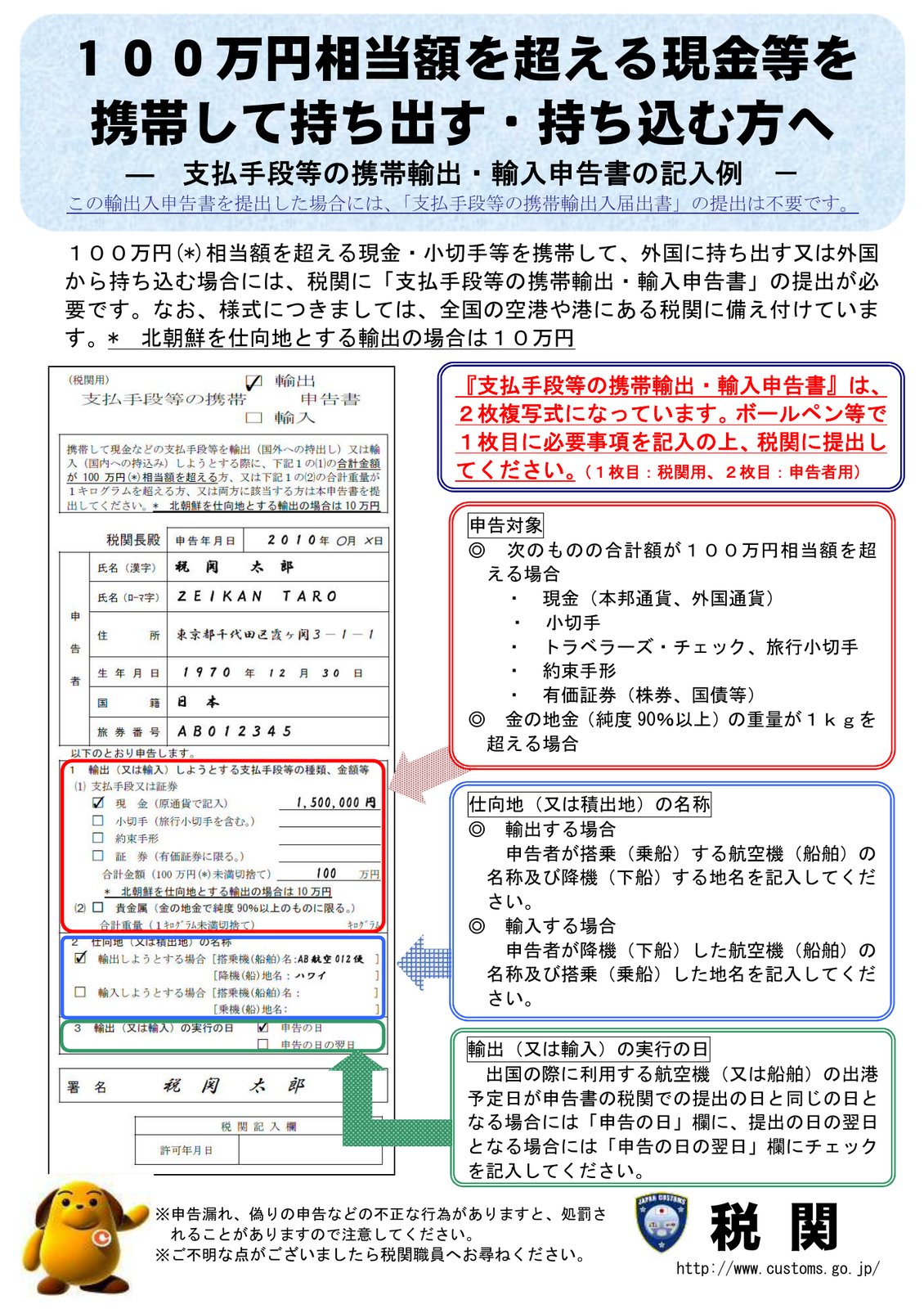
For a large sum such as rent, tuition or a property purchase, Zagdim recommends a bank transfer rather than carrying cash, as it is safer. If you do carry it, declare it.
Pre-Departure Checklist
Zagdim recommends seven steps before you leave:
- Call your card issuer: enable overseas card payments and withdrawals, and ask about fees and daily limits.
- Bring two cards on different networks and keep them separately.
- Exchange some yen cash before you leave, and compare rates first.
- When card payments or withdrawals offer a currency choice, choose yen (JPY).
- If you plan to buy a physical Welcome Suica, keep some yen cash for topping it up.
- For tax-free goods bought from 1 November: keep the receipt, ask how the refund will be paid, and complete the customs confirmation before checking in luggage.
- If you carry cash and similar instruments worth more than 1 million yen in total, declare them.
Summary: Exchange Right, Pay Right, Claim Right
Saving money in Japan comes down to three things: exchange only part of your money as cash, choose yen when paying or withdrawing by card, and for tax-free goods bought from November, complete the customs confirmation before checking in luggage. Yen you exchange but do not spend costs you two spreads when you convert it back on the way home. Choosing the wrong currency can add cost to every payment. And without the customs confirmation, the consumption tax on tax-free goods (10% standard, 8% for food) cannot be recovered.
What you save is enough for another yakiniku dinner or one more onsen visit.
FAQ
How much yen cash should I take to Japan?
There is no standard amount. Japan’s cashless payment ratio was 58.0% in 2025, so more than half of spending by value no longer uses cash, but small shops, temples, regional transport and topping up a physical Welcome Suica still need cash. Zagdim recommends exchanging part of your money first and topping up at an ATM if you need more.
Which ATMs in Japan accept overseas cards?
Seven Bank (inside 7-Eleven stores), Japan Post Bank (post offices) and AEON Bank all accept overseas-issued cards. Seven Bank allows up to 100,000 yen per withdrawal (30,000 yen for magnetic stripe transactions), with fees varying by card brand. Japan Post Bank and AEON allow 50,000 yen per withdrawal. AEON has announced that from 16 December 2026 it will charge 880 yen per withdrawal on overseas Visa, Mastercard and UnionPay cards.
Can I exchange Hong Kong dollars, Taiwan dollars or Chinese yuan for yen in Japan?
Yes, but you need to go to the right place. Travelex Japan’s purchase list names Hong Kong dollars, Taiwan dollars, Chinese yuan, Singapore dollars and ringgit. Daikokuya’s Yurakucho branch accepts Chinese yuan, Hong Kong dollars, Taiwan dollars and Singapore dollars. Some SMART EXCHANGE automatic machines also accept all five. Accepted currencies differ by shop, so check before you go.
Should I pay in yen or my home currency when using a card in Japan?
Choose yen (JPY). Choosing your home currency is dynamic currency conversion (DCC), which fixes the home-currency amount immediately. If you choose yen, the transaction is settled in yen first and your card issuer converts when it bills you. Visa rules require shops and ATMs to let you choose.
Can I still get a tax refund on purchases in Japan after November?
Yes, but the process has changed. For goods bought from 1 November 2026, you pay the tax-inclusive price at the tax-free shop, leave Japan within 90 days of purchase, and have customs confirm the goods before you check in luggage. In principle, the consumption tax is then refunded by the shop or a refund operator. Timing and method differ by shop.
How much cash must I declare when travelling to Japan?
If you carry cash and similar payment instruments worth more than 1 million yen in total, you must submit the “Declaration Form for Carrying Payment Means, etc.” to customs on both entry and exit.
Important Notice
This article is general information and does not constitute financial, tax or legal advice. It draws on Japan Customs, the National Tax Agency, the Japan Tourism Agency, METI, and the websites of airports, banks, exchange operators, and transport and payment providers, as checked on 29 October 2026. Exchange rates, ATM fees, exchange shop accepted currencies and the refund process change, so rely on the latest announcements from each institution and your card issuer. The converted amounts in the tables are mid-market reference figures and do not include any exchange spread or fees.
Have a question about this guide? Leave a comment below, or ask Zagdim directly.
Your first stop for international property and global living.
Research and insights. Know what’s changing. Understand what matters.
Sources
Japan Customs – Procedures for carrying payment means, etc. in and out of Japan (支払手段等の携帯輸出入の手続): https://www.customs.go.jp/kaigairyoko/shiharaishudan.htm
Japan Customs – Example of completing the “Declaration of Baggage and Unaccompanied Articles” (「携帯品・別送品申告書」の記入例): https://www.customs.go.jp/zeikan/pamphlet/tsukan.pdf
Narita International Airport – Banks and exchange counters: https://www.narita-airport.jp/ja/service/exchange/currency/
Haneda Airport Passenger Terminal – Foreign currency exchange: https://tokyo-haneda.com/service/facilities/exchange.html
Kansai Airport – Foreign currency exchange: https://www.kansai-airport.or.jp/service/money_insurance/currency-exchange
Travelex Japan – List of handled currencies: https://www.travelex.co.jp/product-services/countries-list
Daikokuya – Store information: https://gaika.e-daikoku.com/shop_list/
Daikokuya – Foreign currency exchange service: https://gaika.e-daikoku.com/
SMART EXCHANGE – Sugi Drug Shimbashi Ekimae store: https://map.smartexchange.jp/detail/p0539/
SMART EXCHANGE – Automatic foreign currency exchange machines: https://smartexchange.jp/
Sumitomo Mitsui Banking Corporation – Where can I exchange foreign currency?: https://qa.smbc.co.jp/faq/show/1938?site_domain=default
Seven Bank – Overseas-issued cards usable at ATMs: https://www.sevenbank.co.jp/intlcard/card.html
Seven Bank – How to use ATMs with overseas-issued cards: https://www.sevenbank.co.jp/intlcard/service.html
Japan Post Bank – International ATM Service: https://www.jp-bank.japanpost.jp/kojin/access/atm/kj_acs_atm_ias.html
AEON Bank – FAQ: ATMs: https://www.aeonbank.co.jp/atm/en/page04/
AEON Bank – Cash cards and credit cards issued overseas: https://www.aeonbank.co.jp/atm/en/page02/
Ministry of Economy, Trade and Industry (METI) – Calculation of the 2025 cashless payment ratio (2025年のキャッシュレス決済比率を算出しました): https://www.meti.go.jp/press/2025/03/20260331006/20260331006.html
METI – Cashless Promotion Study Group summary (キャッシュレス推進検討会 とりまとめ(概要)): https://www.meti.go.jp/shingikai/mono_info_service/cashless_promotion/pdf/20251226_1.pdf
METI – Calculation of the 2024 cashless payment ratio (2024年のキャッシュレス決済比率を算出しました): https://www.meti.go.jp/press/2024/03/20250331005/20250331005.html
PASMO Association – Notice on resuming sales of anonymous Suica and PASMO cards (無記名の「Suica」・「PASMO」カード発売の再開に関するお知らせ): https://www.pasmo.co.jp/pressrelease/pdf/20250218_resumption_of_blank_Suica_and_PASMO_card_sales.pdf
JR East – FAQ: Suica/Welcome Suica: https://www.jreast.co.jp/multi/faq/
JR East – Welcome Suica purchase and use: https://www.jreast.co.jp/multi/welcomesuica/purchase.html
PASMO – Using TOURIST PASMO: https://www.pasmo.co.jp/tc/tourist-pasmo/
Tokyo Metro – Tap-to-ride with credit cards (後払い乗車サービス(クレカ乗車)): https://www.tokyometro.jp/ticket/types/tap-to-ride/index.html
FamilyMart – Barcode payments (Alipay+ and WeChat Pay): https://www.family.co.jp/services/payment/sp_barcode_other.html
Seven-Eleven Japan – Available payment methods (ご利用可能なお支払方法): https://www.sej.co.jp/services/cash.html
Japan Tourism Agency – What is the consumption tax exemption system (system before October 2026): https://www.mlit.go.jp/kankocho/tax-free/page01_000109.html
National Tax Agency – Review of the export goods sales site system to the refund method: https://www.nta.go.jp/publication/pamph/shohi/menzei/201805/format/002.htm
Japan Tourism Agency – What is the refund method (リファンド方式とは): https://www.mlit.go.jp/kankocho/tax-free/page01_000001_00019.html
National Tax Agency – Q&A on the export goods sales site system (refund method, overview): https://www.nta.go.jp/publication/pamph/shohi/menzei/201805/pdf/0025012-025_02.pdf
Japan Tourism Agency – Procedural changes (comparison table): https://www.mlit.go.jp/kankocho/tax-free/content/001977883.pdf
National Tax Agency – No. 6303 Consumption tax and local consumption tax rates: https://www.nta.go.jp/taxes/shiraberu/taxanswer/shohi/6303.htm
Visa – Dynamic currency conversion: https://www.visa.com/en-us/personal/travel/dynamic-currency-conversion
European Central Bank – Euro foreign exchange reference rates (2026-10-28): https://www.ecb.europa.eu/stats/policy_and_exchange_rates/euro_reference_exchange_rates/html/index.en.html
Taiwan Futures Exchange – Daily foreign currency reference rates (2026-10-27): https://www.taifex.com.tw/cht/3/dailyFXRate