
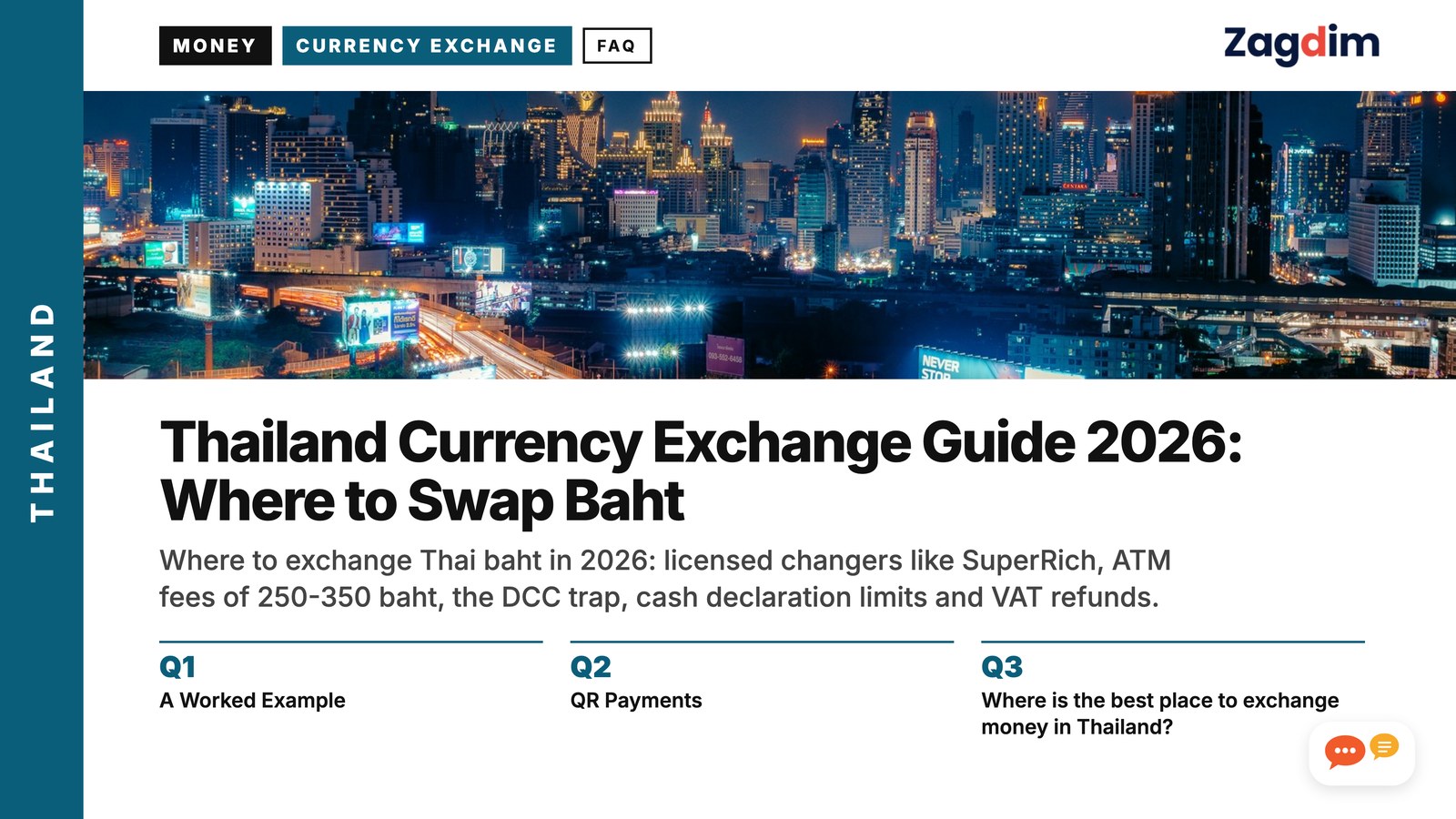
Cash still matters in Thailand: street food, massages, tuk-tuks and night markets often prefer it. Exchange baht in the wrong place or withdraw it the wrong way and your travel budget quietly shrinks. The most common example is the ATM. The published fee schedules of Kasikornbank, SCB and Krungsri state that foreign cards pay 250 to 350 baht per withdrawal, so the more small withdrawals you make, the more you pay.
The short answer: in Thailand, the most transparent approach is to bring cash (Hong Kong dollars, Chinese yuan, Singapore dollars, Malaysian ringgit or US dollars) to a licensed exchange shop such as SuperRich, where rates are posted openly and no commission is charged. Use ATMs only to top up, withdraw once for the full amount, and whenever a screen asks which currency to charge, choose Thai baht (THB).
This guide answers:
- Where is the best place to exchange Thai baht: the airport, city exchange shops or bank counters?
- Which currency should you bring if you are travelling from Hong Kong, Taiwan, mainland China, Singapore or Malaysia?
- What do Thai ATMs charge, and how do card and QR payments work?
- How much cash must you declare on arrival, and how does the tourist VAT refund work?
Key Points
- Who should pay attention: travellers visiting Thailand for tourism, family visits, property viewing or a long-stay visa, whether you hold a Hong Kong, Taiwan, mainland China, Singapore or Malaysia passport or travel from those places, and people who have just moved to Thailand and do not yet have a local account.
- ATM fees: the fee schedules of Kasikornbank (listed under international credit cards), SCB and Krungsri state 250 baht per withdrawal for Visa and UnionPay cards and 350 baht for Mastercard. This does not include any fee your own card issuer adds.
- Exchange shops: Super Rich Thailand and SuperRich1965 both state they charge no fee or commission. Their rate tables list Hong Kong dollars, Taiwan dollars, Chinese yuan, Singapore dollars and ringgit. ID requirements differ by shop (see below).
- Where people overpay: when a card terminal or ATM offers to charge you in your home currency (dynamic currency conversion, DCC). Choose baht.
- Cash declaration: foreign currency cash worth more than US$15,000, or Thai baht, foreign currency and instruments combined worth more than 450,000 baht, must be declared to customs.
- VAT refund: buy at least 2,000 baht (VAT included) from one shop on one day, take the goods out of Thailand within 60 days, and claim at the airport.
Where to Exchange Baht: Safe and Transparent Options
Large licensed exchange shops are the most transparent place to swap baht, and three rules apply: licensed, posted rate, receipt. The Bank of Thailand requires foreign currency to be bought and sold through operators holding a Ministry of Finance exchange licence. Exchange shops must display the licence, the licence number and the day’s buy and sell rates for each currency in a prominent place.
Best Option: Large Licensed Exchange Shops
These shops post daily buy and sell rates and charge no separate fee, so the spread between buy and sell is your cost and is easy to compare. Several operators have official websites that give fairly complete information.
Super Rich Thailand
Super Rich Thailand states that it charges no commission or fee, and its main branch is in central Bangkok.
- The main branch is on Rajdamri Road in Bangkok (45 Rajdamri 1). The website also lists branches in shopping malls such as The Mall Thapra and The Mall Bangkapi.
- The main branch rate table lists buy and sell rates for Hong Kong dollars, Taiwan dollars, Chinese yuan, Singapore dollars and ringgit.
- Its FAQ states that no commission or fee is charged. You must bring unexpired ID or a passport, and coins are not exchanged.
SuperRich1965
SuperRich1965 states that it charges no fee or commission on cash exchange, and it is a different company from Super Rich Thailand.
- This is a different company from Super Rich Thailand (the websites are superrichthailand.com and superrich1965.com), so do not go by the signboard name alone.
- Branches include CentralWorld, MBK Center and ICONSIAM. There are also branches at Suvarnabhumi Airport on level B (basement) and inside the Airport Rail Link ticketing area, open 05:00 to 00:00.
- The rate table lists Hong Kong dollars, Taiwan dollars, Chinese yuan, Singapore dollars and ringgit. Its FAQ states that no fee or commission is charged on cash exchange, and you must bring an original, unexpired ID or passport.
Vasu Exchange and Siam Exchange
Vasu Exchange and Siam Exchange both list Hong Kong dollars, Taiwan dollars, Chinese yuan, Singapore dollars and ringgit in their rate tables, but you should check the day’s rate before you go.
- Both websites list Hong Kong dollars, Taiwan dollars, Chinese yuan, Singapore dollars and ringgit in their rate tables. The rate table on the Vasu website is dated May 2024, so it is not a current rate.
- Vasu’s website says to bring a passport copy. Check the branch location and the day’s rate before you go.
Tips for getting more baht
Four habits get you more baht: use large US dollar notes, check rates, count your money and confirm the operator is licensed.
- Use large US dollar notes. On SuperRich1965’s rate screen on 28 October 2026, 50 to 100 dollar bills were bought at 33.63 baht per US dollar, while 1 to 2 dollar bills were only 33.05. Siam Exchange’s 27 October rates also favored large notes.
- Check rates before you go. Each shop publishes its rate table online, and Zagdim recommends comparing before leaving home, then confirming at the counter.
- Count your money and take a receipt. Zagdim recommends confirming the amount before you leave the counter.
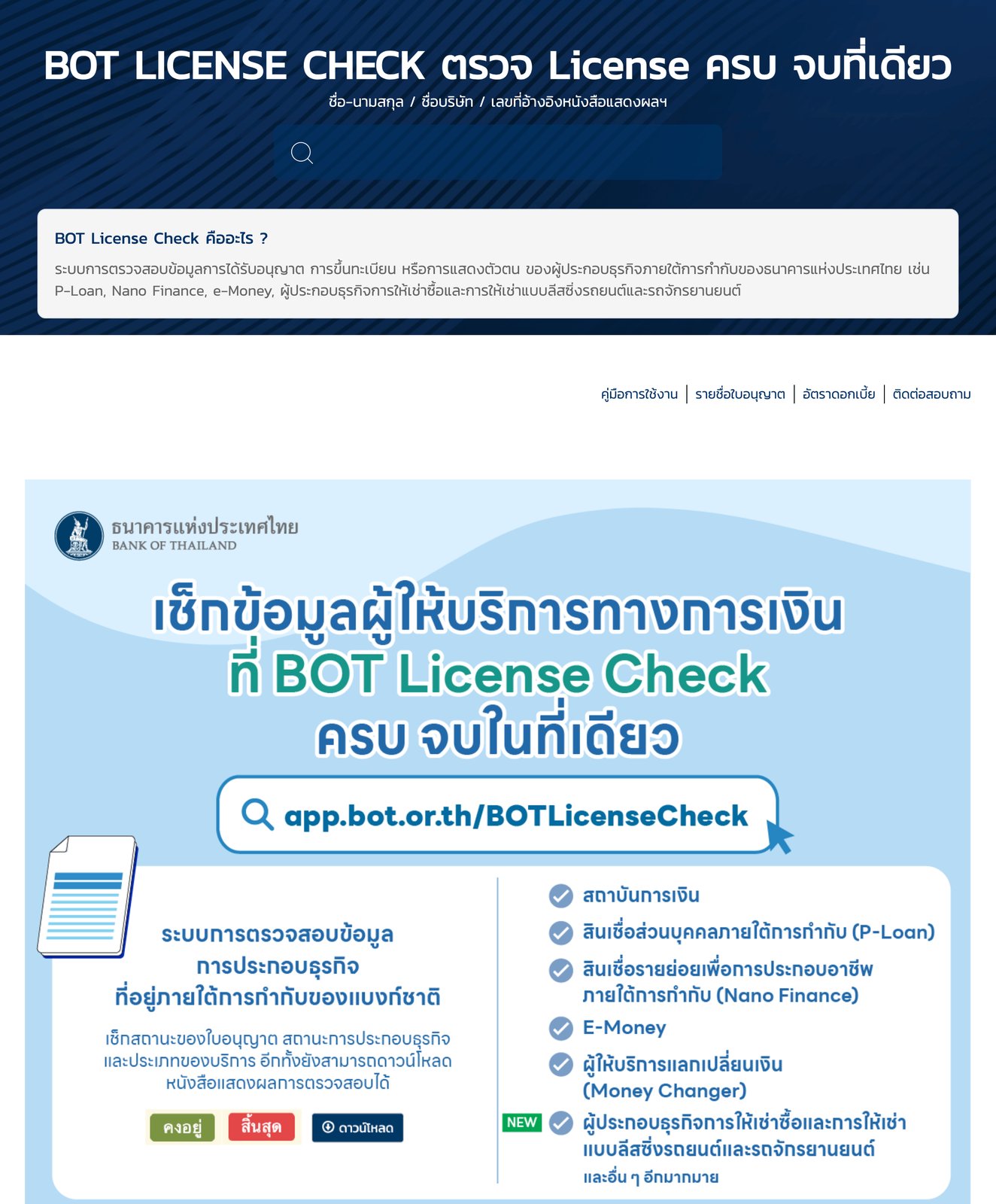
- Confirm the operator is legitimate. On the Bank of Thailand’s BOT License Check, look for the license type Money Changer and a status of active. The official manual says to search by the company’s Thai name (only a few foreign institutions can be found by English name), so ask the shop for its full Thai company name first.
Airports: Exchange a Small Amount on Arrival
Both Bangkok airports have exchange counters, but exchange only a small amount there.
- Suvarnabhumi Airport: Airports of Thailand (AOT) lists a Kasikornbank exchange counter at Gate 5 of the public arrivals area on level 2 of the main terminal. SuperRich1965’s website lists a branch in the basement-level Airport Rail Link ticketing area.
- Don Mueang Airport: AOT lists a Bangkok Bank exchange counter in the public departures area on level 3 of Terminal 1.
Zagdim recommends exchanging only a small amount on arrival, enough for the ride into town and a first meal. Airport counters are convenient, but rates are not always the same as in the city, so save larger sums for a city exchange shop or the basement-level shop where you can compare rates.
Middle Option: ATM Withdrawals, Taken in One Go
Thai ATMs are easy to find, but foreign cards pay 250 to 350 baht per withdrawal, so take everything you need in one go:
| Bank | Visa, UnionPay (per withdrawal) | Mastercard (per withdrawal) | Limit per withdrawal | Fee schedule effective |
|---|---|---|---|---|
| Kasikornbank | 250 baht | 350 baht | 30,000 baht | 22 September 2026 |
| SCB | 250 baht (same for JCB) | 350 baht | Not stated | 1 September 2026 |
| Krungsri | 250 baht (same for JCB) | 350 baht | 30,000 baht | 11 March 2026 |
| Bangkok Bank | As shown on the machine | As shown on the machine | 25,000 baht on specified machines | Not stated |
Note: Kasikornbank lists its fee under the “International credit cards” column. SCB and Krungsri classify fees by foreign card issuer.
Reminders:
- These are the Thai bank’s fees. Your own card issuer may add an overseas withdrawal fee and a foreign transaction fee, and a credit card withdrawal may be treated as a cash advance. Zagdim recommends asking your issuer before you leave.
- One large withdrawal beats several small ones. The fee is charged per transaction, not per amount.
- The per-withdrawal limit is not a daily limit. How much you can take out per day depends on your card issuer’s settings.
Strongly Discouraged: Unlicensed Shops and Private Swaps
Do not use any exchange point that shows no licence, posts no rate and issues no receipt, even if its quoted rate looks high. A rate that is too good to be true is a warning sign.
Summary: Choose Well and Exchange With Confidence
A large licensed exchange shop is the best method, ATMs and airport counters come next, and unlicensed shops should be avoided.
| Method | Cost | Safety | Recommendation |
|---|---|---|---|
| ✅ Large licensed exchange shop (SuperRich and others) | Buy/sell spread only, no fee | High | ⭐⭐⭐⭐⭐ |
| 🏧 ATM withdrawal | 250 to 350 baht per withdrawal plus card issuer fees | High | ⭐⭐⭐ |
| ✈️ Airport bank counter | Compare rates first | High | ⭐⭐ (small amounts only) |
| ❌ Unlicensed shop or private swap | Not transparent | Low | 🚫 Not recommended |
Which Currency to Bring: Travelling From Five Places
Bring cash in your own currency to a licensed exchange shop, and for US dollars bring large notes. The figures below use the European Central Bank reference rates of 28 October 2026 (Taiwan dollars use the Taiwan Futures Exchange US dollar/Taiwan dollar reference rate of 27 October 2026). These are mid-market rates. Actual exchanges always cost a little more, so treat the table as a rough guide only.
| Travelling from | Approx. cost of 1,000 baht (mid-market) | Suggested approach |
|---|---|---|
| 🇭🇰 Hong Kong | About HK$232 | Bring Hong Kong dollar cash to an exchange shop such as SuperRich. Participating apps can scan Thai PromptPay QR codes through FPS. |
| 🇹🇼 Taiwan | About NT$961 | Exchange shops also accept Taiwan dollars. Before you leave, compare exchanging into baht in Taiwan with exchanging into US dollars and then into baht in Thailand. |
| 🇨🇳 Mainland China | About ¥197 (yuan) | Bring yuan cash to an exchange shop. Alipay, WeChat Pay and UnionPay can scan the Thai QR provided by participating banks to Thai merchants. |
| 🇸🇬 Singapore | About S$38 | Bring Singapore dollar cash to an exchange shop. Merchant QR payments run through the PromptPay-NETS link. |
| 🇲🇾 Malaysia | About RM121 | Bring ringgit cash to an exchange shop. Participating apps can scan the QR of participating Thai merchants through the DuitNow link. |
| 🇺🇸 US dollars | About US$30 | Bring 50 and 100 dollar notes, which are bought at a higher rate than small notes. |
Always compare rates from the same shop at the same time. Exchange shops take Hong Kong dollars, Taiwan dollars, Chinese yuan, Singapore dollars and ringgit alike. What matters is whether you end up with more baht by exchanging your own currency at the shop or by buying baht before you leave.
Paying by Card or QR Code in Thailand
Cards and QR codes work in Thailand if you decline the home-currency option and check which QR links your own app supports.
The Big Card and ATM Trap: “Pay in Your Home Currency?”
The trap is being offered your home currency at the point of payment, and the better answer is Thai baht. When you pay by card or withdraw cash in Thailand, the machine may ask: “Pay in Hong Kong dollars (or Taiwan dollars, yuan, Singapore dollars, ringgit)?” This is called dynamic currency conversion (DCC).
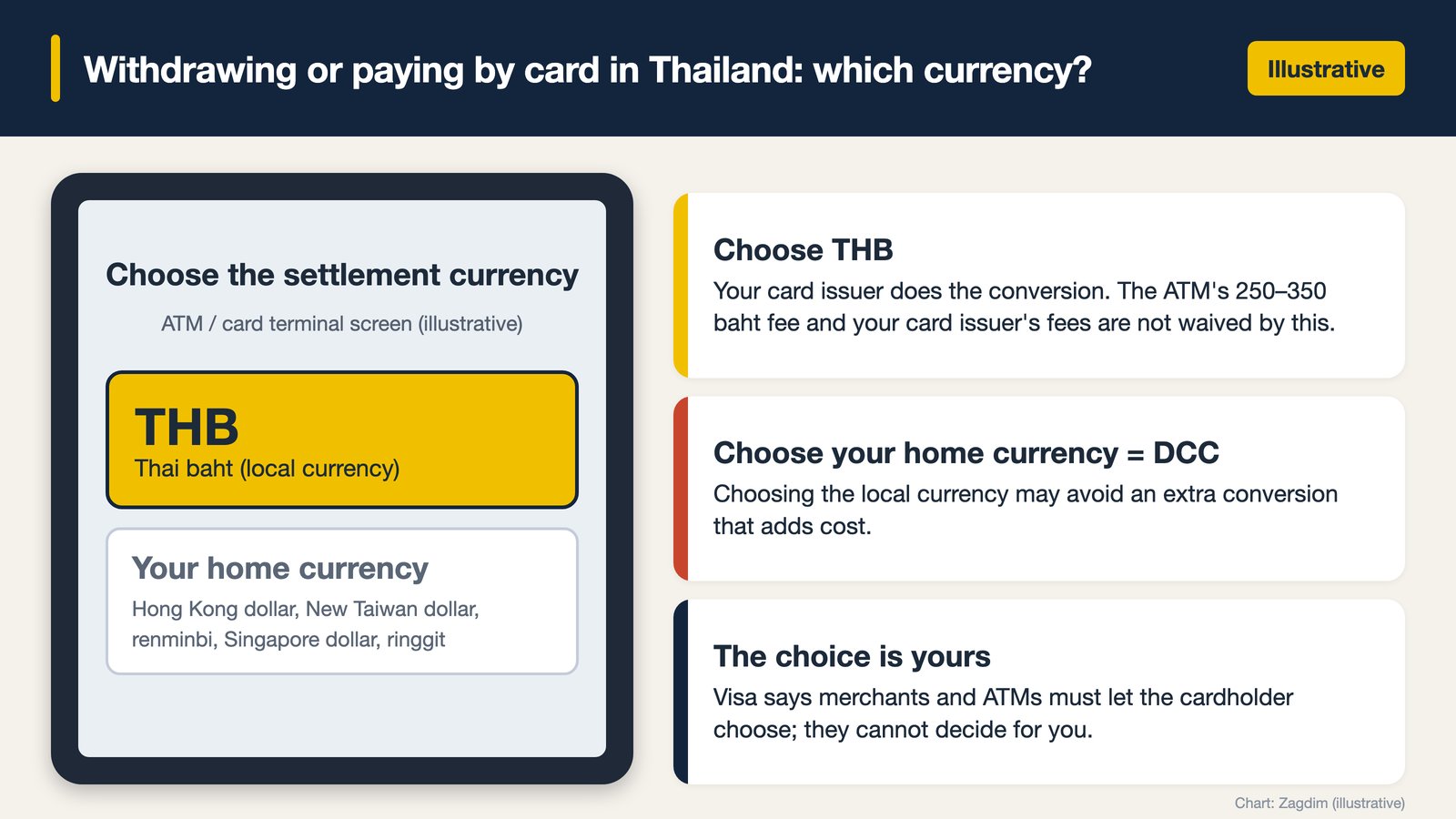
- Visa states that merchants and ATMs must let the cardholder choose whether to accept or decline the currency conversion. They cannot decide for you.
- Mastercard’s Cash Passport help page says that paying in the local currency may avoid an extra currency conversion that adds cost.
Zagdim recommends that when the screen asks, you choose Thai baht (THB). Note that declining DCC does not remove the ATM’s 250 to 350 baht fee, nor your card issuer’s own fees.
QR Payments: Which Wallets Work in Thailand?
Wallet support depends on where you travel from: the Bank of Thailand lists QR links for Hong Kong, mainland China, Malaysia and Singapore, but not Taiwan. PromptPay and Thai QR are widely used in Thailand. The traveller QR payment links published by the Bank of Thailand include:
- Hong Kong: a joint announcement by the Bank of Thailand and the Hong Kong Monetary Authority says travellers from Hong Kong can pay by scanning a Thai merchant’s PromptPay QR code through the Faster Payment System (FPS), using participating mobile payment apps.
- Mainland China: the Bank of Thailand announced that from 30 October 2025, users in China can pay with Alipay, UnionPay or WeChat Pay by scanning the Thai QR that participating banks provide to Thai merchants.
- Malaysia: PromptPay is linked with DuitNow, so Malaysian travellers can scan the QR of participating merchants.
- Singapore: merchant QR payments run through the PromptPay-NETS link. PromptPay-PayNow is a separate link for instant transfers between the two places using mobile numbers.
- Taiwan: Taiwan is not among the links the Bank of Thailand lists. Whether an individual app works in Thailand depends on that app’s own instructions.
A merchant being able to accept a QR code does not mean every bank or wallet has joined. Zagdim recommends checking your app for overseas payment features and fees before you leave.
Tourist E-Wallet
The tourist e-wallet is a standard the Bank of Thailand published in July 2025 for foreign visitors. In July 2025 the Bank of Thailand published a standard for foreign tourist e-wallets. Identity is verified with an NFC passport and biometrics. You can deposit cash at the provider’s counter, or link a debit or credit card to top up. Scanning a regular merchant QR is capped at 500,000 baht per month, and scanning a small merchant’s personal QR is capped at 50,000 baht per month. Cash can only be withdrawn when the account is closed, and the amount cannot exceed the total previously topped up in cash. This is a standard, so actual products and top-up methods depend on each provider.
Cash Declaration When Entering Thailand
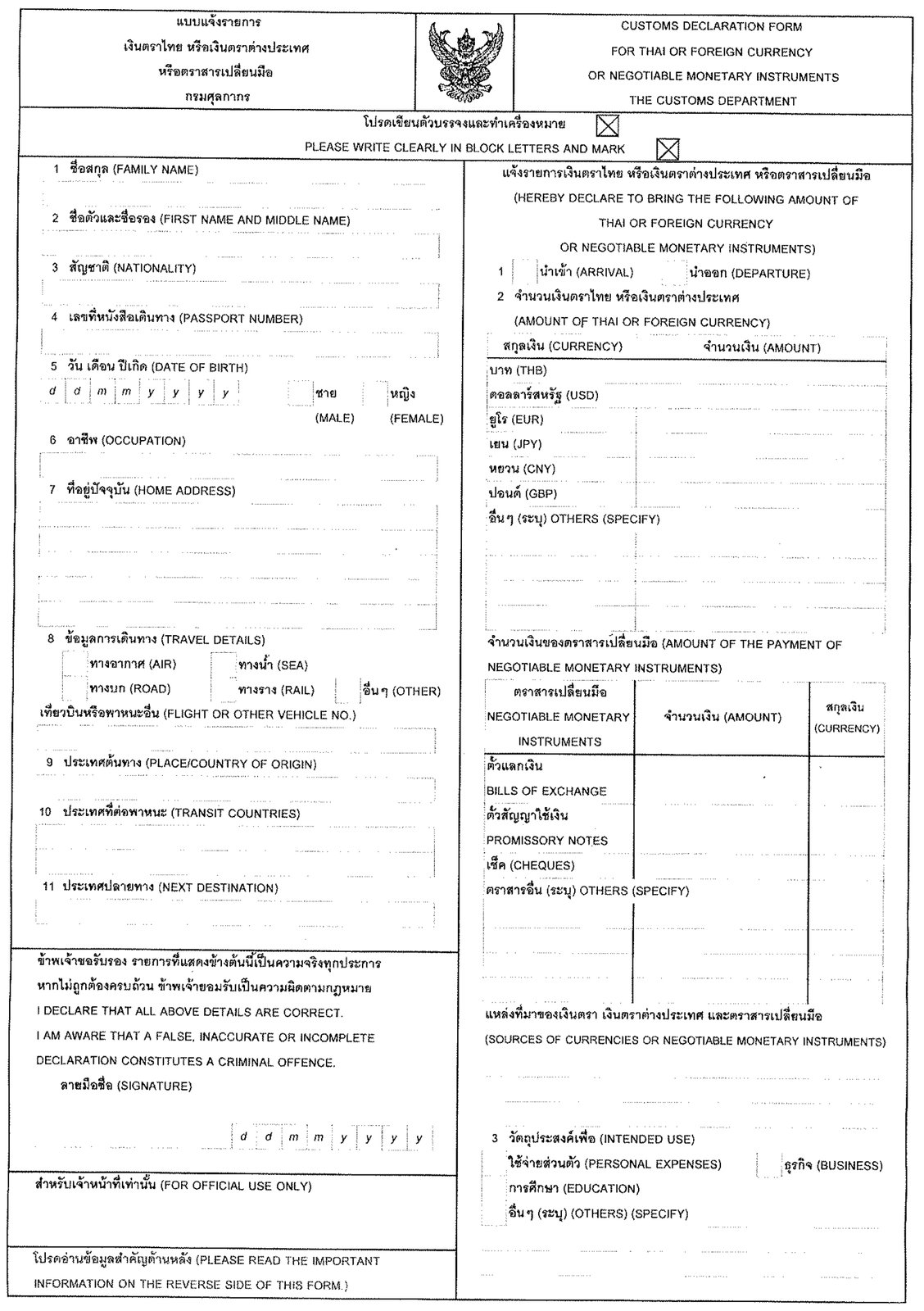
You must declare foreign currency cash worth more than US$15,000, or baht, foreign currency and instruments combined worth more than 450,000 baht, to customs. The rules below are based on the Bank of Thailand and the Thai customs declaration form:
| Situation | Rule |
|---|---|
| Bringing foreign currency cash or Thai baht cash into Thailand | No upper limit, but amounts over the thresholds must be declared |
| Foreign currency cash worth more than US$15,000 | Declare to customs on both entry and exit |
| Thai baht cash over 450,000 baht, or Thai baht, foreign currency and instruments combined worth over 450,000 baht | Must be declared |
| Taking Thai baht cash to Hong Kong, Taiwan, Singapore and similar places | Limit of 50,000 baht; above that you need permission from the Bank of Thailand |
| Taking Thai baht cash to Laos, Cambodia, Myanmar, Malaysia, Vietnam or Yunnan Province, China | Limit of 2,000,000 baht; above that you need permission |
| Taking foreign currency cash out of Thailand | Limited to the amount bought from a licensed bank or exchange operator |
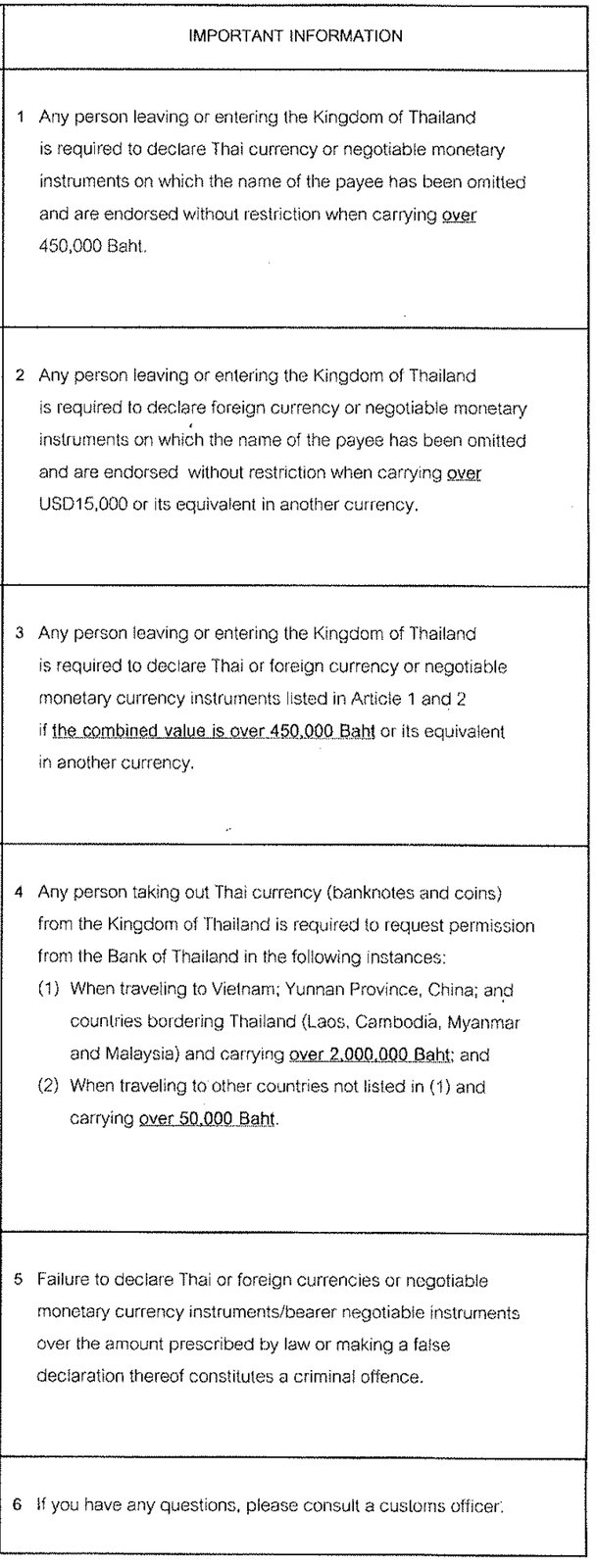
The customs form asks for your passport number, travel details, currency, amount, source of funds and intended use. The form itself states that failing to declare amounts over the thresholds, or making a false declaration, is a criminal offence. For a large sum such as a property payment or long-stay visa deposit, Zagdim recommends a bank transfer rather than carrying cash, as it is safer.
How the Thai Tourist VAT Refund Works
Foreign visitors can claim a VAT refund by spending at least 2,000 baht in one shop on one day and taking the goods out of Thailand within 60 days. Thailand’s value added tax (VAT) is currently 7% (the Thai Revenue Department states the 7% rate, including local tax, is maintained until 30 September 2027). Foreign visitors who shop at stores displaying the “VAT REFUND FOR TOURISTS” sign can apply for a refund:
- Threshold: spend at least 2,000 baht (VAT included) in one shop on one day.
- On the day of purchase: show your passport, ask the shop to issue a P.P.10 tourist refund application form, and keep the original tax invoice.
- Deadline: take the goods out of Thailand with you within 60 days of purchase.
- Customs inspection: if the total value of refundable goods reaches 20,000 baht, present the goods, the P.P.10 form and the original invoice to customs before you check in. Jewelry, gold items and watches worth 40,000 baht or more per item, or other hand-carried goods worth 100,000 baht or more per item, must be shown again at the refund counter after passport control.
- Getting the money: apply at the VAT refund counter at an international airport (you can also mail the documents to the Revenue Department). Refunds up to 30,000 baht can be taken as Thai baht cash or through Alipay or WeChat Pay. Refunds over 30,000 baht can only go to a Visa, Mastercard, Diners or JCB credit card.
Notes:
- You do not get the full 7% back. The Revenue Department’s refund table already deducts the processing fee. Under the refund table applying from 1 September 2013, a single P.P.10 amount of 2,000 to 2,499.99 baht has a listed refund of 80 baht.
- Services such as hotels and restaurants are not refundable, nor are goods already used in Thailand.
- People who live or stay in Thailand for more than 180 days are not eligible for the tourist refund.
A Worked Example: How Much Can You Save?
Withdrawing 20,000 baht in one go instead of four saves 1,050 baht in fees. Suppose you need 20,000 baht in cash in Bangkok and withdraw it with a Mastercard at Kasikornbank (limit 30,000 baht per withdrawal), ignoring your card issuer’s fees:
- Four withdrawals of 5,000 baht: fees of 4 x 350 = 1,400 baht.
- One withdrawal of 20,000 baht: a fee of 350 baht.
- Bringing cash to an exchange shop that charges no fee: only the buy/sell spread, with no 350 baht fee per transaction.
Simply taking it all in one go saves 1,050 baht, enough for a good meal or another massage.
Exchange Reminders
Five points cover most of what you need to remember when exchanging money in Thailand.
- Best place to exchange: large licensed exchange shops such as Super Rich Thailand, SuperRich1965, Vasu and Siam Exchange.
- Best cash to bring: Hong Kong dollars, Chinese yuan, Singapore dollars and ringgit are all accepted at these shops. For US dollars, bring 50 and 100 dollar notes.
- ATMs: 250 to 350 baht per withdrawal, so take it all at once.
- Cards and ATMs: when the screen asks for a currency, choose Thai baht (THB).
- Avoid completely: places with no licence, no posted rate and no receipt.
In Thailand, the people who know how to exchange money well are not just savvy travellers. They are the lucky ones who get an extra good meal or another massage out of the same trip.
FAQ
Where is the best place to exchange money in Thailand?
Large licensed exchange shops, such as Super Rich Thailand, SuperRich1965, Vasu and Siam Exchange. They post buy and sell rates openly, and the websites of both Super Rich companies state they charge no fee or commission. Zagdim recommends checking rates on their websites first, and bringing your passport or ID as each shop requires.
How much does a Thai ATM charge for a foreign card?
The fee schedules of Kasikornbank (international credit cards column), SCB and Krungsri state 250 baht per withdrawal for Visa and UnionPay and 350 baht for Mastercard. Your own card issuer may charge extra. The fee is per transaction, so Zagdim recommends withdrawing everything you need at once.
Can I exchange Hong Kong dollars, Taiwan dollars or Chinese yuan for baht in Thailand?
Yes. The rate tables of Super Rich Thailand, SuperRich1965, Vasu and Siam Exchange list Hong Kong dollars, Taiwan dollars, Chinese yuan, Singapore dollars and ringgit. Compare rates at the same shop, and compare that with the cost of exchanging into baht before you leave.
Where can I exchange money at Suvarnabhumi Airport?
AOT lists a Kasikornbank exchange counter at Gate 5 of the public arrivals area on level 2 of the main terminal. SuperRich1965’s website lists a branch in the basement-level Airport Rail Link ticketing area, open 05:00 to 00:00.
Should I pay in baht or in my home currency when using a card in Thailand?
Choose Thai baht (THB). Choosing your home currency is dynamic currency conversion (DCC). Visa states that merchants and ATMs must let you choose whether to accept or decline it. If you choose baht, your card issuer does the conversion.
How much cash must I declare when travelling to Thailand?
Foreign currency cash over US$15,000 equivalent, or Thai baht, foreign currency and instruments combined over 450,000 baht equivalent, must be declared to customs on both entry and exit. For Thai baht cash taken to Hong Kong, Taiwan, Singapore and similar places, the limit is 50,000 baht.
What is the minimum purchase for a Thai VAT refund?
2,000 baht (VAT included) in one shop on one day. Take the goods out of Thailand within 60 days of purchase and apply at the VAT refund counter at an international airport. Refunds up to 30,000 baht can be taken as cash or paid to Alipay or WeChat Pay.
Important Notice
This article is general information and does not constitute financial, tax or legal advice. It draws on the Bank of Thailand, Thai Customs, the Thai Revenue Department, Airports of Thailand, and the websites of banks, exchange operators and card networks, as checked on 29 October 2026. Exchange rates, ATM fees, exchange shop ID requirements and branch locations change, so rely on the latest announcements from each institution and your card issuer. The converted amounts in the table are mid-market reference figures and do not include any exchange spread or fees.
Have a question about this guide? Leave a comment below, or ask Zagdim directly.
Your first stop for international property and global living.
Research and insights. Know what’s changing. Understand what matters.
Sources
Bank of Thailand (BOT) – Exchange Control Regulation: https://www.bot.or.th/en/our-roles/financial-markets/foreign-exchange-regulations/exchange-control-regulation.html
Thai Customs / Bank of Thailand – Customs declaration form for Thai or foreign currency: https://www.bot.or.th/content/dam/bot/fipcs/documents/FOG/2560/ThaiPDF/25600055.pdf
Bank of Thailand – Rules and Practices regarding the Undertaking of Authorized Money Changers: https://www.bot.or.th/content/dam/bot/documents/en/our-roles/financial-markets/foreign-exchange-regulations/laws-and-regulations/E_BOTMC.pdf
Bank of Thailand – BOT License Check: https://app.bot.or.th/BOTLicenseCheck/
Super Rich Thailand – Exchange rates: https://www.superrichthailand.com/en
Super Rich Thailand – FAQ: https://www.superrichthailand.com/about/faq
Super Rich Thailand – Locations: https://www.superrichthailand.com/about/location
Super Rich Thailand – The Mall branches: https://www.superrichthailand.com/en/news-promotions/exchange-foreign-currency-with-superrich-thailand-receive-exclusive-coupons-for-the-mall.-2
SuperRich1965 – FAQ: https://www.superrich1965.com/en/faq
SuperRich1965 – Branch: https://www.superrich1965.com/en/branch
SuperRich1965 – Exchange rate: https://www.superrich1965.com/en/exchange-rate
Vasu Exchange – Exchange rates: https://www.vasuexchange.com/
Siam Exchange – Exchange rates: https://www.mobile.siamexchange.co.th/_ratetafex.php
Airports of Thailand (AOT) – Kasikorn Bank Exchange, Suvarnabhumi Airport: https://suvarnabhumi.airportthai.co.th/service/facility/detail/1032
Airports of Thailand (AOT) – Bangkok Bank Exchange, Don Mueang Airport: https://donmueang.airportthai.co.th/service/facility/detail/1109
Kasikornbank – Servicing Fees: https://www.kasikornbank.com/en/rate/fee/ChargesDoc/ServicingFees_en.pdf
Kasikornbank – K-ATM services: https://www.kasikornbank.com/en/personal/services/pages/k-atm.aspx
Siam Commercial Bank – Card and electronics fees: https://www.scb.co.th/content/media/personal-banking/rates-fees/others/card-and-electronics-fees/card-and-electronics-fees.pdf
Krungsri – Fee for withdrawal via ATM for international card: https://www.krungsri.com/getmedia/546f2617-8522-47b8-9b06-6c2cb49f32d0/fee-withdrawal-via-atm-for-international-card-11032026-en
Krungsri – Krungsri ATM: https://www.krungsri.com/en/personal/banking-services/online/krungsri-atm
Bangkok Bank – Bualuang ATM: https://www.bangkokbank.com/en/personal/digital-banking/self-services/bualuang-atm
Visa – Dynamic currency conversion: https://www.visa.com/en-us/personal/travel/dynamic-currency-conversion
Mastercard Cash Passport – Help: https://cashpassport.mastercard.com/help
Bank of Thailand – Cross-border Payment: https://www.bot.or.th/en/financial-innovation/digital-finance/digital-payment/cross-border-payment.html
Bank of Thailand / Hong Kong Monetary Authority – Launch of PromptPay x FPS Link: https://www.bot.or.th/en/news-and-media/news/news-20231204.html
Bank of Thailand – Launch of the QR Payment Linkage between Thailand and China: https://www.bot.or.th/en/news-and-media/news/news-20251030.html
Bank of Thailand – Tourist wallet standard (e-wallet standard, July 2025): https://www.bot.or.th/content/dam/bot/documents/th/news-and-media/news/2025/monthly/news-20250731.pdf
Thai Revenue Department – VAT Refund for Tourists conditions: https://vrtweb.rd.go.th/81.html
Thai Revenue Department – VAT Refund for Tourists FAQ: https://vrtweb.rd.go.th/69.html
Thai Revenue Department – Reasons why VAT refunds are disapproved: https://vrtmap.rd.go.th/gps/en/Reasons.aspx
Thai Revenue Department – New VAT Refund for Tourist Processing Fees: https://vrtmap.rd.go.th/gps/Styles/files/prakardChangeEN.pdf
Thai Revenue Department – VAT 7% press release 19/2569: https://www.rd.go.th/fileadmin/user_upload/news/2569thai/news19_2569.pdf
Thai Revenue Department – VAT extension press release 18/2569: https://www.rd.go.th/fileadmin/user_upload/news/2569thai/news18_2569.pdf
European Central Bank – Euro foreign exchange reference rates (2026-10-28): https://www.ecb.europa.eu/stats/policy_and_exchange_rates/euro_reference_exchange_rates/html/index.en.html
Taiwan Futures Exchange – Daily foreign currency reference rates (2026-10-27): https://www.taifex.com.tw/cht/3/dailyFXRate