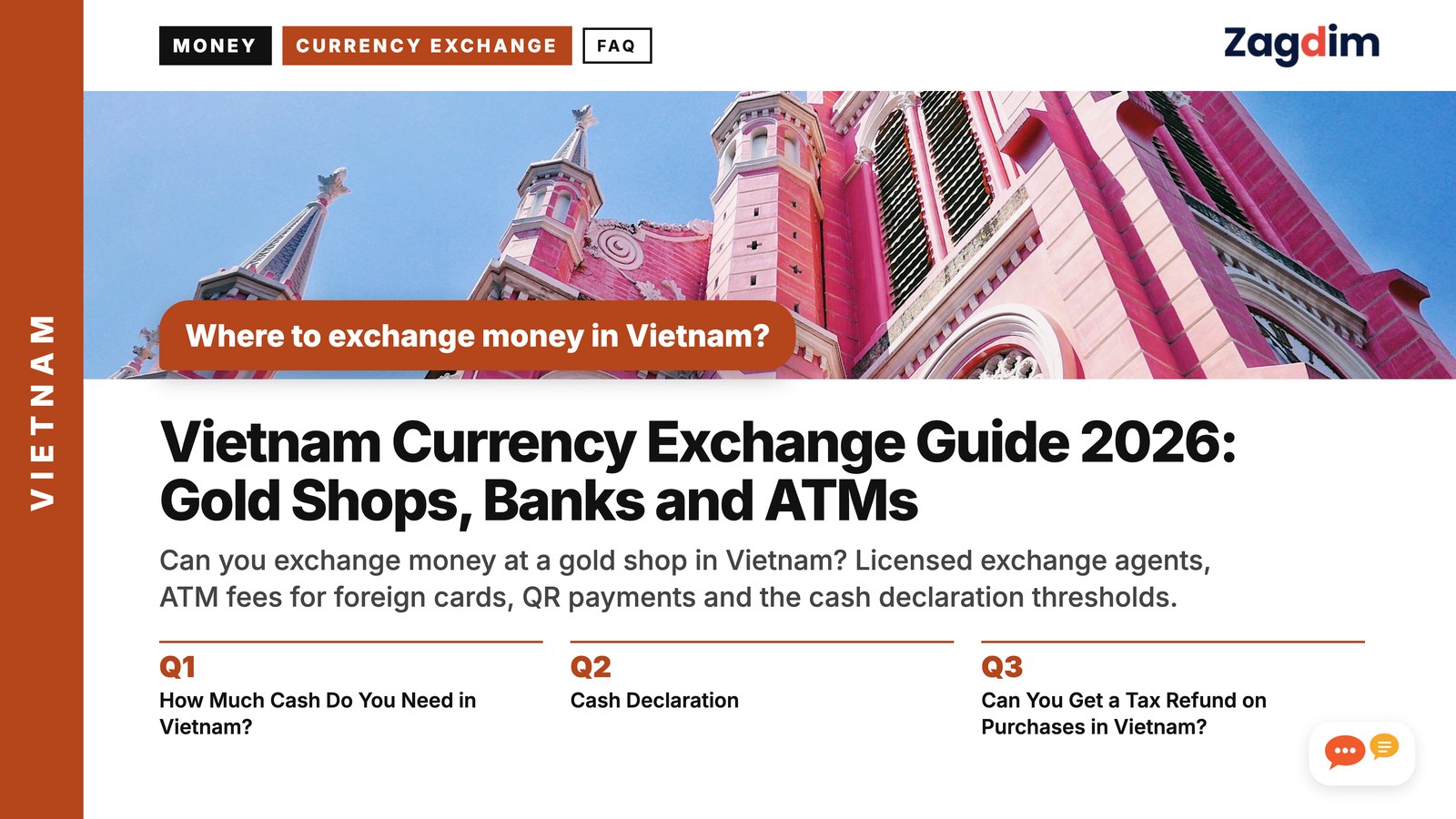
Before going to Vietnam, many visitors are told: “Exchange at a gold shop, the rate is best.” Vietnam’s rule is that whether a shop may exchange foreign currency for travellers depends on whether it has obtained exchange-agent status. A sign saying it sells gold does not count. In June 2026, the State Bank of Vietnam published a consolidated text of its exchange-agent rules that incorporates the latest amendments, and on 1 July new administrative penalty rules for customs took effect. So before exchanging, ask two questions: can this shop exchange, and does the cash you carry have to be declared?
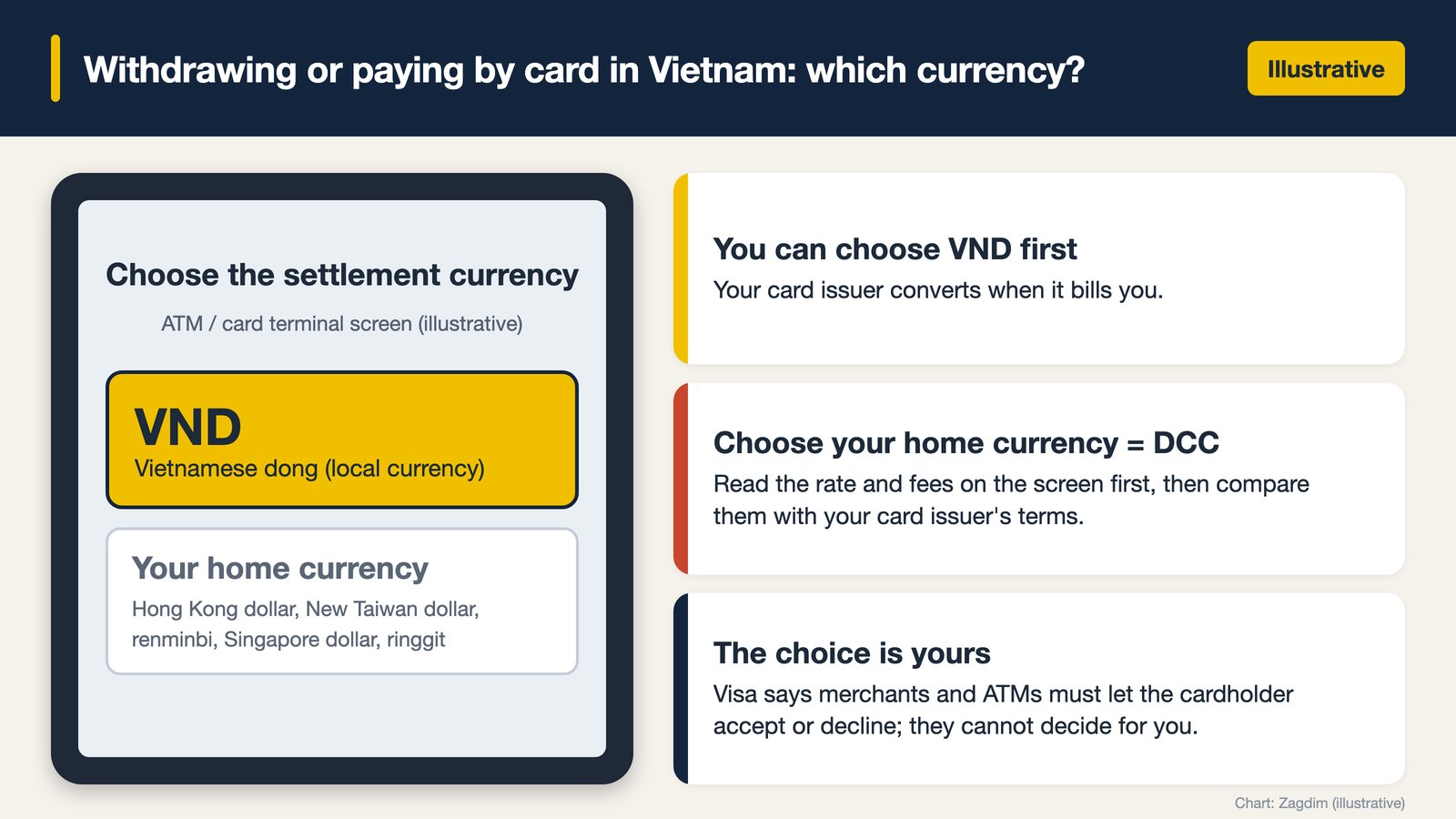
The short version: for Vietnamese dong, start with a bank. If you want to use a gold shop, first confirm that it is a registered exchange agent authorized by a bank, and if you cannot confirm it, go elsewhere. If you carry foreign currency cash worth more than US$5,000, or more than VND 15 million in cash, on entering or leaving, you must declare it to customs. When an ATM or card terminal asks which currency to use, you can choose Vietnamese dong (VND) first.
This guide answers:
- Where is exchanging lawful among gold shops, banks, airport counters and ATMs, and how do you compare to find out what is cheap?
- Which of Hong Kong dollars, New Taiwan dollars, renminbi, Singapore dollars, ringgit and US dollars have bank rate boards you can check?
- What does a withdrawal with an overseas card cost in Vietnam, and which QR codes can Alipay and WeChat scan?
- How much cash must be declared, what does an unreported amount cost, and what should you do with leftover dong?
Key Points
- Who should read this: visitors to Vietnam for travel, family visits, a long stay or property viewing, including those from Hong Kong, Taiwan, mainland China, Singapore and Malaysia.
- Gold shops: selling gold and exchanging currency are two different things. A lawful exchange agent must have a bank’s authorization and a registration certificate, display its exchange rate, and issue an invoice.
- If you exchange at a place that does not qualify, you share the responsibility: for an individual buying or selling foreign currency at an institution not permitted to handle it, the basic penalty below the equivalent of US$1,000 is a warning, and from US$1,000 upward fines and confiscation can apply.
- Cash declaration: with a passport, through an international border gate, foreign currency cash worth more than US$5,000 or Vietnamese dong cash above VND 15 million must be declared. From 1 July 2026, penalties follow the new rules.
- ATMs: when checked, overseas Visa and Mastercard cards withdrawing at ACB, TPBank and BIDV paid at least VND 55,000 to VND 100,000 per transaction (ACB waives the fee for some European and Vietnamese-issued cards), and small withdrawals are hit hardest. JCB and UnionPay are charged differently; see the table below.
- Mobile payments: Alipay, Weixin Pay and some Singapore apps can scan VietQRGlobal. This is limited to partner networks and does not mean every Vietnamese QR code can be paid.
How Much Cash Do You Need in Vietnam?
Bring enough dong for your trip, since no single amount suits everyone, and three conditions help you work it out:
- Declaration threshold: foreign currency cash worth more than US$5,000, or Vietnamese dong cash above VND 15 million, must be declared to customs. Bank cards and traveller’s cheques do not count toward this cash threshold.
- ATM cost: withdrawals with an overseas card have a minimum charge, so taking out a small amount is the least economical; see the fee table below.
- What shops accept: in Vietnam, prepare Vietnamese dong. Paying for goods or services in foreign currency, if it does not comply with the rules, can also be penalized; the basic penalty below the equivalent of US$1,000 is a warning. If a shop quotes a price in US dollars, ask before paying whether you can pay in Vietnamese dong instead.
Zagdim recommends taking a sum of banknotes to exchange at a bank, using a card where cards are accepted, and taking out enough from an ATM in one go if you need more.
Where to Exchange Vietnamese Dong
Start with a bank branch, because it is the most clearly lawful option for exchanging banknotes. Rates differ from one provider to another on the same day. First make sure the place is lawful, then compare how many dong this amount of foreign currency will get.
| Method | Best for | What to watch |
|---|---|---|
| ✅ Bank branches (such as Vietcombank, BIDV, Hong Leong Bank) | People with cash in hand who want to exchange a larger amount | The rate board can be checked on the website first; bring your original passport, and ask about required documents and any other charges |
| ✅ ATM withdrawals | People whose card is enabled for overseas withdrawals | Check the fee and the per-transaction limit; choose Vietnamese dong as the currency |
| ⚠️ Bank counters at the airport | People who need money just after landing | Convenient, but you have to compare the rates yourself; exchange only what you need for transport and a first meal |
| ⚠️ Registered exchange agents (including gold shops that have obtained the status) | People who want to exchange banknotes on their way | Check the four points below first; agents only buy foreign currency in exchange for dong |
| ❌ Shops that show no authorizing bank, no registration certificate, no public rate or no invoice | Not applicable | Both the buyer and the seller may be in breach |
| ❌ Private exchanges with individuals | Not applicable | Buying and selling foreign currency between individuals is also subject to penalties |
Exchanging at the Airport: A List at Noi Bai, On-Site Checks at Tan Son Nhat
Noi Bai has bank exchange counters in both terminals, while at Tan Son Nhat you should check the counters on arrival.
- Noi Bai Airport (Hanoi), international terminal T2: on the ground floor public area, the west side has BIDV and Maritime Bank exchange counters, and the east side has Vietinbank and Techcombank.
- Noi Bai Airport, domestic terminal T1: the ground floor public area has Vietinbank and ACB exchange counters.
- Limits of this list: the airport website page shows no update date, so whether each counter is open on the day depends on what you find there.
- Tan Son Nhat Airport (Ho Chi Minh City): check the current counters with the airport before departure. On arrival, judge them in the same way: look at the bank or authorized bank name on the counter, look at the public rate, and keep the invoice.
How Do Bank Rate Boards Show Six Currencies?
Vietcombank’s board lists cash buying rates for US dollars, Hong Kong dollars, renminbi and Singapore dollars, while ringgit and New Taiwan dollars need checking with a BIDV branch. The table below shows reference figures from bank rate boards, not traded prices, in dong per 1 unit of foreign currency. Each bank’s board has a different date, so the figures cannot be used to rank the banks.
| Currency | Bank rate board (checked 2026-10-30) | Before you go to exchange |
|---|---|---|
| US dollar | Vietcombank cash buying 25,580 (30 October, 20:05); Hong Leong Bank rate of 23 October: 25,640 for US$50-100 notes, 25,630 for notes below US$50 | Denomination may affect the rate, so ask first |
| Hong Kong dollar | Vietcombank cash buying 3,197.02 | Confirm that the branch accepts cash that day |
| Renminbi | Vietcombank cash buying 3,777.73 | Confirm that the branch accepts cash that day |
| Singapore dollar | Vietcombank cash buying 19,663.55 | Confirm that the branch accepts cash that day |
| Malaysian ringgit | Vietcombank’s cash buying column shows “-“; BIDV notes that its ringgit rate applies only to cash buying and selling (page updated 25 September) | Vietcombank’s transfer buying rate does not mean it accepts cash; ask a BIDV branch first |
| New Taiwan dollar | BIDV notes that its New Taiwan dollar rate applies only to cash buying and selling (page updated 25 September) | Ask a BIDV branch first |
The Vietcombank figures for Hong Kong dollars, renminbi and Singapore dollars are the version updated at 02:33 that day. A currency appearing on a rate board does not mean every branch or airport counter accepts it that day. The standards for accepting different banknote series, creases and damage should also be confirmed at the counter on the spot.
Can You Exchange Money at a Gold Shop? Check These Four Things First
Yes, a gold shop can exchange only if it is an exchange agent that has obtained the status; a permit to sell gold does not replace the exchange qualification. A shop without registration is not a lawful channel however large its sign. A gold shop that is widely talked about must be checked item by item before exchanging in the same way.
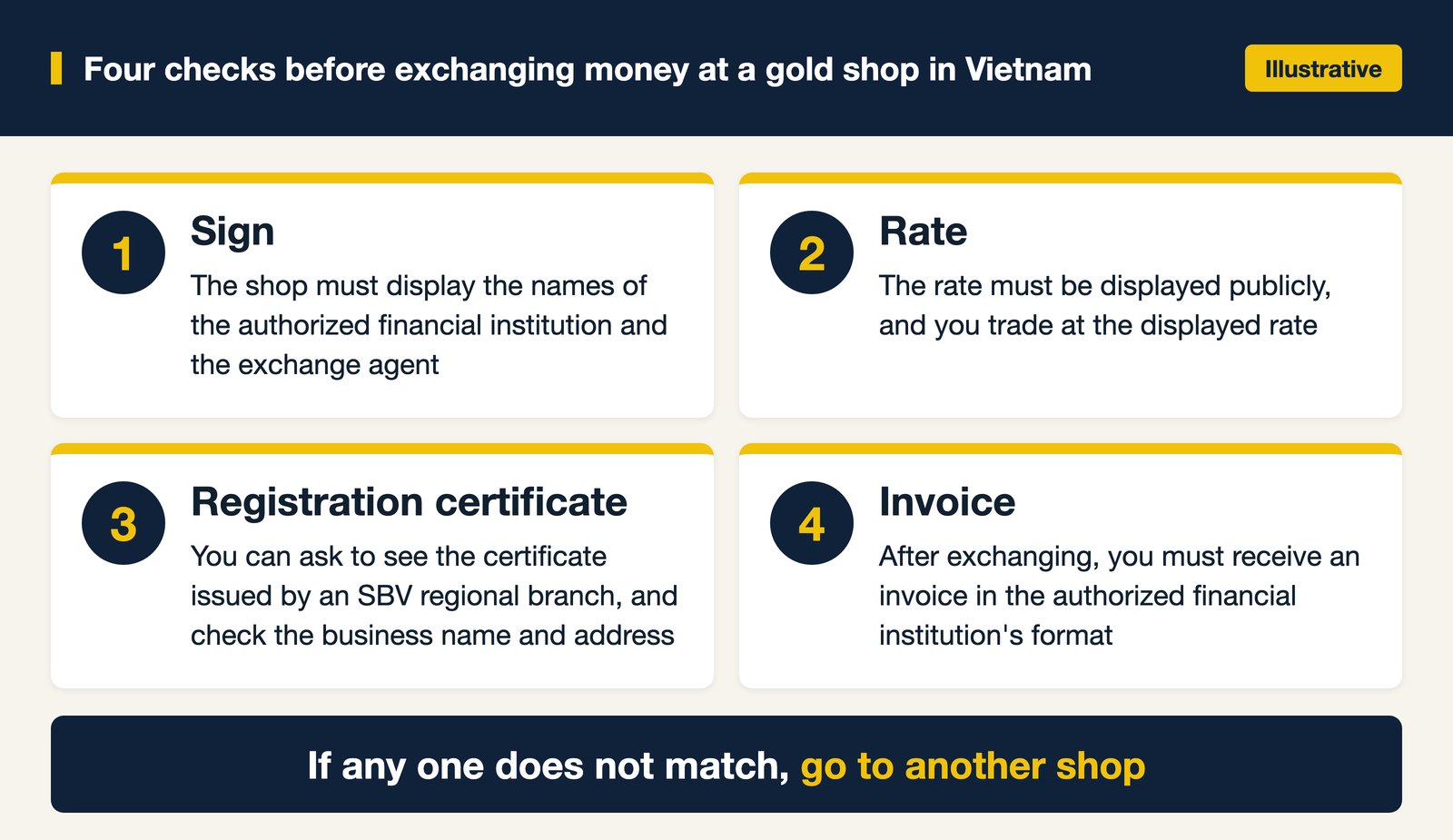
Zagdim recommends checking four things before you exchange, and going to another shop if one does not match:
- Sign: the premises must display the name of the authorized financial institution and the exchange agent.
- Rate: the exchange rate must be displayed publicly, and the transaction must follow the displayed rate. If the price you are quoted differs from the board, be on guard.
- Registration certificate: you can ask the shop to show you the exchange agent registration certificate issued by a regional branch of the State Bank of Vietnam (SBV), and check that the operator’s name and address match the shop; if the certificate names an authorized bank or an expiry, check those too. The rules do not require shops to show it to travellers, and it is not a legal right of travellers, so this is an extra check you make yourself. If the shop will not let you see it, treat it as something you cannot verify and go elsewhere. The validity of the certificate depends on the agency contract; if the contract lapses or is terminated early, the operator must stop exchanging.
- Invoice: after exchanging, you must receive a copy of an invoice in the authorized financial institution’s format. A transaction without an invoice leaves you without documents when you later want to change back to foreign currency.
Also remember that an ordinary exchange agent may only buy individuals’ foreign currency banknotes with Vietnamese dong, and may not sell foreign currency to individuals. Changing dong back into US dollars at a gold shop in the city is not within an agent’s business. The exception is agents inside the international border gate’s restricted area, covered below.
What Is the Penalty for Exchanging in a Place That Does Not Qualify?
Below US$1,000 the penalty is a warning, and from US$1,000 upward fines and confiscation apply. These are the standards that apply to individuals, in force since 9 February 2026. The amount means the value of the foreign currency in the transaction.
| Transaction amount (US dollars or equivalent foreign currency) | Penalty | Confiscation |
|---|---|---|
| Below US$1,000 | Warning | For a repeat offence or repeated violations, the next row applies |
| US$1,000 to below US$10,000 | Fine of VND 10 million to VND 20 million | Foreign currency and Vietnamese dong are also confiscated |
| US$10,000 to below US$100,000 | Fine of VND 20 million to VND 30 million | Foreign currency and Vietnamese dong are also confiscated |
| US$100,000 or more | Fine of VND 80 million to VND 100 million | Foreign currency and Vietnamese dong are also confiscated |
These penalties and the customs cash declaration penalties are two separate sets of rules, so do not add them together.
Withdrawing Cash at ATMs in Vietnam: Comparing Three Banks
Overseas cards pay a percentage fee with a minimum at ACB, TPBank and BIDV, so small withdrawals cost the most. The table below shows what the local ATM operator charges overseas cards. It does not include the overseas withdrawal fee, foreign transaction fee or cash advance fee that your card issuer charges separately.
| ATM | Fee for overseas cards | Per-transaction limit | Applies from |
|---|---|---|---|
| ACB | 4.4% per transaction, minimum VND 100,000 (including VAT). Waived for JCB; waived for Visa issued by Vietnamese or European banks and Mastercard issued by Vietnamese banks | Depends on the machine and your card issuer | 30 August 2025 |
| TPBank (Visa) | VND 55,000 for amounts below VND 5 million; 3.08% for VND 5 million or more (including VAT) | VND 5 million is where the rate changes, not a limit | In effect from 15 November 2025 |
| TPBank (Mastercard) | 3.3%, minimum VND 77,000 (including VAT) | Depends on the machine and your card issuer | In effect from 15 November 2025 |
| BIDV (Visa, Mastercard) | 4.5%-5%, depending on region (the fee schedule does not say which region corresponds to which rate), minimum VND 90,000 (VAT not included) | Maximum VND 5 million per transaction | From 6 January 2026 |
| BIDV (JCB, UnionPay/DFS) | BIDV charges nothing | Maximum VND 5 million per transaction | From 6 January 2026 |

Withdrawing 5 million in one go costs far less per dong than withdrawing 1 million at a time. Working a few amounts through the same table shows the difference (in Vietnamese dong, for Visa and Mastercard cards that pay a fee):
| Withdrawal amount | ACB | BIDV (VAT not included) | TPBank Visa | TPBank Mastercard |
|---|---|---|---|---|
| 1 million | 100,000 | 90,000 | 55,000 | 77,000 |
| 3 million | 132,000 | 135,000-150,000 | 55,000 | 99,000 |
| 5 million | 220,000 | 225,000-250,000 | 154,000 | 165,000 |
Points to remember:
- Many small withdrawals cost the most: withdrawing 1 million at ACB with a minimum charge of 100,000 equals 10%. If you need cash, taking it out in one go is cheaper than three withdrawals.
- Visa cards: note TPBank’s 5 million break point: withdrawing exactly 5 million costs 154,000; below 5 million it is 55,000.
- For JCB and UnionPay cards, look at these two banks first: ACB waives the surcharge for JCB, and BIDV charges nothing for JCB and UnionPay. That only means the ATM side does not charge; ask your card issuer about its own fees separately.
- A per-transaction limit does not mean you can withdraw that much: BIDV’s 5 million for Visa and Mastercard is the bank’s own limit, and the machine and your card issuer may still restrict it.
- Fees change: the table shows announcements as checked, and the ACB and TPBank figures come from 2025 fee schedules, which may no longer be valid; BIDV’s schedule applies from 6 January 2026. Rely on the machine’s screen before you withdraw. BIDV’s calculation gives two figures, for the 4.5% and 5% ends of its range, and which end applies depends on the machine’s screen. For foreign card fees at Vietcombank and other banks, look at the machine screen or ask the bank.
Card Payments and Withdrawals: The Screen Asks Which Currency to Use
Zagdim recommends choosing Vietnamese dong (VND) first when the screen asks. A card terminal or ATM may ask: “Settle in Hong Kong dollars (or New Taiwan dollars, renminbi, Singapore dollars, ringgit)?” This is dynamic currency conversion (DCC).
Visa says merchants and ATMs must let the cardholder accept or decline, and cannot decide for you. Zagdim recommends choosing Vietnamese dong (VND) first and letting your card issuer convert when it bills you. If you want to choose your home currency, read the exchange rate and fees on the screen first and compare them with your card issuer’s terms; only by working it out can you tell which is cheaper.
On transport, Ho Chi Minh City Metro Line 1 lets you buy tickets with a Visa card at the ticket counter or in the HCMC Metro HURC app. This is a way to pay for tickets. It does not mean every gate accepts a card tap directly, and it does not mean other cities are the same.
Alipay, WeChat and Local QR Codes: Know the Acceptance Network First
Alipay and Weixin Pay can scan VietQRGlobal, but only within partner networks. In 2026 Vietnam gained several overseas QR payment options, but whether you can pay depends on whether your app and the shop’s QR code belong to the same partner network.
| Your tool | Who it works for | What to watch |
|---|---|---|
| Alipay | If you hold a mainland China wallet: scan VIETQRGlobal to pay merchants in the NAPAS network | Not the same as AlipayHK, and not every private transfer QR |
| Weixin Pay | If you hold a mainland China wallet: scan VietQRGlobal to pay at partner acceptance points | NAPAS, BIDV and Weixin Pay held a launch event on 6 August 2026; not the same as WeChat Pay HK, and not every Vietnamese QR |
| Singapore partner apps (RoamQR) | If you use a Singapore app: scan VietQRGlobal acceptance points | Announced on 2 July 2026; limited to partner apps connected to RoamQR, not every PayNow app |
| Hong Kong FPS, Malaysia DuitNow, Taiwan LINE Pay, JKOPay, Pi Wallet | Not yet confirmed | Before you leave, ask the app or your bank whether Vietnam is enabled, and prepare a card or cash |
| MoMo (Vietnamese local wallet) | Its official FAQ says a foreign passport can be used for verification | Foreign customers may need to bring the original passport to a customer service center; ask MoMo first whether activation and top-up can be completed without a Vietnamese bank account |
When you actually pay, Zagdim recommends first confirming that the overseas payment function in your app is switched on, then asking the shop whether it accepts it. If a payment fails, keep a card or cash on hand as a substitute.
How Much Is a Sum Worth? Conversions Across Currencies
VND 1,000,000 is worth about HK$306, NT$1,269, ¥260, S$50, RM159 or US$39 at mid-market rates. The conversions below use the European Central Bank reference rates of 29 October 2026 and the same-day Taiwan Futures Exchange US dollar to New Taiwan dollar reference rate for the other currencies, which are mid-market rates; the dong side uses Vietcombank’s US dollar transfer buying rate of 25,610 of 30 October 2026. The table does not include any exchange spread or fees. Actual amounts depend on the operator and the rate on the day, and the table is only to give you a sense of scale.
| Vietnamese dong | Hong Kong dollars | New Taiwan dollars | Renminbi | Singapore dollars | Ringgit | US dollars |
|---|---|---|---|---|---|---|
| 1,000,000 | about HK$306 | about NT$1,269 | about ¥260 | about S$50 | about RM159 | about US$39 |
| 100,000 | about HK$31 | about NT$127 | about ¥26 | about S$5 | about RM16 | about US$4 |
Cash Declaration: How Much Can You Bring Into Vietnam?
When entering or leaving through a Vietnamese international border gate with a passport, foreign currency cash worth more than US$5,000 or its equivalent, or Vietnamese dong cash above VND 15 million, must be declared to border gate customs.

- If you will deposit it into a foreign currency account: on entry, even if the amount does not exceed the equivalent of US$5,000, you must declare it if you intend to deposit it into your own foreign currency payment account in Vietnam.
- Instruments other than cash: traveller’s cheques, bank cards, savings books and securities are not covered by this cash threshold.
- Taking out more than you brought in: if the cash you take out exceeds the threshold and also exceeds the amount declared on your most recent entry, you must show a certificate of carrying issued by a permitted institution, or written permission from the State Bank of Vietnam.
- Taking back the original amount: if the amount you take out exceeds the threshold but does not exceed the amount brought in on your most recent entry, you only need to show the customs-confirmed entry declaration. This form applies only to your next departure within 12 months of the declaration date, so keep it.
- Crossing land borders with border documents: people who clear the border with a border identity card or border pass are covered by separate rules, and the general rules above cannot be applied directly.
For a large sum to buy or rent a home or stay long term in Vietnam, Zagdim recommends asking your bank before you leave about the remittance method and the documents required. If you do have to carry cash, remember to declare it.
What Does Failing to Declare Cost?
Failing to declare costs a fine that rises with the violating portion, with different tables for entry and exit. The penalties from 1 July 2026 are calculated on the violating portion after deducting the amount exempt from declaration. The table shows amounts for individuals, in Vietnamese dong.
| Violating portion equivalent to | Entry: not declared or declared inaccurately |
|---|---|
| 5 million to below 50 million | Fine of 1 million to 2 million |
| 50 million to below 100 million | Fine of 5 million to 10 million |
| 100 million or more, with no criminal liability pursued | Fine of 10 million to 20 million |
| Violating portion equivalent to | Exit: not declared or declared inaccurately |
|---|---|
| 5 million to below 30 million | Fine of 1 million to 3 million |
| 30 million to below 70 million | Fine of 5 million to 15 million |
| 70 million to below 100 million | Fine of 15 million to 25 million |
| 100 million or more, with no criminal liability pursued | Fine of 30 million to 50 million |
Declaring more on entry than you actually carry is also penalized: where the difference is equivalent to 5 million to below 20 million, the fine is 2 million to 5 million; 20 million to below 100 million, the fine is 5 million to 15 million; 100 million or more with no criminal liability pursued, the fine is 15 million to 25 million.
For example, a traveller enters with US$8,000 in cash and does not declare it. After deducting the US$5,000 exempt from declaration, the violating portion is US$3,000, which at 25,610 dong comes to roughly 76.83 million, falling in the “50 million to below 100 million” row. When the amount meets the conditions for criminal prosecution, this table does not apply.
Can You Get a Tax Refund on Purchases in Vietnam?
Yes. When foreigners holding passports and overseas Vietnamese leave the country, eligible purchases can receive a refund of value-added tax, and a new refund procedure applies from 1 July 2026.
| Item | Rule |
|---|---|
| Purchase threshold | Invoices from the same refund-eligible shop on the same day must total at least VND 2 million; several invoices from the same shop on the same day can be combined |
| Goods conditions | Bought from a refund-eligible shop, unused, kept in the original packaging as bought, and compliant with export and aviation security limits |
| Time limit | No more than 60 days from the date the refund invoice is issued to the departure date |
| How much is refunded | 85% of the value-added tax contained in the goods, with the bank retaining 15%. This is 85% of the tax, not 85% of the sale price |
| Refund method | In Vietnamese dong; the bank can pay cash or refund to an international card. If you want foreign currency, it follows the bank’s rate board at the time |
At the airport, you first go through customs inspection and then the bank’s refund counter:
- Customs inspection: go to the customs inspection counter no later than 30 minutes before the aircraft or vessel departs, and show your passport or entry and exit document, the VAT invoice and refund declaration form, and the goods. 30 minutes is the latest time limit, so Zagdim recommends arriving earlier.
- Bank refund counter: after customs inspection, go to the bank’s refund counter and show your boarding pass and the original declaration form confirmed and stamped by customs.
The refund is handled at designated refund border gates, so check before you leave that the airport you depart from offers this service.
By the way, for businesses that calculate tax by the deduction method, the value-added tax on goods and services within the reduction scope falls from 10% to 8%, until 31 December 2026. Telecommunications, finance, banking, securities, insurance, real estate and others are excluded, so not every travel expense carries 8%.
Common Situations and Tips
Five situations come up most often when exchanging money in Vietnam.
- What about leftover Vietnamese dong? After completing exit formalities, a foreign passport holder can buy foreign currency back from an exchange agent in the international border gate’s restricted area. Up to the equivalent of US$1,000, you show your passport; above that, you must also show the original exchange invoice from within the previous 90 days, the amount cannot exceed what the invoice shows, and the invoice is retained.
- Keep the exchange invoice until you leave: apart from being used when you buy foreign currency back, it is also the record of the transaction.
- When comparing, compare “how much you get”: claims about whether there is a fee are hard to compare, so ask directly how many dong this sum will get.
- US dollar banknote denominations: Hong Leong Bank’s rate board quotes US$50-100 notes separately from notes below US$50, so when exchanging US dollars, ask whether denomination affects the rate.
- A quote far better than the bank’s: Zagdim recommends checking the sign, rate, registration certificate and invoice first. If the four do not match, do not exchange however good the rate looks.
Pre-Departure Checklist
Zagdim recommends six steps before you leave:
- Call your card issuer: enable overseas card payments and withdrawals, and ask about fees and daily limits.
- Choose which bank’s ATM to use according to the card you hold (Visa, Mastercard, JCB, UnionPay).
- If you will exchange New Taiwan dollar or ringgit banknotes, ask in advance whether the bank branch accepts them.
- Confirm the overseas payment function in your app, and confirm which acceptance network in Vietnam it applies to.
- Bring your original passport to exchange money, and keep the invoice afterward.
- If your cash is over the declaration threshold, declare on entry and keep the customs-confirmed declaration form.
Frequently Asked Questions
Can you exchange money at gold shops in Vietnam?
Yes, but only a shop that has obtained exchange-agent status can buy your foreign banknotes, and a gold-selling sign cannot replace that status. Before exchanging, check the authorized bank’s sign, the public rate and the exchange agent registration certificate, and after exchanging you must have an invoice.
Where is the best place to exchange money in Vietnam?
There is no single best provider, because rates differ from one to another on the same day. Choose a bank or a registered exchange agent first, then compare how many dong this amount of foreign currency gets. Fees for withdrawing with an overseas card at an ATM must be counted separately.
Can you exchange Hong Kong dollars, New Taiwan dollars, renminbi, Singapore dollars and ringgit in Vietnam?
Vietcombank’s rate board lists cash buying rates for Hong Kong dollars, renminbi and Singapore dollars, and BIDV’s rate board notes that its New Taiwan dollar and ringgit rates apply to cash buying and selling. Whether each branch and airport counter accepts them that day needs to be asked first.
How much is the fee for withdrawing cash with an overseas card at a Vietnamese ATM?
As checked, ACB charges 4.4% per transaction with a minimum of VND 100,000; BIDV charges 4.5%-5% for Visa and Mastercard with a minimum of 90,000 (VAT not included); TPBank charges Visa 55,000 below 5 million. Your card issuer’s fees are calculated separately.
Can you use Alipay and WeChat in Vietnam?
NAPAS announced that Chinese visitors can scan VietQRGlobal with Alipay and Weixin Pay and pay within the partner network. This does not mean AlipayHK and WeChat Pay HK also work, and it does not mean every Vietnamese QR can be paid.
How much cash must you declare when traveling to Vietnam?
With a passport entering or leaving through an international border gate, foreign currency cash worth more than US$5,000, or Vietnamese dong cash above VND 15 million, must be declared to customs. To deposit foreign currency cash into a foreign currency account in Vietnam, you must declare it even if it does not exceed the threshold.
Can leftover Vietnamese dong be changed back into foreign currency?
After completing exit formalities, a foreign passport holder can buy foreign currency back from an exchange agent in the international border gate’s restricted area. Up to the equivalent of US$1,000 requires a passport; above that, you also need the original exchange invoice from within 90 days.
Important Notice
This is a general information summary and is not financial, tax or legal advice. It draws on announcements from the State Bank of Vietnam, the Vietnamese government and the Ministry of Finance, and on the websites of airports, banks, payment networks and operators, as checked on 30 October 2026. Exchange rates, ATM fees, exchange-agent status, the tax refund process and payment acceptance change; rely on the latest announcements from each organization and your card issuer. This guide does not determine that any individual gold shop is lawful or unlawful, and before exchanging you should confirm with the operator and the authorizing bank. The converted amounts in the table are reference figures and exclude any exchange spread and fees.
Have a question about this guide? Leave a comment below, or ask Zagdim directly.
Your first stop for international property and global living.
Research and insights. Know what’s changing. Understand what matters.
Sources
- State Bank of Vietnam (SBV) – Circular 15/2011/TT-NHNN, Articles 1-4 (carrying and declaring cash)
- State Bank of Vietnam (SBV) – Consolidated text 79/VBHN-NHNN on exchange agent rules (2026-06-12, incorporating amendments by 23/2026/TT-NHNN), Articles 4, 7, 7a, 8, 10
- Government of Vietnam – Decree 169/2026/NĐ-CP, Articles 6, 11, 38 (administrative penalties for customs, in force 2026-07-01)
- Government of Vietnam policy portal – Official excerpt of Decree 340/2025/NĐ-CP, Article 27 (administrative penalties for foreign exchange, in force 2026-02-09)
- Ministry of Finance of Vietnam – Consolidated text 18/VBHN-BTC, Appendix IV (tax refund for travellers)
- Ministry of Finance of Vietnam – Circular 84/2026/TT-BTC, Article 4 (refund procedure, in force 2026-07-01)
- Government of Vietnam policy Q&A – Official answer of 2026-10-28 citing Decree 174/2025/NĐ-CP, Articles 1 and 2 (VAT reduction)
- Vietcombank – Exchange rates
- BIDV – Tỷ giá ngoại tệ
- Hong Leong Bank Vietnam – Foreign exchange rates
- BIDV – Biểu phí dịch vụ thẻ, Section 7 (applies from 2026-01-06)
- ACB – Notice on adjusting the surcharge for cash withdrawals by internationally issued cards of other banks at ACB ATMs
- TPBank – Biểu phí thẻ ghi nợ quốc tế, item 18
- Noi Bai International Airport – BANKS & ATM
- Visa – What you should know about Dynamic Currency Conversion
- Visa – Visa and Ho Chi Minh City Metro Line 1 Usher in a New Era of Seamless Commuting
- NAPAS – NAPAS, BIDV and Weixin Pay partner to expand QR payment services
- NAPAS – Announcement on QR payment cooperation between Vietnam and China (2026-04-03 event)
- Liquid Group – Liquid Group Expands RoamQR Network into Vietnam
- MoMo – Hộ chiếu nước ngoài có được xác thực không?
- MoMo – An toàn, an tâm (support for foreign customers)
- European Central Bank – Euro foreign exchange reference rates (2026-10-29)
- Taiwan Futures Exchange – Daily foreign exchange reference rates (2026-10-29)