































This article is part of Zagdim’s wiki series on Vietnam. It looks at how the charter capital you set for a Vietnamese limited liability company affects bank account opening, tax, investment visas and day-to-day operations, for readers outside Vietnam who are considering opening a company there, or moving there to work or live long-term.
Charter capital (vốn điều lệ) is the total value of assets that a company’s members or owners have already contributed, or committed to contribute, at the time the company is established. This figure affects:
- how much shareholders have to pay in
- whether loan interest can be deducted for tax purposes
- how assets are distributed if the company is dissolved
When you apply for an investment visa, you also need to separate your own contribution value from the company’s total capital.
For the basic definition of charter capital, the deadline for paying it in full, and the consequences of not doing so, see Zagdim’s main article on foreign-owned LLCs, charter capital and operating responsibilities in Vietnam.
There is another amount worth separating out. For a company a foreign investor sets up to carry out an investment project, charter capital does not have to equal the investment capital for that project (vốn đầu tư, i.e. the funds needed to execute it). The company has to contribute funds according to the schedule set out in its Investment Registration Certificate (Giấy chứng nhận đăng ký đầu tư, IRC), and raise any other funds it needs on top of that. The IRC is the investment registration document a foreign investor holds when carrying out an investment project.
As an illustration, suppose an investor is planning to set up an LLC in Vietnam and also wants to apply for an investment visa. The sections below use this hypothetical example to show how the rules apply in practice.
Does a Lower Charter Capital Make It Easier to Open a Bank Account?
Start with what the rules and bank documents actually say. There is currently no basis for saying that declaring a lower charter capital makes it easier to open a bank account. The capital account rules below, and the account-opening documents this article found for two banks, both deal with account types and paperwork; neither lists a charter capital threshold.
How a capital account works
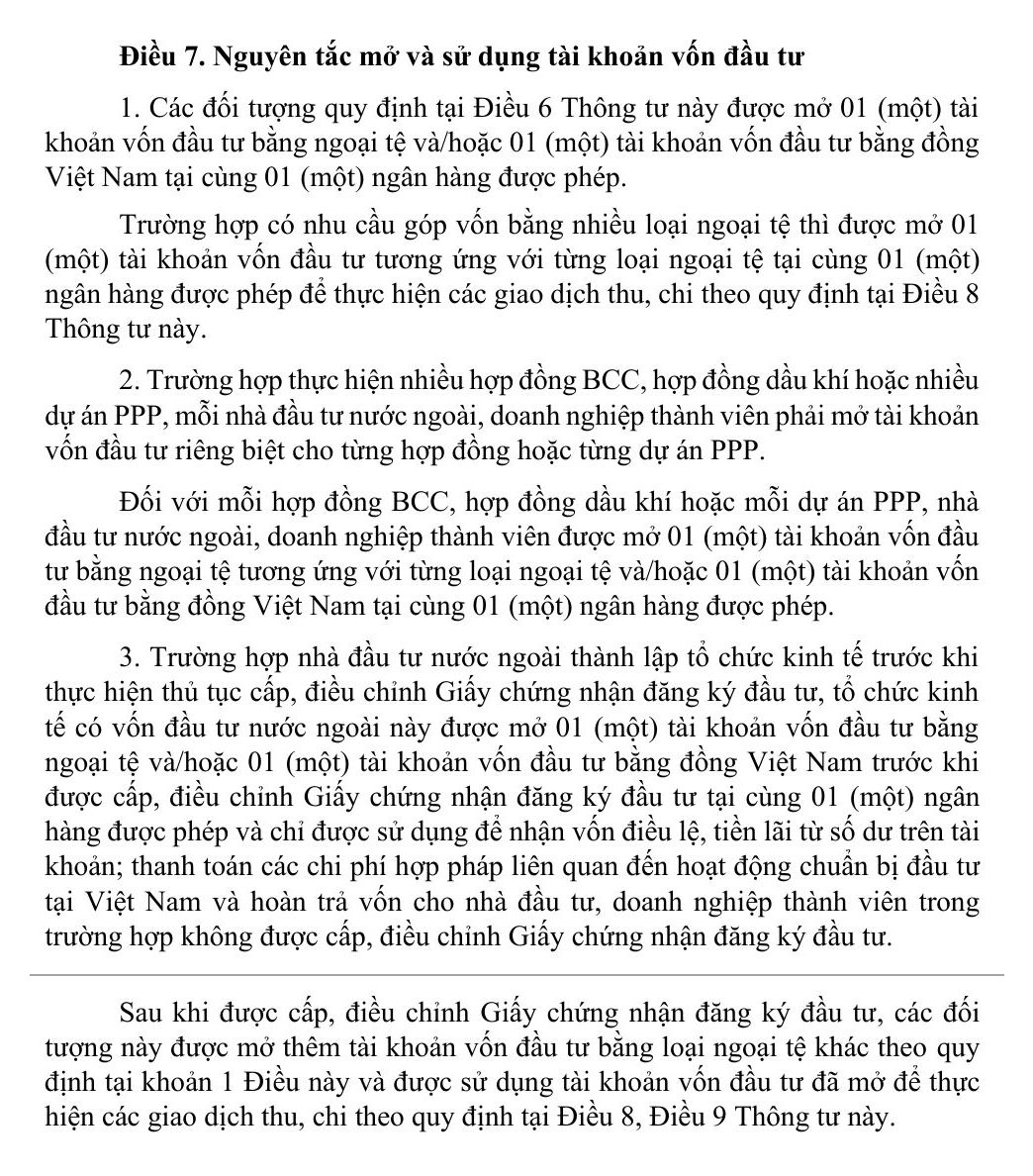
A Foreign Investment Capital Account (tài khoản vốn đầu tư nước ngoài tại Việt Nam) is the account that eligible entities use to receive money contributions and handle related fund flows. An entity subject to this regime must wire its monetary contribution, in foreign currency or Vietnamese dong (Đồng Việt Nam), into a capital account. It is possible to open only a Vietnamese dong capital account, without first opening a foreign-currency one.
Entities covered include:
- Foreign investors, or economic organizations set up by member enterprises: “economic organization” is a defined legal term. “Member enterprise” (doanh nghiệp thành viên) has its own legal definition under the regulations and does not just mean any member of a general group.
- Entities formed through capital contribution, share purchase, or purchase of a contributed capital interest: this category needs a separate assessment. The foreign investor or member enterprise needs to hold more than 50% of charter capital as a member or shareholder; exactly 50% does not count.
As an example, if the investor’s company falls into one of these covered categories, it could open only a Vietnamese dong capital account and wire the contribution into it by bank transfer.
The company exists, but the IRC has not been issued yet
If the company already exists but the IRC has not yet been issued or adjusted, it is also possible to open a foreign-currency capital account, a Vietnamese dong capital account, or both, at the same licensed bank. At this stage, the account can only be used to:
- receive the registered capital and any interest earned on the account balance
- pay the lawful costs of preparing the investment in Vietnam
- refund capital to the investors or member enterprise if the IRC is not issued or adjusted
Being able to open the account does not mean the investment project can start operating ahead of schedule, and the costs of preparing the investment are not the same as all of a company’s day-to-day operating expenses.
What documents do banks ask for
| Bank | Documents found for this article |
|---|---|
| HSBC Bank (Vietnam) Ltd. | Its account-opening guidance lists, as items that “typically include,” the Enterprise Registration Certificate (Giấy chứng nhận đăng ký doanh nghiệp, ERC), the company charter, the ID or passport of the legal representative and chief accountant, and the company’s ownership structure chart. |
| Shinhan Bank Vietnam | Its demand deposit account document field lists the company charter, plus the appointment decision for the chief accountant or person in charge of accounting (if any). |
These are only sample documents, not a complete checklist, and they do not mean in-person attendance is unnecessary or that the process can be completed from outside Vietnam. Before opening an account, confirm whether your company falls within the scope of the capital account rules, then confirm the current document requirements directly with the bank you plan to use.
If Charter Capital Is Set High but Not Fully Paid In, What Does It Cost You at Tax Time?
The main issue here is loan interest. If charter capital is declared at a high figure but the funds are not injected on schedule, the loan interest that corresponds to the unpaid capital cannot be deducted when calculating taxable income for corporate income tax.
This rule looks at the contribution schedule set out in the company’s charter (its basic governing rules). That schedule cannot run longer than the contribution period allowed under the Enterprise Law (Luật Doanh nghiệp), and this applies even once the company has already started operating. In short: capital that should have been paid in but was not means the loan interest on the equivalent amount cannot be used to reduce tax.
The calculation itself follows set rules:
| Borrowing situation | Interest that cannot be deducted |
|---|---|
| Loan amount does not exceed the unpaid capital | All of the loan interest |
| Loan amount exceeds the unpaid capital, across multiple loans | (Unpaid capital ÷ total loans) × total interest |
| Loan amount exceeds the unpaid capital, in a single loan | Unpaid capital × interest rate × length of the unpaid period |
As an example, if the investor’s company still has unpaid capital and its loan amount does not exceed that unpaid capital, none of the loan interest can be deducted.
This rule also has limits:
- It does not mean that interest on every shareholder loan is non-deductible.
- A shareholder loan is not the same as having fulfilled a capital contribution.
- Later amending the registration to match the amount actually paid in does not remove financial obligations that the company already owed before that amendment; see the main article for details.
A second limit: the 30% cap on interest deductions
From the 2026 corporate income tax year, companies with related-party transactions (giao dịch liên kết, meaning dealings with a connected party) face an additional cap on interest deductions:
- Deductible loan interest for the period is first offset against deposit and lending interest, giving a net interest expense figure.
- That net interest expense cannot exceed 30% of the sum of operating net profit, net interest expense and depreciation for the period.
- Any amount that cannot be deducted can be carried forward to later years that have deduction room left, for up to five consecutive years starting from the year after it arose.
This 30% limit does not apply to:
- loans from credit institutions or insurers lawfully established as such
- government-borrowed-then-relent official development assistance or concessional loans, national target program loans, and loans for national social welfare policy projects
Companies that already had transitional arrangements under earlier regulations keep the remaining period of those arrangements; the specific regulation is listed in the research notes below.
How Much Capital Do You Need to Stay in Vietnam on an Investment Visa?
The key here is understanding whose money the threshold is measuring. An investment visa looks at the foreign investor’s own contribution value, not the company’s total registered charter capital, so declaring a certain charter capital figure for the company does not automatically qualify you.
Vietnam’s investment visas fall into four categories, for foreign investors or representatives of foreign investment organizations in Vietnam, each tied to a different contribution threshold and maximum visa length:
| Visa category | Contribution value threshold | Maximum visa length |
|---|---|---|
| ĐT1 (Category 1) | At least 100 billion Vietnamese dong, or investing in an industry or region the government has designated for investment incentives | 5 years |
| ĐT2 (Category 2) | At least 50 billion but under 100 billion Vietnamese dong, or investing in an industry the government has designated for encouraged development | 5 years |
| ĐT3 (Category 3) | At least 3 billion but under 50 billion Vietnamese dong | 3 years |
| ĐT4 (Category 4) | Under 3 billion Vietnamese dong | 1 year |
A few notes on this table:
- Every length above must still be at least 30 days shorter than the validity of your passport or international travel document.
- Where an international treaty Vietnam has joined sets a different term, the treaty applies instead.
- The years shown are maximums, not a guaranteed period of issuance.
- Meeting the contribution category does not guarantee that a visa will actually be granted.
A work permit (giấy phép lao động, the document authorizing a foreigner to work in Vietnam) is also tied to contribution value. If you own or hold a contributing interest in an LLC, and your own contribution value is at least 3 billion Vietnamese dong:
- you are not among the people who need to obtain a work permit
- you do not need to apply for a work-permit exemption confirmation
- you still need to notify the authority responsible for confirmations at your intended place of work, at least 3 working days before you plan to start, giving your name, date of birth, nationality, passport number, employer name, workplace and the period you will work there
As an example, if the company’s total capital reaches 3 billion Vietnamese dong but the investor’s own contribution value is under that amount, this work-permit rule would not apply to them.
For how visas, work permits and temporary residence cards relate to each other, see Zagdim’s article on whether opening a Vietnam company can solve your visa question, covering investment visas, work permits and temporary residence cards.
What Other Operational Effects Does Charter Capital Have?
This breaks down into three areas: financing, profit remittance, and company dissolution. A higher charter capital does not mean a higher loan limit, does not let profit leave the country any earlier, and does not let shareholders claim their capital back ahead of other obligations when the company dissolves.
Bank financing
When a financial institution reviews and decides whether to lend to a legal entity, the borrower needs to meet these conditions:
- have civil legal capacity (the legal standing to hold rights and bear obligations)
- use the funds for a lawful purpose
- have a feasible plan for using the funds
- have the financial capacity to repay
The feasible-plan requirement does not apply to small loans (khoản cho vay có mức giá trị nhỏ). Charter capital cannot be converted directly into a loan limit, and meeting the basic conditions does not mean the bank is guaranteed to approve the loan.
Remitting profit
For a foreign investor to remit annual direct-investment profit out of Vietnam, all of the following need to be completed first:
- the fiscal year has ended
- the invested company has fulfilled its financial obligations to the Vietnamese state
- audited financial statements (financial statements reviewed by an auditor) and the annual corporate income tax settlement filing have been submitted to the directly managing tax authority
If, after carrying forward losses as required by law, that profit year’s financial statements still show accumulated losses, that year’s profit cannot be remitted. The investor, or the enterprise entrusted to remit on their behalf, also needs to notify the tax authority in the prescribed format at least 7 working days before the remittance.

Cash sitting in the company’s account, a returned capital contribution, or loan principal are not the same as remittable annual profit. As an example, the fact that the investor’s company has cash in its account does not mean that cash can be remitted as that year’s profit.
Company dissolution
When a company dissolves, its debts are settled in this order:
- employee wages, severance payments, social, medical and unemployment insurance, and entitlements under collective or individual labor contracts
- taxes
- other debts
Only after dissolution costs and all debts are paid does any remaining property get distributed to shareholders, in proportion to their capital contribution or shareholding. In other words, no matter how high the charter capital is, if the company owes debts or taxes, shareholders cannot claim their capital back first.
What Should You Actually Weigh When Setting Charter Capital?
Consider it from a few angles:
- Whether you need an investment visa or a work-permit exemption: if you do, match your own contribution value to the visa threshold you are aiming for.
- The funds shareholders can actually mobilize: do not inflate the figure past what you can actually pay in, because an unpaid portion carries tax and legal consequences. An LLC must pay in its committed assets in full, by the committed asset type, within 90 days of the date its ERC is issued; time spent transporting or importing contributed assets, and completing the administrative procedures to transfer ownership of them, does not count toward that 90 days.
- Whether you will need to borrow from shareholders or banks later: if capital is not paid in on schedule, the corresponding loan interest cannot be deducted.
Everyone’s funding situation, operating plans and residency needs are different, so the right charter capital figure will differ too.
Frequently Asked Questions
Can charter capital be contributed without cash?
Yes. Contributed assets can include:
- Vietnamese dong, freely convertible foreign currency, or gold
- land use rights, intellectual property, technology, or technical know-how
- other assets that can be valued in Vietnamese dong
Only a person or organization that lawfully owns, or has the right to use, the asset can contribute it under the rules.
From 2026, is a business license fee still due?
No. Collection and payment of the business license fee (lệ phí môn bài) stops from January 1, 2026. This does not exempt enterprise registration fees, other taxes and fees, or any existing arrears.
Can shareholders get their capital back first when the company dissolves?
No. When a company dissolves, employee-related debts, taxes and other debts must be settled first, along with dissolution costs, before any remaining property is distributed to shareholders in proportion to their contribution or shareholding.
Glossary
- Charter capital: the total value of assets that a company’s members or owners have already contributed, or committed to contribute, at the time of establishment.
- Investment Registration Certificate (IRC): the investment registration document a foreign investor holds when carrying out an investment project. Its schedule is the basis for the capital contribution and for raising other funds, and it is different from the Enterprise Registration Certificate.
- Enterprise Registration Certificate (ERC): Vietnam’s company registration certificate. An LLC’s 90-day deadline for paying in capital runs from the date this certificate is issued.
- Foreign Investment Capital Account: the account that eligible entities use to receive money contributions and handle related fund flows, formerly called a “Direct Investment Capital Account.” It is different from an ordinary company payment account.
Research Notes
This article’s data was checked as of November 2, 2026. The conclusions on distinguishing charter capital from project investment capital, the non-deductibility of interest on unpaid capital, investment visa thresholds, and work-permit exemptions are drawn from official documents issued by Vietnam’s National Assembly, government, Ministry of Finance and State Bank. No single official document directly states “how much charter capital should be declared.”
The conclusion that declaring lower charter capital does not make account opening easier is drawn from the capital account regulations and the two banks’ documents found for this article; neither the official regulations nor the bank documents state this directly. The bank account-opening details cite only short excerpts from already-archived public information and do not represent complete account-opening conditions. The Shinhan Bank Vietnam content comes from a short excerpt preserved by a search service’s cache of the official page, since fetching the old URL directly has returned a 404; actual applications still follow each bank’s current process.
The transitional cases for the 30% cap on related-party interest deductions need separate checking against Article 3 of Decree 20/2025/NĐ-CP; this article does not draw a firm conclusion for those cases. Cases that received charter capital through a payment account before Circular 38/2026/TT-NHNN took effect have their own transitional rules that need individual checking. The lending provisions cited in this article do not define the amount for a “small loan.” The sources used for this article do not list matters that have not yet been announced.
Need help with this? Talk to the Zagdim reader desk
If you are deciding how much charter capital to declare for a Vietnam company, the Zagdim reader desk can arrange a suitable specialist to walk through the banking, tax and visa effects for your situation. The first consultation is free.
Message the Zagdim reader desk on WhatsApp Message the Zagdim reader desk on LINE
Have a question about this guide? Leave a comment below, or ask Zagdim directly.
Your first stop for international property and global living.
Research and insights. Know what’s changing. Understand what matters.
Sources
- Office of the National Assembly, Vietnam - Văn bản hợp nhất số 67/VBHN-VPQH hợp nhất Luật Doanh nghiệp: https://congbao.chinhphu.vn/van-ban/van-ban-hop-nhat-so-67-vbhn-vpqh-45865.htm
- Government of Vietnam - Nghị định số 96/2026/NĐ-CP quy định chi tiết và hướng dẫn thi hành một số điều của Luật Đầu tư: https://congbao.chinhphu.vn/van-ban/nghi-dinh-so-96-2026-nd-cp-469246.htm
- Office of the National Assembly, Vietnam - Văn bản hợp nhất số 62/VBHN-VPQH hợp nhất Luật Nhập cảnh, xuất cảnh, quá cảnh, cư trú của người nước ngoài tại Việt Nam: https://congbao.chinhphu.vn/van-ban/van-ban-hop-nhat-so-62-vbhn-vpqh-469192.htm
- Government of Vietnam - Nghị định số 219/2025/NĐ-CP quy định về người lao động nước ngoài làm việc tại Việt Nam: https://congbao.chinhphu.vn/van-ban/nghi-dinh-so-219-2025-nd-cp-45798.htm
- State Bank of Vietnam - Thông tư 38/2026/TT-NHNN: https://congbao.chinhphu.vn/van-ban/thong-tu-so-38-2026-tt-nhnn-470291/67904.htm
- Ministry of Finance of Vietnam - Văn bản hợp nhất số 19/VBHN-BTC hợp nhất Nghị định Quy định chi tiết một số điều và biện pháp để tổ chức, hướng dẫn thi hành Luật Thuế thu nhập doanh nghiệp: https://congbao.chinhphu.vn/van-ban/van-ban-hop-nhat-so-19-vbhn-btc-469710.htm
- Government of Vietnam - Nghị định số 255/2026/NĐ-CP quy định về quản lý thuế đối với các giao dịch liên kết của những doanh nghiệp có quan hệ liên kết: https://congbao.chinhphu.vn/van-ban/nghi-dinh-so-255-2026-nd-cp-469992.htm
- State Bank of Vietnam - Văn bản hợp nhất số 06/VBHN-NHNN hợp nhất Quy định về hoạt động cho vay của tổ chức tín dụng, Chi nhánh ngân hàng nước ngoài đối với khách hàng: https://congbao.chinhphu.vn/van-ban/van-ban-hop-nhat-so-06-vbhn-nhnn-468863/62255.htm
- Ministry of Finance of Vietnam - Thông tư số 186/2010/TT-BTC hướng dẫn thực hiện việc chuyển lợi nhuận ra nước ngoài của các tổ chức, cá nhân nước ngoài có lợi nhuận từ việc đầu tư trực tiếp tại Việt Nam theo quy định của Luật Đầu tư: https://congbao.chinhphu.vn/van-ban/thong-tu-so-186-2010-tt-btc-5433.htm
- National Assembly of Vietnam - Nghị quyết số 198/2025/QH15 về một số cơ chế, chính sách đặc biệt phát triển kinh tế tư nhân: https://congbao.chinhphu.vn/van-ban/nghi-quyet-so-198-2025-qh15-44898.htm
- HSBC Bank (Vietnam) Ltd. - Welcome to HSBC’s account opening process: https://www.business.hsbc.com.vn/-/media/library/markets-selective/vietnam/pdf/client-onboarding-sales-collateral-document.pdf
- Shinhan Bank Vietnam - Demand Deposit Account: https://shinhan.com.vn/en/corporate/demand-deposit-account.html
Important Notice
This article is general information and is not tax or legal advice for any individual case. Data was checked as of November 2, 2026. Vietnam’s regulations may change; follow the current notices of the relevant authorities, and consult a qualified professional for individual cases.