






























This article is part of Zagdim’s wiki series on companies in Vietnam. It sets out the accounting, tax, social insurance, and annual compliance responsibilities a foreign-owned limited liability company in Vietnam carries once it is up and running. It is written for anyone considering incorporating, working, or living in Vietnam long term, wherever they are based, including owners who are not physically in Vietnam.
Incorporation is only the first step. This article explains the ongoing work that follows and the costs that come with it, so you can plan for these obligations before you incorporate. For the more basic groundwork, company types, registered capital, visa implications, and the agencies involved, see Zagdim’s companion article on foreign-owned company basics, registered capital, and operating responsibilities before incorporating in Vietnam.
The examples below follow a fictional foreign owner who incorporated a wholly foreign-owned limited liability company in Vietnam, is its sole owner, and has hired one Vietnamese employee and one foreign employee. This is a made-up scenario; paragraphs marked “Example” simply apply the rules described above to this situation.
What Accounting and Audit Work Is Required Every Year After Incorporation?
Start with the bookkeeping work that falls due every year. A foreign-invested company in Vietnam must submit an annual financial statement, complete an audit, and keep accounting records for a set retention period. These tasks come with fixed deadlines or retention periods; they cannot wait until there is spare time to handle them.
- Accounting year (kỳ kế toán năm): The company’s annual accounting period, usually January 1 to December 31, a full 12 months. If the organization or its operations have special circumstances, it may choose a different full 12-month period starting from the first day of a quarter, but it must notify the finance and tax authorities first; not every company can choose freely.
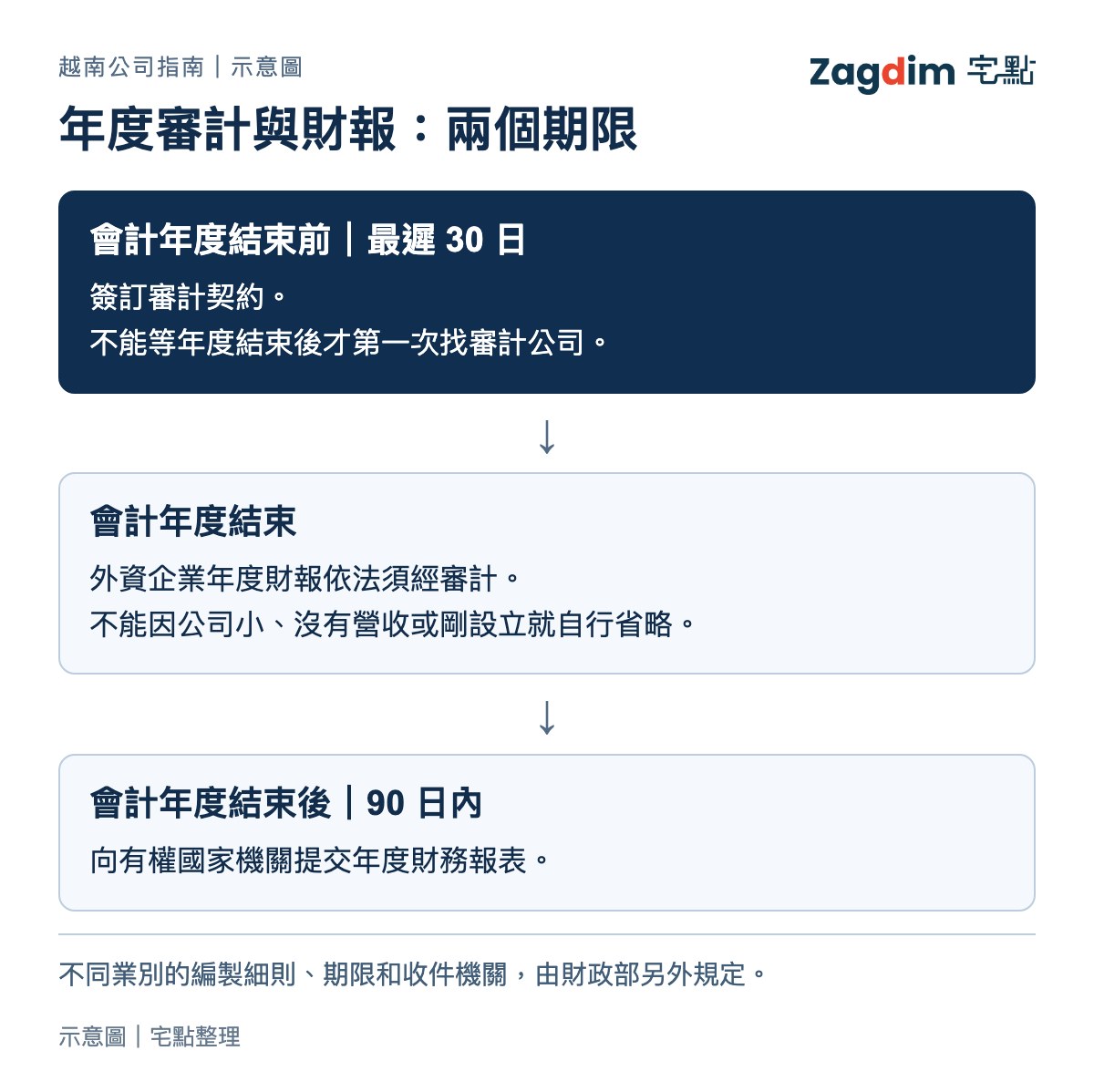
- Annual financial statement (báo cáo tài chính năm): A statement recording the company’s financial position for the year, which must be submitted to the competent state authority within 90 days after the accounting year ends. The detailed preparation rules, deadlines, and receiving authorities vary by industry and are set separately by the Ministry of Finance.
- Audit: An audit firm reviews the financial statement. The annual financial statements of foreign-invested enterprises (doanh nghiệp có vốn đầu tư nước ngoài) fall within the scope of mandatory audit under the law; this cannot be skipped just because the company is small, has no revenue, or was only recently incorporated.
- Audit contract: Must be signed no later than 30 days before the end of the accounting year; a company cannot wait until after year-end to engage an auditor for the first time.
Accounting-record retention periods are tiered by purpose:
| Record Type | Retention Period |
|---|---|
| Records used for management and operations, not directly used for bookkeeping or preparing financial statements | At least 5 years |
| Documents, ledgers, and annual financial statements directly used for bookkeeping or preparing financial statements | At least 10 years, or longer where other laws specify |
| Records of historical value or major economic, security, or defense significance | Permanent |
Example: If the owner’s company uses a January 1 to December 31 accounting year, it must still sign its audit contract at least 30 days before the accounting year ends and submit its financial statement within 90 days after the accounting year ends, even in a year with no revenue.
What Taxes Does a Company Have to Pay, and When Are They Filed and Paid?
This section separates the tax types from their deadlines. Companies in Vietnam deal with corporate income tax (CIT, thuế thu nhập doanh nghiệp) and value-added tax (VAT, thuế giá trị gia tăng, VAT), with filing deadlines that depend on monthly, quarterly, or annual settlement. The two taxes are calculated on different things, so they are covered separately below.
Corporate Income Tax: Start With Taxable Income, Then the Rate
Corporate income tax is calculated on taxable income, which is the income arrived at under tax law that is subject to tax. The tax rate cannot simply be multiplied against revenue.
| Situation | Tax Rate |
|---|---|
| General case | 20% |
| Total revenue in the preceding taxable year not exceeding VND 3 billion | 15% |
| Total revenue in the preceding taxable year above VND 3 billion but not exceeding VND 50 billion | 17% |
A flat 20% is not the actual burden for every foreign-invested company. There are also preferential rates or tax exemptions in some cases, and oil, gas, and rare-resource exploration and extraction follow separate rate rules.
- If operations in the preceding year covered less than 12 months: Actual total revenue is divided by the number of months of operation and multiplied by 12 to annualize it; the month in which the company was established or reorganized counts as a full month.
- A company newly established in the current period: Tax is paid provisionally based on estimated revenue, meaning part of the tax is prepaid in advance. If the final settlement shows the company does not actually qualify for the rate it estimated and it underpaid, it must pay the shortfall plus late-payment interest, except where the low-revenue exemption described below applies.
The 15% and 17% rates do not apply to the following income, with some items carrying further exceptions:
- Transfer of capital or the right to capital contribution
- Transfer of real estate
- Transfer of investment projects
- Transfer of the right to participate in a project, or the right to explore, extract, and process minerals
- Production and business operations carried out outside Vietnam
- Exploration and extraction of oil, gas, and rare resources or minerals
- Online games
- Production and business operations in goods and services subject to special consumption tax
A subsidiary or related enterprise (an enterprise with a related-party relationship) also does not qualify for the 15% or 17% rate if its related enterprise fails to meet the conditions for those rates.
An enterprise established under Vietnamese law whose total revenue in the preceding taxable year does not exceed VND 1 billion has its income treated as exempt from corporate income tax. Revenue here includes income from the sale of goods and services (without deducting revenue reductions), financial income, and other income. This exemption is also subject to the same income-type and related-party exclusions described above; it does not mean every small company, or every foreign-invested company, is tax-exempt, and it does not remove the obligation to file.
Example: If the owner’s company has total revenue not exceeding VND 3 billion in the preceding taxable year, it still needs to confirm the income type and related-party conditions before it can be sure the 15% rate applies.
VAT: A Separate Tax From Corporate Income Tax
VAT is charged on the value added to goods and services as they move through production, circulation, and consumption, and it is a different tax from corporate income tax. Goods and services supplied for production, business, or consumption in Vietnam fall within the scope of VAT in principle, except for items the law excludes. The actual rate depends on the type of goods or service, the method of calculating tax, and any time-limited incentives; not every company is on the same rate.
From July 1, 2025 to December 31, 2026, a VAT reduction applies to goods and services that would otherwise carry the 10% rate and are not excluded:
| Tax Calculation Method | Reduction |
|---|---|
| Input-deduction method (tax collected on sales minus tax paid on purchases) | 8% rate applies |
| Revenue-percentage method (tax calculated by multiplying revenue by a set percentage) | Calculation percentage reduced by 20% |
Telecommunications, finance, banking, securities, insurance, real estate business, metal products, mineral products (except coal), and goods and services subject to special consumption tax (except gasoline) are excluded; the detailed scope follows the relevant appendix. Goods and services that are already not subject to VAT, or already taxed at 5%, keep their existing treatment. The rate from January 1, 2027 onward needs to be confirmed separately.
Filing and Provisional Payment Deadlines
| Filing Item | Latest Deadline |
|---|---|
| Taxes required by law to be filed monthly | The 20th of the month following the month the obligation arose |
| Taxes required by law to be filed quarterly | The last day of the first month of the following quarter |
| A company’s general annual tax settlement filing (declaring the final tax due for the year) | The last day of the 3rd month after the settlement period ends |
| Decisions to cease business, dissolve, go bankrupt, terminate a contract, convert a state enterprise to shares, split, or merge | The 45th day after the decision is made |
Whether filing is monthly or quarterly is set by law; not every company can choose freely. If a deadline falls on a statutory day off, it is pushed to the next working day.
Companies with a provisional corporate income tax payment obligation need to note the following:
- Quarterly deadline: The provisional payment for each quarter is due no later than the last day of the first month of the following quarter.
- Annual floor: The total provisional payments across all four quarters cannot be lower than 80% of the final tax due under the company’s own annual settlement.
- Late-payment interest: Interest on any shortfall is calculated from the day after the 4th-quarter provisional payment deadline up to the day before the shortfall is paid.
- Newly established companies with low estimated revenue: A company newly established in the current period is exempt from provisional payment by law if its estimated total revenue does not exceed VND 1 billion; if actual revenue ends up exceeding the threshold, settlement is still required, but no late-payment interest is charged.
- Related enterprises: A subsidiary or related enterprise does not qualify for this provisional-payment exemption if its related enterprise does not meet the exemption conditions.
- Not an exemption from filing: Exemption from provisional payment does not mean exemption from filing or from the annual settlement; revenue recognition and income-type exclusions still need to be confirmed against the exemption rules above.
One more note: as of January 1, 2026, the business license fee (lệ phí môn bài) has been abolished, but this does not remove obligations for business registration fees, other taxes and fees, or existing arrears.
Who Pays Social Insurance, Health Insurance, and Unemployment Insurance When Hiring Employees?
Start with who pays the premiums. Social insurance, health insurance, and unemployment insurance are split between employer and employee by set proportions, while occupational accident and disease insurance is paid separately by the employer. Whether an employee must participate also depends on their status, their contract, and certain exceptions.
Mandatory social insurance (bảo hiểm xã hội bắt buộc) for Vietnamese employees, meaning employees who meet the conditions must participate:
- Employees working under an indefinite-term labor contract (one with no agreed end date), or a fixed-term contract of at least one month, fall within scope.
- Even if a contract is given a different name, if its substance is paid work carried out under one party’s management, direction, and supervision, it still applies.
- A part-time employee’s monthly wage must reach the minimum wage base used to calculate mandatory social insurance premiums.
- People already drawing a pension, those excluded by law from social insurance or a monthly allowance, and domestic workers are not within the mandatory scope.
Foreign employees who sign a fixed-term labor contract of at least 12 months with an employer inside Vietnam also fall within the scope of mandatory social insurance and health insurance (bảo hiểm y tế), with the following exceptions:
- Intra-company transfers
- Employees who have already reached statutory retirement age at the time of signing
- Cases otherwise provided for by an international treaty Vietnam has joined
- The same social-insurance exclusions as above: people already drawing a pension, those excluded by law, those receiving a monthly allowance, and domestic workers
Whether someone participates cannot be decided purely on shareholder status, and a work-permit exemption does not amount to a social-insurance exemption.
Contributions are split as follows:
| Insurance | Who It Covers | Employee Share | Employer Share |
|---|---|---|---|
| Social insurance | Employees who meet the mandatory-participation conditions | 8% of the contribution wage (retirement and death benefit fund) | 3% (sickness and maternity fund) plus 14% (retirement and death benefit fund) |
| Health insurance | Foreign employees who meet the conditions | One-third of 4.5% of the mandatory social-insurance contribution wage | Two-thirds of 4.5% of the mandatory social-insurance contribution wage |
| Unemployment insurance (bảo hiểm thất nghiệp) | Vietnamese citizen employees who meet the conditions | 1% of monthly wage | 1% of the total monthly wage of insured employees |
Special cases for social insurance:
- If an employee receives no pay for at least 14 working days in a given month, both sides are in principle exempt from contributing for that month, except where there is a separate agreement to pay based on the most recent month’s contribution base.
- In the first month of starting or returning to a job, if the employee takes sick leave of at least 14 working days, social insurance for that month must still be paid.
Who unemployment insurance covers, and reductions:
- It covers Vietnamese citizen employees working under an indefinite-term contract or a fixed-term contract of at least one month; part-time employees must reach the statutory minimum social-insurance contribution wage.
- People already drawing a pension, those on a designated social-insurance benefit or monthly allowance, those who already qualify for a pension, those working under a probationary contract under labor law, and domestic workers are excluded.
- When an employer newly hires and uses a worker with a disability, that employee’s employer-side contribution can be reduced from 1% to 0%. The reduction applies only during the actual working period, for at most the first 12 months after hiring, and requires registration with the social-insurance authority along with a copy of each employee’s disability certification.
Occupational accident and disease insurance: For mandatory social-insurance participants covered by occupational accident insurance rules, the employer must also contribute to the occupational accident and disease insurance fund, generally 0.5% of the mandatory social-insurance contribution wage for an ordinary company. Companies in high-risk industries can apply the lower 0.3% rate only if they meet the conditions and are approved; not every company can choose the lower rate on its own. Piece-rate or contracted work in agriculture, forestry, fishing, and salt production follows separate payment arrangements.
Labor management: Employers must also establish, update, and maintain a paper or electronic labor management register, and produce it when the competent authority requires. Within 30 days of starting operations, the company must declare its labor use, and during operations it must periodically report personnel changes to the labor authority under the provincial people’s committee and notify the social-insurance authority. This reporting does not replace the work-permit or work-permit-exemption notification procedure for foreign personnel.
Example: If the owner’s foreign employee signs a fixed-term labor contract of at least 12 months and does not fall under an exception, that employee is within the scope of mandatory social insurance and health insurance. If the Vietnamese employee signs a fixed-term contract of at least one month and is not excluded, that employee is within the scope of mandatory social insurance and unemployment insurance.
What Other Periodic Reports and Compliance Obligations Does a Foreign-Invested Company Have?
Beyond tax filing, there are several further standing obligations. A foreign-invested company also has to handle quarterly and annual reports on its investment project, monthly reports on foreign loans, beneficial-owner declarations, and ongoing compliance for conditional business lines. Each of these has its own audience and deadline, and none of them ends just because tax filing is done.
Investment Project Quarterly and Annual Reports
An economic organization carrying out an investment project must submit two reports to the local investment registration and statistics authority:
| Report | Due By | Content |
|---|---|---|
| Quarterly report | The 10th of the first month of the following quarter | Investment capital disbursed, net revenue, imports and exports, labor use, taxes and fees, and land and water-surface use |
| Annual report | March 31 of the following year | Also includes profit, employee income, R&D spending and investment, environmental treatment and protection, and the source of technology used |
Monthly Foreign-Loan Reports
Where a company has a foreign loan, the borrower must report online, no later than the 5th of each month, on the execution of its short-, medium-, and long-term borrowing for the preceding period. Only when the online system has a technical fault does the company switch to submitting a written report in the prescribed format. In other words, this monthly reporting obligation is not limited to registered medium- and long-term loans; short-term loans are included too.
Beneficial-Owner Declaration
A beneficial owner (chủ sở hữu hưởng lợi) is the individual who actually, ultimately owns or controls the enterprise. Both the company’s founders and the company itself must identify this person and declare and notify this information to the business registration authority. Identification requires looking through the ownership structure layer by layer until this person is found.
Where the structure includes a legal arrangement defined under anti-money-laundering law, the beneficial owner of that arrangement is identified under anti-money-laundering rules.
For an enterprise with legal-entity status, identification follows this order:
- Look at shareholding first: Check whether a natural person (an individual) directly, indirectly, or in combination holds at least 25% of registered capital or voting shares (shares carrying a vote). Where a group of natural persons with a statutory family relationship or a contractual relationship together hold at least 25%, every person in that group must be identified.
- Look at actual control: If no one meets the shareholding threshold, or there is reason to believe that a person who nominally meets it is not the true beneficial owner, the company must further trace actual control over appointing and removing management, amending the charter or restructuring the organization, financial and investment policy, and restructuring or dissolution.
- Look at the manager: If a beneficial owner still cannot be found, the company identifies the manager with the highest authority to act on the company’s behalf.
Individuals representing state capital are excluded, and all general partners in a partnership are not subject to the shareholding-percentage limit.
The following three approaches do not meet the requirement:
- Listing only the direct shareholders and treating identification as complete
- Declaring there is no beneficial owner simply because no single shareholder holds 25% or more
- Substituting the legal representative (the person who legally represents the company) for this identification
Example: If the owner later brings in family or friends as shareholders and each holds less than 25%, the company still cannot simply declare that there is no beneficial owner. Where a group of people with a statutory family relationship together hold at least 25%, every person in that group must be identified.
Conditional Business Lines
If a company operates in a conditional investment and business line, or a line subject to conditional market access for foreign investors, the relevant conditions are not only checked at the time of incorporation; they must be maintained throughout the entire period the business operates.
Can Profits Be Remitted Abroad at Any Time? What Are the Conditions?
Start with when profits can actually be remitted. The answer is that it cannot be done at any time: a foreign investor’s annual direct-investment profit must meet statutory conditions, and the tax authority must be notified in advance, before it can be remitted.
The following conditions must all be met at the same time:
- The accounting year has already closed
- The invested enterprise has completed its financial obligations to the Vietnamese state
- The audited financial statement and the annual corporate income tax settlement filing have already been submitted to the directly managing tax authority
- After carrying forward losses as required by law, the financial statement for the profit-making year shows no accumulated loss; if there is still an accumulated loss, that year’s profit cannot be remitted
On top of this, the investor or the entrusted enterprise must also notify the tax authority in the prescribed format at least 7 working days before the remittance. In other words, cash sitting in the account, the return of capital contributions, or loan principal cannot be treated as remittable annual profit, and remittance cannot happen before the year has been settled.
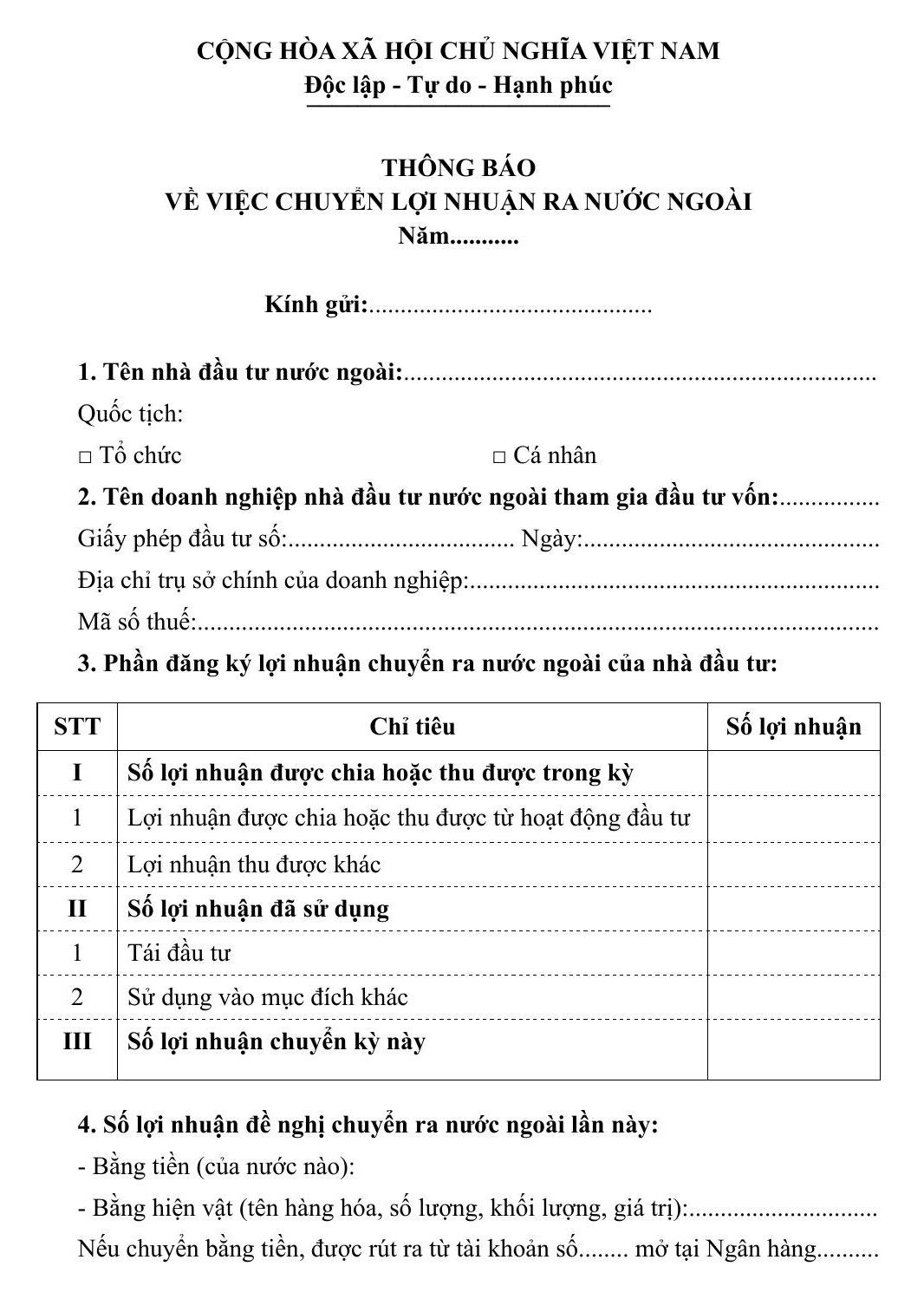
Example: If the owner wants to remit the company’s annual profit back to their home country, they cannot look only at how much cash is sitting in the account. They need to first confirm that all the conditions above have been met, then notify the tax authority in advance.
If a Company Suspends Operations or Dissolves, Do Its Responsibilities End There?
Suspending operations and dissolving need to be looked at separately. The answer is no, responsibilities do not end: during a suspension the company still has to deal with outstanding taxes, insurance, and debts, and before dissolution it must also be able to pay off all debts and other property obligations in full.
Suspension
- Advance notice: If a company wants to suspend operations, or resume operations earlier than the date it originally gave, it must notify the business registration authority in writing no later than 3 working days before the planned suspension date or the earlier resumption date. Having no revenue is not the same as having completed the suspension notification.
- Taxes and insurance: During a suspension, the company must still pay off any outstanding taxes, social insurance, health insurance, and unemployment insurance it owes.
- Debts and contracts: The company must also still settle its debts and fulfil contracts already signed with customers and employees, unless it has a separate agreement with its creditors, customers, and employees. State taxes and fees are not waived by this kind of agreement.
Dissolution
A company may only dissolve once it can ensure that all debts and other property obligations can be paid off in full, and provided it is not in the middle of a court or arbitration dispute process. If dissolution is triggered by the revocation of the company’s business registration certificate, the company and its relevant management personnel bear joint liability for the company’s debts, meaning they are jointly responsible for those debts together. Applying for dissolution does not mean all responsibility ends there.
Debt repayment on dissolution follows this order:
| Priority | Item Repaid |
|---|---|
| 1 | Employee wages, severance pay, social/health/unemployment insurance, and rights under collective or individual labor contracts |
| 2 | Taxes |
| 3 | Other debts |
Only after the costs of dissolution and all debts have been paid in full is any remaining property distributed to shareholders in proportion to their capital contribution or shareholding. In other words, capital cannot be returned to shareholders before employee and tax debts are settled.
Can the Owner of a Single-Member LLC Use Company Funds Freely?
Start by keeping the company’s money and the owner’s own money separate. The answer is no: the property of a single-member limited liability company’s owner must be clearly separated from the company’s property.
Where the owner is an individual, personal and household expenses must also be kept separate from expenses relating to that person’s role as chairman, director, or general manager. Company funds cannot be treated as the owner’s personal money to spend at will.
Example: The owner in this article’s examples is the company’s sole owner, but still cannot treat company funds as personal money; personal and household spending must be kept separate from spending tied to the owner’s role at the company.
Frequently Asked Questions
Does a small company get a lower corporate income tax rate? It may, but it depends on conditions. The general rate is 20%; a company with lower revenue in the preceding year may qualify for 15% or 17%, but only if it meets the revenue threshold, income-type, and related-party conditions. There are also separate preferential rates and exemptions, each of which needs to be checked against its own eligibility rules.
Are foreign employees exempt from Vietnamese social insurance? No. If a foreign employee signs a fixed-term labor contract of at least 12 months with an employer inside Vietnam, they are in principle within the scope of mandatory social insurance and health insurance. Exceptions include intra-company transfers, having already reached retirement age at the time of signing, or cases covered otherwise by a treaty.
Once a company stops operating, do unpaid taxes and employee wages no longer need to be paid? No, they still need to be handled. During a suspension, the company still has to pay off outstanding taxes and all insurance contributions, and it still has to settle debts and fulfil contracts already signed with employees. Where there is a separate agreement on debts and contracts, that agreement governs, but no agreement can waive what is owed to the state.
Glossary
- Beneficial owner (chủ sở hữu hưởng lợi): The individual who actually, ultimately owns or controls the enterprise; identifying this person requires tracing the ownership structure layer by layer, not just looking at the directly registered shareholders.
- Accounting year (kỳ kế toán năm): The annual accounting period of an accounting unit, usually January 1 to December 31, a full 12 months.
- Corporate income tax (thuế thu nhập doanh nghiệp): A tax calculated on an enterprise’s taxable income, with a general rate of 20% and separate tiers and preferential rates.
- Value-added tax (thuế giá trị gia tăng, VAT): A tax on the value added to goods and services as they move through production and circulation, and a different tax from corporate income tax.
About the Research for This Article
The research for this article was checked as of November 2, 2026. The conclusions on corporate income tax rate tiers, the scope and rates for social and health insurance, the monthly foreign-loan report, the conditions for remitting profits abroad, and the order of debt repayment on dissolution are drawn from laws published by Vietnam’s National Assembly, the Government, the Ministry of Finance, and the State Bank of Vietnam. None of the official documents checked for this article consolidate an “annual compliance checklist for foreign-invested companies” into a single document. The health insurance contribution rates set out here cover only eligible foreign employees; rates for Vietnamese employees are not included here. Some preferential tax rates and reductions are limited by sector, income type, or time period, and actual eligibility still needs to be assessed case by case. The VAT rate from January 1, 2027 onward is outside the scope of the sources checked for this article. When the foreign-loan reporting website has a technical fault, the written report uses the Appendix IV format. The owner in this article’s examples is a fictional scenario and does not represent an actual case.
Need help with this? Talk to the Zagdim reader desk
If you are deciding which route fits you, or which authority to deal with, the Zagdim reader desk can arrange a suitable specialist for your situation. The first consultation is free.
Message the Zagdim reader desk on WhatsApp Message the Zagdim reader desk on LINE
Have a question about this guide? Leave a comment below, or ask Zagdim directly.
Your first stop for international property and global living.
Research and insights. Know what’s changing. Understand what matters.
Sources
- Văn phòng Quốc hội – Văn bản hợp nhất số 67/VBHN-VPQH hợp nhất Luật Doanh nghiệp
- Chính phủ – Nghị định số 296/2026/NĐ-CP sửa đổi, bổ sung một số điều của Nghị định số 168/2025/NĐ-CP về đăng ký doanh nghiệp
- Bộ Tài chính – Văn bản hợp nhất số 19/VBHN-BTC hợp nhất Nghị định về Luật Thuế thu nhập doanh nghiệp
- Ngân hàng Nhà nước Việt Nam – Văn bản hợp nhất số 23/VBHN-NHNN hợp nhất Thông tư về quản lý ngoại hối đối với vay, trả nợ nước ngoài
- Bộ Tài chính – Thông tư số 186/2010/TT-BTC hướng dẫn chuyển lợi nhuận ra nước ngoài
- Văn phòng Quốc hội – Văn bản hợp nhất số 41/VBHN-VPQH hợp nhất Luật Kế toán
- Văn phòng Quốc hội – Văn bản hợp nhất số 17/VBHN-VPQH hợp nhất Luật Kiểm toán độc lập
- Văn phòng Quốc hội – Văn bản hợp nhất số 113/VBHN-VPQH hợp nhất Luật Thuế Thu nhập doanh nghiệp
- Chính phủ – Nghị định số 252/2026/NĐ-CP quy định chi tiết thi hành Luật Quản lý thuế
- Văn phòng Quốc hội – Văn bản hợp nhất số 19/VBHN-VPQH hợp nhất Luật Bảo hiểm xã hội
- Văn phòng Quốc hội – Văn bản hợp nhất số 40/VBHN-VPQH hợp nhất Luật Bảo hiểm y tế
- Quốc hội – Luật số 74/2025/QH15 luật Việc làm
- Chính phủ – Nghị định số 374/2025/NĐ-CP quy định về bảo hiểm thất nghiệp
- Chính phủ – Nghị định số 96/2026/NĐ-CP quy định thi hành Luật Đầu tư
- Quốc hội – Nghị quyết số 198/2025/QH15 về chính sách phát triển kinh tế tư nhân
- Văn phòng Quốc hội – Văn bản hợp nhất số 18/VBHN-VPQH hợp nhất Bộ luật Lao động
- Văn phòng Quốc hội – Văn bản hợp nhất số 114/VBHN-VPQH hợp nhất Luật Thuế Giá trị gia tăng
- Chính phủ – Nghị định 174/2025/NĐ-CP về giảm thuế giá trị gia tăng
- Bộ Nội vụ – Văn bản hợp nhất 05/VBHN-BNV về bảo hiểm tai nạn lao động, bệnh nghề nghiệp
Important Notice
This article is a general information summary and does not constitute tax or legal advice for any individual case. The information was checked as of November 2, 2026. Vietnam’s rules can be updated, and so can the rules in your own country or place of residence that affect how they apply to you; please follow the current announcements from the relevant authorities, and consult a qualified professional for your specific situation.