On October 12, 2026, the Vietnamese government signed a resolution, effective the same day, that lets tour groups holding Chinese ordinary passports visit Khanh Hoa Province without a visa; the Chinese Embassy in Vietnam announced it on October 14. The conditions are narrow: a minimum of 2 travelers, on a package tour by a Vietnamese international travel company, limited to Khanh Hoa Province, flying direct from mainland China to Cam Ranh Airport and leaving from the same airport. Hong Kong and Macao SAR passports do not qualify. Anyone outside these conditions still needs to check whether their passport requires a visa before going to Vietnam. This guide explains how to apply for the Vietnam electronic visa (e-visa) and what to watch for depending on your passport.
The short answer: if you hold a Hong Kong SAR, BN(O), Taiwan or mainland China passport, plan on needing a visa to visit Vietnam. There are only two exceptions: direct entry to Phu Quoc Island (all passports, that island only) and the Khanh Hoa Province group-tour visa exemption trial (mainland China ordinary passports only; Hong Kong and Macao passports do not qualify). Apply for the e-visa yourself on the official portal, evisa.gov.vn or thithucdientu.gov.vn. The government fee is USD 25 for a single entry and USD 50 for multiple entries, with validity of up to 90 days. Singapore and Malaysia ordinary passports can stay visa-free for 30 days.
This guide answers:
- Does my passport need an e-visa?
- What do I need to prepare? What are the photo specifications, and should I choose single or multiple entry?
- How are the 90 days counted? What if the application is not yet approved, is refused, or contains a mistake?
- How can I tell the official website from fake sites and paid agents?
Key Points
- Who this is for: Travelers going to Vietnam for tourism, family visits, property viewing or short business talks, including holders of Hong Kong, Taiwan, mainland China, Singapore and Malaysia passports.
- Eligibility: Since August 15, 2023, Vietnam has opened the e-visa to citizens of all countries and territories. You must be outside Vietnam when you apply; foreigners already temporarily residing in Vietnam are not issued one.
- Fees: USD 25 for a single entry, USD 50 for multiple entries; the application fee is not refunded if the application is refused.
- Timing: The official processing deadline is within 3 working days of receiving the application and fee. This is not a guarantee of approval. Taiwan’s Bureau of Consular Affairs lists an application time of 3 to 7 working days.
- 2026 update: New documents, including e-visa form NA1a, were issued in a circular published May 25 and effective July 1. Fields and photo specifications in older guides may not apply.
- Do not confuse: The PAI (pre-arrival information) declaration is not a visa. Completing it does not give you entry eligibility.
Do You Need One? Look at Your Passport, Not Where You Live
Whether you need a visa depends on the type of passport you actually hold and your purpose of entry. A Hong Kong identity card, your place of residence or the language you use cannot replace the passport check.
| Passport | Current position | What to note |
|---|---|---|
| Hong Kong SAR passport | Hong Kong Express’s travel document guidance lists a visa as required, with Phu Quoc Island as an exception; you can apply for an e-visa under the rule that it is open to all countries and territories | This is the airline’s summary. Vietnam’s Ministry of Foreign Affairs visa exemption list does not show Hong Kong SAR passports, but that is not an official item-by-item statement about Hong Kong passports. Confirm with the airline or a Vietnamese mission abroad before departure. Do not apply it to the Document of Identity for Visa Purposes or to all Hong Kong residents |
| BN(O) passport | The Vietnam Ministry of Foreign Affairs exemption list states that the exemption treatment in that list does not apply, and an appropriate visa is required | The 45-day visa exemption for British citizens cannot be applied |
| Taiwan ordinary passport | Taiwan’s Bureau of Consular Affairs lists Taiwan as eligible for the e-visa | Plan on needing a visa for mainland Vietnam. If you see a “visa-free” claim, ask whether it refers to Phu Quoc Island or to the document reserved for relatives of Vietnamese nationals; those are different systems |
| Mainland China ordinary passport | You can apply for an e-visa under the rule that it is open to all countries and territories; there is also a visa-free trial for Khanh Hoa group tours | The China-Vietnam bilateral agreement lists diplomatic, official and “official ordinary” passports; ordinary passports are not in it |
| Singapore ordinary passport | Visa-free stay of 30 days | How long you can actually stay is the period approved on entry |
| Malaysia ordinary passport | Visa-free stay of 30 days | This is a passport entitlement; it does not apply to people of other nationalities who only live in Malaysia |
What should BN(O) holders do? Confirm with a Vietnamese mission abroad before applying, based on the passport you will use to enter. The exemption list only says an appropriate visa is required and does not specify the type.
When should Singapore and Malaysia passport holders consider a visa? When you will stay more than 30 days, or the trip is for more than tourism, first confirm whether the visa exemption applies. Singapore’s Ministry of Foreign Affairs points out two things: if you enter on the 30-day exemption and another visa is approved later, the original period of stay does not extend automatically; and if you enter on a separately applied visa, you can stay until the last valid day of that visa, which may be shorter than 30 days.
Can anyone not use this route? Yes. People listed in Article 21 of Vietnam’s law on entry, exit, transit and residence of foreigners as not permitted to enter do not qualify. Foreigners under Article 8, clauses 1 to 4 of the same law also do not use the individual e-visa application; the inviting or guaranteeing agency must apply to the competent authority of the Ministry of Foreign Affairs.
When to Apply and What to Prepare
When to apply? Apply while you are still outside Vietnam, and allow for processing time. Vietnam’s Ministry of Public Security lists a deadline of within 3 working days of receiving the application and the visa fee, with the clock starting when the fee arrives. Taiwan’s Bureau of Consular Affairs says 3 to 7 working days. Neither is a guaranteed time, so Zagdim recommends that anyone with a fixed itinerary submit early rather than leaving it to just before departure.
You cannot enter before the visa takes effect. The issue date and the effective date are two different dates, and you can enter on the visa only once it is effective. The start and end dates you enter on the form must match your actual trip.
Prepare these before applying: a portrait photo, passport details, contact and occupation details, and trip details.
| Item | Form requirement |
|---|---|
| Portrait photo | Recent, 4 x 6 cm, JPG or JPEG, no larger than 2 MB; white background, facing forward, no hat, no glasses, appropriate dress |
| Passport data page | Upload an image file. The 2 MB limit is for the portrait photo; do not apply it directly to the passport file, and go by what the upload page shows |
| Name | In capital letters, as in the machine-readable zone (ICAO) at the bottom of the passport data page |
| Passport details | Type, number, issuing authority or place, issue date, expiry date |
| Contact details | Contact address, current residential address, phone, email; emergency contact’s name, address, phone and relationship |
| Occupation details | Current occupation; name, position or course, address and phone of the company, agency or school |
| Trip details | Intended period of stay, entry date, entry and exit border gates, address of accommodation in Vietnam, phone number in Vietnam |
| Other questions | Whether you visited Vietnam in the past year, whether you have entered on another passport, whether you hold multiple nationalities |
All information must be filled in in English, and must be complete, accurate and truthful.
A few fields are easy to overthink:
- Insurance: The form asks whether you have arranged health insurance for your stay in Vietnam, with options of yes or no. This field lists no minimum coverage, and you cannot conclude from it that everyone must buy insurance.
- Travel funds: This field is entered in US dollars; it does not imply a minimum financial threshold.
- Flight tickets and hotel bookings: The itinerary field must be fillable. Whether you must attach documents is handled according to what the application page requires.
Single or multiple entry? Choose single entry if you will enter and leave Vietnam only once. If you will leave Vietnam for a neighboring country and come back, choose multiple entry; if you hold a single-entry visa, leave, and want to enter again, you must apply again.
For example, a Hong Kong SAR passport holder enters at Ho Chi Minh City, goes to Cambodia for a few days, then returns to Vietnam. They should apply for a multiple-entry visa and make the start and end dates cover the whole trip. If they applied for single entry, they would have to apply again before returning to Vietnam.
How long must the passport be valid? Taiwan’s Bureau of Consular Affairs gives the rule that the visa validity must be at least 30 days shorter than the passport validity. This does not mean you can travel with a passport that has just over a month left. Vietnam’s tourism visa exemption for another group of countries requires a passport with at least 6 months of validity remaining; that is a different system, but it is a reminder: if your passport is about to expire, Zagdim recommends renewing it before applying and confirming boarding requirements with the airline.
How do you fill in the border gates? The e-visa can be used only at gates on the government list, for both entry and exit. The list names 83 gates in all: 17 airports, 27 land border gates and 39 seaports.
| Type | Examples on the list |
|---|---|
| Airport | Noi Bai, Tan Son Nhat, Cam Ranh, Da Nang, Cat Bi, Can Tho, Phu Quoc |
| Land | Mong Cai, Huu Nghi, Lao Cai, Moc Bai |
| Rail | Dong Dang, Lao Cai |
83 is the number of names on the list; it does not mean every gate has services or is operating today. Long Thanh and Gia Binh airports are on the list but apply only once they begin operating. If you will enter by land, rail or sea, check the operating status of that gate before departure.
How to Apply
Apply on the official portal, evisa.gov.vn or thithucdientu.gov.vn, in eight steps.
- Go to the official portal: English at https://evisa.gov.vn, Vietnamese at https://thithucdientu.gov.vn. Type the address in yourself.
- Fill in the details: Complete the e-visa application form in English, choose single or multiple entry, and enter the start and end dates.
- Upload files: Upload your portrait photo and the passport personal data page.
- Note your electronic application code: The system gives you a code when you finish; you need it later for payment and lookups.
- Pay: After getting the code, pay the visa fee on the designated portal.
- Check progress: Look up the processing status using the code.
- Print the e-visa: Once approved, look it up with the code and print it, and also save a copy on your phone. The Vietnamese Consulate General in Sydney adds that visa information is sent to the email address you entered in the application.
- Check it: Compare name, passport number, start and end dates and single or multiple entry item by item.
The layout of the website fields may not be identical to the form, so go by the page in front of you.
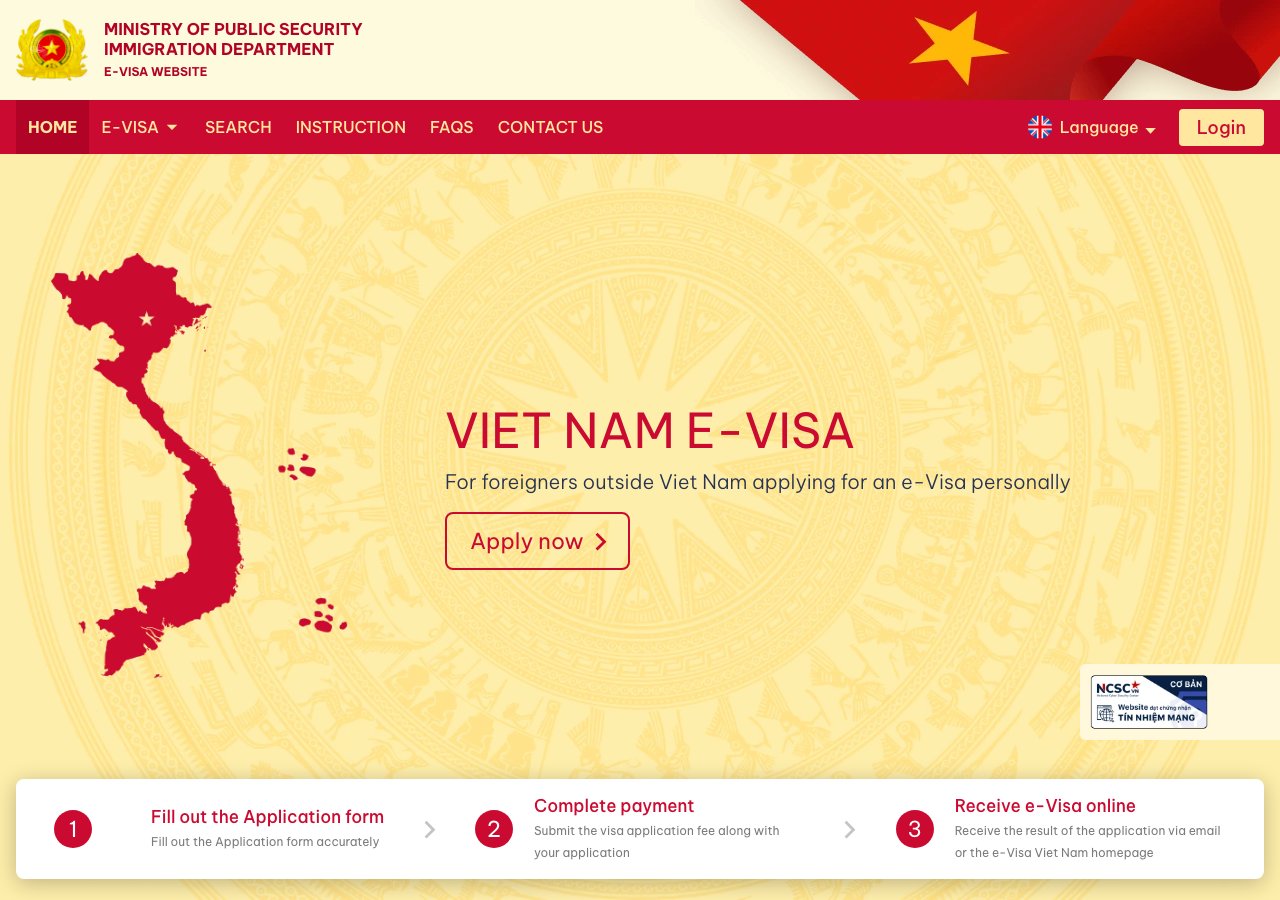
Paying does not mean you have the visa. You have a visa only when you see the approval result.
Do You Need to Fill In the PAI Pre-Arrival Declaration?
PAI is a pre-trip data declaration. It does not accept or process visa applications. For e-visa holders, the visa and PAI are two separate things.
Three sources do not agree, and none says which is newer or which is in force. The Vietnam Ministry of Public Security announced on May 13, 2026 that Tan Son Nhat Airport had been running a trial since April 15, and described it as optional rather than mandatory. The Singapore Embassy in Hanoi announced on June 25 that PAI now covers Noi Bai, Tan Son Nhat and major airports such as Da Nang, Nha Trang and Phu Quoc, and encourages travelers to complete it. Singapore’s Ministry of Foreign Affairs travel page relays a notice from the Ho Chi Minh City immigration office saying foreigners entering through Tan Son Nhat must submit information in advance (transit passengers excepted), and says it currently applies only to Tan Son Nhat.
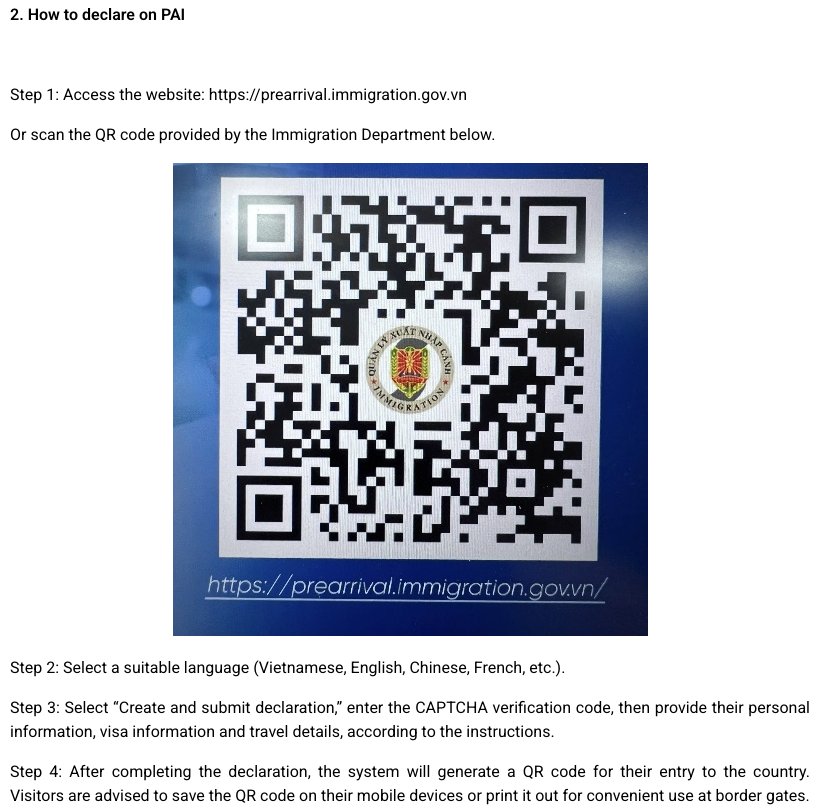
Zagdim recommends confirming with your airline before departure whether it is mandatory at each airport right now. Travelers flying to the airports above can complete it first by following these steps:
- Go to https://prearrival.immigration.gov.vn or scan the official QR code.
- Choose a language; the official options include Chinese.
- Choose to create and submit a declaration, and fill in personal, visa and trip details.
- Complete it within 3 days before entry, and keep the QR code the system generates on your phone or print it.
The authority notes that some unsuccessful declarations come from wrong flight numbers and booking data, so check once more before submitting.
Cost and Validity
A single-entry e-visa costs USD 25, a multiple-entry e-visa USD 50, and validity is up to 90 days.
| Item | Amount or period |
|---|---|
| Single entry | USD 25 |
| Multiple entry | USD 50 |
| Visa for children under 14 | The 2026 fee circular lists USD 25 per visa regardless of validity; how the e-visa system applies it is as shown on the payment page |
| Validity | Up to 90 days |
| If refused | Application fee is not refunded |
The current fee circular has been in effect since April 1, 2026.
- USD 25 and USD 50 are government fees: An electronic payment charge may be added at payment. The total on your card statement is as shown on the payment page and by your card issuer.
- 90 days is the maximum: Not every visa is approved for the full 90 days. Validity is the start and end dates on the document you receive. Do not work it out from the application or approval date, and do not assume each entry resets to 90 days.
- Which day you may stay until: On entry, check the approved period of stay. Do not remember only the number of days on the visa.
Families, Children, Transit and Other Common Situations
A child who shares the applicant’s passport goes in the accompanying-child field, and everyone else applies on their own passport.
Do children apply separately? It depends on the passport. A child under 14 who shares the applicant’s passport goes in the accompanying-child field of the form, with a photo of the same specification. A child who already has their own passport cannot be included in that field and must submit their own application. Whether a child on a shared passport is charged separately is as shown on the payment page.
Only going to Phu Quoc? If you enter Phu Quoc Island directly from abroad, you can stay visa-free for 30 days. It also applies if you stay in the transit area of a Vietnamese international airport or seaport and then fly on to Phu Quoc. If you first enter Hanoi or Ho Chi Minh City, collect your baggage and change to a domestic flight, you cannot assume it applies just because the last stop is Phu Quoc. The scope of this arrangement is Phu Quoc Island; if you want to go elsewhere beyond the island, confirm with a Vietnamese mission abroad before departure.
Transiting through Vietnam? Only the Phu Quoc transit-area arrangement above is spelled out in writing. For transfers to other places, or transfers that leave the transit area, confirm with the airline before booking.
Joining a Khanh Hoa tour group? It applies only to valid Chinese ordinary passports, and all conditions must be met: a minimum of 2 travelers, a package tour by a Vietnamese international travel company, no more than 30 days, limited to Khanh Hoa Province, flying direct from mainland China to Cam Ranh and leaving from the same airport; valid until December 31, 2027. The resolution also requires the authorities to issue separate operating guidance, so before booking, ask the travel agency whether it can already process this.
Viewing property, business talks or work? Your activities in Vietnam must match your purpose of entry, and the purpose field on the form should be filled in truthfully. People going to Vietnam to work must have a work permit as required by law, or documents proving a permit is not required. An e-visa is not a right to work.
Already in Vietnam and want to extend? The e-visa is not issued to foreigners already temporarily residing in Vietnam, so do not assume it can be extended automatically online. Confirm with the local immigration authority how to extend or change your visa lawfully.
What If You Made a Mistake, Were Refused, or Are Not Yet Approved?
Check the case status on the official portal first, and do not pay again or resubmit until you know what the authorities allow.
Made a mistake? Zagdim recommends not paying yet and not rushing to submit another application. First check the case status on the official portal and ask the support channels listed on the portal or a Vietnamese mission abroad whether it can be corrected. Vietnamese immigration authorities refuse applications when they find false information, so it is better to check once more.
Flight, dates, gate or passport changed after approval? Do not assume changes are free, or that you may arrive earlier. First confirm with the authorities whether your case can be changed and how.
| Change | What to do first |
|---|---|
| Entry date | Compare it with the visa’s start and end dates; you can enter only once it is effective |
| Entry or exit gate | Confirm the new gate is on the government list, and check with the portal’s support or a Vietnamese mission abroad |
| Name or passport number | If the approved data does not match your passport, confirm with the authorities before departure; do not board with doubts |
Taiwan’s Bureau of Consular Affairs also notes that people entering by land may be asked to leave through the same gate, so people with such an itinerary should confirm first.
Refused? The application fee is not refunded. First check whether the data has errors, then ask a Vietnamese mission abroad whether you can reapply and how long you would have to wait, or use another visa route.
Departure is close and it is not approved yet? Check the status with your application code and ask the portal’s support or a Vietnamese mission abroad. Do not stake your departure date on expediting, and be wary of promotions for “guaranteed expedited” or “guaranteed approval.” If the visa has not come through, do not assume you can board, and do not treat an e-visa, a visa on arrival and visa exemption as the same thing.
How to Tell Fake Sites and Paid Agents Apart
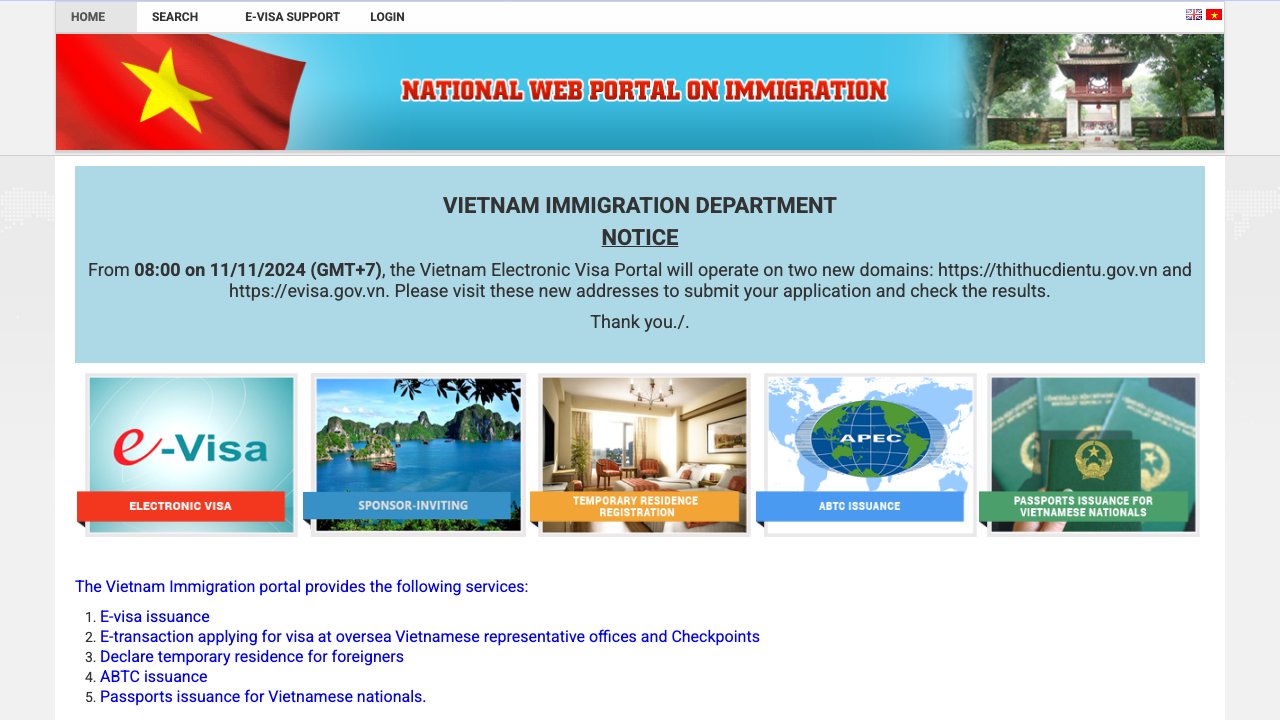
Use only the official addresses, and treat any other site or any extra fee as a warning sign.
The Vietnamese Consulate General in Sydney reminds applicants to use the official website and to watch for unofficial sites that charge high service fees or show signs of fraud. The Vietnam Ministry of Public Security has also warned that fake PAI websites have been found, which may be used to steal credit card data.
Look only at the full address:
| Purpose | Official address |
|---|---|
| e-visa (English) | https://evisa.gov.vn |
| e-visa (Vietnamese) | https://thithucdientu.gov.vn |
| PAI pre-arrival declaration | https://prearrival.immigration.gov.vn |
How to judge the site in front of you:
- Compare the address character by character. A page that looks like the official site, an address that contains “evisa,” or a search ad ranked first are not grounds to trust it.
- Check the amount before paying. The e-visa government fee is USD 25 or 50; if the charge is clearly higher, ask what the extra fee is and who collects it.
- Ask who the other party is. Unofficial sites may charge extra service fees and may be impersonators; not every agent is a scam, but no one should promise you approval.
- Treat “pay and be approved” or “guaranteed in 3 days” as a warning sign.
- A PAI page that wants you to pay a “visa fee” should make you stop and check the address, because PAI is a declaration.
- Enter passport photos and credit card details only after you have confirmed the address.
FAQ
Does a Hong Kong SAR passport need a visa for Vietnam?
Plan on needing one. Hong Kong Express’s guidance lists a visa as required, with Phu Quoc Island as an exception. The e-visa is open to citizens of all countries and territories; confirm the latest requirements with the airline or a Vietnamese mission abroad before departure.
Do Taiwanese travelers need a visa for Vietnam?
Plan on needing a visa for mainland Vietnam. Taiwan’s Bureau of Consular Affairs explicitly lists Taiwan as eligible for the e-visa; Phu Quoc Island and the document for relatives of Vietnamese nationals are separate systems.
How much does a Vietnam e-visa cost?
The government fee is USD 25 for single entry and USD 50 for multiple entries, not refunded if refused. An electronic payment charge may be added at payment, as shown on the payment page.
How many days does the Vietnam e-visa take?
Officially within 3 working days of receiving the application and fee, according to Vietnam’s Ministry of Public Security; Taiwan’s Bureau of Consular Affairs lists 3 to 7 working days. None of these is a guarantee of approval.
From which day are the 90 days counted?
Go by the start and end dates on the visa. Do not work it out from the application or approval date. 90 days is a maximum, and do not assume it restarts on each entry.
If I go to Cambodia and come back to Vietnam, do I need a multiple-entry visa?
If you will leave Vietnam and come back, choose multiple entry. If you hold a single-entry visa, leave, and want to enter again, you must apply again.
Do I still need a visa if I filled in PAI?
Judge by your passport. PAI is only a pre-trip data declaration and does not accept or process visa applications.
Important Notice
This is general information, not financial, tax or legal advice, and it does not mean a visa will necessarily be approved. It is based on public information from the Vietnamese government, Vietnam’s Ministry of Public Security, Ministry of Foreign Affairs and overseas missions, and from agencies such as Taiwan’s Bureau of Consular Affairs, Singapore’s Ministry of Foreign Affairs and China’s Ministry of Foreign Affairs; some passport-specific information comes from airlines. It was checked on October 31, 2026. Names of laws in English are working translations, and the official text is the Vietnamese original. Entry eligibility, fees, validity, forms, border gates and declaration rules change, so follow the latest announcements of the Vietnamese authorities and missions abroad.
Have a question about this guide? Leave a comment below, or ask Zagdim directly.
Your first stop for international property and global living.
Research and insights. Know what’s changing. Understand what matters.
Sources
- Government of Vietnam: Resolution No. 127/NQ-CP (e-visa eligible persons and gates) (https://datafiles.chinhphu.vn/cpp/files/vbpq/2023/8/127nq.signed.pdf)
- Government of Vietnam: Resolution No. 389/NQ-CP (additional e-visa gates) (https://datafiles.chinhphu.vn/cpp/files/vbpq/2025/12/389-nq.signed.pdf)
- Government of Vietnam: Resolution No. 325/NQ-CP (visa exemption for Chinese citizens on group tours) (https://datafiles.chinhphu.vn/cpp/files/vbpq/2026/10/325_nq-cp_12102026-signed.signed.pdf)
- Vietnam Ministry of Public Security Immigration Department: notice of the new official e-visa domains (https://immigration.gov.vn/)
- Vietnam Ministry of Public Security public service portal: procedure for issuing e-visas at the request of foreigners (https://e-services.mps.gov.vn/bocongan/bothutuc/tthc?matt=26277)
- Vietnam Ministry of Public Security: explanation of the new forms under Circular No. 70/2026/TT-BCA (https://mps.gov.vn/chinh-sach-phap-luat/bai-viet/nhung-diem-moi-theo-thong-tu-so-70-2026-tt-bca-1786525709)
- Vietnam Ministry of Public Security: Form NA1a e-visa application form (annex to Circular No. 70/2026/TT-BCA, on the Quang Ngai provincial police website) (https://congan.quangngai.gov.vn/upload/2007003/20260704/Bieu_mau_kem_theo_Thong_tu_70_5cd84.rar)
- Vietnam Ministry of Public Security: Immigration Department launches Pre-arrival Information System (https://en.bocongan.gov.vn/article/immigration-department-launches-pre-arrival-information-system-1778670404)
- ASEM Connect Vietnam: Circular No. 28/2026/TT-BTC, full English text (https://asemconnectvietnam.gov.vn/law.aspx?CapBanHanhID=112&ID1=0&MaVB_Id=3127&TukhoaCoSanID=14&ZID1=0&key=&pagenum=0)
- Vietnam Ministry of Foreign Affairs and Embassy in Singapore: Viet Nam’s Visa Exemption List (https://vnembassy-singapore.mofa.gov.vn/web/guest/tin-chi-tiet/chi-tiet/viet-nam-39-s-visa-exemption-list-57163-172.html)
- Embassy of Vietnam in Switzerland: list of gates open to the e-visa (https://vnembassy-bern.mofa.gov.vn/vi/tin-chi-tiet/chi-tiet/viet-nam-bo-sung-41-cua-khau-quoc-te-cho-phep-nguoi-nuoc-ngoai-nhap-canh-xuat-canh-bang-thi-thuc-dien-tu-e-visa–59652-1423.html)
- Embassy of Vietnam in Belgium: notice on Resolution No. 229/NQ-CP, tourism visa exemption (https://vnembassy-bruxelles.mofa.gov.vn/en/tin-chi-tiet/chi-tiet/thong-bao-ve-nghi-quyet-cua-chinh-phu-ve-viec-mien-thi-thuc-theo-chuong-trinh-kich-cau-phat-trien-du-lich-59009-1354.html)
- Vietnamese Consulate General in Sydney: How to apply for a visa to Vietnam (https://vietnamconsulate.org.au/en/services/how-to-apply-for-a-e-visa-to-vietnam)
- Vietnamese Consulate General in Sydney: Vietnam visa exemption list (https://vietnamconsulate.org.au/en/services/mien-thi-thuc)
- Taiwan Bureau of Consular Affairs: Vietnam travel advisory (https://www.boca.gov.tw/sp-trwa-content-3127-c0824-1.html)
- Taiwan Bureau of Consular Affairs: Vietnam country information and visa reminders (https://www.boca.gov.tw/sp-foof-countrycp-02-8-f4a19-02-1.html)
- China Ministry of Foreign Affairs, Department of Consular Affairs: list of visa exemption agreements between China and other countries (https://cs.mfa.gov.cn/zggmcgx/cgqzapecswlxk/ylb/202607/t20260716_11984014.html)
- Chinese Embassy in Vietnam: Vietnam’s visa exemption policy for Chinese citizens traveling to Khanh Hoa Province (https://vn.china-embassy.gov.cn/lsyw/202610/t20261014_12039922.htm)
- Singapore Ministry of Foreign Affairs: Vietnam travel advisory and visa information (https://www.mfa.gov.sg/travelling-overseas/travel-advisories-notices-and-visa-information/vietnam/)
- Singapore Embassy in Hanoi: Pre-Arrival Declaration for Foreign Travellers Entering Vietnam (https://hanoi.mfa.gov.sg/mission-updates/pre-arrival-declaration-for-foreign-travellers-entering-vietnam/)
- Hong Kong Express: Travel Documents (https://www.hkexpress.com/en/Plan-Your-Trip/Travel-Documents)