

*Written and verified by the Zagdim Research Desk. Last verified: November 17, 2026.*
On July 2, 2026, NAPAS (the National Payment Corporation of Vietnam) announced that QR payments between Vietnam and Singapore had officially launched. Travelers using participating Singapore apps can now scan to pay at Vietnamese merchants that display the VietQRGlobal mark. The service covers only participating apps and marked merchants. It does not mean a foreign banking app can scan every Vietnamese shop’s payment code. This Vietnam payments guide, compiled by Zagdim, sets out how to pay in Vietnam as a short-stay visitor, a student or worker, or a long-term resident: Vietnamese dong cash, cards, VietQR and VietQRGlobal, and local e-wallets.
The short answer: short-stay visitors should rely on Vietnamese dong cash plus an international card that merchants accept, then check whether their own app can scan VietQRGlobal merchants. Official announcements currently cover Alipay and WeChat Pay from mainland China, and participating Singapore payment apps. Do not assume apps from Hong Kong, Taiwan or Malaysia work until you have confirmed it. The local e-wallets MoMo, ZaloPay and Viettel Money all require identity verification, and ZaloPay and Viettel Money also require you to link your own Vietnamese dong bank account. Zagdim suggests short-stay visitors do not count on them as a pre-trip fallback.
This guide answers these questions:
- Are you a visitor, a student or worker, or a long-term resident, and which payment methods does each have?
- Can you pay by card in Vietnam, and what do you choose when the terminal asks which currency to charge?
- What is the difference between VietQR and VietQRGlobal, and which apps can scan in Vietnam?
- Can foreigners register for MoMo, ZaloPay and Viettel Money?
Where to exchange money and how to avoid exchange scams is covered separately in the Vietnam currency exchange guide.
Key Points
- Who should read this: visitors from Hong Kong, Taiwan, mainland China, Singapore and Malaysia, and anyone studying, working or living in Vietnam, or buying or renting a home there.
- Cash: dong banknotes run from 10,000 to 500,000 dong, and coins are not used. The official tourism guide says small purchases and street vendors use cash.
- Cards: the official tourism guide says hotels, tour operators, boutiques, restaurants, grocery stores and spas accept international cards, but not every shop is guaranteed to. Ask before you pay.
- VietQR is not VietQRGlobal: VietQRPay is QR payment at merchants inside Vietnam. VietQRGlobal is international QR payment. Foreign apps need merchants showing the VietQRGlobal mark.
- Check the list of apps: Alipay and WeChat Pay from mainland China and participating Singapore payment apps have official announcements. Apps from Hong Kong, Taiwan and Malaysia need to be confirmed with the operator.
- Local wallets: MoMo can verify with a foreign passport. ZaloPay and Viettel Money require a link to your own Vietnamese dong bank account.
- Cash declaration: entering or leaving with more than the equivalent of US$5,000 in foreign-currency cash, or more than VND 15,000,000 in cash, must be declared to customs at the border gate.
Which Kind of Visitor Are You?
Which payment methods you can use depends on whether you are a short-stay visitor, a student or worker, or a long-term resident, and then on your apps and the merchant. The three groups start from different places:
| Your situation | Options | What you must still confirm |
|---|---|---|
| Short-stay visitor | Vietnamese dong cash, an accepted international card, VietQRGlobal merchants (your app must be on the announced list), Grab with an international card linked | Whether the card is accepted and what foreign transaction fees apply; whether your app supports VietQRGlobal; the cash declaration threshold |
| Student or worker | The above, plus MoMo, ZaloPay, Viettel Money and a Vietnamese bank account | Whether you count as a foreigner “residing in Vietnam”; whether the wallet requires a link to your own dong account; the bank’s own screening of you |
| Long-term resident | The above; a local bank account and bank-linked wallets | Proof of visa or visa exemption; each bank’s and wallet’s own account-opening conditions |
This table is a reading guide, not an approval of your personal eligibility.
Payment Methods Compared
There are six common ways to pay in Vietnam: Vietnamese dong cash, international cards, VietQRGlobal scan-to-pay, MoMo, ZaloPay and Viettel Money.
| Method | Who can use it | What to prepare | Where it works |
|---|---|---|---|
| Vietnamese dong cash | Everyone | Dong banknotes | Small purchases and street vendors; the fallback when cards or QR are not accepted |
| International card (Visa etc.) | Holders of an accepted card | For contactless, a card with the contactless symbol and the function switched on | Hotels, restaurants, shops and other merchants that accept cards; ask before paying |
| VietQRGlobal scan-to-pay | Users of Alipay and WeChat Pay from mainland China, and of participating Singapore payment apps | An app with overseas payment switched on | Merchants showing the VietQRGlobal mark |
| MoMo | People who complete identity verification | A foreign passport can be used to verify the in-app e-wallet account | Merchants that accept MoMo; whether you can top up and use it fully depends on what the app shows |
| ZaloPay | Users who meet its terms | Your own Vietnamese dong bank account or a linked debit card; foreigners residing in Vietnam also need visa-type documents | Merchants that accept ZaloPay |
| Viettel Money | Users who meet its terms | Your own Vietnamese dong bank account or a linked debit card; identity documents and a biometric check | Merchants that accept Viettel Money |
How to Get Started With Each Method
Prepare Vietnamese dong for cash, confirm acceptance before paying by card or QR, and check whether you meet the conditions before relying on a local wallet.
Cash: Do You Still Need Dong in Vietnam?
Yes, bring some Vietnamese dong. The official tourism guide says small purchases and street vendors use cash, and Zagdim suggests keeping cash as the fallback when cards and QR codes are not accepted.
- Denominations: the official tourism guide lists banknotes from 10,000 to 500,000 dong and says coins are not used.
- Notes that are easy to confuse: the 20,000 dong and 500,000 dong notes are a similar shade of blue, and the official tourism guide advises checking the denomination before paying. Zagdim suggests spreading out your change and reading the number on each note before putting it away.
- Where to exchange: the official tourism guide says currency exchange points are located before the departure gates at Vietnam’s international airports, and that after arrival you can exchange at hotels, tourist areas and local banks. For where to exchange, gold shops and scams to avoid, see the Vietnam currency exchange guide.
Do you have to declare cash when entering or leaving? It depends on the amount. Under the State Bank of Vietnam’s rules on carrying cash, an individual traveling on a passport through a Vietnamese international border gate must declare to customs foreign-currency cash worth more than US$5,000, or Vietnamese dong cash of more than VND 15,000,000. A traveler entering with foreign-currency cash worth no more than US$5,000 who intends to deposit it in a foreign-currency account held in their own name at an authorized financial institution must also declare it. The rule covers cash only. It does not cover bank cards, traveler’s checks or account balances.
Cards and ATMs: Can You Pay by Card in Vietnam?
Yes, but ask the staff before you pay. The official Vietnam tourism guide says hotels, tour operators, boutiques, restaurants, grocery stores and spas generally accept international debit and credit cards, and also says not every merchant is guaranteed to.
For contactless payment, look for the symbol. Visa Vietnam’s website says that at merchants displaying the contactless symbol at checkout, you can pay by tapping a Visa card or a device that supports payment. Whether your card works in Vietnam also depends on whether the issuing bank has enabled overseas transactions, so confirm with your bank before you leave.
ATM withdrawals: the official tourism guide lists more than 20,000 ATMs across Vietnam that accept Visa and other international cards. Per-transaction limits are VND 2 million to 3 million at local-bank ATMs and VND 5 million to 10 million at international-bank ATMs. The guide does not show a date for this information, so treat the limit shown on the ATM screen as the real one. Fees are set separately by your issuing bank and the ATM operator, and Zagdim suggests asking your bank about overseas withdrawal fees before you travel.
When the terminal asks which currency to charge: Zagdim suggests choosing Vietnamese dong. Choosing your home currency means using DCC (dynamic currency conversion), where the merchant converts the amount into your home currency at the point of sale:
- Visa says DCC is offered by the merchant and carries a currency conversion fee.
- Visa also says that if you want Visa’s exchange rate, you can choose to pay in the currency of the place where the transaction happens.
- Mastercard’s 2025 merchant guide says that if a cardholder does not clearly choose the billing currency, the transaction must be processed in the local currency.
**Mini glossary | DCC**: at checkout, the merchant converts the amount into your home currency before charging you. Without DCC, the conversion is left to your card issuer.
Choosing dong does not guarantee the lowest total cost, because your card issuer may still add its own foreign transaction fee. The official tourism guide also says the exchange rate and card fees on credit card transactions are set by the card provider. Zagdim suggests reading your card’s foreign transaction fee terms once before you travel.
VietQR and VietQRGlobal: Can a Foreign App Scan Directly?
A foreign app can scan a merchant marked VietQRGlobal only if it is on the list, and you should not assume it can scan every QR code in Vietnam. Keep three terms apart:
- VietQR transfers: NAPAS describes this as letting a customer scan a code to transfer money from their own account to an account at another NAPAS member bank.
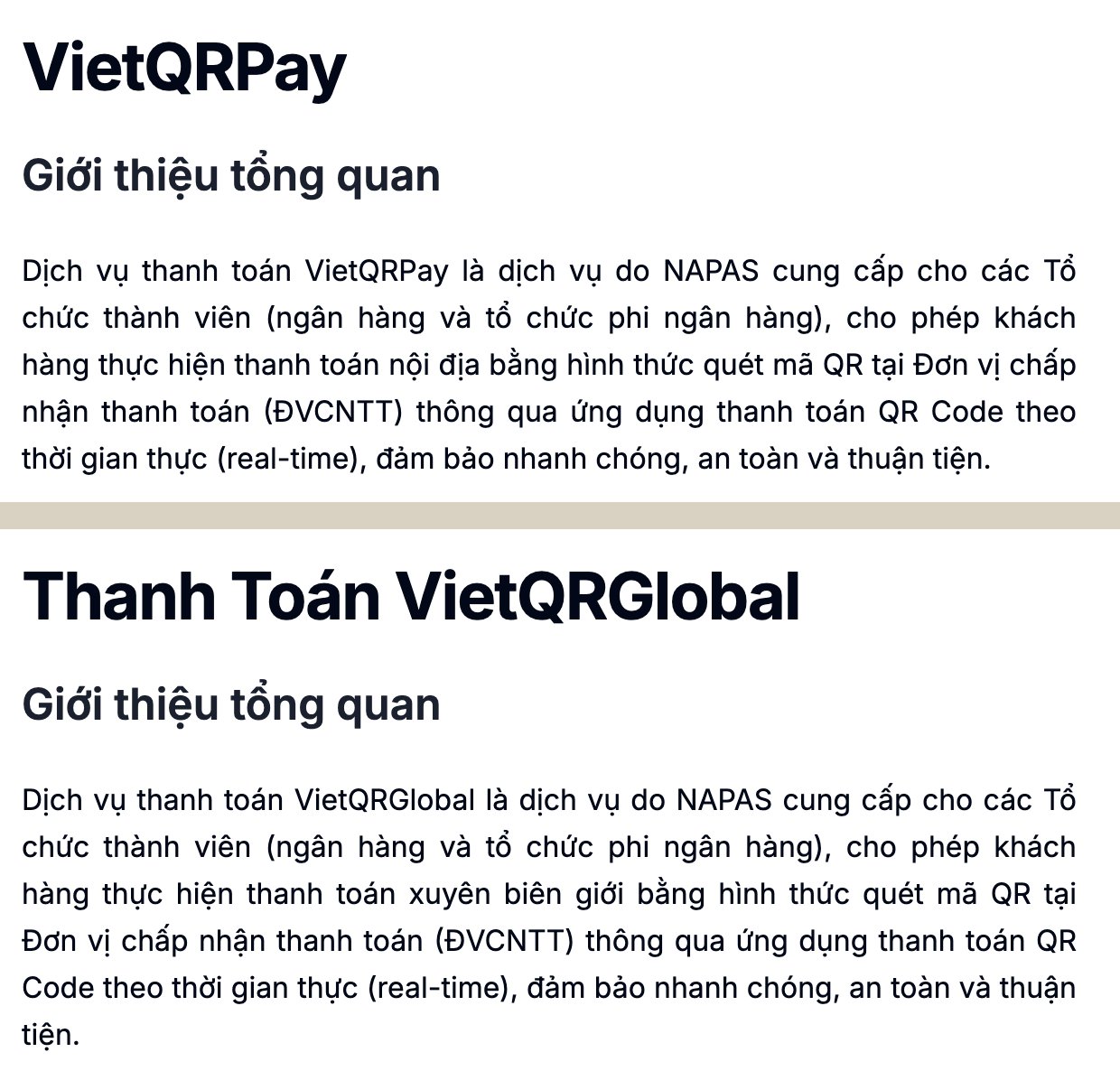
- VietQRPay: NAPAS defines this as a service in which member institutions let customers pay accepting merchants inside Vietnam in real time through a QR payment app.
- VietQRGlobal: NAPAS defines this as a service in which member institutions provide international real-time QR payment at merchant acceptance points through a QR payment app. This is the one foreign visitors should look for.
On November 2, 2026, NAPAS announced that QR connections between Vietnam and six countries or markets are complete: China, South Korea, Thailand, Laos, Cambodia and Singapore. A completed connection only means the market has participating apps. It does not mean every bank app in that market works, and it does not mean every shop in Vietnam accepts it. NAPAS has not published a total number of acceptance points or a shop-by-shop map.
Zagdim suggests checking for the VietQRGlobal mark at the register first, then scanning with the app, and checking the merchant name, amount, currency and exchange rate before you pay. LiquidPay’s help page describes the same order: open the app, choose Scan & Pay, scan the merchant’s code, check the payment details and confirm the transaction.
Vietnamese E-Wallets: Can Foreigners Register?
Whether foreigners can use a Vietnamese e-wallet depends on each provider’s terms, and short-stay visitors should not assume they can open one.
MoMo: MoMo’s customer support FAQ says a foreign passport can currently be used to verify the in-app e-wallet account. The FAQ does not say whether a passport alone is enough to top up and make payments, so Zagdim suggests trying to register and verify in the app before you travel.
ZaloPay: ZaloPay’s terms say that a foreigner residing in Vietnam who opens an account with a passport must also provide an entry visa, a substitute visa document or proof of visa exemption. Throughout use, the account must stay linked to your own Vietnamese dong account at a partner bank, or to your own debit card tied to that account.
Viettel Money: Viettel Money’s terms require users to first link their own Vietnamese dong bank account or related debit card and complete identity-document and biometric checks before using wallet functions. The terms do not say whether a short-stay visitor with only a passport can open an account.
Vietnamese bank accounts: State Bank of Vietnam Circular No. 25/2025/TT-NHNN says a foreigner can open an account with a passport or another identity document issued by a competent foreign authority. A foreigner residing in Vietnam must also provide an entry visa, a substitute visa document or proof of visa exemption. The circular took effect on August 31, 2025. The State Bank says “residing in Vietnam” is determined under the Law on Residence and the laws on foreigners’ entry, exit, transit and residence. Banks still check documents under their own risk policies, so Zagdim suggests asking the bank rather than judging by your number of days in the country.
Grab: Can You Link a Foreign Card?
Most foreign cards can be linked. Grab Vietnam says it supports most international and local payment cards and lists local e-wallets including MoMo, ZaloPay and Viettel Money. To link an e-wallet, you must first download it and activate the wallet account.
Paying with a card issued outside Vietnam carries an extra charge: Grab states that for Grab Rides, Food or Mart paid in Vietnam with a foreign-issued card, it adds an overseas payment fee of 4% of the final amount (including VAT, excluding tip).
Where Your Home Payment App Stands
This section is organized by where your payment apps come from, because the official announcements differ by market. Mainland China’s Alipay and WeChat Pay and participating Singapore payment apps have official announcements. For Hong Kong, Taiwan and Malaysia there is no confirmable list of apps, so rely on cash and cards. Find your row:
| Home market | Tool | How it works in Vietnam | Watch for |
|---|---|---|---|
| Mainland China | Alipay, WeChat Pay | NAPAS announced they can scan VietQRGlobal merchants | The announcement is about Chinese travelers and that linked service, and does not extend to the Hong Kong versions of the apps |
| Singapore | Participating Singapore payment apps | Can scan VietQRGlobal merchants from July 2, 2026 | Sacombank lists LiquidPay, Aleta Planet, DCS DeCard and Starryblu |
| Hong Kong | Local wallets and bank apps | Confirm with the app operator | Bring cash and cards first |
| Taiwan | Local wallets and bank apps | NAPAS says the Taiwan connection is still being built and has not published a completion date or list of apps | Bring cash and cards first; card payments are not affected by this |
| Malaysia | Local wallets and bank apps | Confirm with the app operator | Bring cash and cards first |
- Mainland China: at an event on April 3, 2026, NAPAS announced that Chinese travelers can use Alipay to scan VietQRGlobal and pay at Vietnamese merchants on the NAPAS network. WeChat Pay was announced at an event on August 6, 2026, and the announcement does not list a separate effective date. Neither announcement says every Chinese bank app works.
- Singapore: NAPAS says participating Singapore payment apps can scan VietQRGlobal merchants, and LiquidPay’s help page also lists Vietnam among its supported markets. For the other three apps, Zagdim suggests checking each app’s help page before you travel to confirm Vietnam is still on its supported list. Do not assume other Singapore wallets and bank apps work.
- Hong Kong: Zagdim suggests asking the operators of Octopus Wallet, AlipayHK, WeChat Pay HK and PayMe whether they can scan Vietnam’s VietQRGlobal before you go. The announcements for the mainland China versions of Alipay and WeChat Pay cannot be applied to the Hong Kong versions.
- Taiwan: on November 2, 2026, NAPAS said the QR connection between Vietnam and Taiwan is still being built. That does not mean your card cannot be used or cannot withdraw cash. Zagdim suggests asking your card issuer about foreign transaction fees and withdrawal limits before you go, and bringing Vietnamese dong cash.
- Malaysia: Zagdim suggests asking the operator whether Touch ‘n Go eWallet or DuitNow can scan VietQRGlobal, and relying mainly on cash and cards until you have confirmed it.
FAQ
Can I pay in Vietnam directly with Hong Kong dollars, New Taiwan dollars, yuan, Singapore dollars or ringgit?
Do not expect to pay directly in foreign cash. The official tourism guide only describes Vietnamese dong banknotes and does not say whether foreign cash can be used for payment. Zagdim suggests getting Vietnamese dong before you leave or at the airport.
Can a foreign banking app scan Vietnam’s VietQR?
Look for the VietQRGlobal mark. VietQRPay is the QR for merchants inside Vietnam, and VietQRGlobal is the one for international QR payment. The announcements currently on record cover mainland China’s Alipay and WeChat Pay, and participating Singapore payment apps.
How much can I withdraw at a Vietnamese ATM in one go?
The official tourism guide lists VND 2 million to 3 million per transaction at local-bank ATMs and VND 5 million to 10 million at international-bank ATMs. The limit on the ATM screen is the real one, and fees should be confirmed with your card issuer.
The card terminal asks whether to charge in my home currency or dong. Which should I choose?
Zagdim suggests choosing Vietnamese dong, which leaves the conversion to your card issuer. Choosing your home currency means using DCC, which Visa says is offered by the merchant and carries a currency conversion fee.
Can foreigners register for MoMo or ZaloPay?
MoMo says a foreign passport can be used to verify the in-app e-wallet account. ZaloPay requires a link to your own Vietnamese dong bank account, and foreigners residing in Vietnam must also provide visa-type documents. Short-stay visitors should treat cash and an international card as the main methods.
Do I pay extra when using a foreign card on Grab?
Yes. Grab states that paying with a card issued outside Vietnam in Vietnam carries an overseas payment fee of 4% of the final amount (including VAT, excluding tip).
How much cash must I declare when entering Vietnam?
Foreign-currency cash worth more than US$5,000, or Vietnamese dong cash of more than VND 15,000,000, must be declared to customs at the border gate. A traveler entering with foreign-currency cash worth no more than US$5,000 who intends to deposit it in a foreign-currency account in their own name must also declare it.
Important Notice
This article is general information and is not financial, tax or legal advice. It draws on the websites, terms and help pages of the State Bank of Vietnam, NAPAS, Vietnam’s official tourism information, Sacombank, and payment, wallet and card-network providers, checked on November 17, 2026. Which apps take part in QR payment, where they are accepted, wallet eligibility conditions, ATM limits and fees can change, so rely on the latest announcements from each institution and provider. The tools listed here are a compilation of information. They are not recommendations or rankings, and they do not mean any individual account will pass registration or complete a payment.
Have a question about this guide? Leave a comment below, or ask Zagdim directly.
Your first stop for international property and global living.
Research and insights. Know what’s changing. Understand what matters.
Sources
- Vietnam National Authority of Tourism, Currency and Payments in Vietnam
- State Bank of Vietnam, Circular No. 15/2011/TT-NHNN (declaration of cash carried)
- State Bank of Vietnam, Circular No. 25/2025/TT-NHNN (documents for foreigners opening accounts)
- State Bank of Vietnam, explanation of the residence concept for foreigners opening accounts
- NAPAS, VietQRPay product introduction
- NAPAS, VietQRGlobal product introduction
- NAPAS, FastFund 247 and the VietQR transfer service
- NAPAS, Vietnam-Singapore QR payment officially launched (2026-07-02)
- NAPAS, VietQRGlobal tourist bus promotion and market connection status (2026-11-02)
- NAPAS, NAPAS, BIDV and Weixin Pay expand QR payment between Vietnam and China
- NAPAS, NAPAS, Ant International and Vietcombank expand QR payment between Vietnam and China (2026-04-03)
- Sacombank, expanding VietQRGlobal and Singapore QR payment
- LiquidPay, Where can I use LiquidPay?
- Grab Vietnam, adding or removing payment methods
- MoMo, can a foreign passport be used for verification
- ZaloPay, terms for opening and using ZaloPay
- Viettel Money, terms of use
- Visa Vietnam, Visa contactless payments
- Visa Vietnam, travel support (DCC and local currency)
- Mastercard, DCC Merchant Guide 2025