

Written and checked by Zagdim Research. Last checked: November 17, 2026.
On September 3, 2026, TNG Digital announced that international visitors spent more than RM1 billion in Malaysia through TNG eWallet in the first six months of Visit Malaysia 2026. This is TNG Digital’s own app transaction figure, not an official national tourist statistic. It does point to something useful: Malaysia has a nationwide QR standard, DuitNow QR, and foreign visitors can pay by scanning it with a supported bank or wallet app, so you do not have to convert your whole budget into ringgit cash. This guide explains how cash, contactless credit cards, DuitNow QR and local e-wallets each work when paying in Malaysia, who can use them, and what to prepare.
The short answer: short-term visitors should start with a small amount of ringgit cash plus a contactless credit or debit card, then check whether the bank or wallet app they already have is on PayNet’s DuitNow QR list. If none of your apps is on the list, you can register TNG eWallet before you leave. Visitor registration needs a mobile number from a country or region on the official list and a passport valid for at least 6 months. Boost accepts only Malaysian mobile numbers, and the official sources do not clearly say whether visitors can use a GrabPay wallet. Do not treat either of these as your only way to pay.
This guide answers these questions:
- Which payment methods can you use as a visitor, a student or worker, or a long-term resident?
- Can Visa and Mastercard cards issued in Hong Kong, Taiwan, mainland China or Singapore be tapped to pay in Malaysia?
- When you see the DuitNow QR logo, which foreign apps and wallets can scan it?
- Can visitors register TNG eWallet, Boost or GrabPay, and what does topping up cost?
Where to exchange ringgit, ATM withdrawal fees and cash declaration rules are covered in the Malaysia currency exchange guide, not repeated here. Using the metro, the airport train and the Touch ‘n Go card is covered in the Malaysia transport card guide.
Key Points
- Who should read this: visitors to Malaysia (tourists, business travelers, people visiting family or viewing property) from Hong Kong, Taiwan, mainland China or Singapore, as well as people studying, working or living in Malaysia long term.
- Cash: ringgit banknotes and coins are Malaysia’s only legal tender, issued by Bank Negara Malaysia (BNM, the central bank). BNM’s annual report notes that cash is still in demand even as digital payments grow, and it remains usable when systems go down or networks are limited.
- Contactless cards: for both Visa and Mastercard, the card must carry the contactless symbol and the merchant’s terminal must support contactless before you can tap. If the terminal does not support it, Mastercard advises inserting the chip card instead.
- DuitNow QR: this is Malaysia’s national QR standard, operated by PayNet. Visitors need a bank or e-wallet app that PayNet supports. Look for the QR logo at the shop door, on the table or on a stand before paying.
- TNG eWallet: no Malaysian mobile number is needed and you can register before arriving. Topping up with a credit card issued outside Malaysia carries a convenience fee of up to 2.6% of the top-up amount.
- Boost and GrabPay: Boost’s official FAQ says only Malaysian mobile numbers can register. The official sources do not clearly state whether visitors can use a GrabPay wallet, and Visa cards issued outside Malaysia cannot top it up.
Which Situation Are You In?
The payment methods open to you depend first on whether you are a short-term visitor, a student or worker, or a long-term resident, and then on which cards and mobile number you hold. The starting point differs for each:
| Your situation | Routes available | What you must still confirm |
|---|---|---|
| Short-term visitor | Ringgit cash, contactless credit or debit card, a home-country app on the DuitNow QR list, TNG eWallet registered before departure | Whether your card authorizes depends on the issuing bank; whether your app is on PayNet’s list; the country-code list for TNG eWallet |
| Student or worker | The above, plus a local wallet registered with a Malaysian mobile number | The actual registration conditions for Boost and GrabPay must be checked in the app; verification asks for passport details |
| Long-term resident | The above; once you have a Malaysian mobile number, Boost and GrabPay become options | Wallet features and limits after an upgrade depend on what the app shows; bank account conditions must be confirmed with the bank |
This table is a reading route, not an approval of anyone’s eligibility.
In short, the route runs in four steps: carry some cash and a contactless card first, then check whether your app is on PayNet’s list, then consider TNG eWallet, and use a Malaysian-number wallet only if you have a Malaysian number.
Payment Methods Compared
Visitors to Malaysia commonly use six payment methods: ringgit cash, contactless credit cards, DuitNow QR, TNG eWallet, Boost and GrabPay.
| Payment method | Who can use it | What to prepare | Where it works |
|---|---|---|---|
| Ringgit cash | Everyone | Ringgit banknotes and coins | Backup when cards or QR codes are not accepted |
| Contactless credit or debit card | Anyone with a contactless card | Contactless symbol on the card, card activated | Merchants whose terminal shows the contactless symbol |
| DuitNow QR (with your home app) | People whose bank or wallet app is on PayNet’s list | An app enabled for overseas payments | Merchants with a QR logo at the door, on the table or on a stand |
| TNG eWallet | People whose mobile number’s country or region is on the official visitor list | A passport valid for at least 6 months and a number that can receive a verification code | Merchants that support DuitNow QR |
| Boost | People with a Malaysian mobile number | A Malaysian prepaid or postpaid number | Merchants that accept Boost |
| GrabPay | Visitor eligibility must be confirmed in the app | Name, email, phone number, and MyKad or passport number | Grab services and merchants that accept it |
How to Get Started With Each Method
Bring a small amount of ringgit cash, check your card’s contactless function, and for QR codes and wallets check the lists and registration conditions first.
Cash: Do You Still Need Ringgit in Malaysia?
Yes, bring some ringgit. Ringgit banknotes and coins are Malaysia’s only legal tender, and Bank Negara Malaysia is the sole issuer. BNM’s 2025 annual report notes that cash remains in demand as digital payments grow, and can still be used for transactions when systems are down or networks are restricted.
Legal tender does not mean every shop must accept cash for every transaction, and there are no official statistics on which shops take cash only. Zagdim suggests carrying a small amount of cash each day as a backup if a card or QR payment fails, rather than keeping your whole budget on your phone. For where to exchange ringgit, ATM fees and cash declaration, see the Malaysia currency exchange guide.
Credit Cards: Can a Foreign Card Be Tapped to Pay?
Whether a foreign card can be tapped depends on three things together: the card, the merchant’s terminal and the issuing bank. Visa states that a card can be tapped only if it carries the contactless symbol and the merchant’s terminal shows the contactless symbol. Mastercard states that contactless cards carry the word “contactless” and may also show the contactless symbol, and recommends inserting the chip card if the terminal does not support contactless.
The official sources do not say whether all merchants in Malaysia accept these cards, and they do not guarantee that cards from every issuing bank in Hong Kong, Taiwan, mainland China or Singapore will be authorized. Adding a card to a phone wallet does not change this: the issuing bank must support it, the card must be activated, and the merchant’s terminal must support contactless. Zagdim suggests confirming with your card issuer before you leave that overseas transactions are enabled, and carrying a second card from a different card network.
When the card screen asks which currency you want to pay in: this screen is dynamic currency conversion (DCC), where the shop or ATM offers to charge you in your billing currency. Visa explains that this option includes an exchange rate and extra fees, and that shops and ATMs should let you choose to accept or decline, not choose for you. Zagdim suggests reading the exchange rate and fees on the screen before deciding, and choosing ringgit if you are unsure. Choosing ringgit does not mean your card issuer will not charge its own overseas transaction fee. Fees differ by bank, so check with your bank before you travel.
**Quick Glossary | DCC:** when you pay by card or withdraw cash, the shop or ATM converts the amount into your billing currency before charging you.
DuitNow QR: Which Apps Can Scan It Directly?
The apps that can scan it are the bank and e-wallet apps that PayNet supports. DuitNow QR is Malaysia’s national QR standard. PayNet says that both Malaysians and international visitors can pay by scanning with a supported bank or e-wallet app.
Paying with DuitNow QR takes 4 steps:
- Look for the QR logo at the shop door, on the table or on a stand. PayNet advises confirming the logo before paying.
- Open your DuitNow QR-enabled bank or wallet app and scan the merchant’s QR code.
- Enter the amount in ringgit (MYR).
- Check the merchant name and the amount, then complete the payment.
PayNet’s list of Alipay+ partner wallets, published on March 17, 2025, includes the following wallets that can be used in Malaysia:
| Wallet | Region | Note |
|---|---|---|
| Alipay | Mainland China | A different wallet from Hong Kong’s AlipayHK |
| AlipayHK | Hong Kong | A different wallet from mainland China’s Alipay |
| MPay | Macau | |
| Changi Pay | Singapore | |
| BigPay | Singapore, Thailand |
The table lists only the wallets most relevant to readers from these places. The same PayNet list also names wallets from Thailand, the Philippines, South Korea, Mongolia, Kazakhstan and Italy, which are not listed one by one here. The list is a snapshot from March 17, 2025 and may change. Before paying, still check the wallet app and the merchant’s logo to confirm the payment can go through.
In addition, Tencent said in 2026 that PayNet has integrated DuitNow QR with Weixin Pay, so visitors from China can pay at DuitNow QR merchants. This applies to the Weixin Pay used by visitors from China and should not be assumed for versions of WeChat Pay in other regions.
Check the direction of payment. On October 28, 2026, PayNet announced that users of the Maybank, CIMB and Hong Leong Bank apps can scan to pay at participating merchants in mainland China, Hong Kong, South Korea, the Philippines and Laos through Alipay+. This is for Malaysian users traveling abroad. It is not a new way for foreign visitors to pay in Malaysia.
TNG eWallet: How Can Visitors Register and Top Up?
Visitors can register for TNG eWallet without a Malaysian mobile number, but the number must belong to a country or region on the official visitor list. The official FAQ says visitors can register before arriving in Malaysia.
Check these three things before registering:
- Mobile number: the official visitor list includes Hong Kong +852, Taiwan +886 and mainland China +86. Singapore numbers are not on this list, but another TNG page on wallet limits groups Malaysian and Singapore numbers together, and neither page says whether a Singapore number can register as a visitor. If you have a Singapore number, check inside the app before departure rather than assuming you cannot register.
- Passport: only a passport is needed, valid for at least 6 months.
- Verification code: the one-time code is sent by messaging app, so the number must be able to receive it.
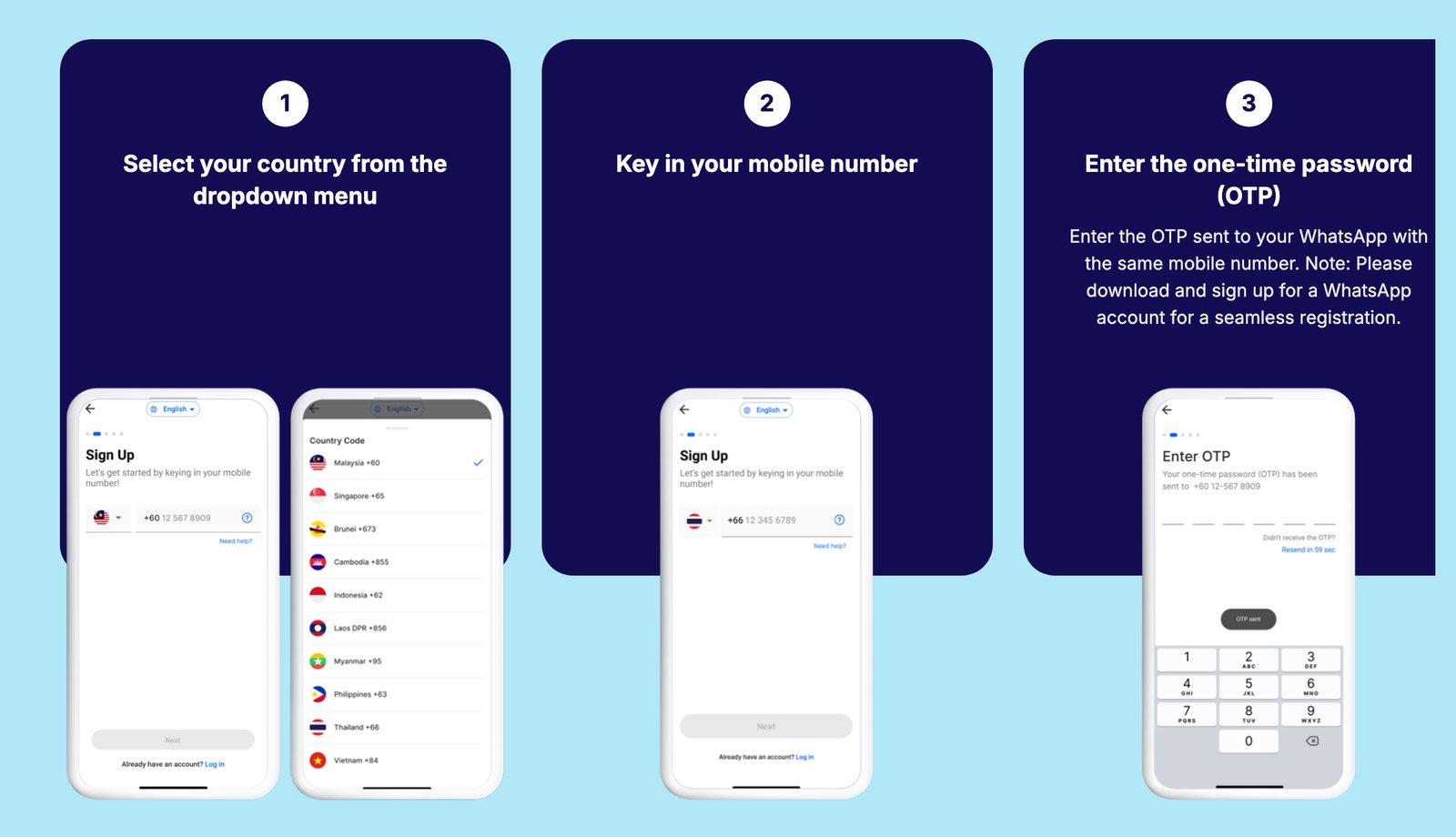
After signing up, choose “Non-Malaysian”, then choose the foreigner identity, photograph your passport and take a selfie. Complete this before you leave, and you can scan to pay as soon as you arrive.
Top-ups depend on your card. TNG eWallet states that some international credit or debit cards cannot be used for top-ups because of restrictions from the issuing bank, the card network or regulators, which vary by country and bank, and TNG cannot lift them. For credit cards issued by non-Malaysian banks, the top-up convenience fee is up to 2.6% of the top-up amount. This is the ceiling TNG lists, and it does not include any fees your card issuer charges separately. Zagdim suggests making a small test top-up before you leave to confirm your card works.
For how TNG eWallet relates to the Touch ‘n Go card and how to use it on transport, see the Malaysia transport card guide.
Boost and GrabPay: Can Visitors Use Them?
Boost currently accepts only Malaysian mobile numbers, and GrabPay wallet eligibility for visitors must be confirmed in the app. Neither wallet is suitable as a visitor’s only way to pay.
Boost: the official FAQ says that only Malaysian prepaid or postpaid mobile numbers can register at present. The terms for Boost Premium Wallet accept a valid passport as an identity document, but also ask for an address, nationality, occupation, employer and source of funds. The terms do not say that short-term visitors qualify. Boost is worth considering only for students, workers and long-term residents who have a Malaysian mobile number.
GrabPay: Grab Malaysia’s GrabPay page says setting up a wallet requires your name, email address, phone number, and MyKad or passport number. These pages do not guarantee that visitors from every place can complete wallet verification. Separate three things:
- Adding a foreign card to the Grab app: Grab Malaysia says most international cards can be added to the app, but does not guarantee every card will work. When paying for Grab rides and deliveries with a credit or debit card issued outside Malaysia, a processing fee of 3% of the total transaction applies, shown when you place the order.
- Topping up a GrabPay wallet: from October 18, 2024, Visa credit and debit cards issued outside Malaysia cannot be used to top up a GrabPay wallet.
- GrabPay merchant payments: whether you can enable them depends on whether you have completed wallet verification.
“A card can be added to the Grab app” does not mean “a card can top up the wallet”. Treat them as two separate questions. For more on riding with Grab, see the Malaysia transport card guide.
Do the Tools You Already Have Work? A Guide by Home Region
Some wallets from Hong Kong, mainland China and Singapore are on PayNet’s published list, while Taiwan’s local wallets have no official basis. Find your own region in the table:
| Region | Tool | How it works in Malaysia | What to note |
|---|---|---|---|
| Hong Kong | AlipayHK | On PayNet’s published Alipay+ list; can scan DuitNow QR | A different product from mainland China’s Alipay; confirm the overseas payment function in the app first |
| Hong Kong | +852 mobile number | On the TNG eWallet visitor number list | The list changes; go by the registration screen |
| Taiwan | Local mobile payment and e-payment wallets in Taiwan | Zagdim found no official announcement of a partnership between Taiwanese banks or wallet providers and PayNet or DuitNow, so it cannot be stated that these can scan directly | Ask the wallet provider whether it supports Malaysia’s DuitNow QR; do not rely on it as your only way to pay |
| Taiwan | Visa and Mastercard cards; +886 mobile number | Cards depend on the issuing bank and the merchant’s terminal; +886 is on the TNG eWallet visitor number list | Confirm overseas transactions with your card issuer before departure |
| Mainland China | Alipay | On PayNet’s published Alipay+ list | A different product from AlipayHK |
| Mainland China | Weixin Pay; +86 mobile number | Tencent says DuitNow QR has integrated Weixin Pay for visitors from China; +86 is on the TNG eWallet visitor number list | Do not extend this to WeChat Pay HK |
| Singapore | Changi Pay, BigPay | On PayNet’s published Alipay+ list | The list is a 2025 snapshot |
| Singapore | Participating banks such as DBS, OCBC and UOB | A 2023 announcement by BNM and MAS says customers of participating financial institutions can scan DuitNow QR or NETS QR to pay merchants; the Singapore participating banks BNM lists are DBS, OCBC and UOB (as of March 31, 2023) | Only customers of participating institutions; the list is not a complete 2026 list |
| Singapore | PayNow | The PayNow and DuitNow link is for person-to-person transfers, not merchant QR payments | Do not use PayNow to scan a merchant QR |
| Singapore | Singapore mobile number | The TNG eWallet visitor list does not name Singapore numbers, which is inconsistent with how the limits page classifies them | Check in the app before departure |
| Malaysia | Local banks and wallets | Scan DuitNow QR with a local bank or wallet app | Boost registers with a Malaysian mobile number |
If You Are Connected to Taiwan or Hong Kong
The Taiwan and Hong Kong rows above are the only parts of this guide specific to those places. For Taiwan, no official partnership between Taiwanese wallets and DuitNow QR was found, so confirm with your wallet provider and carry a credit card and cash as backups. For Hong Kong, AlipayHK is on PayNet’s list and +852 numbers are on TNG eWallet’s visitor list, both subject to change.
Frequently Asked Questions
Do I still need ringgit cash when going to Malaysia?
Yes, bring some. The ringgit is Malaysia’s only legal tender, and BNM’s annual report also notes that cash is still in demand and can be used when systems go down. For where to exchange and what it costs, see the currency exchange guide.
Can Hong Kong or Taiwan credit cards be tapped to pay in Malaysia?
It depends on the card, the merchant and the issuing bank. Where the card shows the contactless symbol and the merchant’s terminal also shows it, Visa and Mastercard can both be tapped. Where the terminal does not support it, insert the chip card. The official sources do not guarantee that cards from every issuing bank will be authorized, so confirm with your issuer before you go.
Can Taiwan’s local mobile payment wallets scan DuitNow QR?
Zagdim found no official basis, so it cannot be stated that they can scan directly. At the time of checking, no official partnership announcement between Taiwanese banks or wallet providers and PayNet or DuitNow was found, and no source says these tools cannot be used. Ask your wallet provider whether it supports Malaysia’s DuitNow QR, and keep a credit card and cash as backups.
Do Alipay and WeChat Pay both work in Malaysia?
It depends on the regional version. PayNet’s Alipay+ list names mainland China’s Alipay and Hong Kong’s AlipayHK, which are different wallets. Tencent says DuitNow QR has integrated Weixin Pay for visitors from China, and this should not be extended to WeChat Pay in other regions.
Can visitors register for TNG eWallet?
Yes, provided the mobile number belongs to a country or region on the official visitor list and the passport is valid for at least 6 months. You can also register before arriving. At the time of checking, the list included Hong Kong, Taiwan and mainland China. Singapore numbers are not on the list, but the limits page classifies them differently from the list, so check in the app first.
What does it cost to top up TNG eWallet with a foreign credit card?
For credit cards issued by non-Malaysian banks, the convenience fee TNG lists is up to 2.6% of the top-up amount, not including any fees your card issuer charges separately. Some international cards cannot top up because of restrictions from the issuing bank, the card network or regulators, so try a small top-up before you leave.
The card screen asks whether to pay in ringgit or my billing currency. Which should I choose?
Zagdim suggests reading the exchange rate and fees on the screen first, and choosing ringgit if you are unsure. Choosing your billing currency means using DCC. Visa explains that this option includes an exchange rate and extra fees, and that shops and ATMs should let you choose.
Important Notice
This article is a general information summary and does not constitute financial, tax or legal advice. It draws on the websites, terms and explanations of Bank Negara Malaysia, PayNet, the Monetary Authority of Singapore, Visa, Mastercard, Tencent, TNG Digital, Boost and Grab Malaysia, checked on November 17, 2026. The DuitNow QR partner list, wallet registration conditions, fees and merchant acceptance change over time, so please rely on the latest announcements from each institution and provider. The RM1 billion figure published by TNG Digital is the company’s own reported app transaction figure, not an official national tourist statistic. The tools listed here are an information summary only. They are not a recommendation or ranking, and do not mean any individual account will pass registration or complete a payment.
Have a question about this guide? Leave a comment below, or ask Zagdim directly.
Your first stop for international property and global living.
Research and insights. Know what’s changing. Understand what matters.
Sources
- Bank Negara Malaysia – Learn about the Ringgit Currency
- Bank Negara Malaysia – Annual Report 2025, Issuing Currency
- Bank Negara Malaysia and Monetary Authority of Singapore – Announcement on the launch of the Malaysia and Singapore QR payment linkage
- Monetary Authority of Singapore and Bank Negara Malaysia – Announcement on the Singapore and Malaysia real-time payment systems linkage
- PayNet – DuitNow Cross Border QR Payments
- PayNet and Ant International – Alipay+ and DuitNow press release
- PayNet – Malaysian banking app users can make overseas DuitNow QR payments via Alipay+
- Tencent – Weixin Empowers Local Businesses ahead of Visit Malaysia 2026
- Visa – Contactless Payments
- Visa – Dynamic Currency Conversion
- Mastercard Malaysia – Frequently Asked Questions
- TNG Digital – International tourists: Go cashless in Malaysia
- TNG Digital – Visitor registration country code list
- TNG Digital – Identification needed to sign up as a tourist
- TNG Digital – Why a credit or debit card cannot top up TNG eWallet
- TNG Digital – TNG eWallet size, limits and mobile number classification
- TNG Digital – TNG eWallet convenience fee rates
- TNG Digital – International visitors’ Visit Malaysia 2026 spending press release
- Boost – Is Boost App available in my city/country?
- Boost – Terms & Condition (Personal)
- Grab Malaysia – GrabPay
- Grab Malaysia Help Centre – Add or remove payment methods
- Grab Malaysia Help Centre – About foreign payment fees
- Grab Malaysia Help Centre – Top up your GrabPay Wallet