






























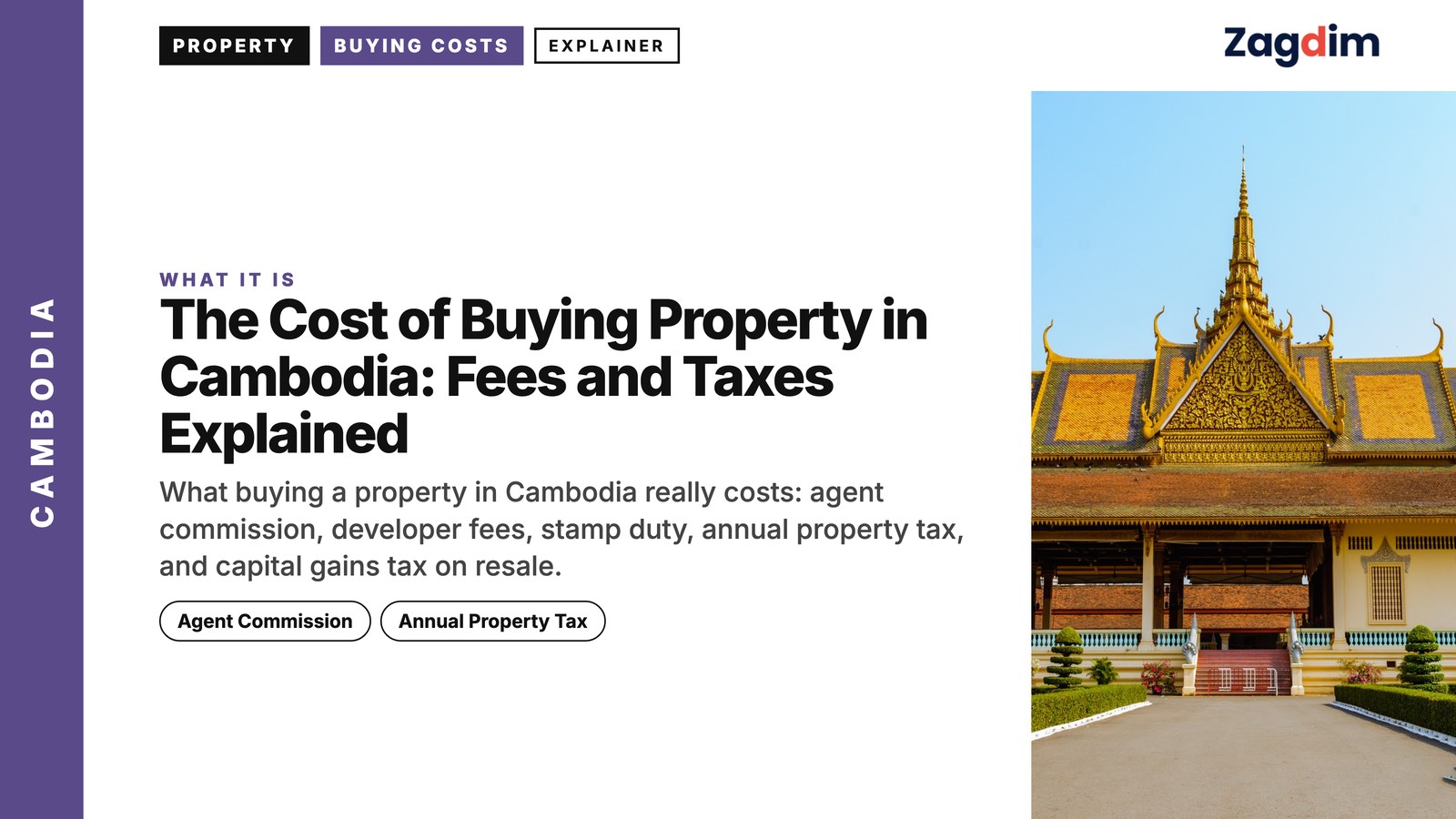
If you are planning to buy property in Phnom Penh, Cambodia’s capital, it helps to know that the purchase price is not the only cost involved. Here is what else you need to budget for.
Agent Commission
Buying a new (first-hand) property from a developer generally involves no agent commission. Buying a resale (second-hand) property, however, typically carries an agent commission of around 5% of the property price (this can vary with the market). This fee may be paid entirely by the seller, entirely by the buyer, or split between both parties — currently it is more common for the seller to pay, but the two sides should agree clearly on who pays before signing the contract.
Pre-Handover Fees from the Developer
When a developer notifies buyers that their unit is ready for handover, it will issue a notice for the final installment payment. Buyers may also be asked to prepay certain fees at this stage, such as a building maintenance fund (to cover future shared building maintenance costs), a management fee deposit, the first month’s management fee, or a water and electricity deposit. Not every developer charges these prepayments — some ask only for the first month’s (or monthly) management fee and nothing else — so check with your developer in advance of buying.
Stamp Duty and Hard Title Registration
After handover, the developer arranges for a “hard title” (permanent ownership document) to be applied for, usually handled by the developer’s representative lawyer. At this stage, the buyer must pay, in a single payment, a 4% stamp duty, legal fees, and a government administrative fee of roughly US$1,000 to US$1,800 (adjusted from time to time by the market). Processing typically takes about 6 to 9 months.
Note that when you later sell the property, a local lawyer will need to handle the legal transfer paperwork, and a 4% transfer tax applies. Buyer and seller should agree clearly, before the sale, on whether the sale price includes this 4% transfer tax or whether the buyer pays it separately.
Annual Property Tax
Owners must pay an annual property tax of 0.1% by September 30 each year. This tax applies only to properties valued above US$25,000. It is calculated as: (80% of the government-assessed value − US$25,000 exemption) × 0.1%. Owners pay this in person, or through a representative, by bringing the tax card to a bank.
Capital Gains Tax on Sale
When you eventually sell your Cambodian property, tax may also apply, as in most other countries. Cambodia’s 20% capital gains tax on immovable property remains postponed, most recently to 1 January 2027 (GDT Notification No. 34236 of 30 October 2025, approved by PM Hun Manet on 14 October 2025); capital gains tax on other capital assets (leases, investment assets, goodwill, IP, and foreign currency) took effect from 1 January 2026 under Prakas No. 496 MEF.PRK of 18 July 2025. On paper, this tax looks like it would take a large share of a seller’s profit, but taxpayers can use one of two calculation methods to legitimately reduce what they owe — both worth understanding in detail.
Method 1: Actual Cost Deduction
Take the sale price, subtract all documented costs (including the original purchase cost, loan interest, legal fees, registration tax, agent commission, renovation costs, advertising costs, and so on), and 20% of the remaining amount is the capital gains tax payable. This method benefits sellers with high documented costs and a relatively thin expected profit.
Example: Chan Tai Man sells a property for US$230,000 that he bought several years earlier for US$100,000. He kept detailed records of his purchase and renovation costs:
- Registration tax: US$4,000
- Loan interest: US$5,000
- Loan management fee: US$800
- Renovation costs: US$38,000
Including the original purchase price, his total costs are US$147,800. Sale price minus total costs = US$82,200. Capital gains tax payable (20%) = US$16,440.
Method 2: Standard (Lump-Sum) Deduction
Take the sale price, subtract 80% of the sale price, and the remainder is treated as the capital gain; 20% of that gain is the capital gains tax payable. This method is favorable for owners who bought low and are selling high.
Example: Chan Tai Man again sells the same property for US$230,000, this time using the standard deduction method. Sale price US$230,000, minus 80% of the sale price (US$184,000), leaves a capital gain of US$46,000. Capital gains tax payable (20%) = US$9,200.
Once you understand these two capital gains tax calculation methods, it becomes clear which one suits your situation. It is also worth keeping detailed records and receipts for all property-related expenses, so you can make the most informed decision as an investor.
About the Author
This article is part of Chara Hung’s Cambodia property column. Chara Hung is a director of 華域不動產有限公司 and 樂意物業顧問有限公司, with many years of experience as a Hong Kong commercial and retail property agent. He is a property owner and long-time investor in Phnom Penh, Cambodia.
Have a question about this guide? Leave a comment below, or ask Zagdim directly.
Your first stop for international property and global living.
Research and insights. Know what’s changing. Understand what matters.